
What Is the Best Night Cream? Ingredients and Formats


No single night cream is best for every skin type, and the best choice matches a specific skin concern and contains moisturizing ingredients with evidence behind them. Popular advice often reverses that logic. It starts with luxury, scent, or a long active list, then asks skin to adapt. That sequence fails for the readers most likely to need help, including adults with very dry, reactive, or perimenopausal skin, and anyone already using a retinoid that stings.
A better starting point asks what is the best night cream for one defined job: adding water, keeping water from escaping, softening roughness, or staying tolerable next to an irritating active. Texture still matters, but comfort is a test of fit, not proof of performance. A bland cream used nightly can beat a refined formula that causes burning and gets abandoned after three uses.
A night cream earns its place by matching the concern, the mechanism, and the skin's tolerance on the same night, not by sounding restorative on the jar.
Table of Contents
- Match Your Night Cream to Your Skin Need
- Claims and Moisturizing Ingredients
- What Melatonin and Collagen Claims Prove
- Cream, Gel and Ointment Formats Compared
- When Skin Symptoms Need a Clinician
- Build Your Routine and Confirm Before You Buy
Match Your Night Cream to Your Skin Need
If your cheeks feel tight and look flaky by morning, a rich texture alone does not tell you whether the cream is helping. The useful question is whether the formula addresses the pattern you notice and remains comfortable alongside the rest of your routine. Oily skin may need water without a heavy film; sensitive skin may react to fragrance before moisturizing benefits matter. Retinoid users also have to account for stinging, redness, or peeling.
How to Read the Comparison
Start with the most frequent complaint and use the matching row to narrow your options. Then compare ingredient families and the checks listed for that need. A cream can contain a useful moisturizer yet still be a poor fit if its fragrance, richness, or timing around an active makes it uncomfortable.
| Skin need | Ingredients to look for | Check before buying | Fit note |
|---|---|---|---|
| Dry or mature skin | Ceramides and hyaluronic acid | Fragrance and tolerance on the label | Rich cream texture often fits |
| Perimenopausal or very dry skin | Ceramides plus an occlusive such as petrolatum | Fragrance-free labeling | Persistent dryness or symptoms warrant a clinician visit |
| Oily or acne-prone skin | Hyaluronic acid or glycerin in a light base | Heavy oils and rich butters | Gel-cream or lotion textures |
| Sensitive or reactive skin | Short ingredient list with few actives | Fragrance and essential oils | Patch test before full use |
| Using retinoids or acids | Gentle, fragrance-free moisturizer | Stinging, redness or peeling | Ask a dermatologist about timing |
The table is a screening tool, not a guarantee of results. For sensitive or perimenopausal skin, fragrance and tolerance can outweigh a long list of appealing actives. If retinoids or acids are already part of the routine, the moisturizer's role is to fit around them without adding another source of irritation.
Turning a Row Into a Purchase Test
- Pick one row first: Tight, flaky cheeks without an active routine point toward the dry-skin row, even if a brightening claim catches your eye.
- Build a shortlist of two creams for your most frequent complaint. Comparing two formulas makes differences in ingredients and fragrance easier to spot.
- Keep the irritation screen beside the choice: Patch testing a small area can help assess comfort before wider use, but it does not replace checking the formula against your needs.
- Watch the morning signal: If tightness returns by morning, the product may not be retaining enough moisture for your skin. Stinging instead points to tolerance as the immediate concern.
Use the complaint that recurs most often to choose a row, then compare two creams against its ingredient and tolerance checks. Optional actives come later: a formula that irritates skin is a poor fit regardless of its claims. For persistent dryness or symptoms, the table points toward a clinician rather than another round of product switching.
Claims and Moisturizing Ingredients
A night cream is a moisturizer applied at bedtime. The word night describes when you apply the cream, and nothing more. The label alone does not establish that a formula works better after dark. Its value depends on what it claims to do, which moisturizing ingredients it contains, and whether its active ingredients have evidence for the promised skin outcome.
The Cosmetic and Drug Line
The FDA cosmetics safety Q&A explains that products intended to cleanse or beautify, including skin moisturizers, are generally cosmetics. Cosmetic ingredients and labeling generally do not require FDA premarket approval, except for color additives. Companies remain legally responsible for product and ingredient safety, and claims must be truthful and not misleading.
This distinction helps interpret familiar label language. “Moisturizes,” “softens,” and “helps reduce the appearance of dryness” describe cosmetic effects. A claim that a product treats or prevents disease, or changes the structure or function of skin, can make it a drug subject to drug requirements. “Reverses aging” therefore makes a different kind of promise from improving the appearance of dryness through moisturization. A strong-sounding claim is not, by itself, evidence that the formula delivers that result.
Three Ways Moisturizers Work
The American Academy of Dermatology winter skin guidance lists hyaluronic acid and glycerin among moisturizing ingredients, and identifies mineral oil, petrolatum, lanolin, and shea butter as ingredients that can work well for dry skin. The useful question is what each ingredient contributes. A cream can attract water, soften the skin's surface, and slow water loss, with the balance depending on its formula.
- Humectants attract water: Hyaluronic acid and glycerin increase water availability at the skin's surface, helping reduce a tight feel.
- Emollients soften roughness: They smooth the outer layer, so flakes lie flatter and skin feels less coarse.
- Occlusives slow water loss: Petrolatum and similar ingredients form a protective film that helps limit evaporation.
- Ceramides support the barrier: These barrier lipids complement humectants by supporting water retention, rather than relying only on water attraction.
One mechanism may not suit every area of the face. A reader with an oily forehead and a very dry patch beside the nose might prefer a lightweight, humectant-rich gel on the forehead and a more occlusive layer on the patch. Applying the same texture everywhere assumes both areas need the same balance of water attraction and protection.
Label rule: “Deep hydration” alone does not identify how a formula moisturizes. Named humectants, barrier lipids, and occlusives offer more concrete clues.
A Four-Step Label Routine
- Find a water-attracting ingredient: Check for hyaluronic acid or glycerin.
- Look for a barrier lipid: Ceramides indicate that the formula addresses retention as well as surface wetness.
- Check for an occlusive if skin is very dry: Petrolatum is one clear example.
- Note fragrance or essential oils: Their presence can matter for reactive or recently irritated skin. Fragrance can also be a deciding factor for sensitive skin, even when the moisturizing ingredients otherwise fit.
These checks help separate a formula's moisturizing mechanisms from broader claims about renewal or radiance. They also make the label easier to assess on its own terms: the ingredients can show what kind of moisturization the cream is designed to provide, while a claim about a more dramatic skin change requires evidence beyond the wording on the jar.
What Melatonin and Collagen Claims Prove
A melatonin cream is a skincare product, not an oral sleep aid. Its value should be judged by skin outcomes, tolerance, and the moisturizing base, not by assumptions about sleep. Readers comparing oral melatonin amounts can consult Sleep All Nite guidance on low-dose melatonin; the same ingredient name does not make topical and oral products interchangeable.
An Encouraging Trial With Narrow Limits
A randomized, split-face, assessor-blinded three-month trial published in Clinical, Cosmetic and Investigational Dermatology followed 22 women with moderate-to-severe skin aging. On the side treated with a melatonin-based cream, crow's-feet severity fell by about 15% and dryness scores fell by 59.5% from baseline, with the untreated side of the face serving as the comparison.
The findings are promising, not decisive. A split-face trial involving 22 women can identify a signal, but cannot establish superiority across skin types, ages, or formulas. Reduced dryness may also reflect the moisturizer base, making it difficult to isolate melatonin's contribution.
The evidence base remains limited. A 2024 review of clinical studies using topical melatonin found that only one of five skin-aging studies was randomized, double-blind, and placebo-controlled, and concluded that none yet provides a clear demonstration of efficacy as an anti-aging agent. That distinction matters: an early signal is not proof of a reliable effect.
The Decision Rule for Optional Actives
- Judge the base first: A melatonin cream still needs a suitable moisturizing formula to address dryness.
- Don't read presence as superiority: Listing melatonin does not prove better wrinkle performance than a cream with a more persuasive moisturizing formula.
- Apply the same skepticism to collagen: Collagen on an ingredient list does not prove that a product increases collagen in skin. That structure-level claim goes beyond ordinary cosmetic moisturization.
Fragrance and essential oils deserve particular attention for sensitive or perimenopausal skin. If they trigger stinging or redness, they can make a cream harder to use consistently, even when its moisturizing base suits the skin. A shorter active list may be the more practical choice when it avoids irritation. The deciding question is whether the product's claims match the available evidence and whether the formula is tolerable enough for regular use.
Cream, Gel and Ointment Formats Compared
Format decides how strongly a product slows water loss. Occlusion is the key term: higher occlusion means a stronger film over skin and less evaporation overnight. A very dry patch needs more occlusion than an oily T-zone, so format isn't a cosmetic preference layered on top of ingredients. It's part of the mechanism.
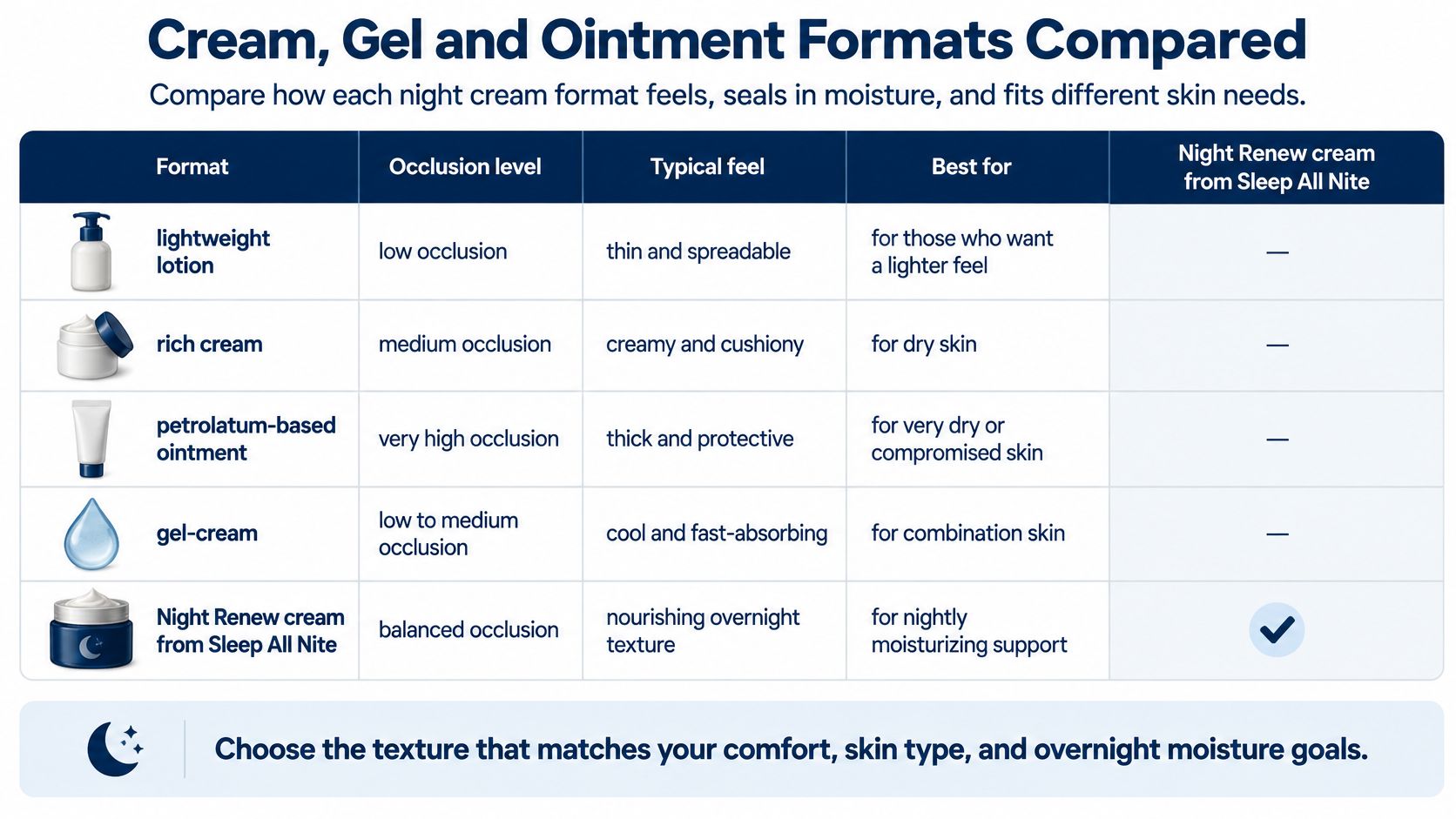
| Format | Occlusion level | Typical fit | Watch for |
|---|---|---|---|
| Lightweight lotion | Low | Oily or combination skin | Less barrier support for very dry skin |
| Rich cream | Moderate to high | Dry or mature skin | Can feel heavy on oily skin |
| Petrolatum-based ointment | Very high | Very dry or cracked patches | Greasy texture under bedding |
| Gel-cream | Low to moderate | Oily skin in warm rooms | Less occlusion than rich creams |
| Nite Renew (Sleep All Nite) | Not stated on the label | Face and neck as a skincare step | Contains melatonin; check the label for exact ingredients, amounts and directions |
Reading Each Format in Practice
A lightweight lotion spreads easily and suits readers who dislike residue, but low occlusion can leave very dry skin tight by morning. A rich cream gives dry or mature skin more cushion and retention, though the same richness can feel uncomfortable in a warm bedroom or on acne-prone areas.
A petrolatum-based ointment sits at the opposite end. It offers very high occlusion for cracked or compromised patches, but greasiness under bedding is a real trade-off, not a minor detail. A gel-cream absorbs faster and often fits oily or combination skin better, while giving up some of the sealing power that flaky skin may need.
The Nite Renew entry requires a different reading because its occlusion level isn't stated. It's described as a gentle moisturizing night cream for all skin types, for men and women, with collagen, hyaluronic acid, aloe vera, avocado oil, and lavender oil. It also contains 2.4 mg of melatonin per ¼ teaspoon, so anyone already taking an oral melatonin product should check with a healthcare professional before adding it. Readers should treat it only as a face and neck skincare step and check its label for exact ingredients, amounts, and directions rather than inferring occlusion from the category name.
A One Week Comfort Test
- Start small: Apply the chosen format to a limited area first, especially when fragrance, essential oils, or unfamiliar actives appear.
- Judge three mornings, not one: Weather, cleansing, and room heating vary, so repeated comfort matters more than a single soft morning.
- Separate feel from function: Greasiness may be acceptable on a cracked patch and unacceptable across the whole face.
Texture and occlusion explain more about overnight performance than the name printed on the jar. Readers asking what is the best night cream should therefore compare formats as delivery systems for water retention, not as luxury tiers.
When Skin Symptoms Need a Clinician
A cream cannot identify why skin is persistently dry, inflamed, or painful. Moisturizers support dry, intact skin, but eczema, infection, contact allergy, and other conditions may need diagnosis. Continually switching products can also introduce new irritants and obscure what started the reaction.
Signs That Change the Next Step
- Persistent rash or itching: If symptoms continue after stopping a newly added product, seek an assessment rather than trying another fragrance.
- Burning or spreading redness: These changes can signal irritation or an allergic response that needs clinical review.
- Cracked skin that doesn't heal: Repeated splitting or open areas may need more than a richer cream.
- Dryness despite consistent moisturizing: Persistent dryness, especially with itching that disrupts daily comfort, warrants attention to possible underlying causes.
Consider a concrete pattern: stinging begins within days of adding a fragranced cream to a routine that already includes a retinoid. The timing and combination matter. Fragrance may be a source of irritation, while a retinoid can contribute to dryness or sensitivity; a clinician can assess whether one or both products should be paused. Avoiding fragrance may also be a useful consideration for sensitive skin.
Perimenopause can bring changes such as thinning skin and persistent dryness. A clinician can assess these symptoms alongside the products in use, including fragranced moisturizers and retinoids, rather than treating ongoing discomfort as a cosmetic issue alone.
Stop a new product if mild irritation begins. Arrange a visit if symptoms persist, spread, become painful, or fail to heal.
A Short Action Checklist
- Record the timeline: Note when symptoms began and which products were introduced around then.
- Pause the newest product: For a mild reaction, stop the recently added formula and observe whether symptoms settle.
- Book a visit when the pattern continues: Persistence, spreading, pain, or skin that does not heal calls for medical assessment.
The useful question is then what is causing the symptoms, not which cream to buy. Identifying the cause can prevent prolonged product switching when the skin needs clinical care.
Build Your Routine and Confirm Before You Buy
A useful nighttime routine is one you adjust to your skin, products, and budget. Start with low-cost choices: cleanse gently, introduce only one new product at a time, and use a moisturizer you already own before buying another. Skin tolerance and existing actives matter more than a cream's nighttime label.
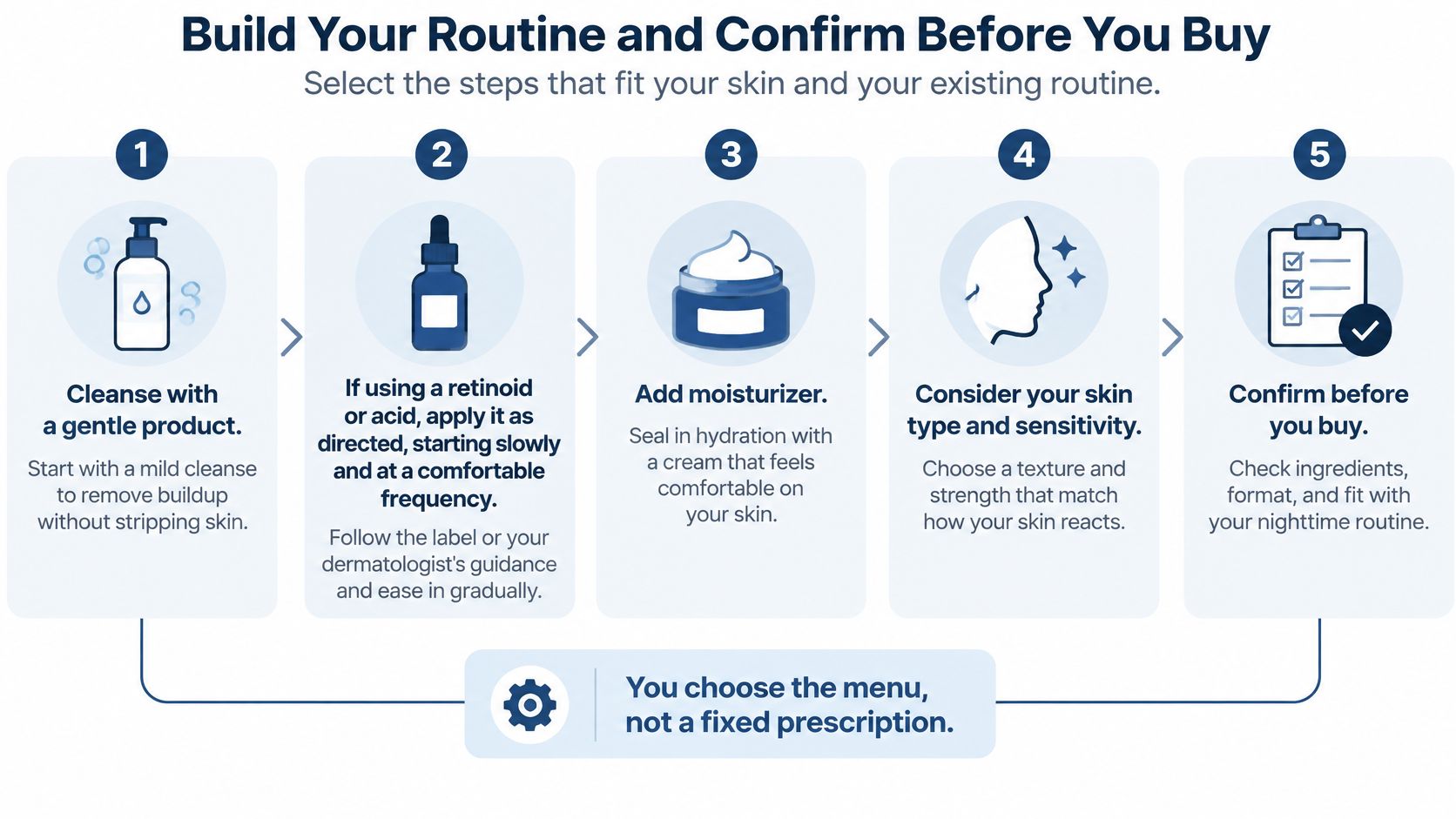
Menu Options for the Evening
- Cleanse with a gentle product: Remove sunscreen, makeup, and buildup without leaving skin tight before moisturizing.
- Use a retinoid or acid only as directed: Start at a low frequency so you can notice redness, peeling, dryness, burning, or stinging before increasing use.
- Place moisturizer before or after the active: Follow the product directions or a dermatologist's advice. For sensitive skin, applying moisturizer first may help improve tolerance.
- Apply night cream to the face and neck as labeled: Follow the amount and timing on the product you choose. Use topical products only as directed, and stop if irritation develops.
Ingredient combinations affect how a routine feels and performs. A fragrance-free, gentle moisturizer may be a more suitable companion to an irritating active than a scented cream with additional actives. If stinging worsens, reducing use or pausing the active is more sensible than adding products to cover the reaction. Persistent irritation warrants a clinical conversation.
Why Measurable Barrier Outcomes Matter
A 2026 review of ceramide-based moisturizers in Cureus notes that ceramide-dominant formulations have been linked to reduced transepidermal water loss and longer-lasting hydration, while also calling for more independent, well-controlled clinical studies to confirm those findings.
Transepidermal water loss, or TEWL, measures water escaping through the outer skin layer. Lower TEWL generally reflects stronger barrier function, making it a useful measure when judging moisturizing claims. Hyaluronic acid attracts water, while ceramides help support the skin barrier. Those mechanisms offer a more specific basis for comparison than a broad promise of deep moisture.
Bedtime skincare and oral supplements are separate decisions, even when sold together. The Beauty Sleep Set pairs Deep Rest, an oral formula with 10 mg of melatonin per serving, with Nite Renew, a collagen night cream that also contains melatonin. Because both contain melatonin, check with a healthcare professional before using them together, and assess each product on its own terms, including its ingredients, directions, and fit with your routine.
Confirm Before Buying
- Match the concern: Use the skin-need table to rule out formulas aimed at a different problem.
- Check moisturizing mechanisms: Look for a water-attracting ingredient alongside a barrier lipid or, for very dry skin, an occlusive.
- Consider melatonin separately: Its presence in a cosmetic is optional and does not establish moisturizing effectiveness.
- Choose fragrance-free for reactive skin: Include essential oils in that check, even when they are described as natural.
- Patch test and stop if irritation develops: Try a small area before applying a product across the face.
- Check personal risk factors: If pregnant or nursing, under 18, managing a medical condition, or taking prescription medication, consult a healthcare professional before starting a supplement or a routine involving a melatonin-containing topical.
Consistency is a practical final test. A cream that suits the skin concern, provides relevant moisturizing ingredients, and remains comfortable with repeated use is a more defensible choice than one selected for its label alone.
Readers comparing formats and ingredient amounts can review the nighttime skincare and supplement options at Sleep All Nite, check each label closely, and confirm suitability with a healthcare professional before use. Choose a product that matches the skin need, states its ingredients clearly, and feels comfortable enough for regular use.
*These statements have not been evaluated by the Food and Drug Administration. These products are not intended to diagnose, treat, cure, or prevent any disease.
This article is for general education and isn't medical advice. Talk with a healthcare professional before starting a supplement, especially if you're pregnant or nursing, under 18, managing a medical condition, or taking prescription medication.


