
Sleep Aid Melatonin Dose, Timing and Safety


A sleep aid melatonin is a night-timing signal, not a sedative, and 0.5 to 1 mg is a reasonable low starting amount for adults considering occasional use in the evening. More isn't better, because higher amounts don't keep improving sleep and can make the next morning worse. Popular advice often gets this backwards. It treats milligrams like strength and suggests climbing from 1 mg to 5 mg to 10 mg until sleep feels forced. That approach ignores timing, ignores next-day clarity, and assumes the printed dose is exactly what reaches the body. A calmer decision starts lower, stays in the evening, and stops escalating when the problem calls for medical evaluation instead.
Table of Contents
- How Melatonin Works in the Body Clock
- Melatonin Doses and Why More Is Not Better
- How Melatonin Times Sleep
- What Trials Show About Falling Asleep
- Safety Interactions and Who Should Pause
- Strips, Capsules and Gummies Compared
- Choose a Low Evening Dose or Get Checked
How Melatonin Works in the Body Clock
Bright lights, a glowing phone, and a late bedtime can leave the brain receiving daytime cues after dark. Taking melatonin at the last minute may not make sleep arrive like a sedative would.
Melatonin is a hormone the brain releases as light fades. It signals that biological night has begun and helps shift the body clock toward sleep. The signal can support sleep timing, but it does not silence racing thoughts or guarantee uninterrupted sleep.

A Common Pattern That Causes Confusion
Someone might fall asleep easily, then wake near 3 a.m. and lie awake thinking about the next day. Taking melatonin at that moment can seem logical, but its role is to signal night earlier in the evening, not to act as a middle-of-the-night rescue.
Falling asleep and returning to sleep are different problems. An evening timing signal may suit occasional difficulty falling asleep. Repeated waking, loud snoring, severe daytime sleepiness, or months of poor sleep call for a conversation with a clinician.
Judge a sleep aid melatonin by two questions: Did sleep start sooner, and did the next day feel clear?
What a Reader Needs to Decide
Before choosing a product, identify whether the main difficulty is occasional trouble falling asleep, whether you can keep a consistent evening schedule, and whether medicines, pregnancy, a medical condition, or persistent symptoms warrant professional advice.
If your schedule keeps shifting, circadian rhythm disruption and sleep timing explains how light, wake time, and bedtime can pull in different directions. A consistent routine makes it easier to tell whether a change in sleep timing is helping.
Melatonin Doses and Why More Is Not Better
A higher number on the label does not guarantee a stronger or better-timed effect. The amount swallowed is not the same as the amount absorbed, and trial benefits do not clearly keep increasing with dose. For occasional difficulty falling asleep, the useful comparison is a low evening dose against a larger one, including how each affects the next morning.
Sleep aid melatonin amounts by purpose
| Purpose | Amount | When | What to expect |
|---|---|---|---|
| Body's own night signal | 0.1 to 0.3 mg | Evening, before bed | A physiologic-size signal, not a sedative |
| Low starting dose | 0.5 to 1 mg | Evening, before bed | A reasonable first try; judge next-day clarity |
| Range used in studies | 0.1 to 10 mg | Typically up to 2 hours before bed | No maximum dose defined in trials; more is not automatically better |
| Higher labeled doses | 5 to 10 mg | Evening, not after a night waking | Not clearly more effective; may bring drowsiness, headache, and dizziness |
| Chronic insomnia | Not a dose to escalate | Seek clinical advice | Evidence is insufficient to recommend melatonin |
How to Read the Bands
Physiologic doses of about 0.1 to 0.3 mg are close to the size of the body's own night signal. A starting band of 0.5 to 1 mg is higher, while still below many common high-dose labels. It gives a low-dose trial a clearer starting point than jumping straight to 5 or 10 mg.
The NCBI Bookshelf summary on melatonin describes studies using 0.1 mg to 10 mg, generally taken up to two hours before bedtime, and notes that a maximum dose has not been defined in trials. The dose-response research covered below suggests benefits level off rather than climbing with every extra milligram, while higher doses bring more side effects such as drowsiness, headache, and dizziness. In other words, extra milligrams can add side effects without adding a better result.
For chronic insomnia, evidence is insufficient to recommend melatonin, according to practice guidelines from the American Academy of Sleep Medicine and the American College of Physicians, as summarized by the National Center for Complementary and Integrative Health. Ongoing insomnia calls for clinical advice, not a higher dose by default.
Practical rule: Keep the same evening clock time for several nights. Changing both dose and timing each night makes the result difficult to interpret.
A Step-by-Step Low-Dose Test
- Set a realistic schedule: Choose a bedtime and wake time you can keep steady for several nights.
- Start at 0.5 to 1 mg: Take the chosen amount in the evening, before bed. Do not add a second melatonin product.
- Track two outcomes: Record roughly how long falling asleep takes and how clear the next morning feels.
- Adjust one factor at a time: If the result disappoints, review timing, caffeine, alcohol, light, and schedule before changing the amount.
- Pause if symptoms appear: Grogginess, bothersome vivid dreams, dizziness, or stomach symptoms are reasons to stop and seek advice.
If 1 mg seems ineffective, moving straight to 5 mg or 10 mg may miss more useful questions: Was the timing suitable? Did bright light continue until bedtime? Is the problem repeated waking rather than falling asleep? The guide to low-dose melatonin choices explains why a low starting amount can make a trial easier to assess.
These dose bands concern adults with occasional difficulty falling asleep, not a treatment plan. Severe or persistent symptoms, or symptoms that interfere with daytime functioning, warrant clinical evaluation. A supplement cannot make an unworkable schedule workable.
Why Next-Day Clarity Counts
Record how you feel the next morning alongside how quickly you fell asleep. If the dose seems to help at bedtime but leaves you groggy, that trade-off matters, especially before driving, caregiving, or other tasks requiring alertness.
How Melatonin Times Sleep
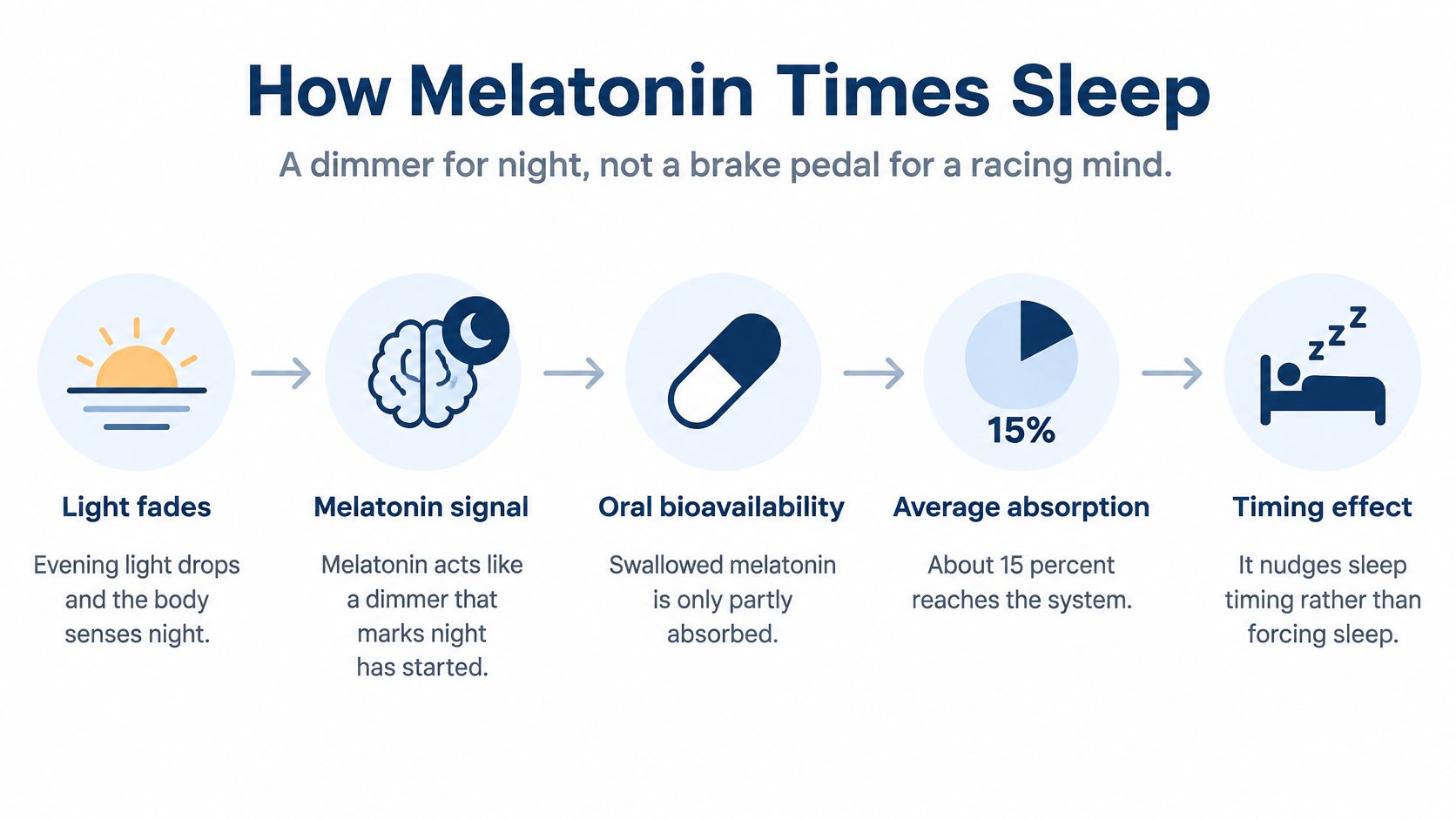
A labeled milligram does not tell you exactly how much melatonin reaches your bloodstream. Absorption varies, and trial benefits plateau, so raising the dose is not a reliable route to a better night. Melatonin works chiefly as a signal for the body's night-time timing. It may help with sleep onset, but it cannot address every reason someone lies awake.
Absorption Is Only Part of the Label Story
The amount printed on a tablet or capsule is the swallowed dose, not a precise measure of what enters the bloodstream. The NCBI Bookshelf summary reports oral bioavailability ranging widely, from about 1% to 74%, so people can respond differently to the same labeled amount, and formulation and timing also affect how the signal reaches the body.
Immediate-release melatonin is absorbed relatively quickly, which helps explain why products are commonly taken shortly before bed. A peak in blood levels, however, is not the same as a shift in the body clock. Taking a dose at lights-out may not have the intended timing effect if bedtime varies widely or bright light continues late into the evening.
- Light fades: Dimmer evening light supports the body's own night signal.
- Melatonin signal: The hormone marks night and can nudge the sleep window earlier or steadier.
- Absorption varies: Formulation and individual differences affect how much reaches the bloodstream and when.
- Timing matters: The body's response depends on when the signal appears, not only on the number of milligrams swallowed.
What Dose-Response Research Adds
A dose-response meta-analysis indexed in PubMed examined 26 double-blind randomized controlled trials involving 1,689 observations. Its modeled benefits peaked near 4 mg/day, rather than increasing indefinitely. The analysis also found that administration approximately 3 hours before the intended sleep episode was associated with better sleep-onset results than taking 2 mg about 30 minutes before bedtime.
This pattern is consistent with melatonin's role in circadian timing, which differs from a simple sedative effect. Before increasing a dose, consider whether the timing, bedtime, or evening light may be working against the intended signal.
The modeled timing result is not a personal prescription. Work schedules, medicines, drowsiness risk, and the desired sleep window all affect what is appropriate. Any earlier dose should still leave enough alertness for evening tasks such as driving, caregiving, or cooking.
Timing can be the missing variable. A low dose at a steady, sensible clock time is more informative than a high dose taken at random.
A Menu, Not One Required Routine
A few simple habits can make the timing signal easier to interpret: keep a steady wake time, dim lights during the last hour, put screens away before bed, or write down tomorrow's tasks before getting into bed. Choose habits that fit the evening rather than attempting a complete overhaul.
Consistency matters more than perfection. Keeping two habits for several nights gives a clearer picture than changing everything for one night. If you wake during the night, melatonin is intended for the evening, before bed, rather than as a middle-of-the-night dose.
What Trials Show About Falling Asleep
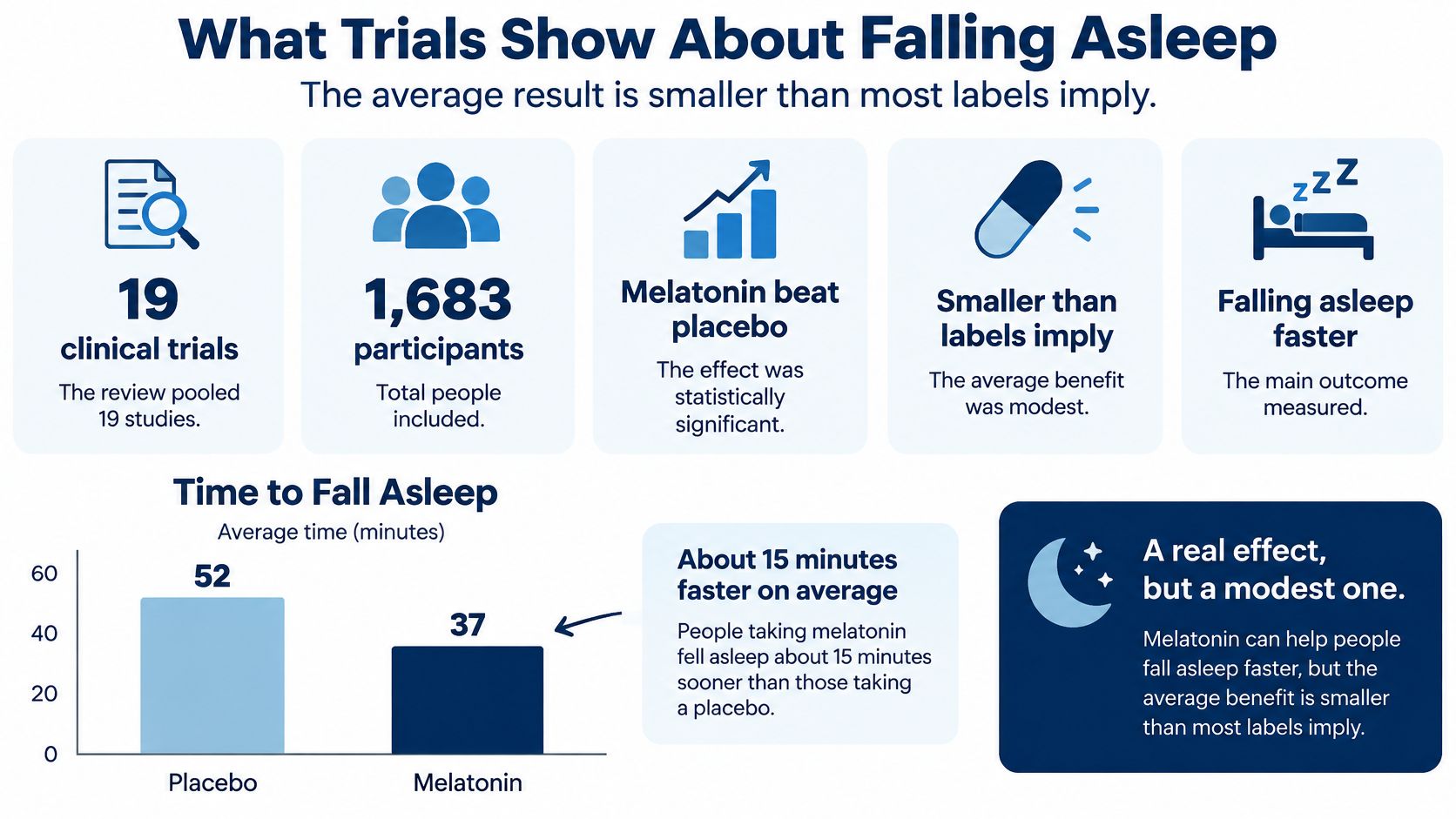
Melatonin's average effect on sleep onset is small: people in trials fell asleep several minutes earlier than those given a placebo. That may help someone who has trouble drifting off occasionally, but it is not a reliable way to resolve long-term insomnia.
The pooled results put that difference in perspective.
The Pooled Numbers
A systematic review and meta-analysis in PMC pooled 19 clinical trials involving 1,683 participants. Compared with placebo, melatonin was associated with falling asleep an average of 7.06 minutes earlier (95% confidence interval: 4.37 to 9.75 minutes). Total sleep time increased by 8.25 minutes (95% confidence interval: 1.74 to 14.75 minutes), and overall sleep quality improved by a standardized mean difference of 0.22 (95% confidence interval: 0.13 to 0.32).
These averages were statistically significant, but modest. Seven minutes may matter to someone who regularly lies awake, while eight additional minutes of sleep will not make up for a night cut short by an inadequate sleep window.
The studies used crossover and parallel-group designs, and individual studies ranged from 8 to 746 participants, according to the same review. All of the trials involved people with primary sleep disorders. The findings do not guarantee the same result for every person, dose, formulation, age group, or cause of poor sleep.
The video below explains how to read modest average effects.
A Timing Disorder Is a Different Case
Melatonin's effect can be larger in a specific circadian timing problem. The NCCIH overview of melatonin describes a randomized controlled trial of 307 adults with delayed sleep-wake phase disorder. Participants took melatonin one hour before their desired bedtime and followed a fixed bedtime. After four weeks, they fell asleep an average of 34 minutes earlier and reported improved daytime functioning.
That result applies to a particular timing disorder and a specific routine, not every kind of poor sleep. The fixed bedtime was part of the trial, so the result cannot show that melatonin alone produced the change. For general sleep-onset difficulty, the pooled trial average is the more relevant guide.
- Set modest expectations: The pooled average was a few minutes sooner to sleep.
- Consider the cause: A timing-disorder trial does not establish benefits for stress, pain, or waking during the night.
- Track daytime function: How you feel the next day matters alongside the time it took to fall asleep.
When Trials Point Away From Self-Treating
The American Academy of Sleep Medicine guideline and American College of Physicians guideline conclude that evidence is insufficient to recommend melatonin for chronic insomnia. Persistent trouble falling asleep, waking unrefreshed, or daytime impairment warrants a conversation with a clinician. Behavioral care, including CBT-I, is covered in the guide to insomnia treatment, and sleep support supplements offers broader comparisons.
A supplement cannot replace an evaluation or treat the cause of ongoing sleep problems. If a low evening dose has not helped, raising it is not a dependable next step. A clinician can help assess what may be keeping sleep difficult.
Safety Interactions and Who Should Pause
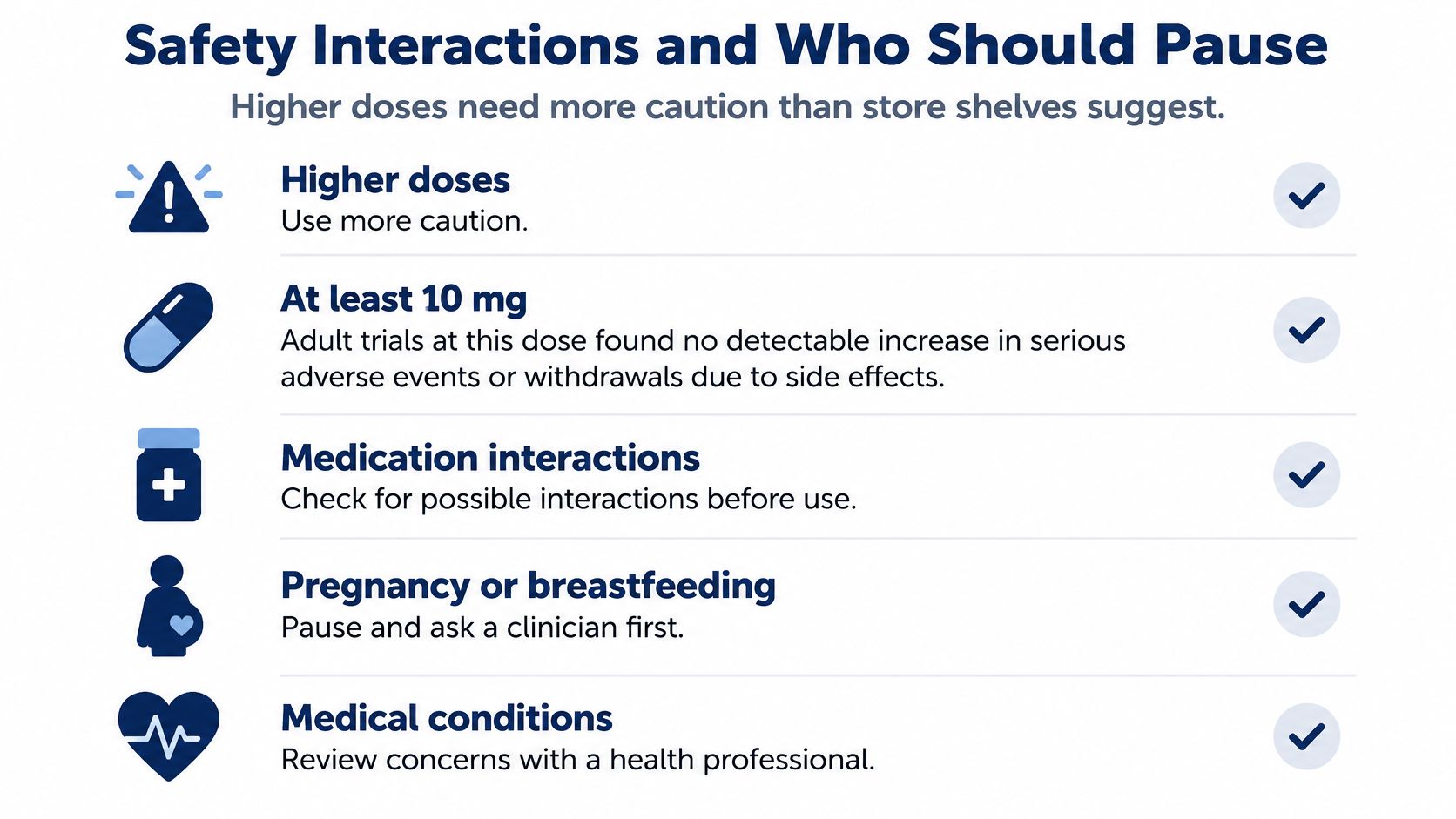
A 10 mg label does not guarantee a better night, and higher doses call for care. Before trying melatonin, check the evidence and these safety points.
The 10 mg Finding
A 2022 systematic review and meta-analysis on higher-dose melatonin examined randomized trials in adults over 30 taking doses of at least 10 mg. It found no detectable increase in serious adverse events or withdrawals due to adverse events. However, adverse effects such as drowsiness, headache, and dizziness were more common, with a rate ratio of 1.40 and a 95% CI of 1.15 to 1.69. The authors also noted that many trials didn't report adverse events at all, so the true picture is less certain than the headline numbers suggest.
Trial findings do not guarantee that a high dose is trouble-free for every adult. Drowsiness at the wrong time can create a practical hazard, especially around stairs, driving, or other tasks that require alertness.
Who Should Ask First
Ask a clinician or pharmacist before using a sleep aid if you:
- Are pregnant or nursing.
- Have a diagnosed medical condition.
- Take prescription or over-the-counter medication.
Sleep All Nite cannot determine whether its products are safe to combine with a prescription. Bring the product's ingredient and dose list to your prescriber or pharmacist.
Simple Rules That Prevent Common Mistakes
Do not combine Sleep All Nite products with alcohol or sedatives, or take them before driving, operating machinery, or doing anything else that requires alertness. These products may cause drowsiness. Avoid stacking multiple melatonin products in one night, since combining doses makes your total exposure harder to judge.
If you wake at 3 a.m., follow the evening timing guidance above rather than taking a dose then. New or worsening symptoms also deserve attention. Loud snoring with witnessed pauses, severe daytime sleepiness, falls, confusion, depressed mood, or sleep trouble lasting for months call for medical evaluation rather than a higher dose.
Strips, Capsules and Gummies Compared
A strip, capsule, or gummy changes how melatonin is taken, not whether a larger dose is more effective. The format also does not tell you how long the product releases melatonin. None of the Sleep All Nite formats is extended-release, prolonged-release, or sustained-release. See the guide to melatonin sustained-release claims for how release wording differs from standard formats.
Melatonin formats at a glance
| Format | Labeled melatonin | How it is taken | Main pitfall |
|---|---|---|---|
| Oral strip | 1 mg (Drift Off) | Dissolves on the tongue, no water | Hard to divide |
| Standard capsule | 2 mg per two-capsule serving (Nite Cap) | Swallowed with water | Above the 0.5 to 1 mg starting band |
| Gummy | Amount printed per piece on the label | Chewed | Easy to take a second piece and raise the dose |
The Label Problem
Label accuracy is a real issue in this category. According to the NCCIH, a 2017 study of 31 melatonin supplements found that most didn't contain the amount listed on the label, and a 2023 study found that 22 of 25 over-the-counter melatonin gummy products were inaccurately labeled. That does not prove every product is unreliable. It does show that a labeled dose, tested potency, batch consistency, and independent quality verification are different things.
This helps explain why two products labeled 2 mg may feel different: one might leave someone groggy while the other feels milder. Actual potency, other ingredients, timing, food, and individual absorption can all contribute. Raising the dose without knowing the cause adds uncertainty.
- Check the serving definition: The amount may be listed per piece, strip, or two-capsule serving.
- Don't stack formats: A gummy plus a capsule can turn a planned low dose into an unknown total.
- Treat taste carefully: A pleasant gummy can make an extra piece feel like a bedtime snack.
- Keep one variable steady: Changing brand, format, dose, and timing together makes it harder to identify what helped or caused a side effect.
Two Sleep All Nite Examples
Drift Off is a raspberry oral strip that dissolves on the tongue without water. Each strip contains 1 mg melatonin, which sits inside the low starting band, along with valerian root, lavender, chamomile, and hibiscus. The label directs one strip any time before bed, up to one strip a day. The format suits adults who prefer not to swallow a pill or keep water beside the bed.
Nite Cap is a standard capsule, not an extended-release capsule. Each two-capsule serving contains 2 mg melatonin, along with valerian, chamomile, GABA, L-tryptophan, lemon balm, and passion flower. That is above the 0.5 to 1 mg starting band, so it fits someone who has already tried a lower amount rather than a first experiment.*
Strips are convenient without water; capsules make the serving easy to count but need water. Gummies are easy to chew, which can also make an extra piece easy to take. Melatonin-free options, such as Deep Calm magnesium glycinate capsules and Nite Bites gummies, offer another format choice for winding down without melatonin.*
Choose a Low Evening Dose or Get Checked
For occasional trouble falling asleep, the decision is deliberately modest. Start with the 0.5 to 1 mg band in the evening, keep the clock time fixed for several nights, and judge both sleep onset and next-day clarity. Keep that amount only if sleep starts sooner and the morning feels clear.
If results disappoint, adjust timing and evening habits before climbing the milligrams. Free options come first as a menu, not a prescribed routine: a set wind-down, screens put away, lights lowered, or a fan or free white-noise app if one is already available. Melatonin belongs only before bed, never after a 3 a.m. waking.
Sleep trouble that's chronic, severe, or impairing daytime function calls for a clinician, and the guide on when to see a doctor for insomnia outlines useful warning signs. Sleep All Nite cannot say whether a product is safe with a prescription, so the ingredient and dose list should go to a prescriber or pharmacist. Products may cause drowsiness and shouldn't be used before or while driving, operating machinery, or performing any activity requiring alertness. A physician should be consulted before use during pregnancy or nursing, with a diagnosed medical condition, or with prescription or over-the-counter medication.
Adults comparing a sleep aid melatonin can review formats, labeled amounts, and full ingredient lists at Sleep All Nite before choosing a low evening option or a melatonin-free path. Take the exact ingredient and dose list to a healthcare professional before starting, especially when any prescription medicine is involved. No comparison promises an outcome or replaces care for persistent sleep problems.
*These statements have not been evaluated by the Food and Drug Administration. These products are not intended to diagnose, treat, cure, or prevent any disease.
This article is for general education and isn't medical advice. Talk with a healthcare professional before starting a supplement, especially if you're pregnant or nursing, under 18, managing a medical condition, or taking prescription medication.


