
Melatonin Sustained Release Explained


Falling asleep can feel like a victory, especially after a demanding day. Then the clock shows 3 a.m., the mind starts replaying unfinished conversations, and sleep seems to disappear just when the body needs it most. By morning, the problem isn't just too little sleep. It's broken, unrefreshing sleep.
That pattern is common among people dealing with stress, changing schedules, night shifts, or hormonal transitions. A fast-acting sleep aid may help with the first part of the night, but it may not provide support through the later sleep cycles. Melatonin sustained release takes a different approach by extending melatonin availability instead of creating only a short-lived peak.
Table of Contents
- The 3 AM Wake-Up Call and the Search for Better Sleep
- How Melatonin Sustained Release Works in the Body
- Comparing Immediate and Prolonged Release Profiles
- Who Actually Benefits from Extended Sleep Support
- Rethinking Dosing and Circadian Timing
- Weighing the Pros and Cons of Nightly Use
- Building Your Complete Nighttime Wellness Routine
The 3 AM Wake-Up Call and the Search for Better Sleep
At 10:30 p.m., a tired professional finally gets into bed. Sleep arrives quickly, but several hours later the sleeper wakes with a racing mind and a body that feels strangely alert. The bedroom is quiet, the phone stays face down, and yet the next stretch of sleep won't begin.
For a perimenopausal woman, the interruption may follow a temperature change or a period of physical discomfort. For a night-shift worker, the internal clock may be sending an alertness signal at an inconvenient hour. For someone under sustained stress, the brain may treat a brief awakening as an invitation to review every unresolved task from the day.
This is often called sleep-maintenance insomnia. The defining problem isn't always falling asleep. It's staying asleep and returning to sleep after an awakening. A person can become sleepy at bedtime yet lose that sleep pressure later, particularly when the body's circadian signals, environment, stress response, or physical comfort work against uninterrupted rest.
A short-acting melatonin product may seem mismatched to that problem. Immediate-release melatonin is generally designed to become available relatively quickly, which can make it more relevant when sleep onset is the main concern. If the central complaint is waking during the night, a brief exposure may not address the entire sleep period.
Practical rule: A sleep aid should match the sleep problem. Difficulty falling asleep and difficulty staying asleep aren't identical targets.
The familiar experience described in this guide to waking up at 3 a.m. can have several causes, so melatonin isn't a universal answer. A bedroom that's too warm, alcohol, untreated breathing problems, pain, hot flashes, anxiety, and irregular work hours can all fragment sleep. A sustained-release formulation may support the sleep signal, but it won't correct an underlying medical or behavioral cause by itself.
The appeal of prolonged release is therefore specific. It aims to reduce the gap between falling asleep and remaining asleep by providing a more gradual melatonin profile. That distinction moves the discussion away from merely taking more and toward asking a better question: how long should melatonin remain available for the sleep goal?
How Melatonin Sustained Release Works in the Body
Melatonin is a biological timing signal, not a conventional sedative that forces the brain into unconsciousness. Darkness normally helps the body release melatonin as part of the circadian process. A supplement adds melatonin from outside the body, and the formulation determines how that dose becomes available after swallowing.
Immediate-release melatonin can be compared with a flash flood. A relatively large amount becomes available over a shorter period, creating a noticeable rise that then declines. That profile may suit a sleeper whose main challenge is beginning the night.
A prolonged-release formulation behaves more like a steady stream. The tablet or capsule is designed to release melatonin gradually in the gut, allowing absorption to continue instead of delivering the entire dose at once. The aim isn't necessarily a higher peak. The aim is a smoother exposure profile that remains present across more of the night.
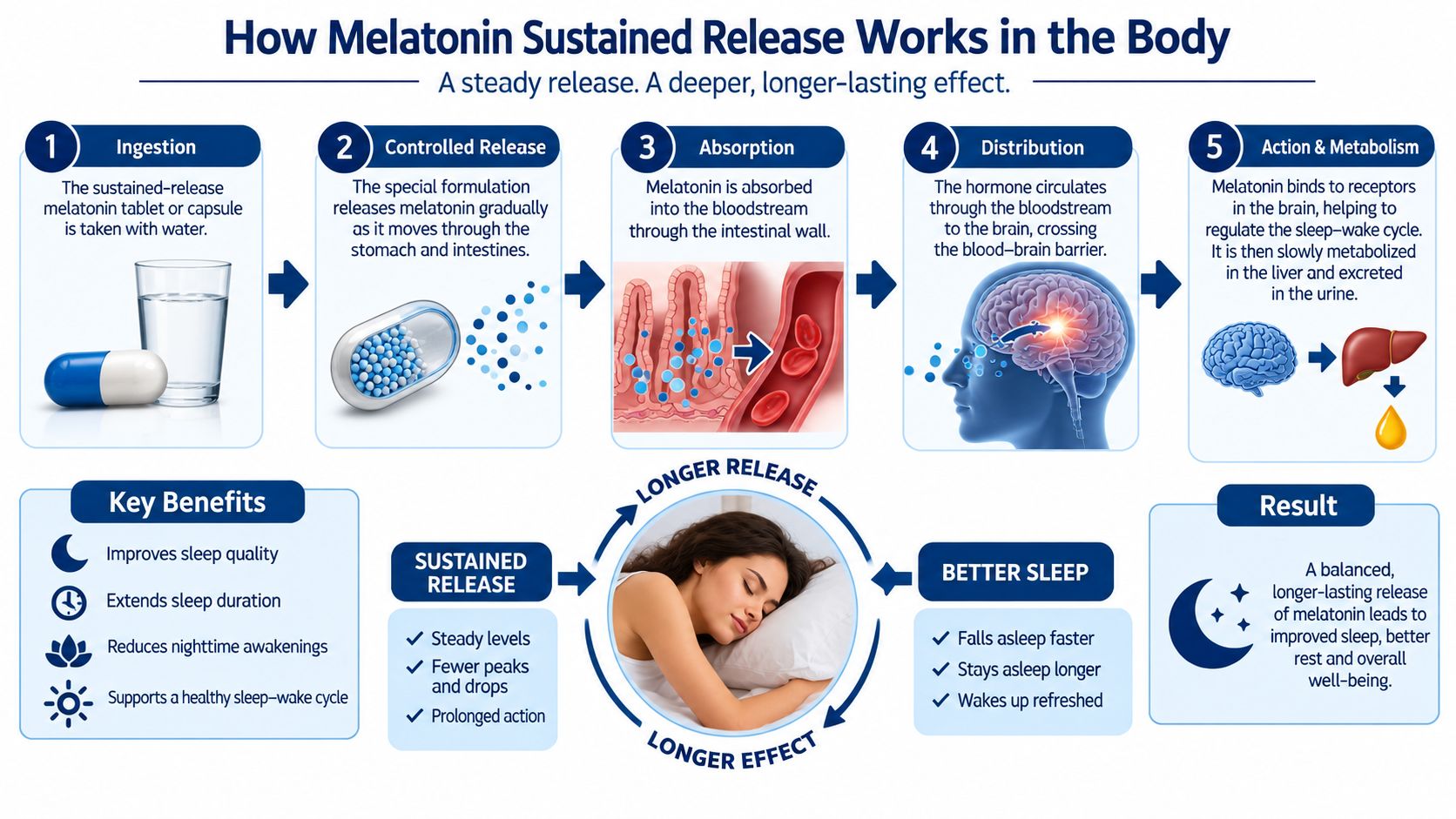
The release process in simple terms
The body processes a prolonged-release product through several connected stages:
- Swallowing: The sleeper takes the formulation according to the product directions or a clinician's advice.
- Gradual dissolution: The delivery system breaks down progressively rather than releasing all of its melatonin immediately.
- Ongoing absorption: The gut transfers melatonin into the bloodstream over a longer interval.
- Extended circulation: Melatonin remains available beyond the initial sleep-onset period.
- Nighttime support: The extended profile is intended to align more closely with the body's overnight signaling window.
A key historical milestone was prolonged-release melatonin 2 mg, designed to release melatonin gradually in the gut and maintain circulating levels for about 8 to 10 hours, closely matching the body's natural overnight secretion window. In a multicenter randomized placebo-controlled study of 170 adults aged 55 years and older, 3 weeks of treatment improved sleep quality and morning alertness compared with placebo, with no reported rebound insomnia or withdrawal effects after discontinuation. A separate prospective open-label study of 244 community-dwelling adults found that efficacy and safety remained during 6 to 12 months of nightly use, without evidence of tolerance, withdrawal symptoms, or suppression of endogenous melatonin production. These findings are detailed in the clinical review of prolonged-release melatonin.
The important limitation is that circulating melatonin isn't the same as guaranteed sleep. A sustained signal may be useful for a sleeper who wakes too early, but it can't neutralize every trigger for an awakening. Product design, dose, timing, personal metabolism, light exposure, and the reason for the insomnia all influence the result.
Comparing Immediate and Prolonged Release Profiles
The most useful distinction between immediate and sustained release appears in pharmacokinetics, the study of how a substance enters, moves through, and leaves the bloodstream. Two products can contain the same hormone while producing different exposure patterns.
In a randomized, double-blind crossover study of 18 healthy adults, extended-release melatonin 4 mg was compared with immediate-release melatonin 4 mg. The extended-release version showed slower absorption and a longer exposure profile. A separate 2024 crossover study of sustained-release capsules reported a mean half-life of 5.10 hours for sustained-release melatonin versus 1.01 hours for immediate-release melatonin, about a five-fold prolongation, with plasma levels maintained for up to 8 hours after one dose. The pharmacokinetic study of sustained-release melatonin provides the relevant comparison.
Half-life doesn't mean a person sleeps for that exact period, and it doesn't establish that one formulation works better for every sleeper. It describes how the concentration declines. A longer half-life supports the concept of continued availability, while the actual sleep experience still depends on timing, sensitivity, and the cause of nighttime waking.
| Feature | Immediate Release | Sustained Release |
|---|---|---|
| Absorption | Faster absorption and a quicker rise | Slower absorption with a more extended profile |
| Peak pattern | More pronounced early exposure | Less emphasis on a short peak and more on continued availability |
| Exposure | Declines sooner after the initial dose | Can remain measurable for longer, with sustained-release plasma levels reported for up to 8 hours in a crossover study |
| Best-matched goal | Sleep onset for some sleepers | Sleep maintenance or early waking for some sleepers |
| Main limitation | May not cover later nighttime awakenings | May not be ideal when rapid sleep onset is the only problem |
Why the difference matters at 3 a.m.
A sleeper who lies awake for an hour before falling asleep may need a different strategy from someone who falls asleep easily but wakes repeatedly. Immediate release may provide a faster signal, while sustained release is intended to extend that signal. Neither format should be treated as a guarantee, and a delayed or extended profile may feel less useful when the challenge is just getting to sleep.
The distinction also explains why increasing an immediate-release dose can be an unsatisfying response to a maintenance problem. A larger early peak doesn't automatically create a well-timed signal later in the night. It may instead increase the chance of unwanted effects without solving the point at which sleep breaks down.
Sleep trackers can help identify patterns, but they don't measure melatonin concentration directly. A device may show repeated awakenings or reduced sleep continuity, yet it can't determine whether the cause is circadian timing, temperature, breathing, stress, or a formulation's release profile. The data can guide questions for a clinician, not replace a clinical assessment.
Who Actually Benefits from Extended Sleep Support
The strongest clinical narrative for prolonged-release melatonin involves older adults with persistent insomnia, not every person who has an occasional poor night. The evidence is also narrower than many consumer articles suggest. It doesn't establish that sustained release is superior for all ages, all causes of insomnia, or every combination with other sleep treatments.
A sleeper with this pattern may be a reasonable candidate for a clinician-guided discussion:
- Sleep onset is manageable: Falling asleep isn't the dominant complaint.
- Sleep becomes fragmented: Awakenings occur later in the night or happen repeatedly.
- The pattern persists: The problem isn't limited to a single stressful evening.
- Circadian disruption is plausible: Work schedules, aging, or irregular light exposure may be contributing.
- Other causes receive attention: Physical symptoms, medications, mood, breathing, and environmental triggers aren't ignored.
The evidence becomes less certain for perimenopausal women and middle-aged adults who experience 3 a.m. awakenings. Hormonal changes, night sweats, temperature shifts, anxiety, and changes in circadian timing can interact, creating a sleep problem that a melatonin formulation alone may not resolve. Sustained release may address one part of the nighttime biology, but it doesn't treat hot flashes, depression, sleep apnea, pain, or an unsuitable work schedule.
Night-shift and rotating-shift workers face a separate challenge. Their sleep window may occur during daylight, when the body receives signals associated with alertness. A prolonged-release product could be poorly timed if the underlying schedule changes frequently. Light management, a stable sleep opportunity, and professional guidance about circadian scheduling may matter as much as the delivery format.
What the evidence doesn't establish
Recent guidance mainly supports prolonged-release melatonin for selected older adults with persistent insomnia. The licensed prolonged-release product in Europe is a 2 mg dose taken 1 to 2 hours before bed for up to 13 weeks in adults aged 55 and older, according to the European Medicines Agency's product information. Reviews of the evidence describe small-to-medium improvements in sleep onset and a modest objective gain in sleep efficiency, with the clearest signal in that older age group, and limited evidence for broader use, repeated use, or combinations with other hypnotics.
The current evidence doesn't directly settle whether sustained release outperforms CBT-I or prescription sleep medication for perimenopausal women, stressed professionals, or younger adults. That uncertainty deserves honesty. Extended sleep support may be a targeted option, but it shouldn't delay evaluation of persistent insomnia or symptoms that suggest another disorder.
The following video offers additional context for people assessing nighttime awakenings and sleep maintenance:
A person who repeatedly wakes and can't return to sleep can also review this explanation of sleep-maintenance insomnia before discussing options with a healthcare professional.
Rethinking Dosing and Circadian Timing
The most common melatonin habit is taking it at the exact moment the sleeper gets into bed. That timing feels intuitive, but melatonin works partly as a circadian signal, so the clock time may matter as much as the release profile.
A 2024 dose-response meta-analysis reported that melatonin's effect on total sleep time and sleep-onset latency peaks around 4 mg per day, and that taking it 2 to 3 hours before sleep can outperform taking it right at bedtime for sleep-onset outcomes. The dose-response analysis of melatonin timing and dose supports a more nuanced approach than taking a larger amount at lights-out.
This doesn't mean every sleeper should use 4 mg, take melatonin several hours before bed, or change a prescribed regimen. The finding concerns averages across research, not an individualized instruction. Age, medications, work schedules, sensitivity, formulation, and the desired sleep window all affect the appropriate plan.
A more useful timing framework
A person can start by identifying the primary failure point:
- The body won't become sleepy: Circadian timing, evening light, inconsistent wake time, and excessive stimulation deserve attention.
- Sleep begins but doesn't last: A prolonged-release profile may be worth discussing, particularly when a clinician considers the person an appropriate candidate.
- The sleep schedule changes: Shift workers need a schedule-specific plan rather than a fixed bedtime assumption.
- The sleeper feels groggy: The dose, timing, formulation, alcohol use, and other sedating products should be reviewed instead of adding more melatonin.
A sustained-release product isn't automatically stronger or better. Its defining feature is the pattern of availability. A lower, well-timed exposure may make more sense than a large immediate-release peak, but “lower” isn't a universal prescription and shouldn't be inferred from a product label alone.
Timing matters: A formulation can extend melatonin exposure, but it can't compensate for a schedule that continually conflicts with the body's circadian cues.
Dose escalation deserves particular caution among people who have already felt burned by high-dose melatonin. More exposure can produce morning sleepiness, vivid dreams, headache, or an unsettled feeling in some individuals. A clinician or pharmacist can help determine whether the problem is dose, timing, formulation, interaction, or an unrelated sleep disorder.
Weighing the Pros and Cons of Nightly Use
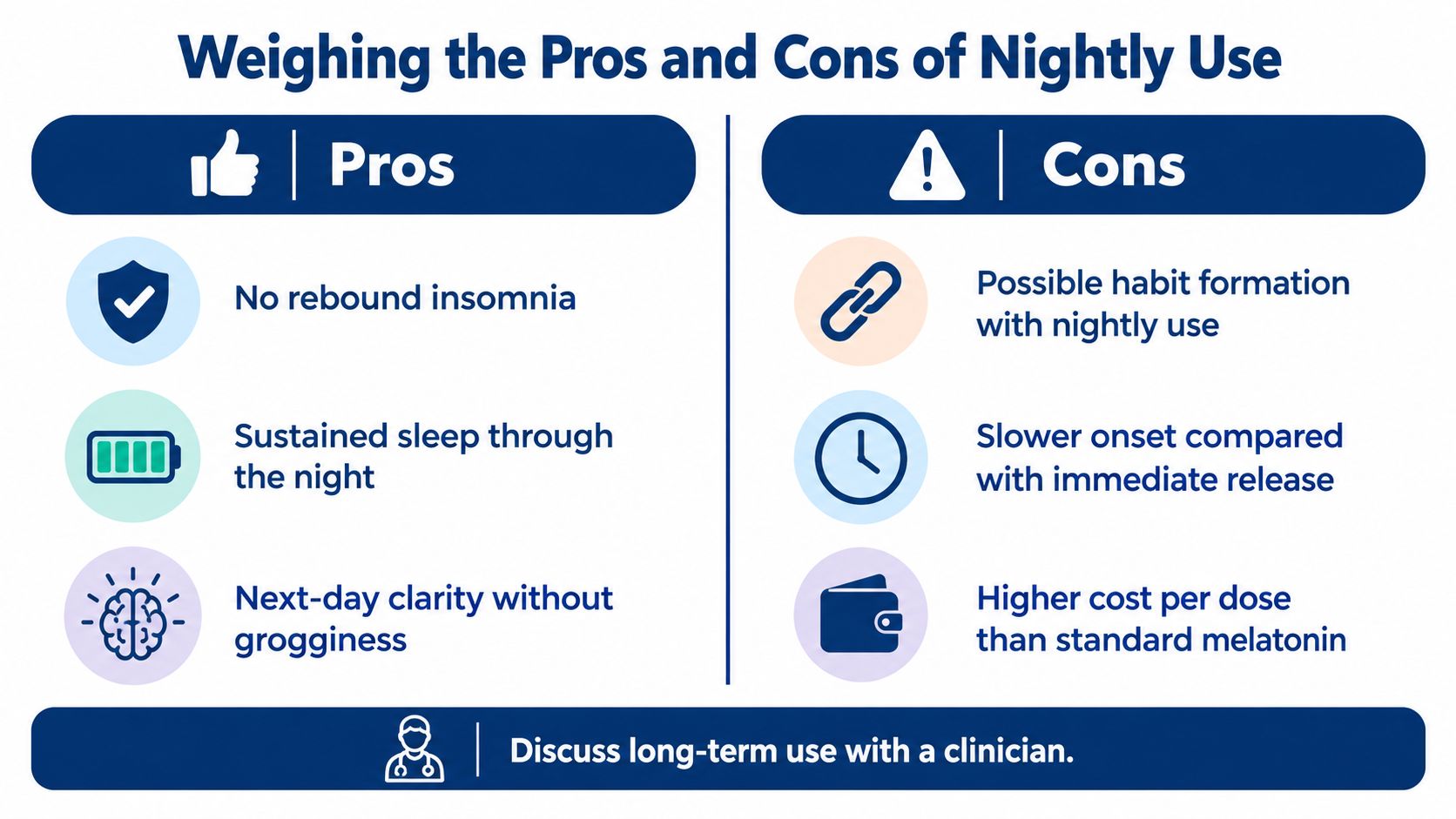
Nightly use raises two separate questions: does the formulation address the sleep problem, and is the chosen regimen appropriate for continued use? A favorable safety finding in a clinical study doesn't turn every over-the-counter product, dose, or combination into a long-term recommendation.
The longer follow-up described earlier found no evidence of tolerance, withdrawal symptoms, rebound insomnia, or suppression of the body's own melatonin production across 6 to 12 months of continuous nightly use in the studied group. That result is reassuring for the specific formulation and population examined, but it shouldn't be generalized carelessly to every product or every person.
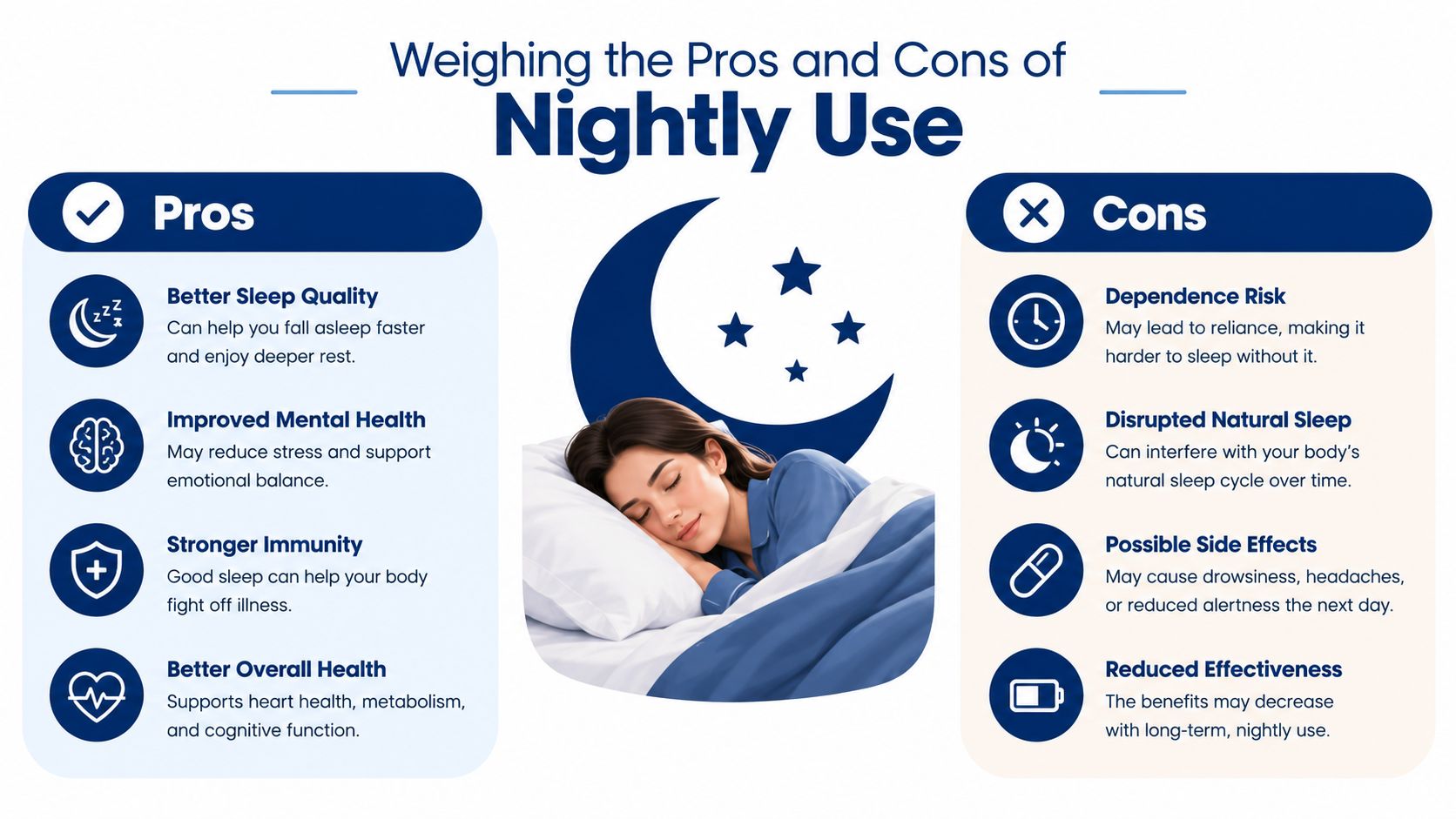
Potential advantages
- Extended coverage: A gradual release profile is designed to support sleep maintenance rather than only the transition into sleep.
- A targeted match: People who fall asleep normally but wake too early may find the pharmacokinetic rationale more relevant than just increasing an immediate-release dose.
- No automatic assumption of dependence: The clinical evidence cited above did not show withdrawal or rebound insomnia in the studied prolonged-release regimen.
Practical limitations
- Evidence remains selective: The best-supported population is older adults with persistent insomnia, not every age group or sleep complaint.
- Guidance is narrow: The licensed prolonged-release regimen covers selected older adults and limits use to 13 weeks, with the details linked earlier.
- Underlying causes remain: A formulation won't address breathing disorders, untreated mood symptoms, pain, night sweats, or a chaotic sleep schedule.
- Combination risks need review: Evidence for combining prolonged-release melatonin with other hypnotics is limited, so a prescriber or pharmacist should review the full regimen.
- Product labels vary: “Extended release,” “prolonged release,” and “sustained release” describe a delivery goal, but labels don't always provide equivalent evidence or pharmacokinetic data.
The question of excessive intake also deserves care. A person considering a higher dose can review guidance on using too much melatonin, then discuss symptoms and product details with a pharmacist rather than stacking multiple sleep aids.
For persistent insomnia, CBT-I remains an important treatment to discuss because the available evidence doesn't show that prolonged-release melatonin is the right replacement for behavioral treatment across all patients. The most sensible approach is often layered: identify the cause, stabilize the sleep schedule, use behavioral treatment when indicated, and consider a formulation only when it fits the specific sleep pattern.
Building Your Complete Nighttime Wellness Routine
A nighttime routine works better when it starts with the actual problem instead of the ingredient list. A sleeper who needs faster sleep onset may consider an immediate-release format, while someone whose main complaint is repeated waking may discuss sustained release with a clinician. A person who feels mentally tense but doesn't want melatonin may prefer a relaxation-focused, melatonin-free option.
A simple decision process can keep the choice focused:
- Name the failure point: Falling asleep, staying asleep, waking too early, or winding down are different goals.
- Check the clock: Timing should fit the intended sleep window, work schedule, and circadian pattern.
- Reduce competing signals: Consistent wake time, dimmer evening light, a comfortable bedroom, and a repeatable wind-down routine support the same biological direction.
- Review the full regimen: Prescription medicines, alcohol, other supplements, pregnancy, nursing, and medical conditions require professional review.
- Track function, not just sleep duration: Morning alertness, nighttime awakenings, and daytime impairment matter more than a single wearable score.
Format can also match the routine. Capsules may suit a planned bedtime ritual, while dissolvable oral strips can suit a person who dislikes swallowing pills or carrying water. Botanical and mineral formulas may support relaxation, but they shouldn't be assumed to provide the prolonged-release pharmacokinetics discussed here.
That applies to our own lineup too. Deep Rest is a standard capsule, not a prolonged-release formula. Each two-capsule serving contains 10 mg of melatonin alongside magnesium, vitamin B6, GABA, L-theanine, ashwagandha, 5-HTP, chamomile, passion flower, lemon balm, and St. John's Wort, which can interact with many prescription medicines. The label directs two capsules once daily before bed, and anyone who is pregnant or nursing, under 18, managing a medical condition, or taking prescription medication should consult a physician first.
Persistent 3 a.m. awakenings deserve a cause-based assessment, not endless dose escalation. A carefully timed, appropriately selected routine gives the sleeper a better chance of finding what supports uninterrupted rest.
Sleep All Nite offers nighttime products in capsule, dissolvable strip, and gummy formats, organized by nighttime goal and including melatonin-free options for winding down. Visit Sleep All Nite to compare those formats and choose a routine that matches the sleep problem rather than just adding more melatonin.
*These statements have not been evaluated by the Food and Drug Administration. These products are not intended to diagnose, treat, cure, or prevent any disease.
This article is for general education and isn't medical advice. Talk with a healthcare professional before starting a supplement, especially if you're pregnant or nursing, under 18, managing a medical condition, or taking prescription medication.


