
Melatonin Timing for Sleep: When to Take It


At midnight, the ceiling fan keeps turning, the phone is face-down, and the melatonin bottle sits beside the bed like a promise that didn't deliver. The usual reaction is to blame the dose and take more. That's often the wrong diagnosis. Melatonin timing for sleep matters more than chasing a bigger number, because melatonin can either support sleep onset or shift the body clock, depending on when it enters the system.
The practical split is simple. Someone trying to fall asleep tonight usually thinks in minutes, while someone trying to move a delayed sleep schedule thinks in biological clock time. Confusing those goals is how a well-intended dose becomes ineffective, mistimed, or followed by morning grogginess.
Table of Contents
- Why the Clock Matters More Than the Dose
- The Two Goals of Melatonin Timing
- Timing for Falling Asleep Tonight
- Matching Timing to Shift Work and Jet Lag
- Light, Screens, and Evening Habits That Change Timing
- Starting Low and Why More Melatonin Can Backfire
- Your Tonight Checklist
Why the Clock Matters More Than the Dose
At midnight, someone who has been awake for an hour may reach for another melatonin tablet. That reaction treats the clock problem like a dose problem. In darkness, the body's own melatonin usually begins rising about 90 to 120 minutes before habitual bedtime, while immediate-release melatonin is often taken 45 to 60 minutes before usual bedtime, when it reaches its bloodstream peak, according to the NCBI clinical reference on melatonin.
A larger dose cannot reliably repair poor timing. Supplements act for a limited period, and products vary in how quickly they dissolve and absorb. If the dose peaks too early or too late, increasing it may add grogginess without bringing sleep closer.
Rewinding the failed bedtime
The midnight dose may have targeted sedation, while the issue was a delayed body clock. Someone who becomes sleepy several hours later than work or family life allows needs an earlier timing signal, not automatically a stronger tablet at the mattress.
Check the pattern before changing the dose. Keep a 3-day sleep diary with the time you first feel sleepy, the time you fall asleep, your wake time, outdoor light exposure, naps, and any shift or travel changes. If sleepiness arrives consistently late, the record points toward a scheduling problem rather than a simple bedtime failure. Review circadian rhythm disruption as part of that assessment.
Practical rule: Set the sleep goal and intended timing first. Adjust the dose only after the schedule is clear.
For sleep onset tonight, ask, “When should sleep begin?” For a delayed schedule, ask, “When should the biological night move?” Those answers can be separated by several hours. A milligram added to a mistimed dose will not close that gap.
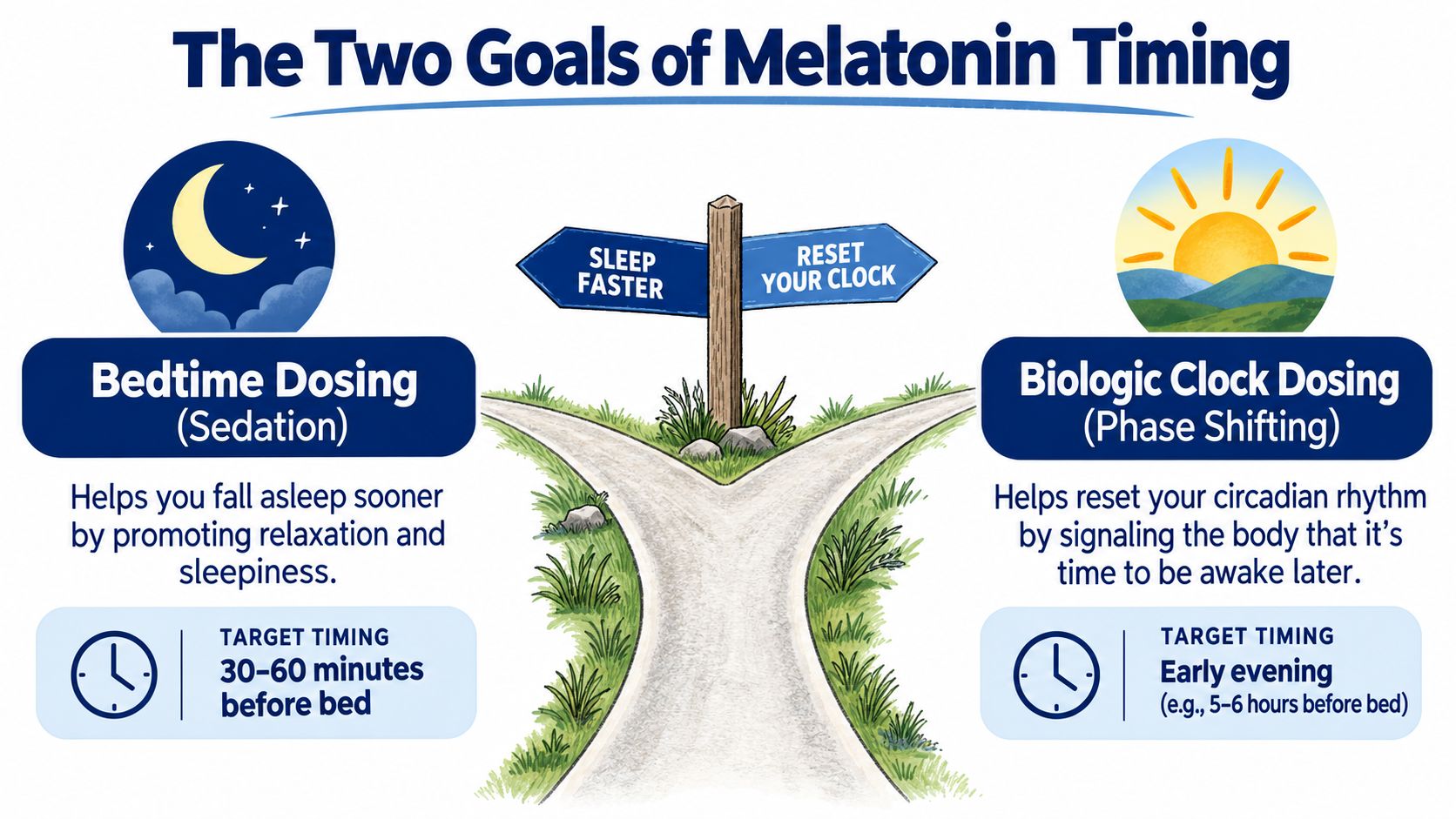
The Two Goals of Melatonin Timing
A 10:30 p.m. bedtime and a delayed body clock require different plans. If you already become sleepy near 10:30 p.m. but need help settling, an immediate-release dose usually belongs around 9:30 to 10:00 p.m. If your natural sleep begins near 2:00 a.m. and you want an 11:00 p.m. schedule, dosing at bedtime may miss the clock-shifting goal. An earlier window, such as 4:00 to 6:00 p.m., is the more relevant starting point to discuss with a clinician.
Goal one, sleep onset tonight
Use bedtime-relative timing when your sleep schedule is already close to where you want it. For immediate-release melatonin, clinical guidance commonly places the dose 30 to 60 minutes before bedtime. Modified-release products generally belong 1 to 2 hours before bedtime, according to the NHS melatonin timing guidance.
Here, the target is the transition into sleep tonight. Take the dose as your evening winds down, not after stimulating work, bright light, or phone use has kept your brain alert. This approach supports sleep onset without attempting to reset the schedule.
Goal two, moving the body clock
Choose biologic-clock timing when sleep arrives naturally, but several hours later than work, school, or family life allows. Delayed sleep-wake phase disorder, jet lag, and rotating shifts fit this problem.
The NCCIH's melatonin overview summarizes a randomized trial involving 307 people over 4 weeks. Melatonin taken 1 hour before desired bedtime, alongside a fixed bedtime, improved outcomes in delayed sleep-wake phase disorder. Earlier controlled research found that 1.5 mg at 4:00 p.m. could advance endogenous melatonin and cortisol rhythms. Afternoon dosing can therefore shift internal timing rather than just make you drowsy.
Use this quick split:
- Sleep tonight: Dose relative to intended bedtime.
- Earlier sleep over several nights: Dose relative to biological timing, often several hours before bed.
- Jet lag or shift changes: Coordinate dose timing and light exposure with the direction of travel or schedule change.
Decide which goal you have before choosing the hour. The same tablet can be well timed at 9:30 p.m. for tonight's sleep and poorly timed for a body-clock reset, which usually calls for a dose several hours earlier.
Timing for Falling Asleep Tonight
If you want to sleep at 10:30 p.m. tonight, take immediate-release melatonin between 9:30 and 10:00 p.m. That window targets sleep onset. It does not attempt to reset your body clock.
Start the evening routine before dosing. Dim the lights, finish stimulating work, put away the phone, and give sleep pressure room to work. Taking melatonin at lights-out can leave too little time for its intended effect. Taking it several hours earlier serves a different goal, shifting biological timing rather than just supporting sleepiness.
For ordinary sleep-onset support, begin low. Clinical references describe study doses ranging from 0.1 mg to 10 mg, while expert guidance often favors starting with 0.5 to 1 mg. More is not automatically better. A larger dose can keep melatonin levels raised longer and make the morning feel sluggish.
What the timing window means
The formulation changes the schedule. Modified-release melatonin generally belongs earlier, commonly 1 to 2 hours before bedtime. Immediate-release products fit the 30 to 60 minute window more directly. A dissolving format may make administration easier, but it does not turn a sleep-onset dose into a body-clock treatment.
For people who dislike swallowing pills, Drift Off is a raspberry-flavored oral strip that dissolves on the tongue and provides 1 mg of melatonin, along with valerian root, lavender, chamomile, and hibiscus extracts. Take one strip 30 to 60 minutes before intended sleep, with a maximum of one strip a day according to the label directions.
A racing mind needs more than a supplement. Melatonin can mark biological night, but it will not clear unfinished tasks, worries, or learned associations with wakefulness. Pair the dose with a structured wind-down, especially if you deal with a brain that keeps racing at bedtime.
Tonight's rule: Set the intended sleep time, take immediate-release melatonin 30 to 60 minutes beforehand, and keep the dose low enough for a clear morning.
Matching Timing to Shift Work and Jet Lag
Shift work and travel turn melatonin timing into a scheduling problem. The aim isn't always to sedate the body on command. It may be to move sleep and wake signals so they better match a new work block or destination.
For rotating shifts, the intended sleep block comes first. A dose around 30 to 60 minutes before that sleep block may support sleep onset, but a person also needs darkness during daytime sleep and carefully planned light before the work period. Taking melatonin at a conventional nighttime hour while working overnight can reinforce the wrong signal.
| Scenario | When to Dose | Typical Dose | Light Behavior | Phase Direction |
|---|---|---|---|---|
| Ordinary sleep onset | 30 to 60 minutes before intended bedtime | Low-dose immediate-release, often starting at 0.5 to 1 mg | Dim evening light | Supports sleep onset |
| Night or rotating shift | Relative to the intended sleep block, with schedule-specific planning | Use the lowest effective amount appropriate to the product | Seek strategic light before work, use blackout conditions for daytime sleep | Depends on the shift pattern |
| Eastward travel | Earlier relative to destination sleep, based on biological timing | Individualized | Seek appropriately timed morning light at destination, avoid mistimed late light | Earlier phase |
| Westward travel | Later relative to destination sleep, based on biological timing | Individualized | Avoid advancing light too early, use evening light strategically when appropriate | Later phase |
Travel changes the clock, not just the bedtime
For circadian phase advances, the phase-response research on melatonin identifies the strongest advance around 3 hours before dim-light melatonin onset, with commonly reported windows of 2 to 4 hours before DLMO or roughly 9 to 11 hours before sleep midpoint. In practical terms, the useful window can fall several hours before bedtime, particularly when the goal is to move a delayed clock earlier.
Eastward travel generally asks the body to sleep and wake earlier. Westward travel generally asks it to tolerate a later schedule. The dose should follow the desired biological shift, not just the departure city's old bedtime.
A controlled phase-advance protocol used 0.5 mg beginning 5 hours before baseline bedtime, then moved the dose earlier each day. That methodology illustrates the difference between clock-shifting work and a one-night sleep-onset routine. It isn't a universal self-treatment schedule.
Deep Rest is another product format to evaluate carefully because its serving contains 10 mg of melatonin, alongside magnesium, vitamin B6, GABA, L-theanine, botanicals, ashwagandha, and 5-HTP. That amount doesn't fit a low-dose-first approach for every person, so anyone considering it should follow the product directions and review the ingredients with a clinician when medical conditions or prescription medicines are involved.
The wrong clock hour can move the rhythm in the unwanted direction. For shift workers and frequent travelers, light timing is as important as supplement timing.
Light, Screens, and Evening Habits That Change Timing
Melatonin works inside an environment that can either support or oppose the intended signal. Bright overhead lights, phone screens, television, and light entering through a bedroom window can tell the brain that biological day is still underway. A dose taken while the room remains bright and stimulating is being asked to compete with the surroundings.
A better sequence starts before the capsule, strip, or tablet:
- Dim the room first. Move to warmer, lower lighting during the wind-down period.
- Take the dose in the chosen window. For ordinary sleep onset, that's usually 30 to 60 minutes before bed.
- Protect the sleep environment. Keep the bedroom dark and avoid checking the time repeatedly.
Caffeine deserves a firm cutoff because it can interfere with sleep even when melatonin helps someone fall asleep. The exact cutoff depends on sensitivity, but people who sleep poorly should avoid treating melatonin as permission for late caffeine. Alcohol also makes a poor sleep aid. It may feel relaxing initially, yet it can leave sleep less stable later.
Food can change the feel of the dose
A heavy meal close to administration may slow or alter absorption, especially when a person expects a quick onset. Taking immediate-release melatonin away from a large meal may produce a more predictable experience, although product instructions should always take priority.
The practical mistake is treating melatonin like an on-off switch. The stronger routine is a chain: lower light, reduce stimulation, take the product at the correct time, and enter a dark bedroom. If one link fights the others, the person may conclude that the supplement failed when the sequence was never aligned.
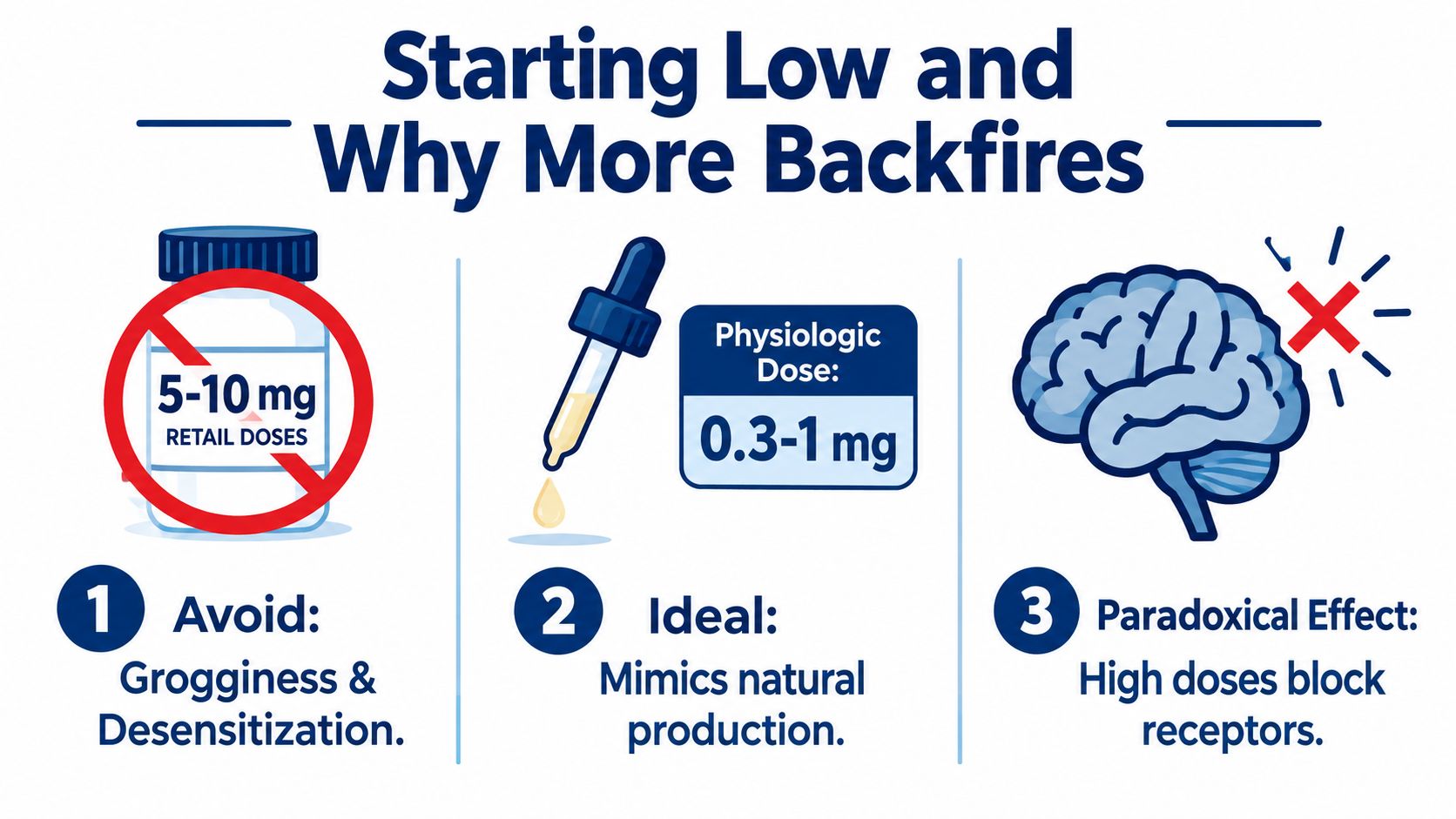
Starting Low and Why More Melatonin Can Backfire
Retail shelves make high-dose melatonin look routine. That is a poor reason to start there. Clinical study doses vary widely, so begin with the smallest amount that fits the goal, then adjust timing or formulation before increasing the dose.
Melatonin supplies a night signal. Taking more does not automatically make that signal stronger or better, especially when the underlying problem is a mistimed dose or an evening environment that keeps the body alert.
A calmer dose-finding method
For sleep-onset support, try 0.5 mg in the same 30 to 60 minute window for three nights. Track morning alertness on a 1 to 5 scale and note how long falling asleep takes. If sleep latency stays above 30 minutes and mornings remain clear, increase by only 0.5 mg. Hold the new dose for another three nights before judging it.
The UC Davis explanation of melatonin timing describes sleep-onset benefits with earlier administration and reports maximal efficacy around 2 to 4 mg per day, approximately 3 hours before bedtime, in a specific timing and dose context. It does not support taking 4 mg automatically every night.
If 0.5 mg works, stop there. If it does not, check the target first. Sedation tonight and shifting a delayed body clock require different timing, and increasing the dose will not repair the wrong schedule.
The discussion of taking too much melatonin reinforces the practical point: extra milligrams can add unwanted effects without correcting mistimed use. Persistent insomnia, breathing interruptions, restless legs, medication effects, pain, or severe anxiety call for appropriate assessment instead of repeated dose increases.
Dose principle: Use the smallest effective amount at the correct hour.
Check the label before choosing a product. Modified-release and immediate-release melatonin are not interchangeable. Anyone taking prescription medicines, pregnant or nursing, under 18, or managing a medical condition should ask a healthcare professional before using a supplement.
Your Tonight Checklist
A good plan should fit on one screen and survive a tired evening. The following sequence keeps the decision focused on the actual target rather than the loudest number on the label.
Before dinner
- Get daylight: Spend time in natural light earlier in the day to give the body clock a clear daytime signal.
- Set the caffeine boundary: Keep caffeine well away from the intended sleep period, especially when awakenings or racing thoughts are already a problem.
- Keep alcohol out of the sleep strategy: It may feel sedating, but it can destabilize the night and won't correct circadian timing.
About 90 minutes before bed
- Lower the lighting: Switch off harsh overhead lights and use dimmer, warmer illumination.
- Prepare the room: Make the bedroom dark, comfortable, and ready before sleepiness arrives.
- Reduce mental input: Put the phone away, finish demanding tasks, and choose a quiet activity.
- Keep food modest: Avoid a heavy meal close to the dose. If hunger is distracting, choose a light snack rather than a large late dinner.
During the dose window
- Name the goal: For sleep onset tonight, choose 30 to 60 minutes before intended sleep. For a delayed body clock, the dose may need to be several hours earlier and should be planned around biological timing.
- Start conservatively: Use the lowest effective dose permitted by the product and appropriate for the individual.
- Set a reminder: A phone alarm earlier in the evening prevents the familiar midnight mistake.
- Track the morning: Note grogginess, alertness, sleep onset, and awakenings instead of judging the night by one sensation.
Response varies with age, travel, shift schedules, light exposure, and formulation. Adjusting the timing in 15-minute increments across several nights is more sensible than changing the entire routine after one disappointing attempt.
If sleep trouble persists, causes daytime impairment, or comes with breathing pauses, dangerous sleepiness, or frequent severe awakenings, a clinician should investigate the cause. Sleep All Nite offers goal-based nighttime products, including dissolving strips and capsule formulas, so readers can review formats and ingredient amounts at Sleep All Nite while keeping timing, dose, and medical suitability at the center of the decision.
*These statements have not been evaluated by the Food and Drug Administration. These products are not intended to diagnose, treat, cure, or prevent any disease.
This article is for general education and isn't medical advice. Talk with a healthcare professional before starting a supplement, especially if you're pregnant or nursing, under 18, managing a medical condition, or taking prescription medication.


