
Insomnia Middle of Night: Practical Steps to Stay Asleep


Waking at 3 a.m. and staring at the ceiling is a different kind of misery than lying awake at bedtime. The room is quiet, your mind is suddenly loud, and the worst part is the feeling that sleep should be easy right now. For many adults, insomnia in the middle of the night is the sleep problem that keeps repeating, night after night, long after the lights go out.
This pattern is not rare. A large epidemiologic analysis found 19.9% of the population had middle-of-the-night awakenings over 12 months, compared with 16.4% for difficulty initiating sleep and 16.7% for early morning awakenings, and 16% reported these awakenings at least three times per week. It also showed the symptom was more common in women and increased with age, reaching 23% among adults 65 and older (PMC epidemiologic analysis).
Table of Contents
- Why You Keep Waking Up in the Middle of the Night
- Immediate Steps When Your Eyes Snap Open
- Choosing the Right Supplement Strategy
- Optimizing Your Sleep Environment for Long Durations
- Long-Term Strategies and Professional Support
- Frequently Asked Questions About Overnight Sleep
Why You Keep Waking Up in the Middle of the Night
The story is usually familiar. Someone falls asleep fine, then wakes at 2:47 a.m. with a racing mind, a dry mouth, or a vague feeling that something is off. They try to “fix” sleep with a better pillow, a darker room, or another bedtime routine, but the underlying issue is not sleep onset. It's sleep maintenance, and that changes the plan.
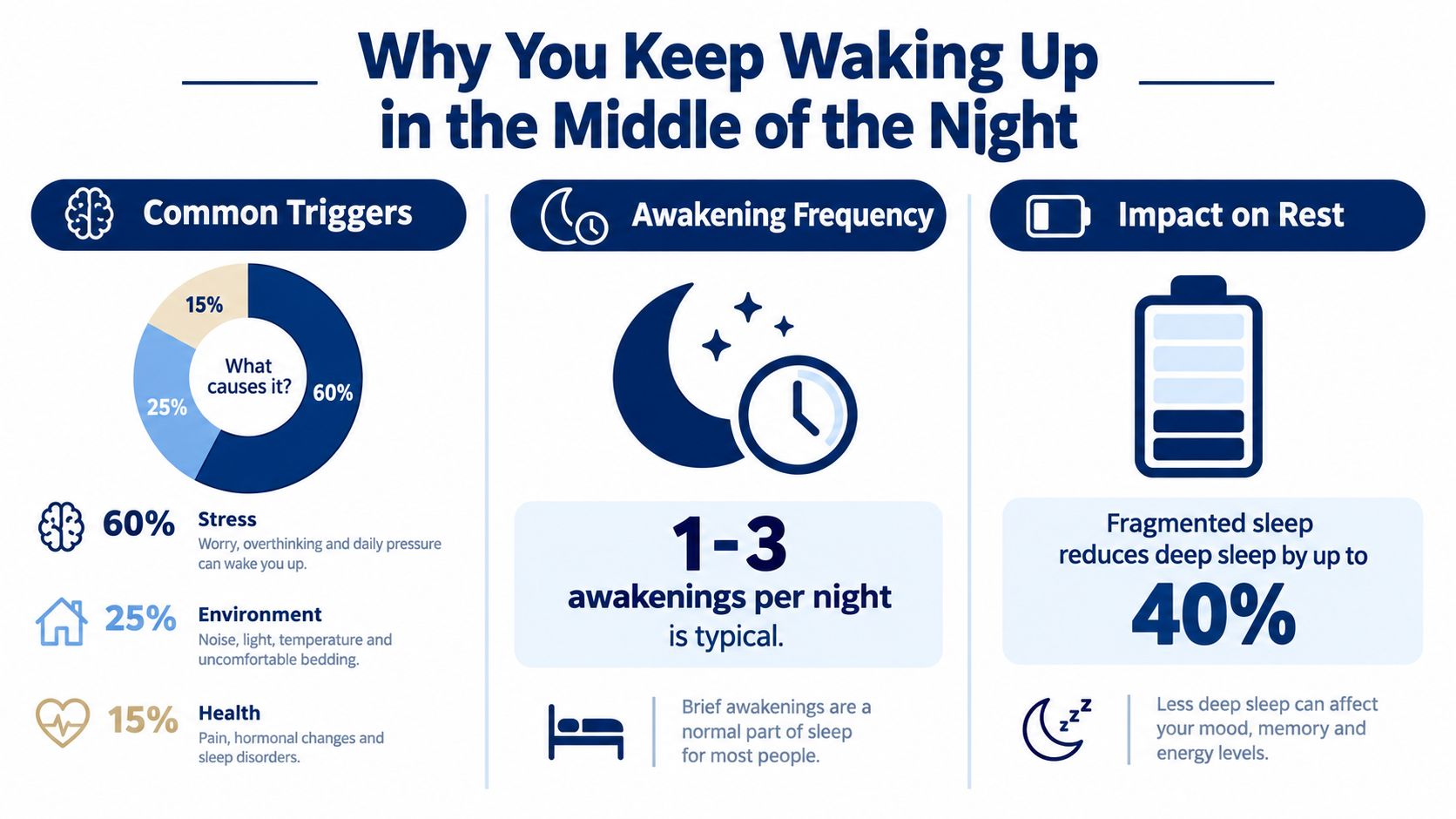
This is a distinct sleep pattern
Nocturnal awakenings are common even outside a formal insomnia diagnosis. One population study found about one-third of the general population had nocturnal awakenings, with 35.5% waking at least three nights per week and 23.0% waking every night. Nightly awakenings rose to 34.6% among people aged 65 or older (population study on nocturnal awakenings).
That matters because people often treat a 3 a.m. wake-up like a bedtime problem. It isn't. Bedtime routines help with falling asleep, but waking in the middle of the night usually reflects a different mix of triggers, including stress, environment, pain, bladder urgency, alcohol, caffeine, hormones, or a conditioned pattern of waking and then fighting sleep. For a practical primer on the 3 a.m. experience itself, the guide at Why Do I Wake Up at 3 AM fits this problem well.
Practical rule: don't judge the night by how fast sleep came at bedtime. Judge it by whether sleep stayed intact.
Why the old advice misses the point
Generic sleep hygiene often overemphasizes “relax before bed” and underemphasizes what to do after the first awakening. That creates a false expectation, as if a warmer shower or earlier screen cutoff should solve a problem that's happening at 3 a.m. instead of 10 p.m.
The more useful question is simple, what is waking the sleeper up? In midlife women, the answer is often tied to menopause-related hormone shifts, bladder urgency, stress or anxiety, pain, medications, and alcohol or caffeine effects. That's why the right fix often starts with identifying the trigger, not forcing sleep faster.
Immediate Steps When Your Eyes Snap Open
The first minutes after waking matter more than many realize. Once the brain notices, “I'm awake again,” the instinct is to check the clock, grab the phone, and start negotiating with sleep. That sequence trains the brain to associate the bed with alertness, which is exactly what needs to stop.
Use stimulus control, not willpower
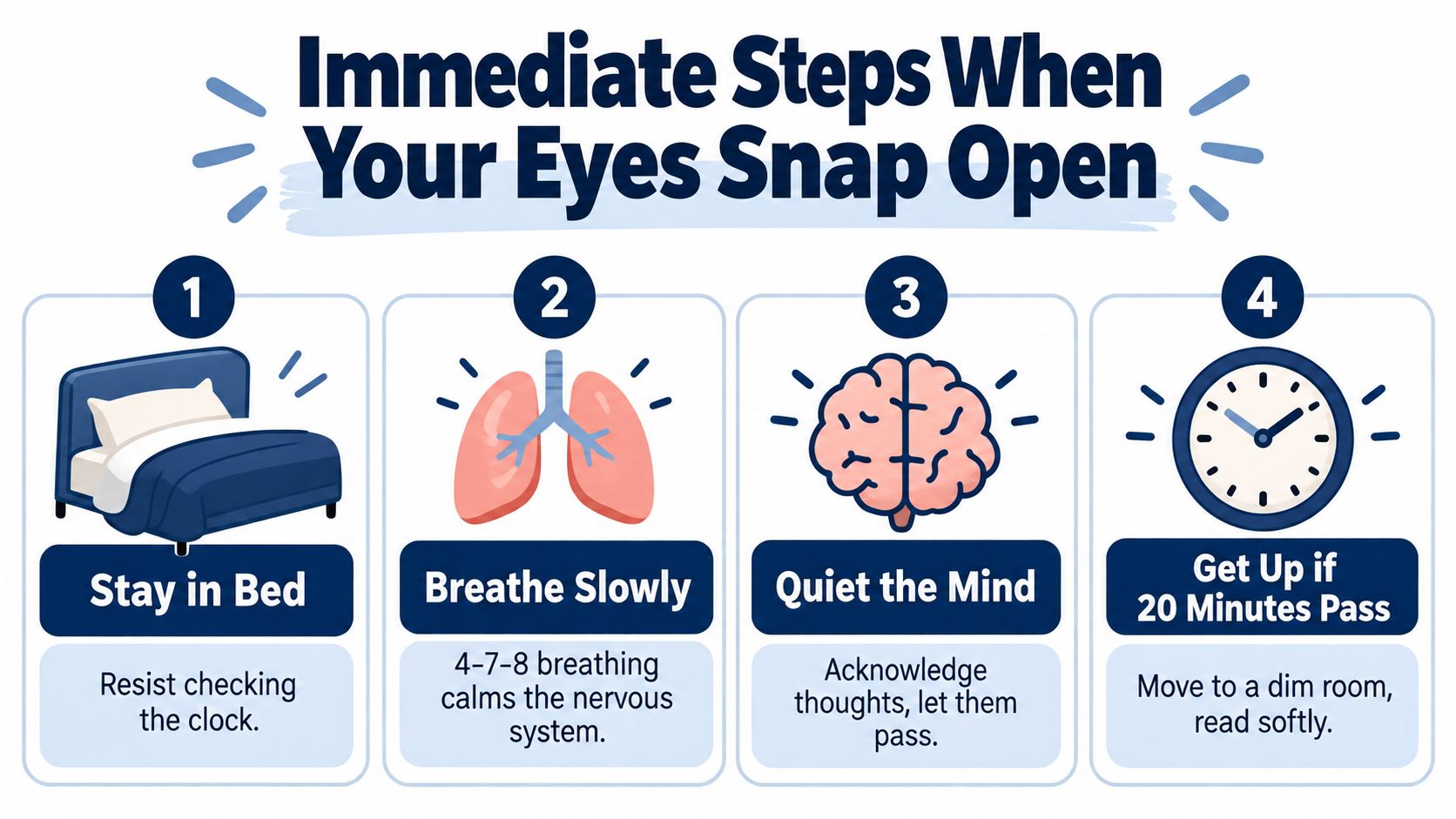
Middle-of-night insomnia is commonly managed with CBT-I stimulus control. The core instructions are direct, lie down only when sleepy, keep the bed for sleep and sex only, get out of bed if sleep doesn't return after about 15 to 20 minutes, do a quiet activity, then return only when sleepy. Expert summaries describe CBT-I as the most effective treatment for sleep-maintenance insomnia, often delivered over 4 to 8 in-person sessions across 6 to 8 weeks (CBT-I and stimulus control summary).
That “get out of bed” step feels backwards to frustrated sleepers. It works because the brain learns through repetition. Staying in bed while annoyed strengthens the bed-wake association, while a calm exit teaches the opposite.
What to do in the moment
- Stay in bed briefly, but stay still: resist the urge to start a mental battle or reach for the phone.
- Breathe slowly: keep the exhale longer than the inhale, because that helps dial down arousal.
- Let thoughts pass: label the thought as a thought, not a task.
- Get up when sleep stalls: move to a dim room, read something quiet, and return only when sleepiness comes back.
One thing this list leaves out on purpose is reaching for a supplement. Melatonin taken after a 3 a.m. wake-up arrives at the wrong point in the night and is more likely to leave the morning foggy than to bring sleep back. Supplements belong in the evening routine, which is covered below.
Do not do this: stay in bed frustrated, scroll in the dark, or keep peeking at the time. Those habits raise alertness and slow return-to-sleep.
Handle the 3 a.m. spiral
The mind often starts with one worry and expands it into a full crisis. That's normal, but it's not useful. The practical move is to give the brain a short, boring job, like counting breaths or rereading the same dimly lit page, then stop before the task becomes stimulating.
For sleepers whose mind races hard enough that the night feels hijacked, the guide at How to Sleep When Your Brain Is Racing pairs well with this approach. The point is not to “try harder” to sleep. It's to make wakefulness less rewarding.
Choosing the Right Supplement Strategy
Supplements sit in a narrow lane here. They can help bridge the gap when behavioral work is underway or when the person needs a gentler nighttime routine, but they can also backfire if the dose is too high, the timing is wrong, or the expectation is unrealistic. For sleep maintenance, the best choice is usually the one that supports steadiness without leaving the next morning foggy.
Compare the main options
| Type | Best For | Onset | Considerations |
|---|---|---|---|
| Low-dose melatonin | People who want a light nudge back toward sleep | Usually taken before bed, not after the wake-up | Lower doses tend to fit people who dislike next-day grogginess |
| Higher-dose melatonin | People who have already tried simpler options and still wake often | Usually before bed | More isn't automatically better, especially if morning sedation is a problem |
| Magnesium | People who notice muscle tension or want a melatonin-free option | Taken as part of the evening routine | Best framed as relaxation support, not a knockout solution |
| L-theanine | People with an active mind and a need for a calmer wind-down | Usually before bed | Works as a non-hormonal calming option rather than a sleep trigger |
Melatonin-free choices can make sense when the person doesn't want a hormone-based product every night. In the Sleep All Nite lineup, Deep Calm is a magnesium glycinate capsule with 275 mg of magnesium per serving, and Nite Bites are melatonin-free gummies built around calming ingredients like L-theanine, lemon balm, passion flower, valerian root, and reishi mushroom extract. Those formats may fit sleepers who want relaxation support without melatonin.*
For people who do want a low dose of melatonin in a travel-friendly, no-water format, Drift Off is a raspberry-flavored oral strip that dissolves on the tongue and pairs 1 mg melatonin with valerian root, lavender, chamomile, and hibiscus extracts. It belongs in the evening, taken 30 to 60 minutes before bed, not at 3 a.m. And no supplement works well if the person keeps checking the clock every ten minutes.
Match the product to the problem
A history of repeated night waking calls for a different lens than bedtime anxiety alone. If the main problem is waking and then staying alert, a lower-dose option often makes more sense than a stronger dose that may carry into the morning. If the person has a sensitive stomach, hates swallowing pills, or travels often, oral strips may fit better than capsules.
The right supplement also depends on what's already been tried. If behavioral steps are still inconsistent, even the best-formulated supplement can feel weak. If the behavioral routine is strong but the body still breaks sleep up, a modest support strategy may be more reasonable.
Practical rule: use supplements to support sleep, not to replace a broken nighttime routine.
Optimizing Your Sleep Environment for Long Durations
A bedroom doesn't have to be luxurious to support better sleep, but it does have to be predictable. Small triggers add up over six or seven hours, and what seemed minor at bedtime can become the reason the body wakes later. Light, sound, temperature, and clutter all matter because they change how hard the brain has to work to stay asleep.

Make the room easier to stay asleep in
Keep the room cool enough that the body doesn't have to fight heat overnight. Too much warmth can fragment sleep, especially in people who already wake easily. Darkness helps too, but the goal isn't just blackout curtains, it's reducing every small cue that tells the brain morning is near.
Sound deserves the same attention. A steady, predictable sound, like a fan or a free white-noise app, can reduce the way random sounds pull the brain toward wakefulness. Even if the sleeper doesn't fully wake, those micro-arousals can still break the continuity of sleep.
Remove the common sleep breakers
- Reduce light spill: cover bright LEDs and stop using the phone as a flashlight.
- Limit overnight bathroom trips: shift fluids earlier in the evening if that fits the person's health plan.
- Keep the bed for sleep: avoid turning the mattress into a reading chair, work desk, or scrolling station.
- Treat alcohol as a sleep disruptor: falling asleep faster after drinking does not mean staying asleep will be easier.
These are simple changes, but they work best when they're consistent. The point isn't to create a perfect sleep sanctuary, it's to remove the small friction points that turn one normal awakening into a full-blown episode.
Long-Term Strategies and Professional Support
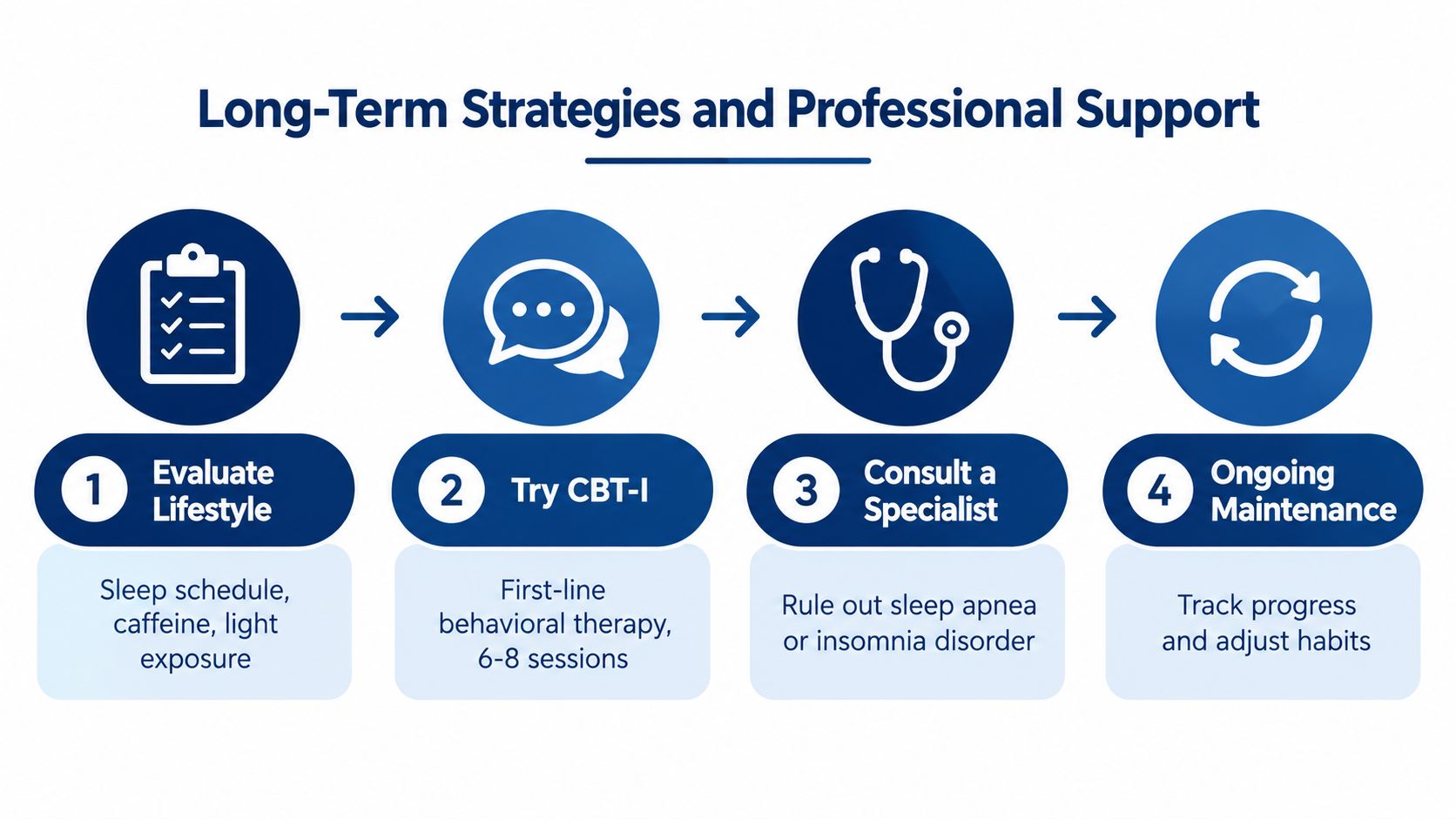
When a person keeps waking in the middle of the night, the next step is not just more effort. It's a better diagnosis. Chronic sleep maintenance problems can reflect conditioned insomnia, but they can also point to pain, bladder symptoms, anxiety, medication effects, or sleep apnea, so a broader review matters.
Use data before guessing
Sleep tracking can be useful if it stays simple. The point is not to obsess over every number. It's to notice patterns, like whether awakenings cluster after alcohol, later meals, stress-heavy days, or a warm bedroom.
A short log with bedtime, wake time, number of awakenings, caffeine timing, and whether the person had trouble returning to sleep gives a clinician something concrete to work with. That kind of record usually tells a better story than memory alone, especially when the same issue has been happening for weeks.
Know what CBT-I actually does
CBT-I is still the clinical gold standard for sleep-maintenance insomnia because it targets the habits that keep the problem alive. It combines stimulus control, sleep restriction, and cognitive work so the bed stops functioning like a wakefulness cue. It's not a quick fix, but it's the most durable behavioral approach for people whose nights are repeatedly broken.
Ask for a medical check when the pattern fits
A specialist visit is appropriate when awakenings come with snoring, gasping, pain, reflux, restless legs, persistent nighttime urination, or major daytime fatigue. Those signs point away from simple bad sleep habits and toward a problem that may need testing or a different treatment plan.
Rule of thumb: if the same wake-up pattern keeps repeating despite good habits, it's time to look for the cause, not just add more bedtime rituals.
Frequently Asked Questions About Overnight Sleep
Do perimenopausal women need a different approach? Yes. Women in midlife often wake because of hormone shifts, bladder urgency, stress, pain, medication effects, or alcohol and caffeine patterns, so the question is usually what is waking me up? rather than how to fall asleep faster. That's why a symptom-based review tends to help more than generic sleep-hygiene advice.
What about shift workers? Shift workers often have a circadian problem layered on top of insomnia. Regularity matters as much as possible, but the primary challenge is protecting sleep time when the body wants to be awake, so blackout conditions, quiet, and a consistent sleep window become more important than a perfect bedtime routine.
Are sleep supplements safe to use long term? They're not all the same. Melatonin-free options may be easier for some people to use as part of a routine, while melatonin-based products should be chosen carefully with dose and timing in mind. A clinician should review long-term use if the person is pregnant, nursing, under 18, or dealing with a known medical condition.
If middle-of-the-night waking is wearing you down, start with the behavioral basics and then choose support that fits the pattern, not the marketing. Sleep All Nite offers goal-based nighttime options, including strips, capsules, gummies, and a night cream, so shoppers can match a format to their evening routine, whether that's winding down or a low-dose bedtime cue. Visit Sleep All Nite to compare formats and build a routine that fits real 3 a.m. wake-ups.
*These statements have not been evaluated by the Food and Drug Administration. These products are not intended to diagnose, treat, cure, or prevent any disease.
This article is for general education and isn't medical advice. Talk with a healthcare professional before starting a supplement, especially if you're pregnant or nursing, under 18, managing a medical condition, or taking prescription medication.


