
How to Sleep When Your Brain Is Racing Tonight


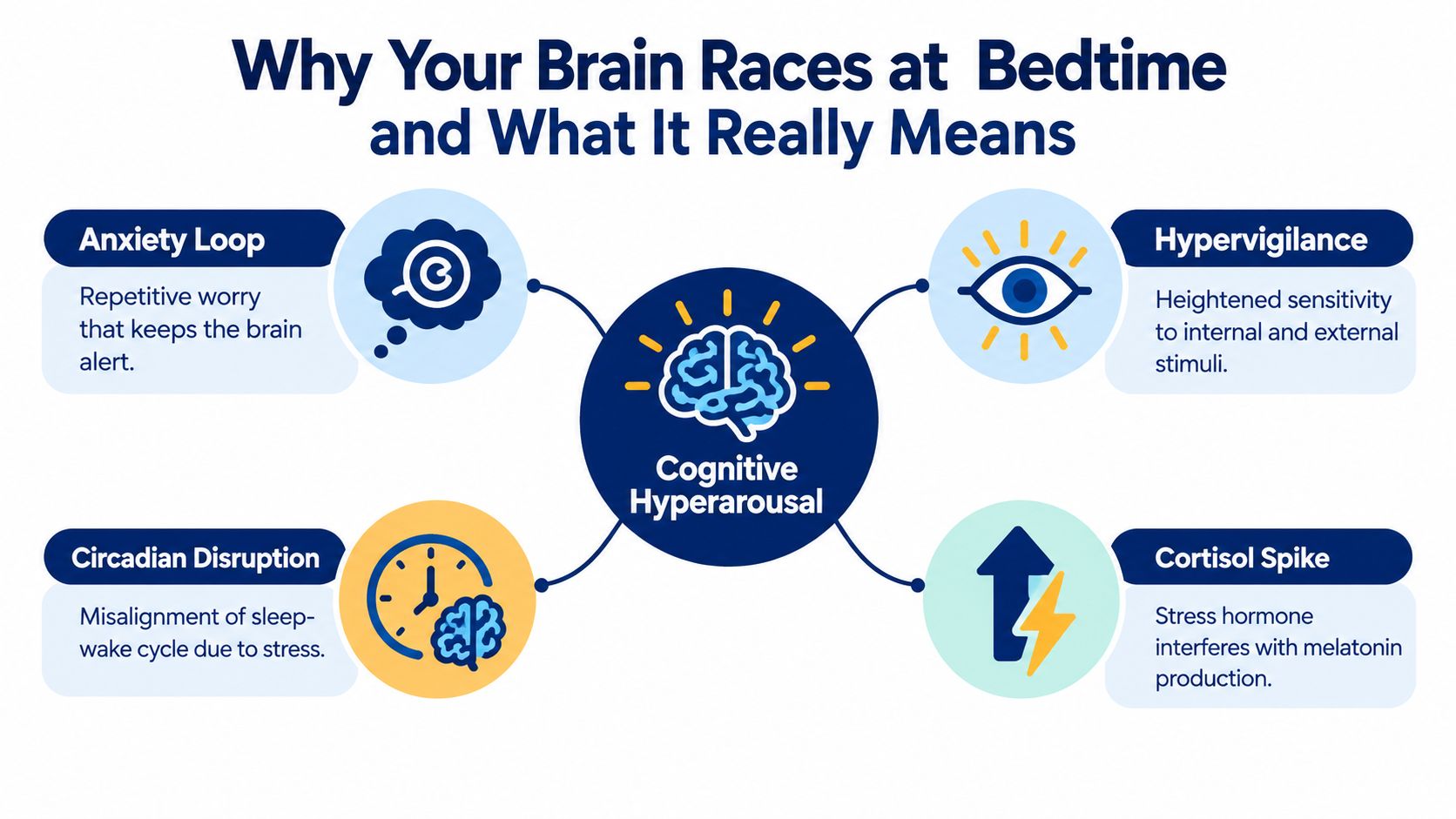
It's 11:17 p.m., the room is dark, and the second your head hits the pillow, your brain starts replaying tomorrow's email, that awkward comment from lunch, the thing you forgot to buy, and a worst-case story about why sleep might not happen tonight. Your body is tired. Your mind is not. That split is exactly why how to sleep when your brain is racing feels so frustrating, because the problem is not just stress, it is a specific pattern of cognitive hyperarousal that shows up right when sleep should be easiest.
Table of Contents
- Why the bed can become an alert zone
- How to Offload Thoughts Before Bed With Worry Time and Journaling
- Calming Techniques to Quiet a Racing Mind in Bed
- How to Reset Your Bed Sleep Connection With Stimulus Control
- Choosing Wind Down Support Without Overdoing Melatonin
- Your Tonight Plan and What to Do When Sleep Still Does Not Come
Insomnia research has treated that racing-mind state as a core mechanism for years, not a side effect. A classic cognitive model described people with insomnia as becoming overly worried about sleep and its consequences, which then drives arousal and threat-monitoring at night as outlined in the insomnia cognition literature. Later reviews kept pointing to hyperarousal as central, and that research history shows bedtime racing thoughts are not just “thinking too much,” they are a measurable insomnia phenotype tied to sleep-onset difficulty.
Why the bed can become an alert zone
When someone lies awake night after night, the brain starts linking the bed with alertness instead of sleep. That conditioning matters because the body learns quickly, and a place that should cue drowsiness can begin cueing checking, worrying, and scanning for whether sleep is happening yet. The result is familiar to many sleepers, the clock gets louder, the body gets tighter, and the mind starts monitoring every missed minute.
That pattern can spread beyond the night itself. A day filled with stress, unfinished tasks, and constant mental switching can keep the nervous system primed, so bedtime arrives before the brain has fully downshifted. A 24-hour downregulation approach matters here, because calming the mind only at lights-out often leaves too much carryover from the rest of the day, while cognitive hyperarousal keeps the sleep system stuck in alert mode. Sleep educators often treat this like a smoke alarm that stays sensitive after the fire is out, it keeps sounding because the system has not reset yet.
This is also why generic relaxation advice often falls short. Racing thoughts at bedtime are not always the same as daytime worry or rumination, and later work found that bedtime racing thoughts can be more strongly tied to insomnia severity than general worry or rumination as reported in the insomnia cognition review. That distinction matters, because the target is not just calming down in a vague sense, it is teaching the brain to stop treating bedtime as a problem-solving session.
Practical rule: if the bed has become a place for thinking, not sleeping, the fix has to change that association, not just add more effort.
The rest of the routine has to serve two jobs at once. It has to lower mental load before bed, and it has to prevent the bed from becoming another place where alertness gets rehearsed. That combination is what turns a racing brain from a nightly crisis into a solvable sleep-onset pattern.
How to Offload Thoughts Before Bed With Worry Time and Journaling
A quiet night usually starts earlier than the pillow. If the mind tends to sprint when the lights go out, the goal is to give those thoughts a scheduled place to land before bedtime, so they don't all arrive at once at 11 p.m.
Put worry on the calendar, not on the pillow
Set aside 15 minutes in the late afternoon or early evening for a simple worry session. The point is not to obsess, it's to tell the brain, “There is a time for this, and it isn't bedtime.” During that window, write down the worries in plain language, then add one next action if there is one.
For example, work stress might become, “Send the revised deck tomorrow at 9 a.m.” Parenting mental load might become, “Pack school bag before dinner.” A body-symptom spiral at 3 a.m. in perimenopause often starts as, “If I wake up, I'll know what to do, and I won't solve it at 3 a.m.” That kind of note matters because the brain often keeps thinking when it has not been given a clear plan.
Use a brain dump that closes the loop
A useful journal entry has three parts.
- What's on my mind: list the thought without polishing it.
- What needs action: note any task, appointment, or message.
- What can wait: write the item that doesn't need attention tonight.
That last line is important. If the mind believes every thought is urgent, it keeps reopening the file. A next-action note gives the nervous system permission to stand down because the issue has been captured somewhere outside the head.

A melatonin-free option some people use for a wind-down routine is Nite Bites, a blackberry gummy with reishi, L-theanine, lemon balm, passion flower, and valerian root. The value here is format and timing, not magic, a chewable ritual can fit naturally after journaling if a person wants a simple, non-pill option.
Build a short buffer after the notebook closes
Once the writing is done, keep the next 30 to 60 minutes low-stimulation. Dim lights. Put the phone away. Do one predictable activity, like washing face, setting out clothes, or reading something non-dramatic.
A simple evening sequence can look like this: worry time, dinner cleanup, brief journal closeout, then a calmer pre-bed routine. The brain learns faster when the pattern is repeatable, and the point is to make bedtime feel less like a sudden plunge into silence.
Calming Techniques to Quiet a Racing Mind in Bed
Some nights the thoughts keep arriving after the lights go out. That pattern usually points to sleep-onset hyperarousal, a brain that stays too alert to settle, even when the body is ready for sleep. The goal is to lower that alert state in a way the nervous system can follow.
Start with breathing that slows the pace, not one that feels forced
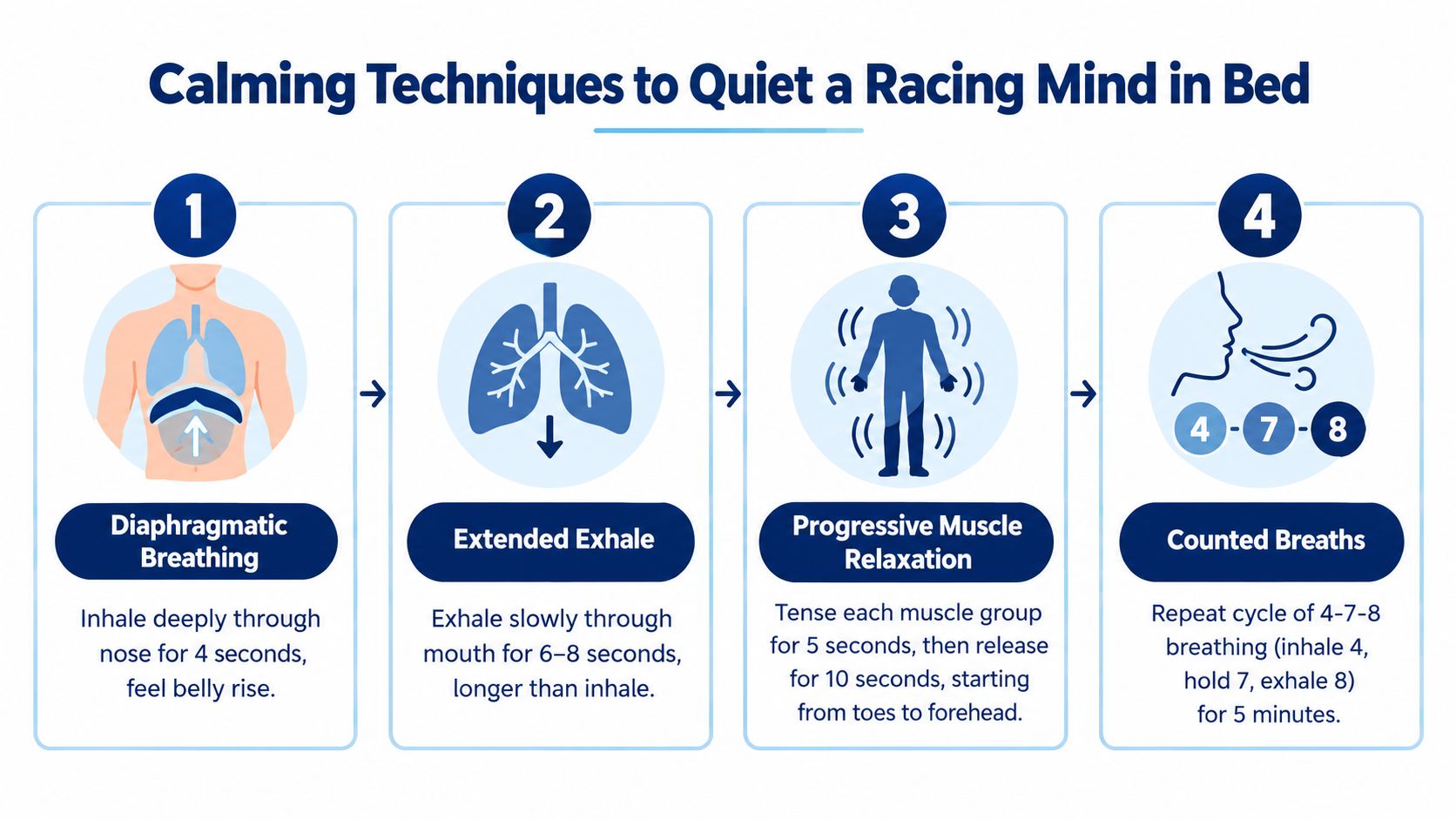
Breathing exercises work best when they feel easy enough to repeat. Lie on your back or side, rest one hand on the belly, and inhale through the nose for about 4 seconds so the abdomen rises. Then let the exhale last longer than the inhale, around 6 to 8 seconds, through the mouth or nose, whichever feels more natural.
If your attention wanders, that does not mean you are doing it wrong. The return is the exercise. Each time the mind jumps to tomorrow's list, bring it back to the exhale and count one slow cycle. The longer out-breath gives the body a slower rhythm to match, like easing your foot off a gas pedal instead of slamming the brakes.
Takeaway: a calmer exhale is often more useful than trying to “empty the mind.”
Use muscle release when the body feels keyed up
Progressive muscle relaxation helps when the body feels tight, restless, or ready to spring. Start with the toes, tense one muscle group for about 5 seconds, then release it for about 10 seconds. Move upward through the calves, thighs, stomach, hands, shoulders, and face.
The release does most of the work. The contrast between tension and let-go sends a clear signal that the body can stand down. If the brain starts commenting on every sensation, keep moving through the sequence without arguing with it. A racing mind often turns body feelings into stories, and this technique gives it less material to work with.
Use imagery when the thoughts are fast and fragmented
When thinking feels scattered, a simple mental scene can hold attention better than more analysis. Choose a familiar place with little emotional charge, such as a dock at dusk, a quiet room, or a path through trees. Then keep returning to plain sensory details, the light, the air, the floor, the distance to the water or the end of the path.
The scene should be dull enough to stop problem-solving, but specific enough to stay in view. If the mind keeps trying to edit the scene, gently return to one detail at a time.
A few sleepers also like a small chewable wind-down ritual after breathing or imagery. Nite Bites fits that kind of routine for people who want a non-pill option.
Pick one calming method and repeat it for several nights. The brain settles more easily when the cue is familiar. If you keep changing techniques every few minutes, the mind stays busy learning instead of relaxing.
How to Reset Your Bed Sleep Connection With Stimulus Control
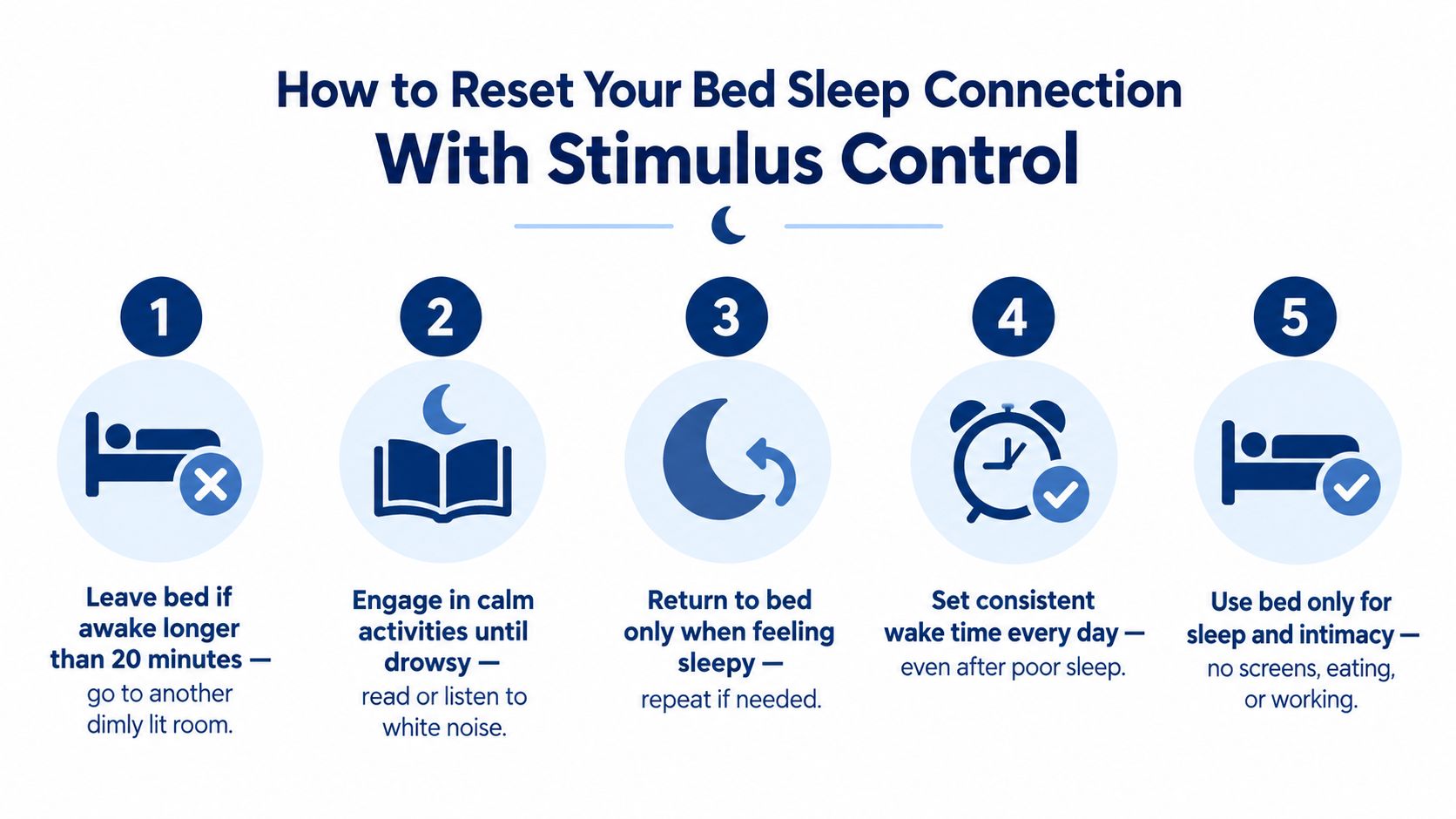
A racing mind in bed often needs a stronger fix than more bedtime effort. The goal is to retrain the bed itself, so the brain starts linking that space with sleep instead of alertness. That retraining is called stimulus control.
Follow the bed rule exactly
The sequence is straightforward.
- Go to bed only when sleepy. Wait for real sleepiness, not just a bedtime on the clock.
- Use the bed only for sleep and sex. Leave out scrolling, work, eating, and worry time.
- If sleep does not come within about 15 to 20 minutes, get out of bed. Move to a dim room and do something quiet.
- Return only when sleepy again. Repeat the pattern if needed.
- Keep a fixed wake time every day. Hold it even after a rough night.
- Avoid naps. They reduce the sleep drive that helps bedtime work.
This is the part many sleepers miss: lying awake in bed teaches the brain that bed is a place for alertness practice. A racing mind is quick to form that habit, because every wakeful minute becomes another lesson.
Use sleep restriction to rebuild sleep drive
Sleep restriction is normally run with a clinician, because cutting time in bed causes real daytime sleepiness in the first week or two, which matters if you drive or operate machinery.
Sleep restriction sounds harsher than it is. It temporarily limits time in bed to roughly actual sleep time, then expands that time as sleep becomes more efficient. A guideline-based approach uses sleep efficiency as the guide, with a common target above 85% to 90% before time in bed is increased, and a reduction if efficiency falls below 80% as described in clinical guidance on CBT-I.
That target matters because extra time in bed can backfire when the nervous system is already revved up. More time awake in bed usually means more clock watching and more frustration. Sleep restriction rebuilds sleep pressure so the bed starts to predict sleep again.
Watch for the habits that quietly undo the plan
Reading in bed, checking the phone, shifting wake time on weekends, and napping all weaken the association you are trying to build. These may feel like small exceptions, but the brain notices patterns, not intentions. One consistent week teaches more than several mixed signals.
In clinical guidance, stimulus control and sleep restriction are favored over ad hoc relaxation alone because they target conditioned arousal directly and can be adjusted week by week as summarized in CBT-I guidance. That is why this approach often becomes the backbone of care for insomnia with racing thoughts.
Choosing Wind Down Support Without Overdoing Melatonin
Some sleepers want a supplement or format that fits the routine, and the right choice depends on the goal. A product that helps someone settle into a calm evening isn't the same as one designed for sleep onset, and a low-dose melatonin format isn't the same as a melatonin-free option.
Match the format to the problem
| Goal | Format Example | Melatonin Level | Best For |
|---|---|---|---|
| Wind down without melatonin | Botanical gummies or magnesium capsules | None | People who want a non-melatonin evening routine |
| Fall asleep faster with a small dose | Dissolvable strip | Low | People who dislike pills or want a quick bedtime format |
| Stay asleep overnight | Capsule formula | Moderate | Sleepers who wake after initially falling asleep |
| Stronger sleep-onset support | Higher-dose capsule | Higher | People whose clinician has suggested a stronger melatonin approach |
That table works best when the goal is clear before shopping. The question is not “What is strongest?” It's “What matches the sleep problem and the person's comfort level?”
Consider melatonin-free options first when the goal is calming, not forcing sleep
Magnesium glycinate and botanical blends often make sense for people who mainly want a wind-down ritual, not a hormone-based nudge. Sleep All Nite's Deep Calm delivers 275 mg of magnesium per serving as magnesium glycinate, a form used to support muscle relaxation and normal nervous system function, while staying melatonin-free. That kind of format may fit someone who wants a calmer evening without adding more melatonin.
Keep low-dose melatonin in its lane
Low-dose melatonin can be useful when the issue is sleep onset, especially if the person wants something simple and easy to take. Higher doses are not automatically better, and for many people the better question is whether a low-dose or non-melatonin format matches the actual problem more cleanly.
For a broader look at option types and format differences, the product guide at Sleep All Nite's sleep support supplement overview lays out the brand's goal-based approach. The useful habit here is to choose by nighttime need, not by trend.
Your Tonight Plan and What to Do When Sleep Still Does Not Come
A racing mind usually needs a 24-hour downregulation plan, not just a bedtime trick. Start earlier in the evening with a short worry-time session, a quick brain dump, and a low-stimulation last hour. Then get into bed only when sleepiness is present, because a bed used while alert teaches the brain the wrong lesson.
If the mind switches on once you are in bed, keep the response small and boring. Use one breathing or relaxation method, keep the light low, and avoid clock-checking. If sleep still has not arrived after about 15 to 20 minutes, get out of bed and reset the cue with a quiet, sleepy activity, then return only when drowsiness comes back.
Early-morning awakenings follow the same rule. A 3 a.m. wake-up often sits inside the same sleep-onset hyperarousal pattern, so the fix is not a new philosophy, just the same conditioning rules. Protect the bed-sleep connection, stay in dim light, and do not lie there rehearsing tomorrow. A fuller explanation of why people wake up at 3 a.m. can help make the pattern easier to recognize, but the night-time response stays simple.
Track the right signal
One difficult night does not tell you much. The better sign is whether sleep starts to feel easier after the routine has been kept steady for several nights. Keep the same wake time, avoid naps, and use the bed only for sleep. That is how the brain relearns the cue.
Consistency matters more than intensity. A smaller routine done every night beats a bigger routine done only after a bad night.
People with persistent insomnia, shift work, or a pattern that returns after short improvements often need structured CBT-I support. Benefits can last after treatment, as summarized in CBT-I follow-up data. That makes this a trainable sleep pattern, not a personal flaw.
Try the full system for seven nights. Keep the rules steady and watch for the first sign that the bed starts feeling sleepy again. If the mind keeps racing despite that consistency, the next step is a structured insomnia plan, not more self-blame.
This article is for general informational purposes only and is not medical advice. It is not intended to diagnose, treat, cure, or prevent any disease. The techniques described here, including stimulus control and sleep restriction, are components of clinical insomnia treatment and are best used with guidance from a qualified healthcare provider. Talk to your doctor before starting any new supplement or sleep program, especially if you are pregnant or nursing, taking medication, or managing a health condition.
These statements have not been evaluated by the Food and Drug Administration. This product is not intended to diagnose, treat, cure, or prevent any disease.


