
Non Drowsy Sleep Aid: A Complete Comparison Guide


The most reliable non drowsy sleep aid is usually a single-mechanism formula matched to your specific problem, not a heavy multi-ingredient blend. Magnesium glycinate suits physical tension, L-theanine suits a racing mind, and low-dose melatonin suits timing problems. Stacked sedating ingredients are what cause morning grogginess.
If you're shopping for a non drowsy sleep aid tonight, you're probably tired, wired, and tempted to take whatever promises knockout sleep. You also know exactly what tomorrow feels like when a “sleep” supplement turns into brain fog, slow speech, and a second cup of coffee that barely helps.
That's the real question. Not just “Will this make me sleepy?” but “Will I still feel like myself in the morning?”
The best choices come from treating non-drowsy as a spectrum, not a marketing label. Some products reduce mental tension without much carryover. Some support circadian timing when used carefully. Some are sedating, even if the front label sounds gentle.
Table of Contents
- Why Morning Grogginess Changes the Whole Conversation
- Understanding the Science Behind Non-Sedating Sleep Support
- Comparing the Main Non-Drowsy Sleep Aid Mechanisms
- How to Read Labels and Spot Hidden Sedatives
- Matching Your Sleep Pattern to the Right Option
- Building a Safe, Low-Grogginess Sleep Routine
- Non Drowsy Sleep Aid FAQ
Why Morning Grogginess Changes the Whole Conversation
The usual sleep-aid mistake happens at 10:30 p.m. You have a restless night or two, buy a stronger-looking formula, take it right before bed, and wake up feeling chemically flattened. You may have slept longer, but you didn't wake restored.
That's why morning grogginess matters more than most labels suggest. A supplement can “work” for sleep onset and still be the wrong tool if it dulls your reaction time, focus, mood, or motivation the next day.
What non-drowsy actually means
A non drowsy sleep aid doesn't always mean zero effect on the nervous system. It usually means one of two things:
- Low carryover by design: The formula aims to calm the body or support sleep timing without pushing heavy sedation.
- Milder mechanism: The ingredients lean toward relaxation, tension reduction, or circadian support instead of forcing sleep through blunt sedation.
That distinction matters. A product can be sold as natural and still feel heavy the next morning if it stacks multiple sedating pathways together, especially when it combines higher-dose melatonin with botanicals and other calming compounds.
Practical rule: If your first priority is clear thinking at 7 a.m., “stronger” is usually the wrong shopping filter.
The trade-off most people miss
The search for better sleep usually starts with one symptom and ignores the full cycle. Falling asleep faster feels urgent, so you shop for whatever sounds most powerful. But if you have demanding mornings, school drop-offs, rotating shifts, or perimenopausal sleep changes, you need a narrower target than that.
The better question is this:
- Is the problem sleep timing, physical tension, or mental overactivation?
- Does the formula match that problem without overshooting it?
- Is the label transparent enough to predict next-day feel?
A transparent low-dose melatonin strip behaves differently from a broad proprietary blend with a high melatonin load and extra sedating ingredients. A magnesium glycinate product behaves differently from a botanical “night complex.” An L-theanine-centered formula often feels different from a GABA-heavy capsule.
What to avoid when clear mornings matter
Some patterns raise concern quickly:
- High melatonin positioning: More melatonin doesn't automatically mean better sleep quality.
- Large proprietary blends: If the label hides exact amounts, it's harder to estimate how heavy the product may feel.
- Stacked calming ingredients: A formula can look elegant on paper and still create too much carryover when several sedating ingredients sit together.
You don't need a sleep aid that wins the bedtime battle and loses the morning.
Understanding the Science Behind Non-Sedating Sleep Support
The market for lighter sleep support is large because the need is large. Survey-based estimates cited by the National Center for Biotechnology Information found nighttime insomnia in 21.8% to 28.9% of adults ages 18 to 64 and 18.6% to 25.8% of adults 65 and older, and the same analysis notes that Americans spent $427 million on OTC sleep aids in 2023, while melatonin sales reached $821 million in 2020 (NCBI overview of insomnia prevalence and OTC sleep-aid market context).
That spending doesn't just reflect poor sleep. It reflects dissatisfaction with heavy solutions.
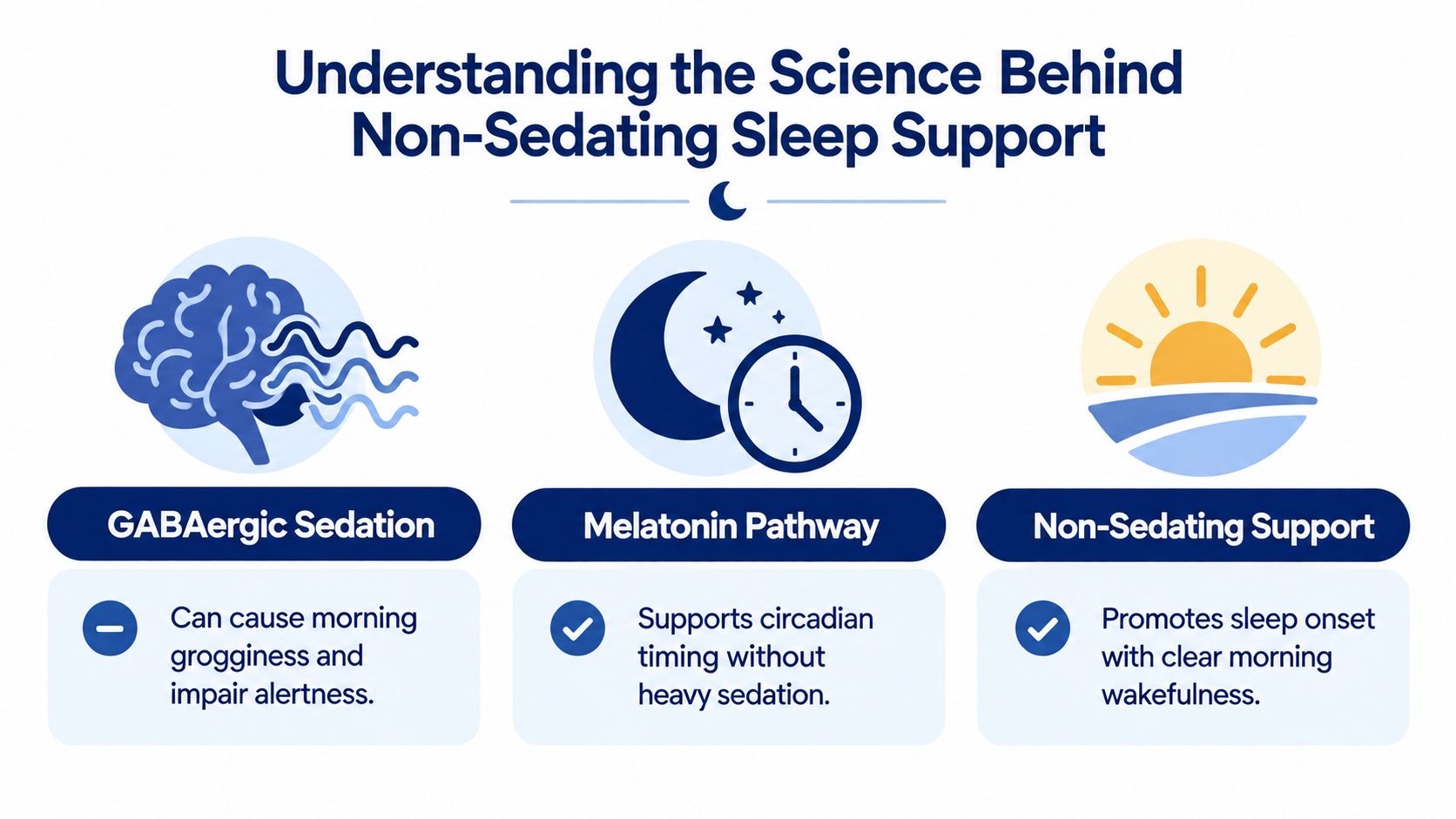
A useful way to think about a non drowsy sleep aid is by mechanism, not marketing category.
Sedation versus regulation
Some products work mainly by sedation. They reduce wakefulness in a blunt way, which can be useful in certain contexts but often raises the chance of next-day dullness.
Others lean toward regulation:
- Circadian support: Often associated with low-dose melatonin used to cue sleep timing.
- Relaxation support: Ingredients such as L-theanine or magnesium are often chosen to ease mental or physical tension without trying to create a knockout effect.
- Botanical winding-down formulas: These sit in the middle. Some feel mild. Some become heavy when combined with melatonin and additional calming compounds.
Your body doesn't experience all “sleep ingredients” the same way. That's why ingredient lists alone aren't enough. The mechanism, dose, and timing all shape whether a product feels clean or sticky the next morning.
Why melatonin gets so much attention
Melatonin has moved far beyond niche use. Nationally representative survey data showed adult use rising from 0.4% in 1999-2000 to 2.1% in 2017-2018, and another survey found 64% of Americans had taken melatonin to help sleep, with 29% using it occasionally or regularly. The same set of findings reported that the average adult melatonin user takes it 211 days per year, about four days a week, with an average dose of 4.8 mg, while 71.2% of users stayed at 5 mg or less (NIH summary of rising melatonin use).
That pattern says two things at once. People clearly want accessible sleep support. But they also gravitate toward relatively modest dosing, which fits the broader move toward lower-intensity options with less morning drag.
Non-sedating support works best when the mechanism matches the problem. Timing problems respond differently than tension problems.
Comparing the Main Non-Drowsy Sleep Aid Mechanisms
Most buyers compare products by scanning the front label for ingredient names. That misses the part that usually determines the morning outcome. The more useful comparison is what the formula is trying to do.
Non-Drowsy Sleep Aid Mechanism Comparison
| Mechanism | Typical Use | Onset Profile | Next-Day Carryover Risk |
|---|---|---|---|
| Magnesium glycinate | Physical tension, nervous system support, bedtime winding down | Usually gradual rather than dramatic | Low to moderate, often lower when used alone |
| L-theanine | Racing thoughts, stress-driven bedtime alertness, relaxation without heavy sedation | Often feels subtle and smooth | Low, especially when not stacked into a heavy blend |
| Gentle botanical blends | Mild evening relaxation, bedtime ritual support | Variable, depends on formula | Low to moderate when light, higher when combined with stronger sedatives |
| Low-dose melatonin | Sleep timing support, schedule shifts, occasional bedtime cueing | Often timing-dependent more than “strength”-dependent | Low to moderate, especially when used early enough and kept conservative |
| Higher-dose melatonin blends | Broad sleep support, often marketed for stronger effect | Can feel more noticeable | Moderate to higher, especially in sensitive users or when combined with multiple calming ingredients |
L-theanine works better for mental quiet than forced sleep
L-theanine belongs in many non drowsy sleep aid conversations because it doesn't behave like a hard sedative. A 2025 systematic review found the most consistent sleep-supporting doses were 200 to 450 mg/day, and a meta-analysis of 18 randomized controlled trials reported small but statistically significant improvements in subjective sleep onset latency, daytime dysfunction, and overall subjective sleep quality, while objective sleep efficiency and sleep duration did not improve consistently (PubMed review on L-theanine and sleep outcomes).
That profile matters. L-theanine is a good fit if your summary of the problem is “my body is tired, but my brain won't stop.” It's less convincing if you're expecting a dramatic hypnotic effect. Worth noting that the effect sizes here are modest and self-reported, so treat L-theanine as a nudge rather than a switch. Nite Bites pairs L-theanine with reishi, lemon balm, passion flower and valerian root in a melatonin-free gummy, with every ingredient amount listed individually rather than hidden in a blend.
Melatonin works best when treated as a dosing tool
Melatonin often gets misused as a strength contest. That's where problems start.
An expert review of melatonin trials notes that clinical use ranges from 1 mg/day in some low-dose situations to 10 mg multiple times daily in very different indications, which shows that melatonin exposure is highly indication-specific rather than a single standard approach.
For practical shopping, that means:
- Low-dose melatonin is often the cleaner option when the issue is timing.
- Higher-dose melatonin increases exposure but doesn't automatically mean better results.
- Transparent labeling matters more than “extra strength” language.
Magnesium and botanicals fit a different problem set
Magnesium glycinate usually belongs in routines where you feel physically keyed up, restless, or tense at night. It's less about a dramatic sleepy feeling and more about softening your body's resistance to sleep. Deep Calm is a melatonin-free example of this category, using magnesium bound to glycine in capsule form.
Botanicals sit on a spectrum. Valerian, chamomile, lemon balm, and passion flower can be reasonable if you want a gentler ritual, but they become less predictable once they're bundled into dense formulas with melatonin, GABA, and other compounds.
If you want to compare ingredient categories in more detail, this guide to best sleep support supplements is a useful next read.
How to Read Labels and Spot Hidden Sedatives
A lot of “non-drowsy” disappointment starts on the back label, not the front. The front panel may say calm, rest, restore, or gentle. The supplement facts panel often tells a very different story.
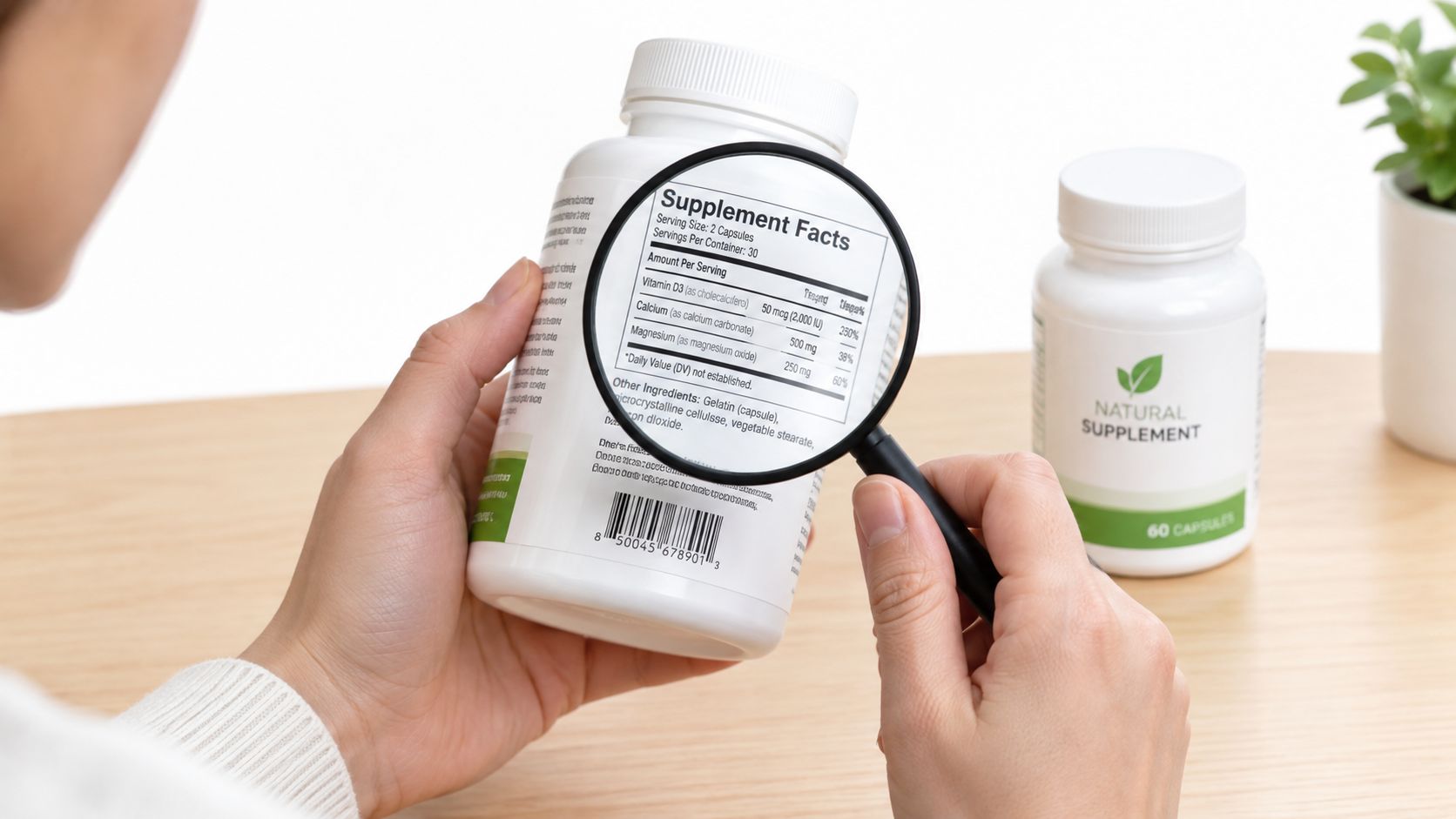
Start with the melatonin line
The easiest screen is the simplest one. Check whether the product is melatonin-free, low-dose, or high-dose.
That single line often predicts whether a formula is built for gentle support or stronger sedation. If you've said melatonin “doesn't work for me,” what usually happened is that the dose or timing didn't fit the problem, or the product combined melatonin with too many other calming agents.
Watch for blends that hide the real weight
A proprietary blend isn't automatically bad. It is automatically less informative.
If a brand lists a large combined blend but doesn't show how much valerian, GABA, L-theanine, or other calming compounds are inside it, you lose the ability to estimate how heavy the formula will feel. That's a problem if you're trying to minimize next-day carryover.
Label check: If the amount that matters most is hidden, you're being asked to trust marketing over formulation.
Use transparency as a proxy for restraint
A cleaner non drowsy sleep aid label usually has a few traits:
- Clear milligram disclosure: The active ingredients are listed individually, not buried.
- Mechanism coherence: The formula is built around one main job, such as relaxation or sleep timing.
- No kitchen-sink stacking: More ingredients don't always mean more precision.
One useful shopping shortcut is to browse a clearly segmented melatonin-free collection, such as the melatonin-free sleep support options. Even if you don't buy from that collection, it's a practical way to compare how brands present transparency, format, and intended use.
Red flags worth taking seriously
Some labels deserve extra caution:
- High-dose melatonin paired with multiple calming compounds. This often raises the chance of morning drag.
- Botanical-heavy formulas with no exact amounts. It becomes hard to tell whether the product is mild or stealthily sedating.
- Claims that promise clear mornings without showing the dose logic. If the ingredient architecture says “heavy,” the promise doesn't matter much.
A transparent label won't guarantee a perfect response. It does make better decisions possible.
Matching Your Sleep Pattern to the Right Option
The right non drowsy sleep aid depends less on brand loyalty and more on the shape of your sleep problem. Trouble falling asleep at the start of the night is different from waking at 3 a.m. with a fast mind. Both are frustrating. They need different tools.
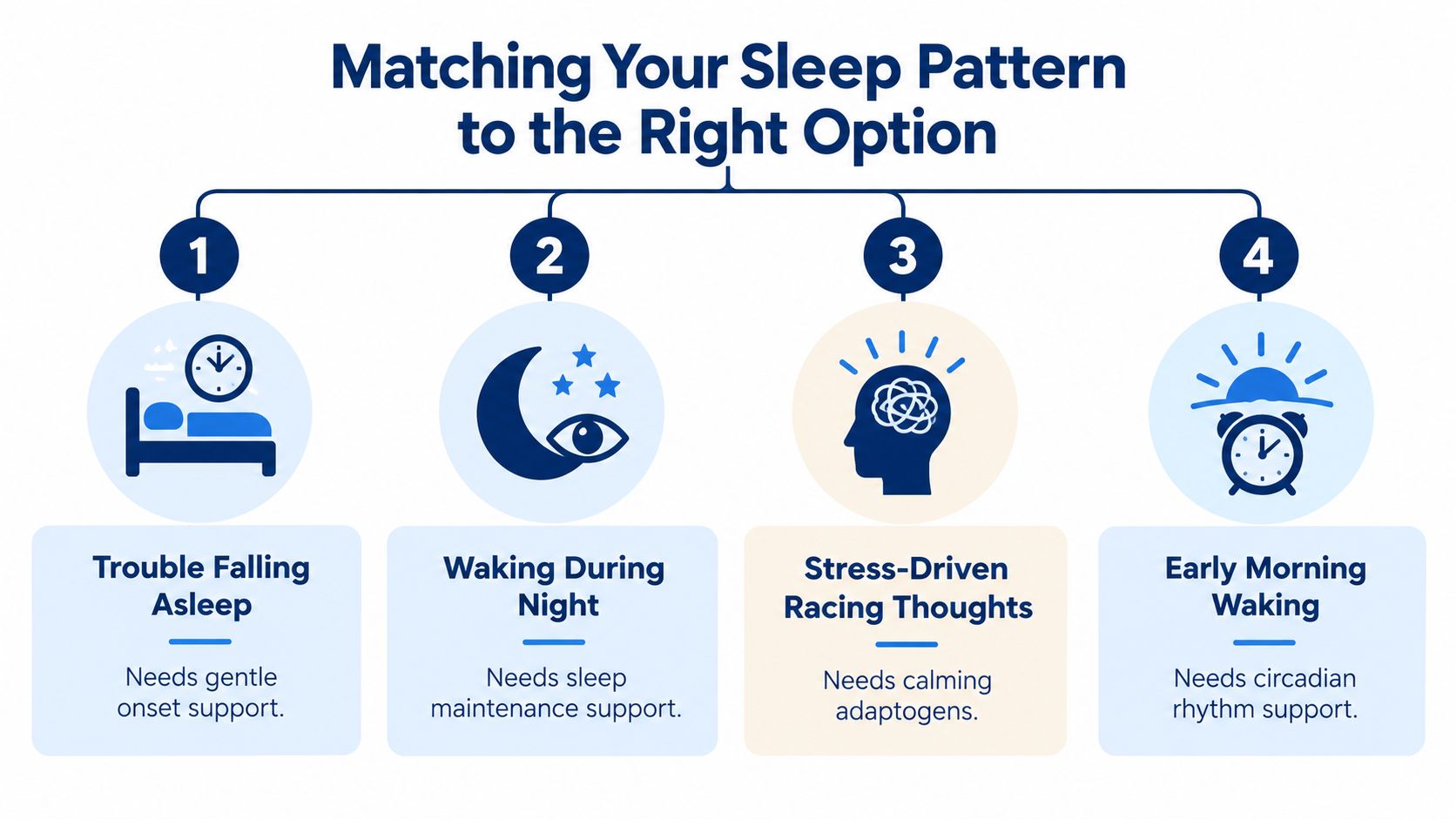
Trouble falling asleep
If this is you, you probably feel alert at bedtime rather than sleepy. Your best fit is usually gentle onset support, not brute force.
Low-dose melatonin makes sense when your bedtime is drifting later than you intend. Drift Off is an example of the low-dose end of that range at 1 mg per dissolvable strip, which is well under the 4.8 mg average the NIH survey reported. L-theanine may fit better when the issue is mental activation rather than circadian timing. A lighter botanical formula can also work if you want a ritual effect without heavy next-day carryover.
Waking during the night
Middle-of-the-night waking needs more caution. The common response is to take stronger sedatives, then pay for it at sunrise.
For this pattern, magnesium-based support usually makes more sense than chasing a sharper sedative feeling. It's a better match when your body feels tense or unsettled rather than mentally frantic. Deep Calm is melatonin-free and discloses its full magnesium amount, which matters here because the goal is a steadier night rather than a heavier one.
If 3 a.m. is your specific recurring wake time, it's worth reading why you wake up at 3 a.m. alongside this guide to sleep maintenance insomnia, because the fix for that pattern is more often behavioral than chemical.
If the complaint is “I can fall asleep, but I can't stay asleep,” the answer usually isn't to keep increasing bedtime heaviness.
Stress-driven racing thoughts
Mechanism matching matters most here. You can be exhausted and still mentally overclocked.
L-theanine-centered formulas tend to fit this profile because the target isn't sedation alone. It's reduction of the mental edge that keeps sleep from starting. Melatonin-free options built around botanicals work on the same logic, and Nite Bites is one example, using reishi and other botanicals traditionally valued for relaxation rather than a sedative load. Lemon balm and similar botanicals may help too, but the priority is avoiding a stack so dense that calm turns into morning dullness. If the racing mind shows up alongside a wired-but-tired feeling late in the evening, cortisol and sleep problems covers why that happens.
Sleep changes during perimenopause
Perimenopause reshapes sleep for a lot of women in their forties and fifties, and the pattern is usually specific. Falling asleep is manageable. The 2 a.m. and 3 a.m. wakeups arrive on schedule, often with temperature swings attached.
That pattern tends to get treated with escalating bedtime strength, which is the wrong lever. A heavier blend taken at 10 p.m. has largely done its work by the time the 3 a.m. wakeup happens, and what's left over is next-day drag. If your mornings already feel harder than they used to, adding more sedation to the front of the night makes the day worse without fixing the middle of the night.
A steadier, lower-carryover approach usually fits better. Magnesium glycinate is a common starting point because it's melatonin-free and doesn't push your circadian timing around. A cool bedroom, a fixed wake time, and moderating evening alcohol all do more for 3 a.m. wakeups than a stronger capsule does. If the pattern keeps up month after month, it's worth raising with a clinician rather than solving it at the supplement shelf.
Schedule disruption and shift-work patterns
Shift workers and rotating-schedule sleepers usually need timing support more than a sedative feeling. That makes low-dose melatonin the more logical option when used with discipline. The important issue here isn't force. It's whether the product helps cue sleep at the intended time.
If you're changing sleep windows, be realistic. No supplement fully overrides bright light, erratic meal timing, and fragmented work schedules. The best product in this category supports a plan you already have. It doesn't replace one.
A simple matching framework
- Busy mind at bedtime: Lean toward L-theanine and lighter calming support, such as Nite Bites, which lists L-theanine alongside reishi and calming botanicals.
- Physically tense body: Lean toward magnesium glycinate, such as Deep Calm.
- Bedtime drifting later: Consider low-dose melatonin used strategically, such as Drift Off at 1 mg.
- Waking at 3 a.m.: Try steadier, melatonin-free magnesium support before reaching for a heavier bedtime formula.
- History of morning grogginess: Avoid dense blends with higher melatonin and multiple sedating add-ons.
The cleaner the match, the less trial-and-error follows.
Building a Safe, Low-Grogginess Sleep Routine
A conservative routine beats an aggressive one if you care about next-day clarity. The least groggy outcomes come from starting with the narrowest effective tool, then adjusting only if the pattern stays unresolved.
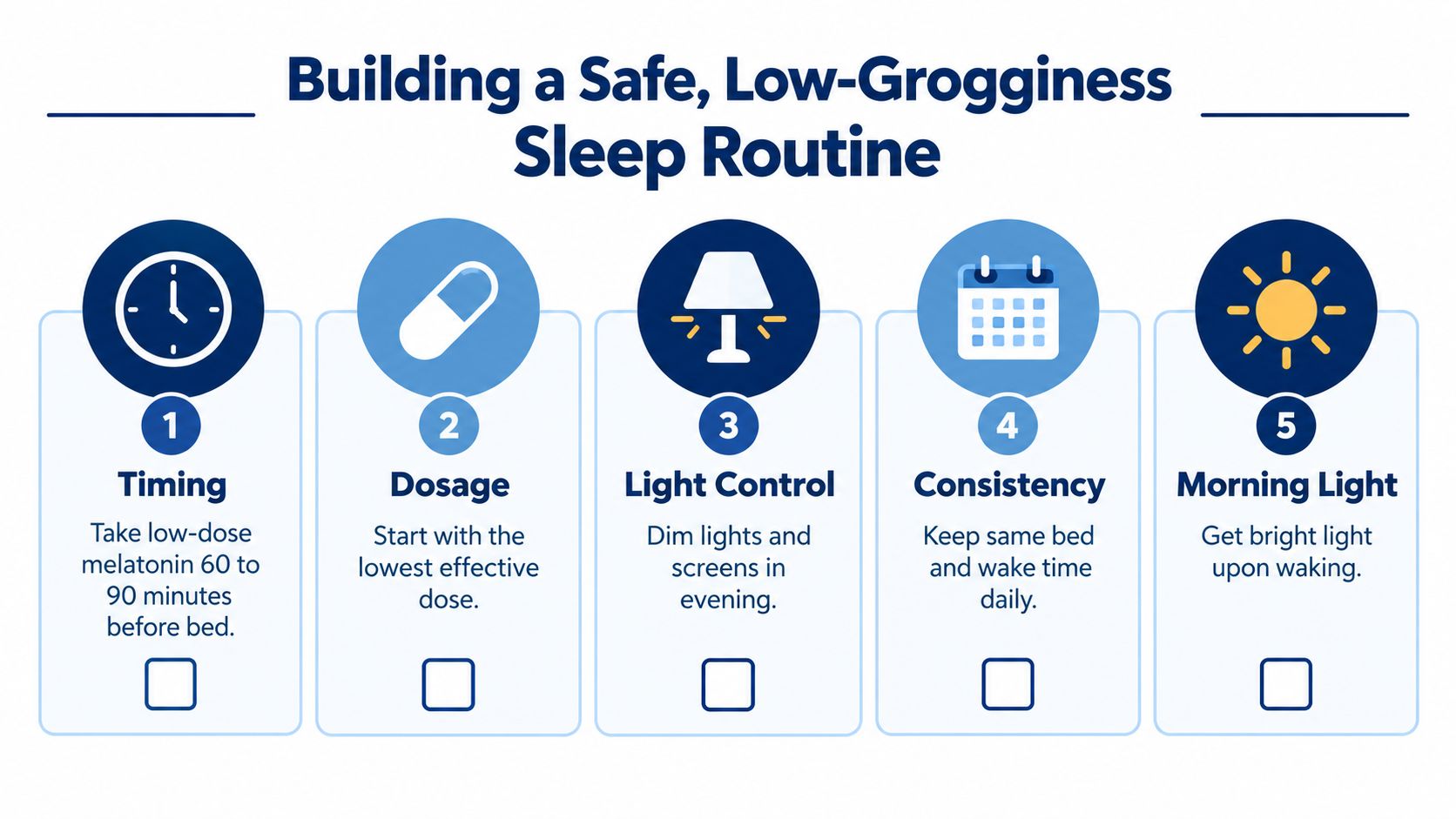
Start with one mechanism, not a pile
The cleanest way to test a non drowsy sleep aid is to avoid stacking multiple new products at once. If you start melatonin, magnesium, a botanical blend, and a gummy on the same night, there's no way to tell what helped or what caused the morning drag.
A safer progression looks like this:
- Choose your main target first. Timing, racing thoughts, or physical tension.
- Pick one category. Not three.
- Hold it steady long enough to judge the morning. Bedtime results matter, but the morning score matters more.
Use timing with intent
Timing changes the experience as much as dose does. The central rule is simple: low-dose melatonin is usually better used earlier and more strategically than heavier blends used late and reactively. If your bedtime has drifted, a small dose 60 to 90 minutes before your target bedtime does more than a large dose at lights-out.
If your problem is a racing mind, a non-melatonin option may fit better altogether. A magnesium glycinate formula can sit closer to bedtime without the same concern about circadian mistiming. If you're dealing with mental overactivation, you can also compare behavioral support ideas in this article on how to sleep when your brain is racing.
Keep the routine boring on purpose
Most people want a supplement routine that feels well-considered. In practice, the routines that preserve morning sharpness are usually simple.
- Keep bedtime and wake time steady: The supplement has less work to do.
- Lower evening stimulation: Bright screens and mental activation fight the routine.
- Track morning feel, not just total sleep: If you slept longer but wake foggy, you haven't found the right fit yet.
Best test: Judge a sleep aid by the next morning's clarity, mood, and functionality, not just whether it made bedtime feel heavier.
Know when to pause and ask for help
A few situations justify more caution. Repeated nightly use, combining supplements with prescription medications, pregnancy or nursing, and complex medical conditions all call for clinician input. So does sleep trouble that persists despite sensible changes.
A supplement should support sleep. It shouldn't create dependency on escalation, and it shouldn't become a workaround for ongoing sleep trouble that needs a clinician's eye, a medication issue, alcohol-related sleep disruption, or a stress load that needs direct management.
The best non drowsy sleep aid routine is usually the one with the fewest moving parts and the clearest morning.
Non Drowsy Sleep Aid FAQ
Does melatonin cause morning grogginess?
It can, and dose and timing usually explain why. Higher doses taken late increase the chance of next-day drag, while smaller doses taken earlier are more about cueing sleep timing than sedating you. NIH survey data put the average adult dose at 4.8 mg, with 71.2% of users staying at 5 mg or less, so if you're taking 10 mg you're well above where most people land.
What is the best sleep aid that won't make you groggy?
There isn't one answer, because it depends on your problem. Magnesium glycinate fits physical tension, L-theanine fits a racing mind, and low-dose melatonin fits a bedtime that's drifting later. The formulas most likely to leave you groggy are dense blends that stack several sedating ingredients at once.
Is it safe to take a non drowsy sleep aid every night?
Occasional use is different from nightly use, and nightly use is worth a conversation with a clinician, especially alongside prescription medication, during pregnancy or nursing, or with an existing medical condition. A supplement shouldn't become a permanent substitute for addressing why sleep is hard.
How long before bed should you take a non drowsy sleep aid?
Low-dose melatonin generally works better 60 to 90 minutes before your target bedtime, because you're cueing timing rather than forcing sedation. Magnesium and relaxation-focused options are usually taken closer to bedtime. Follow the label on whatever you buy, and change one variable at a time so you can tell what's working.
Does magnesium glycinate make you drowsy the next day?
It's one of the lower-carryover options, which is part of why it shows up so often in melatonin-free formulas. Most next-day heaviness people blame on magnesium is actually coming from other ingredients stacked alongside it.
Sleep All Nite offers goal-based nighttime wellness products across melatonin-free options, low-dose melatonin formats, and higher-dose blends, along with dissolvable strips, capsules, and gummies that let you match the format to the problem. Deep Calm covers magnesium glycinate, Drift Off covers low-dose melatonin at 1 mg per strip, Nite Bites covers melatonin-free winding down with L-theanine, and Nite Cap is the fuller botanical blend for nights when staying asleep matters more to you than a razor-sharp 6 a.m.
Not every nighttime product is a sleep aid. Hangover Strips use a dissolvable oral strip format with plant extracts inspired by traditional Ayurvedic practice, positioned to support mental clarity, normal fluid levels, and relaxation for restful sleep. That's a morning-after product rather than a sedative, and it's a good example of how nighttime wellness can target how you wake up instead of how hard you go down.
For transparent ingredient amounts and products organized by whether you need to fall asleep, stay asleep, wind down, or wake up clearer, it's worth browsing Sleep All Nite.
These statements have not been evaluated by the Food and Drug Administration. These products are not intended to diagnose, treat, cure, or prevent any disease. This article is for general information and is not medical advice. Talk with a qualified healthcare provider before starting any supplement, especially if you are pregnant or nursing, taking prescription medication, or managing a medical condition.


