
Circadian Rhythm Disruption Explained and How to Fix It


Some readers are finding this article at 3 a.m. The room is dark, the alarm is still hours away, and the body feels tired while the brain feels strangely switched on. That moment often gets labeled as stress, insomnia, or “just getting older,” but very often it's something more specific.
A circadian rhythm disruption is usually a timing problem first and a sleep problem second. The body may still be capable of sleep. It may be trying to sleep, wake, eat, and stay alert at the wrong biological times.
That distinction matters because the fix for a rotating shift worker isn't the same as the fix for a woman in perimenopause waking early every night. It also isn't the same as the fix for someone who flew across time zones and now feels sleepy at odd hours. The symptoms can look similar on the surface. The underlying pattern often isn't.
Table of Contents
- Why Your Body Clock Feels Off Lately
- How the Body Clock Actually Works
- The Three Main Causes of Circadian Rhythm Disruption
- What Chronic Misalignment Does to Your Health
- Which Disruption Pattern Fits You Best
- Light, Meals, and Melatonin Timing That Work
- Your Two Week Plan to Reset the Rhythm
- Myths Worth Retiring About Your Sleep Cycle
Why Your Body Clock Feels Off Lately
You go to bed at a reasonable hour, but your body acts like it missed the memo. Your eyes may be tired while your brain is ready to start the day. Or you fall asleep easily, then wake at 3 a.m. feeling oddly alert. Or you do fairly well on weekends and fall apart once the workweek starts.
Those patterns often get lumped together as a sleep problem. Often, they are a timing problem first.
The body keeps a daily schedule for sleepiness, alertness, appetite, temperature, and hormone release. When that schedule matches your actual life, sleep usually feels more natural and daytime energy feels steadier. When the schedule and the day stop matching, the experience can feel confusing. You may be sleepy at the wrong hour, hungry late at night, or fully awake when you hoped to be asleep.
That is why the same complaint can come from different kinds of circadian disruption.
A shift worker may feel as if day and night keep trading places. A woman in perimenopause may notice early waking, sleepiness at unusual times, or a sense that the old routine no longer fits her body. A traveler who crossed time zones may feel hungry, tired, and alert on local time that makes no sense yet. The surface symptoms overlap. The recovery path often does not.
A few phrases are especially common:
- “I'm exhausted, but not sleepy at the right time.”
- “I wake in the night and feel switched on.”
- “I can sleep, just not when I need to.”
- “My schedule feels easier on days off.”
These clues matter because they point to clock timing, not just sleep quantity.
Different patterns can look alike at 3 a.m.
Shift work is one of the clearest examples. A review on shift work and circadian disruption describes night work as common and notes that only a minority of workers fully adapt their central clock to a night schedule without targeted help (review on shift work and circadian disruption). That helps explain why many night workers feel as if they are living in a state of permanent jet lag, even when they are technically getting some sleep.
Perimenopause can create a different pattern. Here, the problem is often more than “bad sleep” in a general sense. Hot flashes, temperature shifts, hormone changes, and a weaker or less stable daily rhythm can all pull the clock off beat. The result may look like insomnia, but for many women it is partly a mistimed rhythm layered onto sleep disruption.
Jet lag is different again. The clock is usually still working. It is just set to the old location, like a watch that still shows home time after a flight. That is why hunger, sleepiness, and alertness can arrive at the wrong local hour for a few days.
The same 3 a.m. wake-up can come from different timing problems.
The first question to ask yourself
Before trying another supplement, app, or bedtime routine, start here: Is my body refusing sleep, or is it asking for sleep at the wrong time?
That question sounds simple, but it changes the whole strategy. A person with chronic shift-related misalignment usually needs stronger timing cues and better protection from unwanted light. A person in perimenopause may need a plan that accounts for both circadian timing and hormone-related sleep disruption. A traveler with jet lag usually needs a short, targeted reset rather than a full sleep overhaul.
How the Body Clock Actually Works
The body clock makes more sense when it's pictured as an orchestra rather than a single switch. One part of the brain keeps time. Many parts of the body follow that timing.
The conductor and the musicians
At the center is the suprachiasmatic nucleus, often shortened to SCN. It sits in the brain above the optic chiasm and acts like a conductor. The eyes function like musicians handing the conductor the latest sheet music about light and dark. Organs such as the liver, gut, heart, and lungs then play to that beat.
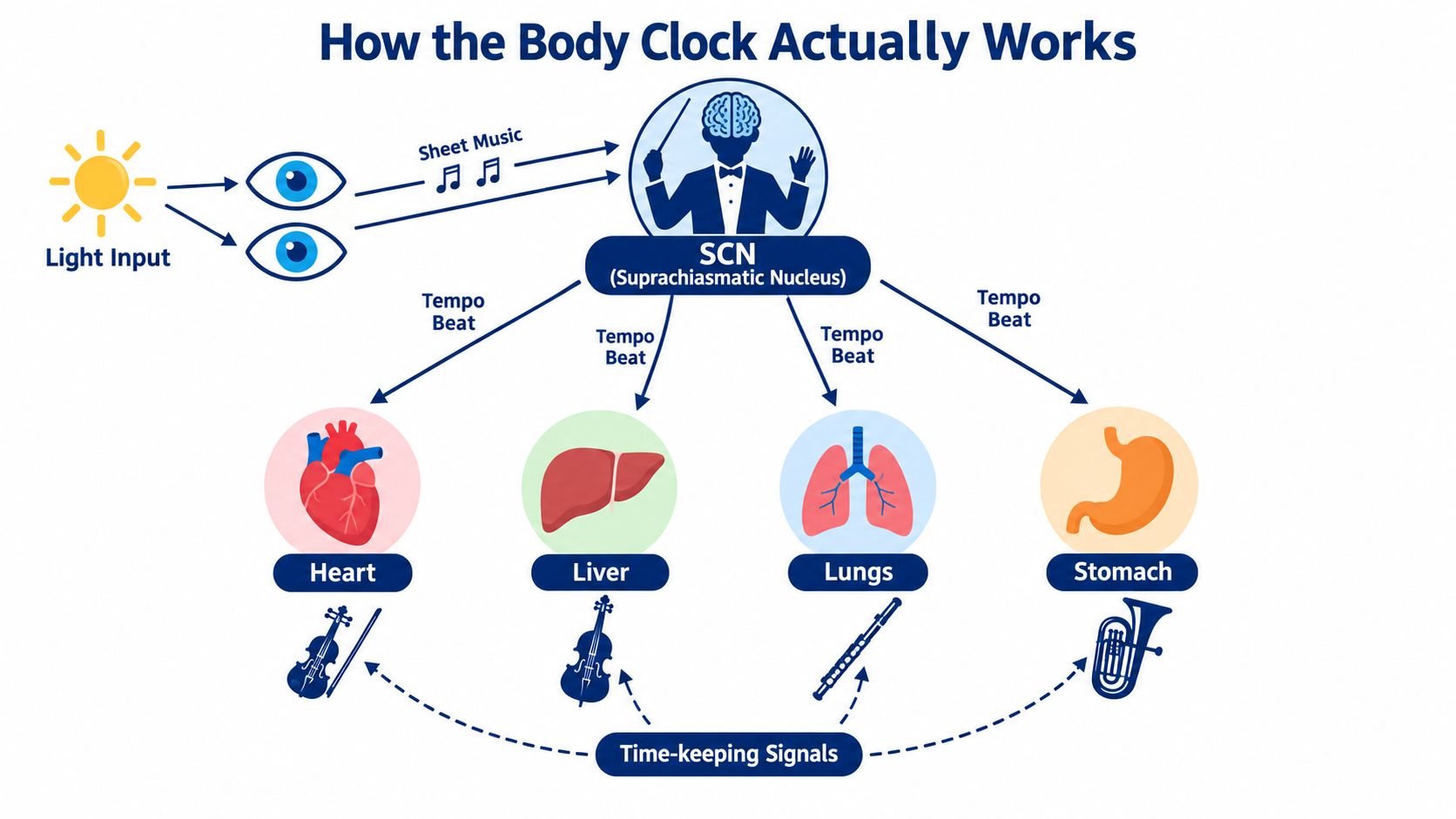
Light is the strongest signal. Morning light tells the SCN what time “day” is. Evening darkness allows the body to shift toward night mode. Melatonin helps with that transition, but it's better understood as a time signal than a knockout button.
Why the clock needs daily tuning
The internal clock is roughly a 24-hour system, but it doesn't hold perfect time on its own. It needs regular cues, often called zeitgebers, or “time givers.” Light is the strongest one. Meals, activity, and social routine also help.
If those cues arrive consistently, the body knows when to do different jobs:
- Sleep timing: when the body prepares for rest
- Alertness timing: when concentration is easiest
- Appetite timing: when hunger rises
- Metabolic timing: when organs expect food and fasting
When those cues arrive at conflicting times, the system doesn't break. It loses alignment.
Practical rule: Circadian rhythm disruption usually means mismatch, not damage. The clock is often still working. It's just being trained by the wrong signals.
Why this became such a major health topic
Circadian biology moved from niche science into mainstream medicine over many decades. A major milestone came in 2017, when the Nobel Prize in Physiology or Medicine was awarded to Jeffrey C. Hall, Michael Rosbash, and Michael W. Young for discoveries of the molecular mechanisms controlling circadian rhythm, building on earlier work that traced the body clock to the discovery of the period gene and later identification of PER protein (2017 Nobel Prize press release).
That matters because circadian disruption is no longer treated as a bad habit or weak discipline problem. It's understood as a biological timing issue that can affect appetite, glucose regulation, mood, and cardiovascular risk.
The Three Main Causes of Circadian Rhythm Disruption
A person can sleep badly for many reasons. Circadian disruption usually starts one step earlier. The clock is being trained at the wrong hour.
That distinction helps because the recovery path depends on the pattern. A rotating shift worker is fighting repeated clock reversals. A traveler with jet lag is dealing with a temporary time-zone mismatch. A person exposed to bright evening light is often nudging the clock later night after night without realizing it.
Rotating shift work
A nurse finishes three night shifts in a row, drives home in bright morning light, sleeps in fragments through the day, then tries to eat dinner and act alert when the body is preparing for nighttime biology. That is a timing collision, not just a rough week.
Shift work works like asking an orchestra to play at noon while half the musicians are still reading the midnight score. The brain can stay awake under pressure, caffeine, and workplace lighting. The rest of the body often lags behind. Sleep becomes lighter, hunger shows up at odd times, and alertness can dip right when the job requires precision.
The hardest version is rotating work, where the schedule keeps changing before the clock can settle. Some shift workers adapt partly to nights if the schedule stays steady. Many do not get that chance. They swing back toward daytime living on days off, then have to reverse again.
Jet lag after long-distance travel
A traveler lands in London, feels tired at breakfast, wide awake near midnight, and hungry on the old home schedule. The suitcase arrived. The clock did not.
Jet lag is the clearest example of a timing problem first. Sleep may be available, but at the wrong local hour. The usual clues are familiar once you know what to look for: early evening sleepiness, wake-ups in the middle of the night, flat morning energy, and appetite arriving off schedule.
Unlike rotating shift work, jet lag usually has a finish line. The body clock adjusts gradually as light exposure, meals, and activity line up with the new time zone. That is why occasional travelers often recover in days, while shift workers can feel stuck in a repeat cycle for months or years.
Late-evening light exposure
A woman in perimenopause finally gets the house quiet, answers messages under bright kitchen lights, scrolls in bed, then wonders why she feels tired but not sleepy. That pattern can look like insomnia. Often it starts as delayed timing.
Light at night tells the clock that evening is still in progress. Screens are only part of the story. Overhead LEDs, bathroom lighting, late exercise under bright lights, and irregular bedtimes can all push the night signal later. If hot flashes or night waking are also present, the picture gets confusing fast. The symptoms feel like a sleep problem, but the clock may already be drifting later underneath it.
This is common in people who say, “I go to bed on time, but my body does not agree.”
Three Causes of Circadian Disruption Compared
| Cause | What is throwing off the clock | Typical pattern | Recovery path |
|---|---|---|---|
| Rotating night-shift work | Light, meals, and wake time keep flipping between day and night schedules | Repeated misalignment between work demands and biological night | Usually requires a stable anchor routine, especially around light exposure and sleep timing |
| Transatlantic jet lag | Local clock changes suddenly after crossing time zones | Temporary mismatch between destination time and internal time | Often improves as the body adjusts to the new light-dark cycle over several days |
| Late-evening screens and bright light | Evening light delays the brain's night signal | Later sleepiness, later melatonin timing, and trouble feeling ready for bed | Often improves when evening light and bedtime cues become more consistent |
The main point is simple. These three patterns can feel similar at 2 a.m., but they do not need the same fix. Shift workers usually need protection from mistimed light and repeated schedule flips. Jet lag needs re-anchoring to the new time zone. Evening light problems need a cleaner runway into night.
What Chronic Misalignment Does to Your Health
You can be in bed for seven hours and still feel as if your body showed up to the wrong time zone.
That mismatch is the core problem with chronic circadian misalignment. It is a timing problem first. Sleep can be part of it, but timing is often the hidden driver. A person may sleep at a biologically awkward hour and then ask the brain, gut, hormones, and cardiovascular system to perform on a schedule they do not fully recognize.
Timing trouble is different from sleep loss
A duration problem means you did not get enough total sleep.
A timing problem means you may have slept enough on paper, but the sleep landed at the wrong biological phase. That is why a night-shift nurse, a woman in perimenopause whose schedule is drifting later, and a traveler with jet lag can all say, “I slept, but I still feel off,” even though the recovery path is not the same for each one.
The easiest way to picture it is a house with many clocks that are supposed to chime together. If the kitchen clock, furnace timer, and alarm panel all run on different times, the house still has clocks. It just does not run smoothly. Your circadian system works in a similar way.
Duration Problems vs Timing Problems at a Glance
| Feature | Duration Problem | Timing Problem |
|---|---|---|
| Main issue | Too little total sleep opportunity or too little actual sleep | Sleep occurs at a biologically mismatched hour |
| Common complaint | “There just aren't enough hours” | “I can sleep, just not when life requires it” |
| Daytime effect | Sleepiness from insufficient rest | Sleepiness, fogginess, and off-timing even with a fair sleep window |
| Best first lever | Protect more total sleep time | Shift light, meals, and routine timing |
The strongest health concerns
The clearest long-term concern is not feeling tired. It is living with repeated biological mixed signals.
Across expert reviews, chronic circadian misalignment is linked with cardiometabolic strain, especially when late or irregular sleep timing, rotating shift schedules, and mistimed eating keep happening together. Reported associations include higher body weight, higher blood pressure, more inflammation, and greater type 2 diabetes risk (expert review on circadian misalignment and cardiometabolic outcomes).
Why would timing affect so many systems at once? Because the body clock helps schedule more than sleep. It helps organize hunger, insulin response, alertness, body temperature, hormone release, and cardiovascular activity across the day. If meals arrive when the body expects darkness, or if bright light arrives when the brain expects night, the signals no longer line up cleanly.
This also helps explain a common point of confusion. A person can improve sleep quantity and still feel unwell if the schedule keeps shifting underneath them. More time in bed does not fully solve a clock that never knows when “day” starts.
Daytime function often suffers before people realize what is happening. Attention can feel less steady. Reaction time can slow. Mood can get more brittle. Many people also notice appetite showing up at odd hours, especially during biological night, when the body is poorly prepared for food and work at the same time.
Stress biology can overlap with a circadian problem, but the two are not identical. If that distinction feels blurry, this guide on cortisol and sleep problems can help sort out what belongs to stress response and what belongs to clock timing.
Why this is encouraging
A mistimed clock is frustrating, but it is trainable.
That matters for three groups in particular. Shift workers often need stronger anchors so the schedule stops flipping their signals around. Perimenopausal women often need to separate hormone-related awakenings from an underlying clock delay or instability. Jet lag usually improves faster because the mismatch is temporary and tied to a new local time cue.
The body clock learns from repetition. Consistent light, meal timing, and wake timing give it clearer instructions than force, willpower, or spending extra hours in bed.
Which Disruption Pattern Fits You Best
The same symptom can belong to very different circadian patterns. The most useful next step is matching the complaint to the right pattern.
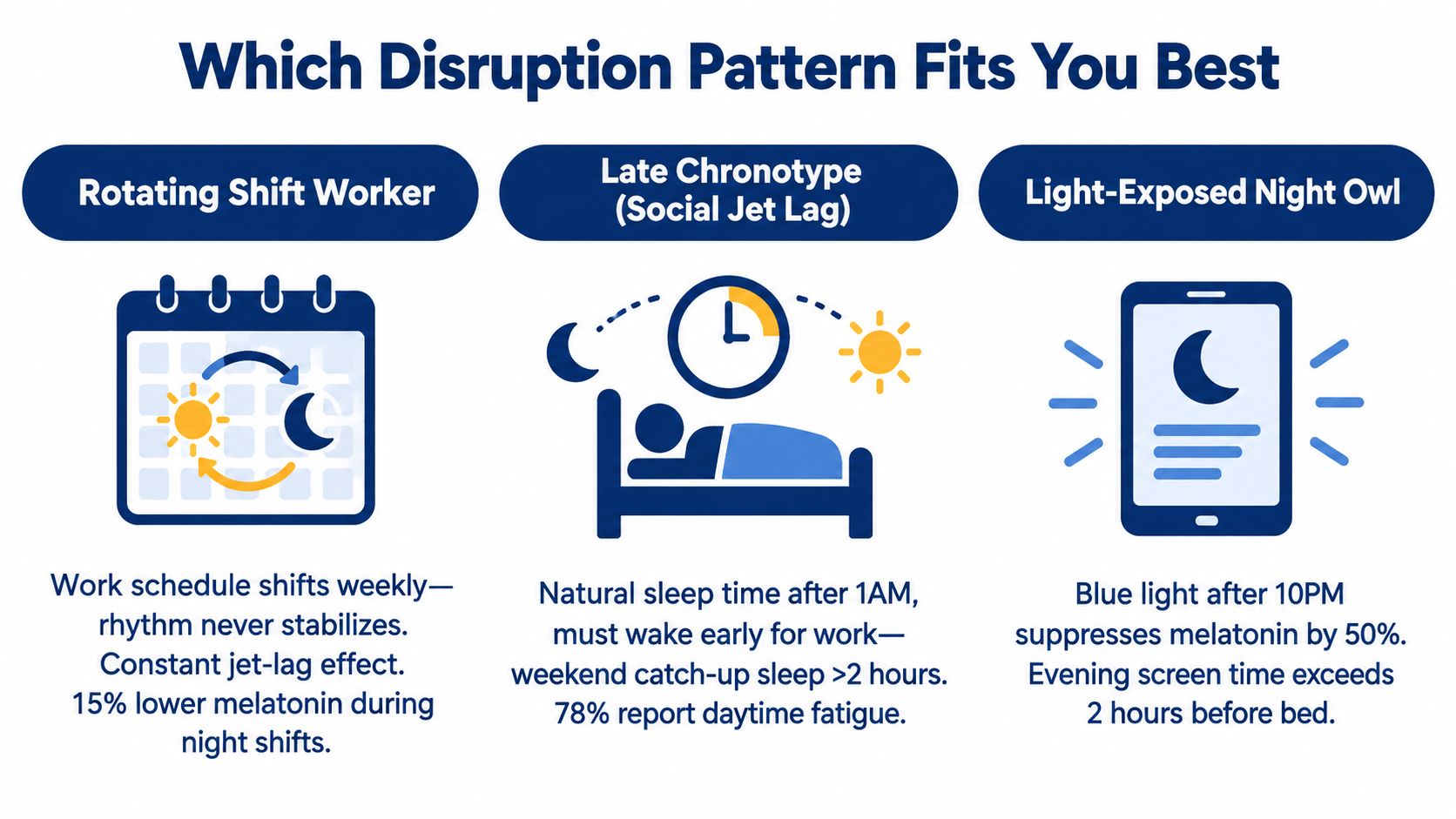
Pattern one is the rotating shift worker
This person's schedule moves often enough that the clock never settles. One week includes nights. Another includes days. Days off often swing back toward daytime family life.
Diagnostic question: Does the schedule itself keep changing?
The dominant symptom is instability. Sleep may happen, but it rarely feels anchored. A newer underserved angle in the literature is cumulative circadian disruption, not just permanent night work. Recent data found that cumulative disruption over six years was associated with more sleep problems, more melatonin use, more sleep-medication use, and slightly higher overweight prevalence, even among shift workers who did not perform night shifts. Another 2025 study found poor sleep risk rose when cumulative shift hours exceeded about 24 hours in four weeks (study abstract on cumulative circadian disruption).
The main lever later will usually be light control, especially after the shift and during the desired wake window.
Pattern two is the perimenopausal early waker
This person often has enough opportunity for sleep but gets fractured sleep, early waking, or a sense that the night is ending too soon. Hot flashes may be part of it. So may mood changes. But the timing system can also be shifting.
Diagnostic question: Does sleep feel earlier, lighter, or more fragmented even when bedtime habits are decent?
The dominant symptom is often early activation. The lever that tends to matter most is morning light plus stable timing, with special attention to cooling the sleep environment and not assuming that a bigger melatonin dose is the answer.
Pattern three is the frequent flyer or occasional jet-lagged traveler
This person usually sleeps reasonably well at home but unravels after crossing time zones. The body is healthy enough to sleep. It just hasn't yet updated to the destination.
Diagnostic question: Does the problem appear mainly after travel, then ease as the days pass?
The dominant symptom is temporary mismatch. The key lever is direction-specific light and melatonin timing, not random napping and not sleeping in as long as possible.
When the pattern is clear, the strategy gets simpler. When the pattern is mixed, morning light and schedule regularity usually deserve attention first.
Light, Meals, and Melatonin Timing That Work
You can sleep badly for two very different reasons. One is that sleep itself is broken. The other is that your body is trying to sleep at the wrong clock time. Light, meals, and melatonin matter most in the second situation because they help reset timing.
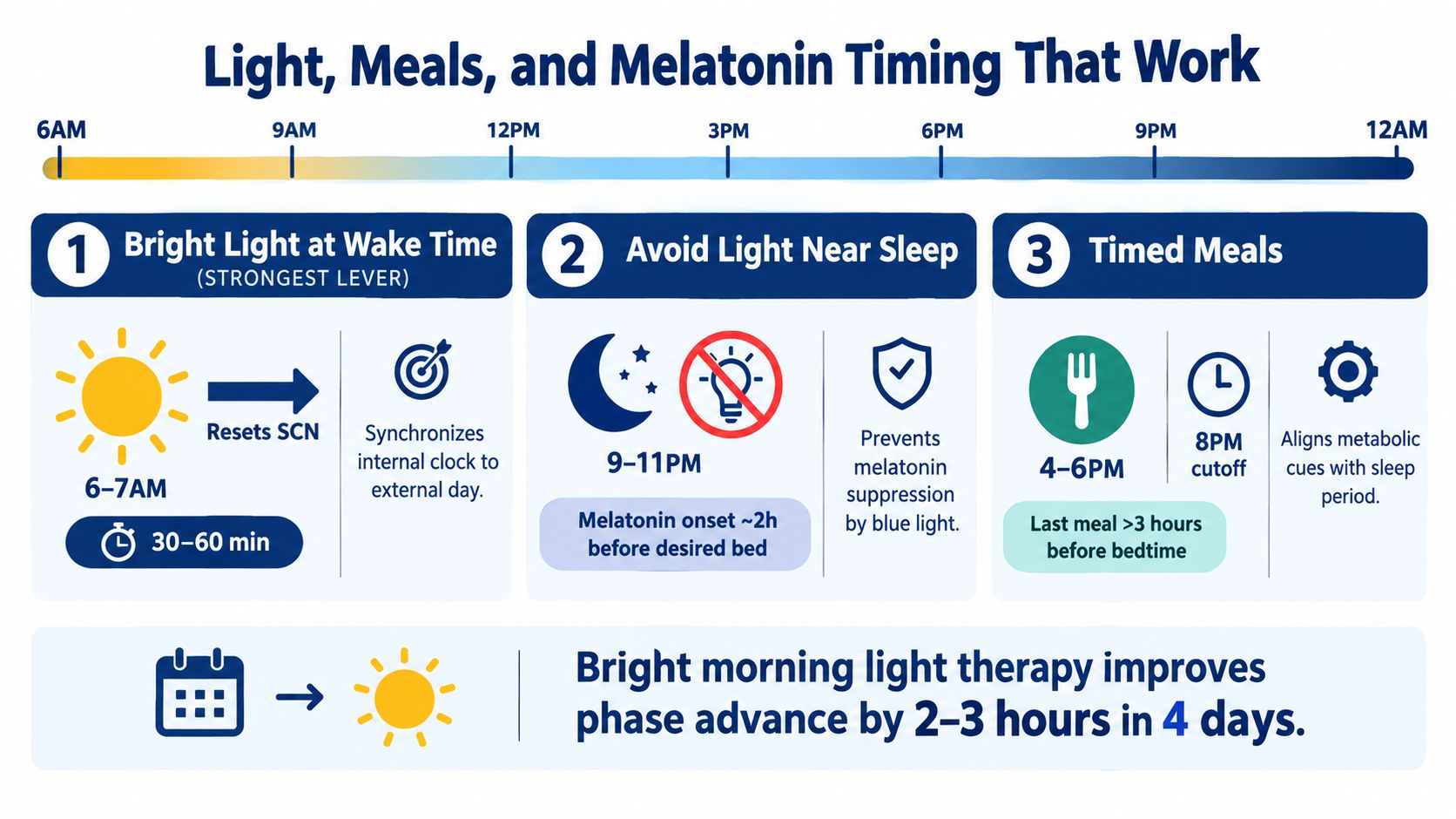
Start with light
Light works like the clock setter for the brain. If you want your rhythm earlier, light needs to show up earlier. If you want to protect daytime sleep after a night shift, early morning light on the commute home can push the clock the wrong way.
That is why the same advice does not fit every pattern.
A rotating shift worker usually needs bright light during the planned work window and less light after the shift ends. A perimenopausal early waker often does better with steady morning light and calmer, dimmer evenings. A traveler recovering from jet lag needs light timed to the destination clock, not the home clock.
Outdoor light is often the cleanest signal. Indoor light can help, but it is usually weaker and easier to mistime.
If you are also sorting out whether a supplement is meant to calm you down or shift your schedule, this guide to best sleep support supplements can help make that distinction clearer.
Then use meals to line up the rest of the clocks
Your brain is not the only timekeeper. The liver, gut, pancreas, and other tissues also run on daily timing cues. Food is one of the clearest signals they get.
A simple way to picture this is a group of musicians following different conductors. If light says one schedule and meals say another, the body can feel off even when you are spending enough hours in bed.
Regularity helps more than perfection. For many people, that means:
- Eating the first meal at about the same time each day
- Keeping dinner from sliding later across the week
- Leaving some space between the last meal and intended sleep
- Avoiding overnight grazing that turns the biological night into eating time
Shift workers often need a practical version of this rather than a textbook one. The goal is to create a repeatable pattern your body can recognize.
Use melatonin like a timing cue
Melatonin is easy to misunderstand because people often treat it like a stronger sleeping pill. Its main job here is different. It sends a time-of-day signal.
That is why random dosing can disappoint. A mistimed dose may do little, or it may nudge the clock in a direction you did not want.
This matters across all three patterns, but the details differ. A traveler may use melatonin to help the body accept destination night. A shift worker may need much more caution about timing because the target sleep period is unusual. A perimenopausal reader with early waking may assume that taking more will fix the problem, even when the larger issue is light timing, rising body activation, or both.
Some people prefer a lower-dose bedtime routine product rather than a large-dose approach. Drift Off is one example. It's a raspberry-flavored oral strip that dissolves on the tongue and provides 1 mg of melatonin with valerian root, lavender, chamomile, and hibiscus extracts. That format may suit people who don't want pills or water at bedside, but timing still matters more than format.
A short visual overview can help make the timing logic easier to grasp:
Use melatonin with the same care you use with light. The clock reads both signals.
People who are pregnant or nursing, under 18, taking other medications, or managing a medical condition should check with a clinician before self-supplementing.
Your Two Week Plan to Reset the Rhythm
A reset plan works better when it has one goal. The first week stabilizes. The second week reinforces.
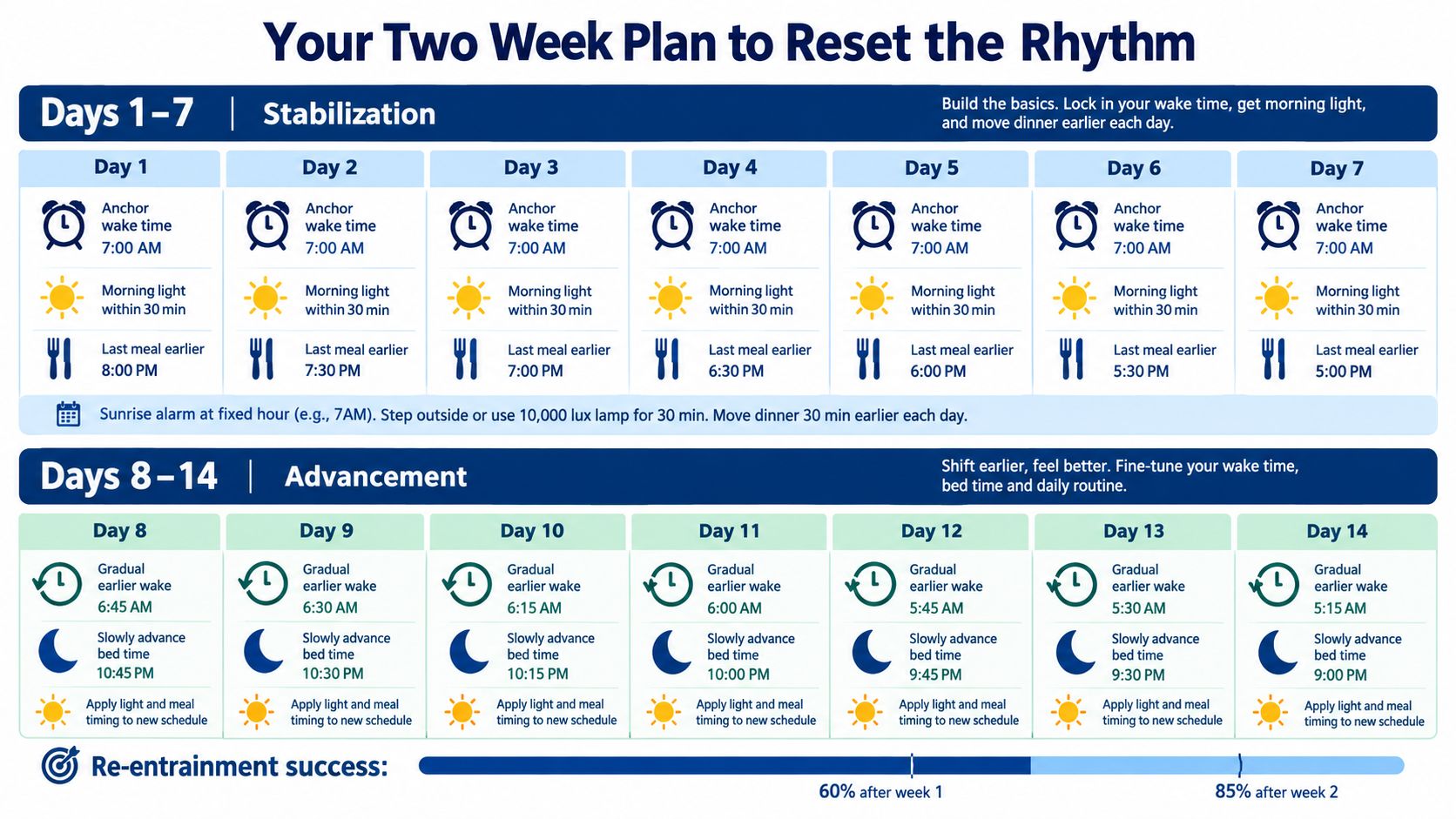
Days one through seven
Pick an anchor wake time and protect it. That matters more than chasing the perfect bedtime at first. Light should arrive soon after waking, and the last meal should stop drifting later into the evening.
A simple first-week framework:
- Fix wake time: keep it as consistent as real life allows.
- Get early light: outdoor light is usually the cleanest signal.
- Move food earlier: especially the final meal.
- Limit late bright light: phones, tablets, overhead LEDs, and bright rooms all count.
For the rotating shift worker, the decision path changes. Dark glasses or other light reduction on the commute home can help preserve daytime sleep, while bright light during the shift may support alertness. For the perimenopausal profile, morning light and a cool bedroom often matter more than chasing sedation. For the frequent flyer, the destination schedule should lead the plan.
Days eight through fourteen
The second week is about repetition. Keep wake time, light, meals, and wind-down cues matched to the intended schedule. Don't test the clock with late weekends if the goal is stability.
A racing mind can complicate retraining because the person starts fearing bedtime itself. When that's part of the picture, this guide on how to sleep when your brain is racing can help distinguish mental activation from true circadian mistiming.
When to get extra help
A professional evaluation makes sense when:
- Sleep problems stay persistent beyond several weeks
- Snoring, gasping, or suspected sleep apnea enters the picture
- Mood symptoms rise sharply as sleep timing shifts
- The person can't tell whether the issue is insomnia, hormones, apnea, or schedule misalignment
Clock problems respond best when they're named accurately.
Myths Worth Retiring About Your Sleep Cycle
One myth says more melatonin is always better. It usually isn't. For circadian rhythm disruption, timing matters more than piling on a bigger amount.
Another myth says weekend sleeping in fixes the week. It may reduce some sleep pressure, but it can also push the clock later and create a Monday version of social jet lag.
A third myth says a sleep tracker can diagnose circadian phase. Most trackers are better at estimating movement-based sleep timing than identifying where the internal clock sits. A person can end up chasing a score instead of fixing alignment.
The useful takeaway is simple. Circadian rhythm disruption is mainly a timing problem. The tools that usually help most are timed light, timed meals, and well-timed melatonin, not random doses, all-day sleeping in, or more dashboard data.
Sleep All Nite offers practical sleep and nighttime wellness tools in formats that fit real routines, including low-dose melatonin options and pill-free oral strips for people who want a simpler bedtime setup. Readers dealing with circadian rhythm disruption, early wake-ups, or travel-related timing issues can explore those options and the brand's educational resources at Sleep All Nite.


