
Cortisol and Sleep Problems: A Practical Guide


At 3 a.m., the room is quiet but the body isn't. A racing pulse, warm skin, a busy mind, and the sudden conviction that sleep has disappeared can make cortisol seem like the obvious culprit. Online advice often reduces the story to “high cortisol,” followed by a list of supplements and stress-reduction tricks.
That explanation is incomplete. Cortisol and sleep problems are often connected through timing, rhythm, and sleep continuity, not only through cortisol being too high. Poor sleep can alter the daily cortisol pattern, and cortisol activity before sleep can also make sleep shorter or more fragmented. The useful question isn't only how to lower cortisol. It's which pattern is present, where the timing has drifted, and what can restore a stable sleep-wake rhythm.
Table of Contents
- Why Cortisol Stays on Your Mind at 3 a.m.
- How the HPA Axis and Cortisol Actually Work
- The Four Cortisol Patterns Behind Common Sleep Problems
- Why Lower Cortisol Can Also Mean Worse Sleep
- Timing Interventions That Target Cortisol
- Putting It Together for Your Situation
- When to Test, Track, or See a Clinician
Why Cortisol Stays on Your Mind at 3 a.m.
A person wakes suddenly, checks the time, and notices a strong heartbeat. The mind scans the day for an explanation. Maybe the late coffee caused it. Maybe a stressful conversation is still active in the nervous system. Maybe cortisol rose at exactly the wrong moment.
The familiar explanation says that a nighttime cortisol surge causes the awakening. That can fit some experiences, especially when a person wakes alert, tense, and ready to solve problems. But another explanation deserves equal attention: repeated awakenings, irregular schedules, and insufficient sleep can disrupt the normal cortisol rhythm, producing a pattern that is flattened, delayed, or poorly aligned with the person's sleep period.
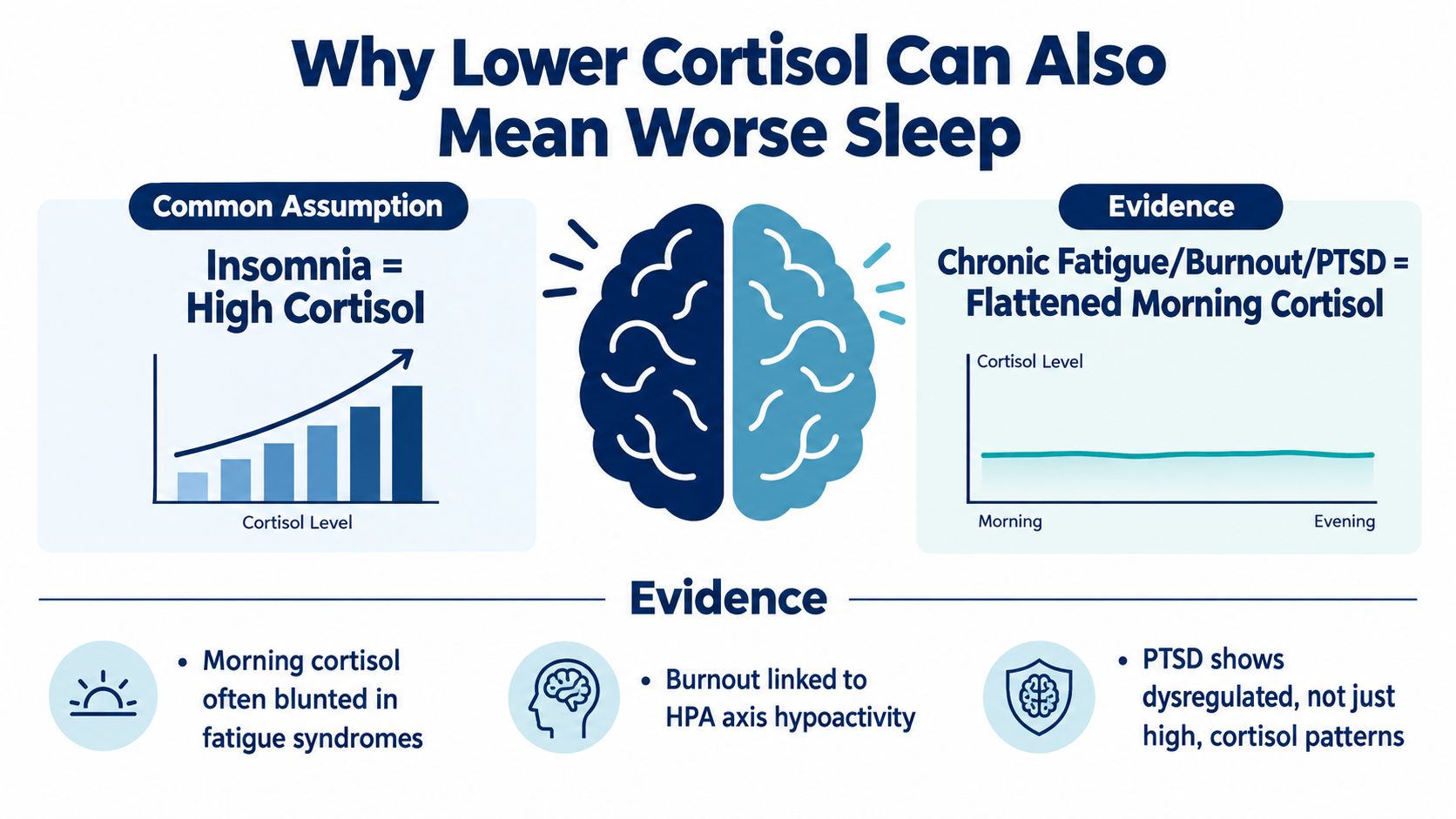
Research doesn't support treating every 3 a.m. awakening as proof of excessive cortisol. A 2012 study of 4,066 Danish civil servants found that disturbed sleep was associated with lower salivary cortisol, not higher cortisol. Each score increase in disturbed sleep corresponded to 3.1% lower morning and evening cortisol, while each score increase in awakening problems corresponded to 4.7% lower morning and evening cortisol. Three months later, waking problems still predicted lower cortisol, and follow-up cortisol profiles were flatter among people with sleep problems (the Danish civil-servant sleep and cortisol study).
Two stories can describe the same night
One person falls asleep calmly, wakes at 3 a.m. with a surge of alertness, and can't return to sleep. Another sleeps lightly through much of the night, wakes unrefreshed, and has a weak morning transition. Both may describe “cortisol problems,” but the biological timing may differ.
Persistent insomnia can involve genuine HPA-axis hyperarousal. The Endotext review reports that people with insomnia had higher 24-hour ACTH and cortisol concentrations than matched controls, with greater cortisol secretion among those with more severe objective sleep disruption (the Endotext discussion of insomnia and HPA-axis activity). That finding doesn't prove that cortisol is the original cause in every case. It shows that sleep disruption and stress biology can reinforce one another.
A practical guide to sleep maintenance insomnia and 3 a.m. awakenings can help distinguish a recurring sleep-maintenance pattern from an occasional bad night.
Practical rule: A 3 a.m. awakening is a symptom to interpret, not a cortisol diagnosis.
The most useful clues are the full signature: what happens before bed, how alert the person feels on waking, whether the awakening occurs at a consistent clock time, how the morning feels, and whether the schedule changes on workdays. Those details point toward the intervention that fits.
How the HPA Axis and Cortisol Actually Work
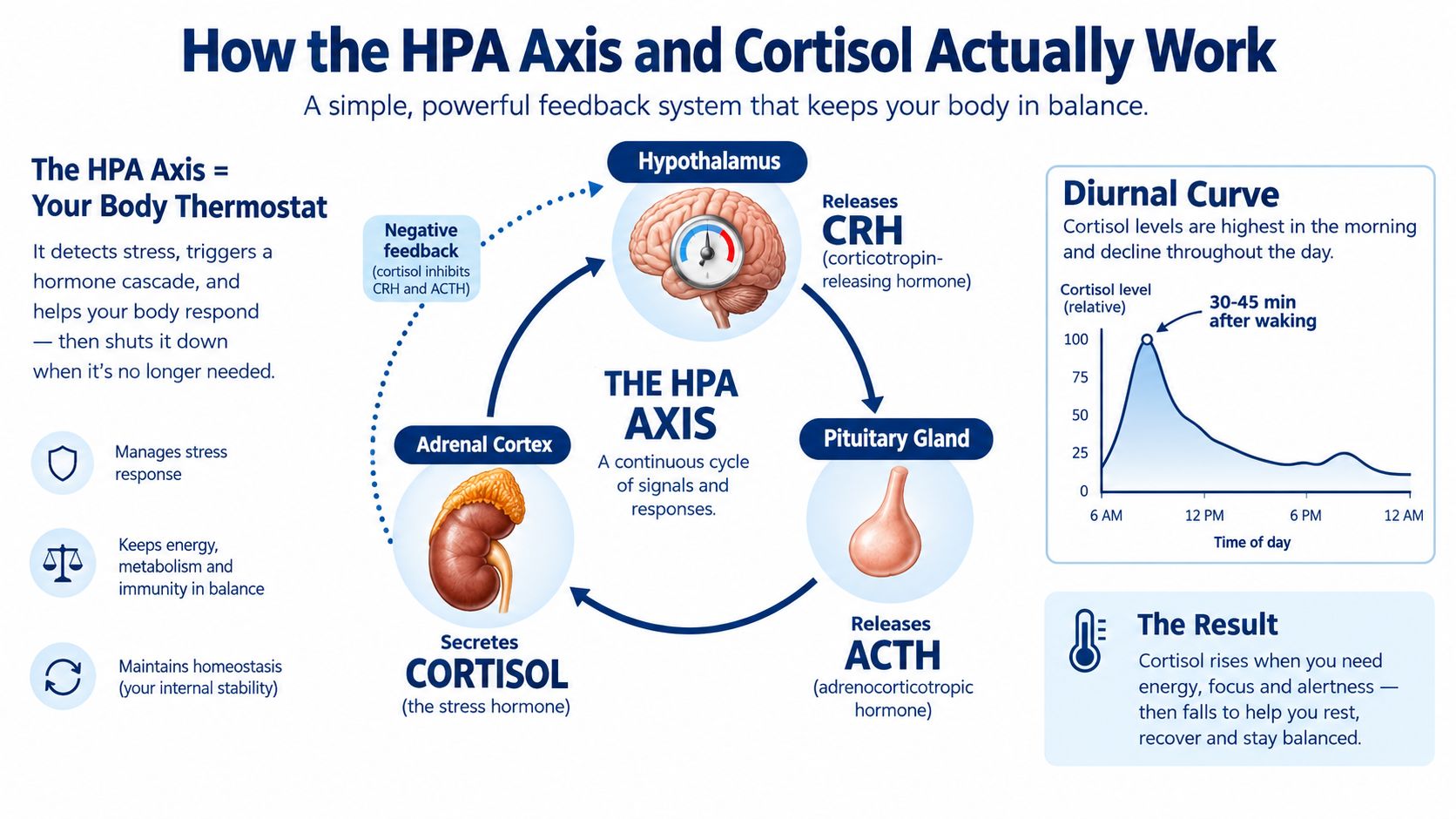
The hypothalamic-pituitary-adrenal axis, or HPA axis, works like a thermostat. It senses internal and external demands, adjusts cortisol output, and uses feedback to prevent the response from continuing unchecked.
The hypothalamus starts the signal by releasing corticotropin-releasing hormone, or CRH. CRH prompts the pituitary gland to release adrenocorticotropic hormone, or ACTH. ACTH then signals the adrenal cortex, located in the outer portion of the adrenal glands, to secrete cortisol.
The thermostat analogy
A healthy thermostat doesn't keep the heating system at full power all day. It raises output when the room needs warmth, reduces output when the target is reached, and responds to changing conditions. Cortisol follows a comparable daily pattern. It normally rises around waking, with the cortisol awakening response typically reaching its peak 30 to 45 minutes after waking, then declines across the day toward a low point around midnight.
That rhythm helps coordinate alertness, energy availability, and the transition between sleep and wakefulness. The precise shape depends on sleep duration, sleep architecture, light exposure, physical activity, and schedule regularity. The cortisol awakening response isn't just a switch flipped by opening the eyes.
What happens overnight
During a stable sleep period, the HPA axis should remain relatively quiet compared with its daytime activity. A threat, illness, intense exercise, emotional rumination, or a disrupted circadian schedule can increase signaling. The hypothalamus releases more CRH, the pituitary sends more ACTH, and the adrenal cortex responds with cortisol.
Cortisol also helps maintain energy availability. If the body senses a physiological challenge, including inadequate food intake or a demanding schedule, cortisol can support the release and use of stored fuel. That response is adaptive in the short term, but a late signal can feel like sudden alertness in the middle of a sleep period.
The final step is negative feedback. Rising cortisol signals the hypothalamus and pituitary to reduce CRH and ACTH. If the feedback system, sleep schedule, or circadian inputs become misaligned, the daily curve may no longer match the person's desired sleep window.
Cortisol isn't an enemy to eliminate. It's a timing signal that needs the right amount of activity at the right part of the day.
This model explains why evening light, late stimulation, irregular waking, and rotating shifts matter. They can change the signals that tell the thermostat when to raise output and when to stand down.
The Four Cortisol Patterns Behind Common Sleep Problems
Sleep clinics do not interpret a cortisol value alone. They examine its timing alongside symptoms, sleep history, light exposure, work schedule, and repeated patterns. The four descriptions below are working patterns, not diagnoses.
| Pattern | Typical trigger | Wake signature | Distinguishing clue |
|---|---|---|---|
| Bedtime activation | Evening rumination, work stress, stimulating content, or late light | Difficulty falling asleep with a busy mind or tense body | Alertness begins before sleep, not only during the night |
| Early nocturnal activation | Fragmented sleep, stress, schedule instability, or an overly early biological trough | A sudden middle-of-the-night awakening with alertness or a racing pulse | The awakening repeats at a similar point in the sleep period |
| Flattened morning response | Long-term insomnia, accumulated sleep debt, or circadian disruption | Sleep may feel unrefreshing, with slow or incomplete morning activation | The person feels depleted rather than sharply activated on waking |
| Shift-work misalignment | Night work, rotating shifts, changing wake times, and light exposure at unusual hours | Sleep occurs during an adverse circadian phase and may be short or broken | Symptoms follow the work schedule more than the bedroom environment |
Bedtime activation often starts before the head reaches the pillow. Someone may feel physically tired while mentally reviewing conversations, planning tomorrow, or responding to late light and stimulation. The issue may be a delayed evening signal rather than a massive cortisol excess. The active part of the day has not ended clearly enough for sleep to take over.
Early nocturnal activation has a different shape. Sleep begins normally, then an internal jolt wakes the person. Stress physiology can contribute, but so can noise, temperature changes, breathing problems, hormonal transitions, or the brain's learned response to repeated awakenings. Clock time alone cannot identify the cause. Repeated timing is a clue, not a diagnosis.
Low output can be disruptive too
Flattened morning response is easier to overlook because it lacks a dramatic surge. A person may sleep for a reasonable interval yet wake foggy, unrefreshed, and slow to become fully alert. The longitudinal findings from the Danish study associated disturbed sleep and awakening problems with lower morning and evening cortisol, along with altered daily cortisol measures (the longitudinal sleep and cortisol findings).
Shift-work misalignment adds a timing problem. The body can produce a cortisol curve suited to one schedule while the worker is trying to sleep and wake on another. An analysis of shift workers found that the relationship between sleep and cortisol varied with shift timing, sleep duration, and wake time (the shift-worker sleep and cortisol analysis).
These patterns point to a practical reframing: cortisol is not a high-or-low problem. A disrupted sleep schedule can flatten or misalign the daily pattern, so improving sleep timing and continuity may be more useful than trying to suppress stress physiology alone. A single reading cannot show which pattern is present.
Why Lower Cortisol Can Also Mean Worse Sleep
At 3 a.m., a person may lie awake with a racing mind and assume cortisol is too high. That explanation is appealing because it offers one clear target. Sleep biology is less tidy. Poor sleep can occur with lower morning cortisol and a flatter daily rhythm, so the useful question is often whether cortisol is mistimed rather than merely high or low.
The Danish findings described earlier illustrate this pattern. Sleep disturbance was associated with lower morning and evening salivary cortisol, and the relationship with awakening problems persisted over time. This does not show that low cortisol causes every sleep complaint. It shows that a poor night does not produce one universal cortisol response.
A 2024 meta-analysis also reached a cautious conclusion about acute sleep deprivation. Across 24 studies, the pooled effect was not significant in either 21 crossover studies or 3 randomized controlled trials. The clearest subgroup signal appeared in serum cortisol, which increased significantly, and studies using multiple cortisol measurements also showed a significant effect. The response therefore depends on sampling method and measurement timing. One saliva or blood result cannot define a person's sleep biology (the 2024 meta-analysis of acute sleep deprivation and cortisol).
The feedback loop matters more than the label
Pre-sleep cortisol may predict shorter or poorer sleep, while sleep characteristics can influence cortisol the next morning. A 2024 intensive longitudinal study found that higher pre-sleep salivary cortisol predicted shorter sleep, poorer sleep quality, and longer sleep-onset latency that same night (the 2024 pre-sleep cortisol and sleep study). These effects can reinforce each other. Evening tension may fragment sleep, and fragmented sleep may then produce a blunted or poorly timed morning response.
That pattern explains why aggressive cortisol suppression can backfire. If the problem is a weak morning anchor, an early nighttime alerting signal, or a constantly changing schedule, lowering cortisol everywhere could reduce daytime alertness without restoring sleep continuity.
A more precise clinical question is: Where is the rhythm broken? It may be bedtime activation, middle-of-the-night arousal, insufficient sleep, a delayed schedule, or a medical condition. Treatment should address that timing pattern, rather than treating cortisol as a number that always needs to be lowered.
Timing Interventions That Target Cortisol
Timing interventions work by giving the HPA axis and circadian system repeated, predictable cues. They aren't a promise to force cortisol lower. They help place alerting signals in the morning and reduce competing signals near the intended sleep period.
Anchor the morning first
Morning light is the strongest practical starting point for many people. Exposure to bright outdoor light for 15 to 30 minutes within an hour of waking can help anchor the cortisol awakening response and the broader circadian schedule. Cloudy outdoor light still provides a useful environmental cue, while indoor lighting may be weaker.
Caffeine requires a realistic boundary. A cutoff before mid-afternoon protects the later sleep period from stimulant effects and reduces the chance that a tired person uses caffeine to mask a drifting schedule. Someone with an early bedtime may need an earlier cutoff, while a night-shift worker must place caffeine relative to the planned sleep period rather than the conventional clock.
A protein-containing breakfast can support regular morning eating and reinforce the day's first active phase. It isn't a cortisol treatment by itself, but consistent meal timing gives the body another predictable cue.
Build a deliberate evening descent
A 90-minute wind-down sequence can include dimmer light, reduced work, a warm shower, gentle stretching, reading, and a written plan for unresolved tasks. The sequence matters because it removes decision-making and stimulation in stages instead of expecting the nervous system to switch from work mode to sleep instantly.
Late screens can be especially disruptive when they delay the sleep period. If bedtime is already late, adding more tasks to the evening can increase pressure. The priority should be a shorter, repeatable routine that protects the intended sleep window.
Respond differently at 3 a.m.
At a middle-of-the-night awakening, the first goal is to avoid teaching the brain that waking means problem-solving. Don't check the clock, reach for the phone, or begin mentally calculating the remaining sleep opportunity. Slow breathing, including a comfortable 4-7-8 pattern for people who tolerate it, can reduce effort and attention without turning relaxation into a performance test.
If the person remains fully awake, leaving the bed for a quiet, dim activity can be more helpful than lying there frustrated. The return to bed should happen when sleepiness returns.
The intervention isn't “force sleep.” It's “remove the signals that keep wakefulness active.”
These changes need repetition. A person can evaluate the pattern after several weeks of consistent timing, while recognizing that persistent insomnia may require cognitive behavioral therapy for insomnia rather than more cortisol-focused experimentation. For a broader review of sleep-support options, readers can consult this guide to sleep support supplements, while remembering that supplements don't replace an evaluation of schedule, sleep continuity, or medical symptoms.
Putting It Together for Your Situation
A useful plan changes according to the wake signature. A racing mind at bedtime needs a different emphasis from a person who sleeps easily but wakes repeatedly, and a rotating-shift worker can't apply a fixed daytime schedule without modification.
| Profile | Morning anchor | Caffeine cutoff | Wind-down | 3 a.m. response | Track |
|---|---|---|---|---|---|
| Stress insomnia | Outdoor light soon after waking | Before the person's mid-afternoon | Written task closure and dim light | No clock or phone, quiet reset | Sleep latency and restoration |
| Repeated 3 a.m. awakening | Consistent wake time and morning light | Earlier if sleep is fragile | Reduce stimulation before bed | Leave bed briefly if fully awake | Wake frequency and return-to-sleep time |
| Perimenopause | Consistent wake time and morning light | Earlier if sleep is fragile | Protect a cool, dark sleep environment | Follow the same low-stimulation response | Temperature symptoms, wake frequency, and continuity |
| Shift-work misalignment | Light matched to the intended wake period | Relative to planned sleep | Protect a dark, quiet sleep environment | Follow the same low-stimulation response | Shift timing, sleep continuity, and wake frequency |
The stress-insomnia profile
A person who lies awake with a racing mind can set a stable wake time, get outdoor light soon afterward, and move unfinished thoughts onto paper during the evening. The wind-down should begin before exhaustion arrives, because waiting until the person feels desperate for sleep often keeps attention fixed on the outcome.
The morning anchor matters even after a poor night. Sleeping much later can feel restorative in the moment, but it may weaken the next night's sleep pressure and shift the schedule further.
The repeated-awakening profile
For someone who falls asleep quickly but wakes at a predictable point, the key experiment is to protect sleep continuity. That means checking for alcohol near bedtime, bedroom temperature changes, noise, urinary symptoms, hot flashes, breathing disruption, and the habit of clock-watching. A consistent wake time provides a stronger reference point than trying to guess the exact cortisol event.
Perimenopausal awakenings may include heat, sweating, or a sudden change in body comfort. In that situation, temperature management and medical discussion of hormonal symptoms belong alongside sleep timing.
The shift-worker profile
Night-shift and rotating-shift workers need a schedule anchored to the intended sleep period. Light exposure should support the worker's chosen wake time, while the sleep environment should block daylight and reduce interruptions. Rotating schedules are particularly difficult because the body receives changing signals, so a single cortisol measurement may describe the previous schedule rather than the current one.
Wearables can help with trends, but a daytime “stress” score doesn't automatically predict a bad night. Momentary cortisol proxies are indirect. More actionable signals include changes in sleep continuity, wake frequency, resting heart rate trends, and HRV patterns, interpreted over time rather than after one unusual reading.
A simple tracker can record:
- Light: Approximate time and duration of outdoor light after waking.
- Caffeine: Last serving relative to the planned sleep period.
- Sleep: Bedtime, estimated sleep onset, and wake count.
- Restoration: A brief morning rating of how refreshed the person feels.
- Context: Shift timing, alcohol, illness, hot flashes, or unusual stress.
People who want to explore a calming sleep routine can review Deep Calm as one optional part of a broader sleep plan, but any product should remain secondary to identifying the schedule and symptom pattern. These statements have not been evaluated by the Food and Drug Administration. This product is not intended to diagnose, treat, cure, or prevent any disease.
When to Test, Track, or See a Clinician
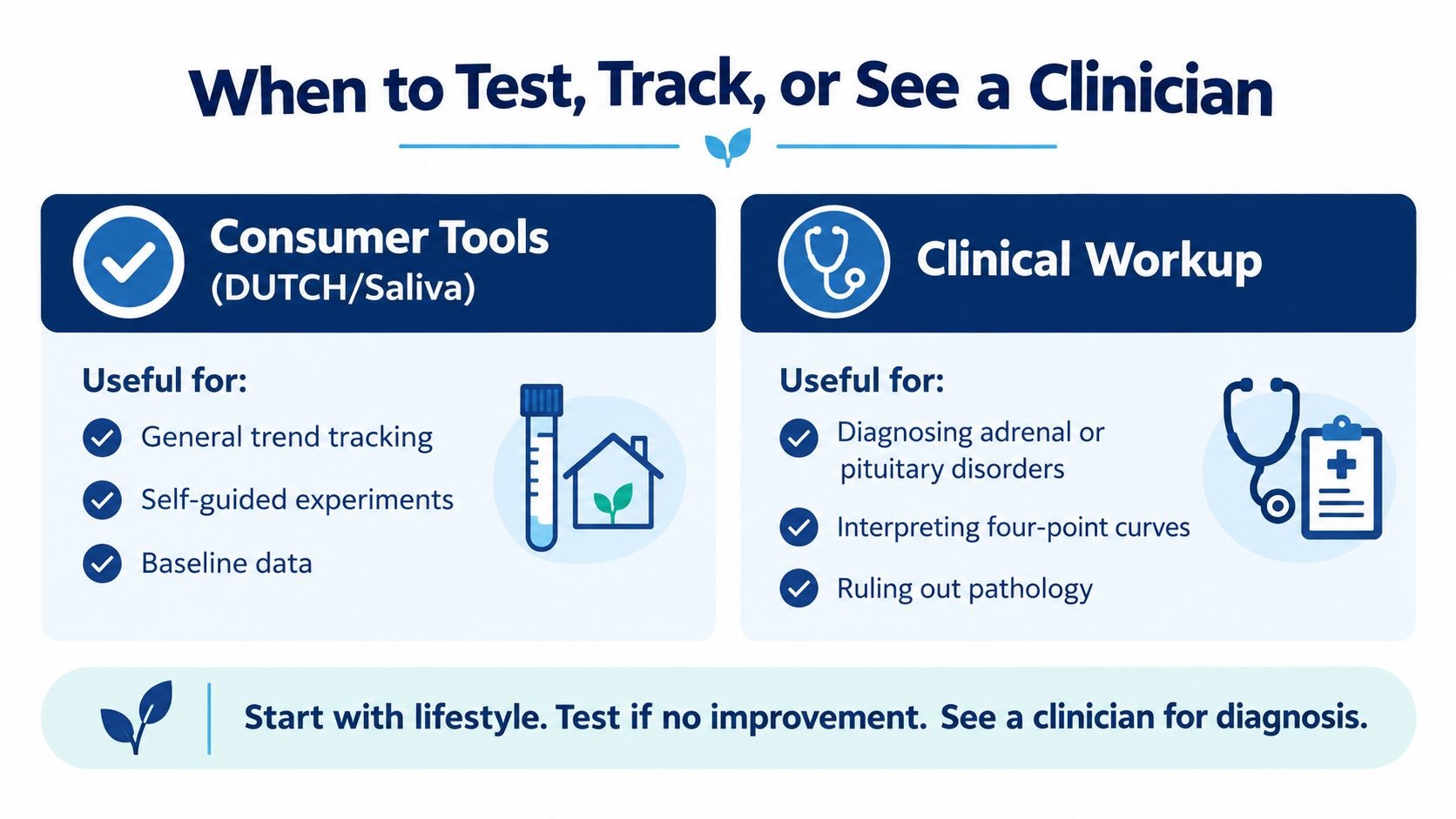
Consumer cortisol testing can be tempting because it appears to offer a direct answer. Saliva or urine panels may help a person observe a general trend or run a structured self-guided experiment, but they can also capture the consequences of a disrupted sleep schedule without explaining the cause.
A multi-point salivary curve may provide context when the timing of symptoms is unclear, especially if the person records sleep, wake time, shift timing, light exposure, and caffeine alongside the samples. A result becomes less useful when the collection schedule is inconsistent or when the person treats one abnormal value as proof of a specific disorder.
Clinical evaluation has a different purpose. A clinician can assess symptoms, medications, steroid exposure, blood pressure, glucose-related concerns, menstrual changes, and possible adrenal or pituitary disease. Severe cortisol disorders aren't diagnosed through internet pattern matching.
Red flags deserve medical attention
Nighttime awakenings should receive prompt clinical attention when they occur with unexplained weight loss, tremor, major menstrual changes, persistent weakness, markedly low blood pressure, or other significant physical changes. Symptoms that suggest sleep apnea, such as loud snoring, witnessed pauses in breathing, gasping, morning headaches, or pronounced daytime sleepiness, point toward a breathing evaluation rather than a cortisol experiment.
People taking prescribed glucocorticoids should discuss sleep and cortisol concerns with the prescribing clinician. They shouldn't change or stop the medication independently.
Wearables can support observation, not diagnosis. Resting heart rate trends, HRV patterns, and sleep continuity may help identify a change in recovery or schedule stability, but consumer devices don't directly measure HPA-axis function with the precision needed to diagnose endocrine disease. A single stressful reading is usually less informative than a persistent pattern paired with symptoms.
A practical decision sequence
A reasonable sequence starts with consistent timing interventions and a symptom log. If sleep doesn't improve after a sustained trial of several weeks, tracking can help clarify whether caffeine, light, shifts, temperature, or wake-time variability is involved. If the pattern remains unclear, symptoms escalate, or self-management stops producing progress over a prolonged period, a clinician should review the case.
The central lesson is simple: cortisol and sleep problems don't always call for cortisol suppression. They often call for a better-aligned sleep period, stronger morning cues, protected sleep continuity, and medical evaluation when the symptoms warrant it.
Sleep All Nite shares practical sleep education and selected sleep-support products for people working to build a steadier nighttime routine. Visit Sleep All Nite to browse the collection and explore current sleep resources.


