
Best Sleep Support Supplements Compared for Real Results


The most popular sleep advice often starts with the wrong question: Which supplement is best? That framing pushes people toward higher melatonin doses, larger ingredient stacks, and generic promises that ignore why sleep is failing. A person with jet lag, a stressed sleeper, and someone waking at 3 a.m. may all describe “poor sleep,” but they don't have the same biological problem.
The better question is: What kind of sleep problem needs support? Melatonin has its clearest role in circadian timing. L-theanine is more relevant to a racing mind and subjective relaxation. Magnesium may fit people seeking evening muscle relaxation, although its sleep evidence is less established than melatonin's. Herbal products can be reasonable options, but their evidence and formulations vary considerably.
The comparison below uses four filters: evidence strength, likely target, dose and timing, and fit for a specific sleeper. It also separates difficulty falling asleep from repeated waking, circadian disruption, and chronic insomnia. That distinction matters because a supplement can be useful for one pattern while offering little for another.
| Supplement family | Evidence position | Main sleep target | Most plausible fit |
|---|---|---|---|
| Melatonin | Strongest dose-response evidence among the options discussed, with benefits shaped by timing and sleep problem | Circadian timing and sleep onset | Jet lag, shift-work timing, selected sleep-onset problems |
| Magnesium | Commonly used for relaxation, but the provided evidence base is less specific than melatonin's | Evening relaxation and possible muscle comfort | People whose sleep difficulty accompanies tension or low dietary intake |
| L-theanine | Emerging human evidence, more consistent for subjective sleep quality than sleep architecture | Calmness and mental overactivation | Racing-mind sleepers who want a non-hormonal option |
| Herbal combinations | Variable evidence, extract quality, and ingredient combinations | Relaxation or sedation | People considering a carefully labeled botanical formula |
| Mineral and multi-ingredient blends | Depends on the individual ingredients and their doses | Several targets at once | People who prefer a single formula, provided interactions are reviewed |
Table of Contents
- Why More Melatonin Is Not Better Sleep
- Understanding the Sleep Supplement Categories
- How Popular Sleep Supplements Compare on Evidence and Fit
- Dosing and Timing That Actually Moves Sleep
- Safety Interactions and Who Should Be Cautious
- Choosing the Right Option for Your Sleep Pattern
- Your Next Step Plan for Better Sleep Support
Why More Melatonin Is Not Better Sleep
Melatonin is not a conventional sedative, so increasing the dose does not reliably produce better sleep. A 2024 dose-response meta-analysis found gradual improvements in sleep-onset latency and total sleep time, with effects peaking around 4 mg per day. It also suggested that taking melatonin about 3 hours before the desired bedtime may improve some outcomes more than taking 2 mg 30 minutes before bed (dose-response meta-analysis).
The practical implication is specific: adjust timing before adding milligrams. For example, someone who wants to sleep at 11 p.m. could test melatonin around 8 p.m. rather than taking a larger dose at 10:30 p.m. The suitable schedule still depends on the sleep problem, and a mistimed dose may fail to shift the body clock while increasing morning grogginess or vivid dreams.
Practical rule: Change the timing before escalating the dose.
Melatonin fits circadian disruption better than persistent insomnia. It may help with jet lag or changing work schedules, while benefits for chronic insomnia are small or inconsistent (evidence-based sleep supplement overview). Repeated waking linked to stress, hot flashes, pain, alcohol, or an untreated sleep disorder is unlikely to be solved by taking more.
Match the supplement to the sleep problem
A useful decision sequence is:
- Body clock out of sync: Consider melatonin when time zones or work schedules shift sleep timing.
- Mental overactivation: L-theanine may better fit a racing mind because its intended role is calmness rather than circadian signaling.
- Evening tension or possible low intake: Magnesium may be a reasonable option, although its evidence is less specific for sleep outcomes.
- Repeated waking: Investigate the likely cause before adding a supplement combination.
- Persistent insomnia: Clinical assessment and behavioral treatment may be more appropriate than dose escalation.
“Natural” does not remove the need for dose discipline. Reported melatonin use among U.S. adults rose from 0.4% in 1999 to 2000 to 2.1% in 2017 to 2018, while use above 5 mg per day rose from 0.08% in 2005 to 2006 to 0.28% in 2017 to 2018, according to a peer-reviewed adult study summarized in the sleep-aids market analysis. Greater use does not establish greater benefit. It makes matching the dose and timing to the sleep pattern more important.
Understanding the Sleep Supplement Categories
Sleep supplements now form a large consumer market, but market size says little about which product fits a specific sleep problem. One industry estimate valued worldwide sleep supplement sales at US$8.74 billion in 2025 and projected US$17.96 billion by 2035, while another estimated USD 7.91 billion in 2026 and USD 13.38 billion by 2036 (sleep supplements market estimates). The differing estimates are not a precise market total. They do show established demand for non-prescription support related to insomnia, stress-disrupted sleep, and age-related changes.
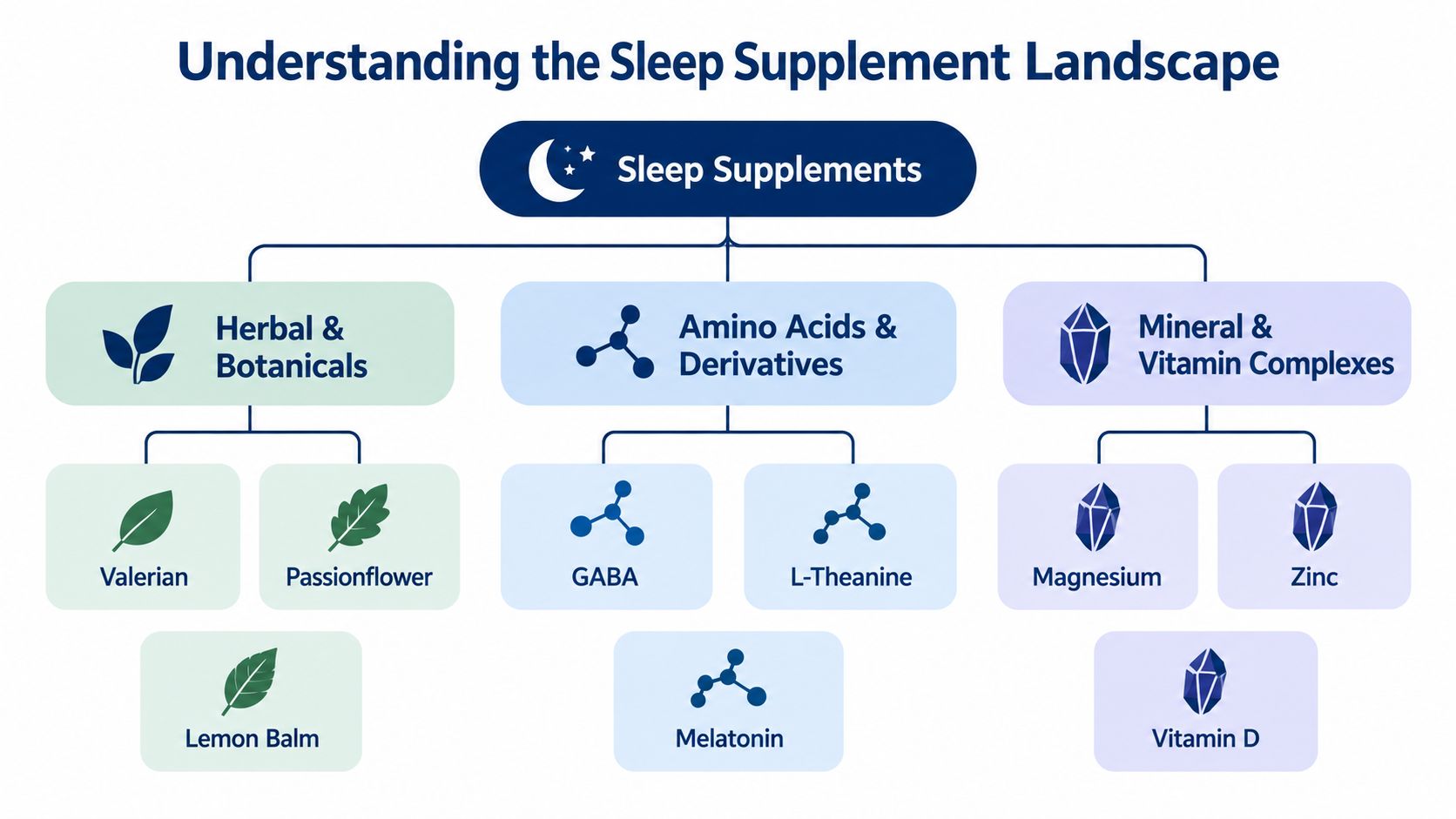
Five families, five different targets
Melatonin variants provide a signal linked to the body's sleep-wake rhythm. Immediate-release products are generally used for sleep onset, while longer-acting formats extend exposure. The practical question is whether the problem involves circadian timing, difficulty falling asleep, or repeated waking. Melatonin is most defensible when timing is misaligned, not as a universal treatment for chronic insomnia.
Magnesium forms are commonly chosen for relaxation and muscle comfort. Magnesium glycinate appeals to shoppers seeking an evening product with a calming profile, while other forms can differ in tolerability and absorption. Available evidence does not establish magnesium as a universal insomnia treatment, so the formulation and the person's health context matter.
L-theanine is an amino acid derivative associated with calm alertness rather than direct sedation. Human evidence is still emerging. A 2026 systematic review identified 13 eligible trials involving 550 participants, using 50 to 900 mg per day, and concluded that 200 to 450 mg per day appeared safe and effective for supporting healthy sleep in adults (L-theanine systematic review). The signal is more convincing for subjective sleep quality than for objective sleep architecture, making it a better fit for mental overactivation than a shifted body clock.
Herbal and botanical formulas may contain valerian, passionflower, lemon balm, hops, or other extracts. Their effects can vary with the extract, preparation, dose, and combination. A multi-botanical formula therefore requires review of the full label rather than relying on one familiar ingredient.
Mineral and vitamin complexes combine nutrients that may address broader nutritional or physiological needs. Their relevance to sleep depends on the ingredients, deficiency status, medication interactions, and reasons to avoid supplementation. A longer ingredient list does not demonstrate a stronger effect.
The useful evaluation lens is target, evidence, dose, timing, tolerability, and fit, rather than whether a product is natural or synthetic.
How Popular Sleep Supplements Compare on Evidence and Fit
The practical question is not which supplement ranks first. It is which failure point needs attention: a shifted sleep schedule, difficulty settling, physical tension, or an unpredictable product formula. That distinction changes both the candidate and the standard for judging whether it worked.
| Supplement | Main decision variable | Potential role | Fit to test |
|---|---|---|---|
| Melatonin | Is the body clock out of alignment? | Supports circadian timing and may help sleep onset | Jet lag, shift work, or a clearly delayed schedule |
| Magnesium glycinate and other magnesium forms | Is there a plausible nutritional or physical-relaxation rationale? | May support relaxation or muscle comfort | Evening tension, after checking health factors and medications |
| L-theanine | Is cognitive activation keeping the person alert? | May support calmness and subjective sleep quality | Stress-related difficulty settling |
| Valerian and other botanicals | What exact extract and dose does the label provide? | May promote relaxation or sedation | A standardized product chosen with attention to formulation |
| Multi-ingredient sleep formulas | Can every ingredient and dose be evaluated? | May combine effects on onset, relaxation, or maintenance | Someone who prefers one product and can verify the full label |
Fit is a clinical judgment, not a universal ranking.
Compare the trade-offs, not just the ingredients
Melatonin has the clearest use case when timing is the bottleneck. Its value falls when the schedule is reasonable but worry, conditioned alertness, pain, or environmental disruption repeatedly prevents sleep. A product that changes sleep onset without addressing those drivers may produce a measurable result while leaving the underlying problem intact.
The relevant trade-off is therefore precision versus breadth. Melatonin offers a relatively specific intervention for circadian timing. Magnesium has a broader but less certain rationale, because its usefulness depends on formulation, nutritional status, health context, and concurrent medication. L-theanine sits between them: its purpose is less about resetting the clock and more about reducing the friction between mental activation and rest.
Use evidence strength to set expectations
Evidence should determine how narrowly a product is tested. A targeted melatonin trial makes sense for a shifted schedule. A magnesium trial requires closer attention to the form used and the person's medical context. A botanical formula cannot be judged from the reputation of one ingredient, because extract quality, preparation, dose, and combinations can change the result.
L-theanine has an emerging human evidence base, with a clearer signal for subjective sleep quality than for objective sleep architecture. The review evidence used doses from 50 to 900 mg per day and identified 200 to 450 mg per day as a range that appeared safe and effective for supporting healthy sleep in adults (L-theanine review and trial evidence). That supports a focused trial for difficulty settling, not a promise of treating chronic insomnia.
A separate meta-analysis associated higher doses and longer treatment with better sleep-onset latency and total sleep-time outcomes, but not sleep quality (primary sleep disorder meta-analysis). The distinction matters: longer sleep is not automatically more restorative sleep.
A useful product decision records four points: the sleep problem, the ingredient and formulation, the expected outcome, and the reason to stop. This prevents a large ingredient list or a stronger subjective sensation from being mistaken for stronger evidence.
Dosing and Timing That Actually Moves Sleep
A supplement trial is easier to interpret when only one variable changes at a time. First identify the sleep pattern, then choose one product, record the labeled dose, and adjust timing before increasing the amount. This separates a failed ingredient from a poorly timed trial or an unwanted effect.
Melatonin timing deserves priority
Melatonin is most useful when the problem involves circadian timing. Dose-response evidence found effects peaking around 4 mg per day, while taking it approximately 3 hours before desired bedtime may work better for sleep timing than the familiar pattern of 2 mg 30 minutes before bed (melatonin dose and timing evidence). These findings do not establish a universal prescription. They support deliberate timing, especially for a shifted schedule, while offering less reason to expect melatonin to resolve chronic insomnia by itself.
Immediate-release melatonin generally fits sleep-onset difficulties because it delivers exposure closer to bedtime. Prolonged-release products may suit a need for longer exposure, depending on the formulation and goal. Read the label before combining release types. A lack of immediate sensation does not justify adding another dose.
L-theanine and magnesium need a fit-based trial
The L-theanine review included studies using 50 to 900 mg per day and identified 200 to 450 mg per day as a range that appeared safe and effective for supporting healthy sleep in adults (L-theanine systematic review). Because the evidence is not uniformly strong for insomnia, beginning near the lower end of a labeled range is easier to evaluate than starting high. L-theanine therefore fits a trial for difficulty settling or subjective sleep quality more than a claim of treating persistent insomnia.
Magnesium requires label scrutiny. Products differ in chemical form and elemental magnesium content, so the total compound weight may not equal the magnesium amount being consumed. Compare the Supplement Facts panel, and consider tolerability and personal fit rather than choosing solely by front-label claims.
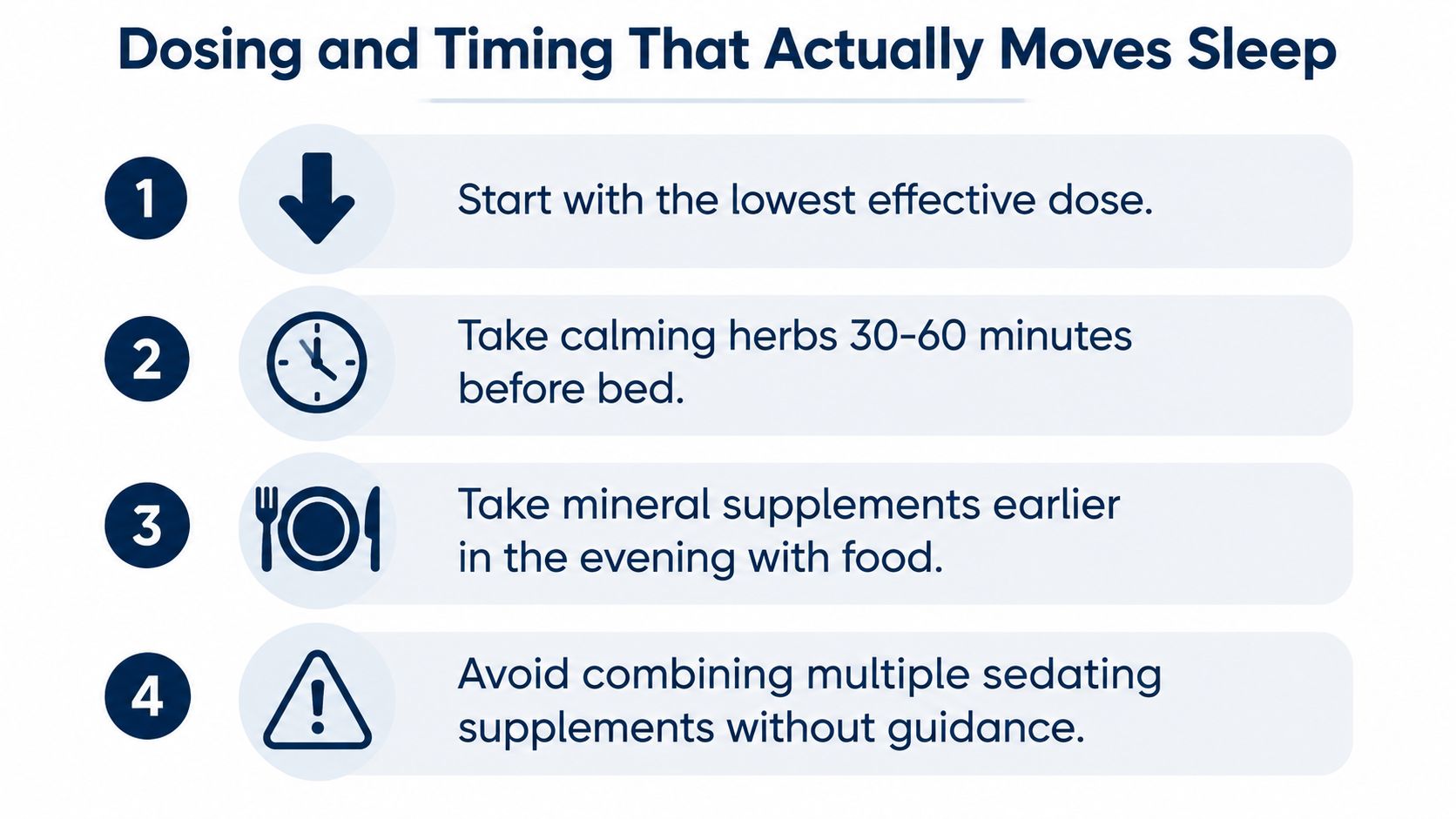
Timing before escalation: A failed trial at the wrong time does not prove that a supplement is ineffective.
Calming herbs are commonly used 30 to 60 minutes before bed. Mineral products may be easier to tolerate earlier in the evening with food. Anyone considering a ready-made formula such as Drift Off should check its full ingredient panel, serving size, and warnings instead of assuming that a combination is better.
A short sleep diary can track bedtime, estimated sleep onset, awakenings, final waking, and next-day alertness. Wearable stage estimates can provide context, but daily function and perceived sleep remain important. If a consistent trial produces no meaningful benefit, reassess timing and product fit before raising the dose.
Safety Interactions and Who Should Be Cautious
Safety depends on the person, the product, and the treatment context. Melatonin, magnesium, L-theanine, and botanicals may seem mild alone, while combinations can increase sedation or make side effects harder to interpret. Anyone taking prescription sedatives, antidepressants, blood-pressure medicines, anticoagulants, or other regular treatments should review the proposed supplement with a pharmacist or clinician.
Read the entire label
A sleep formula can combine several sedating botanicals with melatonin or minerals. If morning drowsiness, digestive upset, vivid dreams, or an allergic reaction develops, the full ingredient list helps identify possible causes. It also helps prevent accidental duplication when a second product contains the same ingredient.
Label review matters most when the product uses a blend rather than listing each ingredient clearly.
Extra caution is appropriate during pregnancy or breastfeeding, with liver or kidney disease, before surgery, or when treating a hormone-sensitive condition. These circumstances can change how an ingredient is handled, how it interacts with medication, and what treatment goal is appropriate. Individual advice is safer than assuming that a nonprescription product is low risk.

More exposure can create less useful sleep
Use patterns reported in sleep-aid coverage describe common melatonin use, not a dose recommendation. A product's serving size is therefore a reference point, not a target every person should reach. More exposure can also make morning alertness, unusual dreams, or other adverse effects more likely, while obscuring whether the supplement is addressing circadian timing or causing sedation.
Chronic insomnia deserves a different level of caution. Persistent poor sleep may reflect sleep apnea, restless legs, mood disorders, medication effects, menopause-related symptoms, pain, or another condition that supplements cannot resolve. Loud snoring, gasping, dangerous daytime sleepiness, severe mood change, or ongoing functional impairment warrants clinical evaluation rather than repeated product changes.
Stop and review: New symptoms, dose escalation, or several nights of worsening sleep are reasons to pause and reassess, not add another supplement.
Choosing the Right Option for Your Sleep Pattern
The useful question is not which supplement is strongest. It is which sleep problem is limiting recovery. “Poor sleep” may mean delayed sleep onset, repeated waking, a shifted schedule, or mental overactivation. Each pattern supports a different first trial.
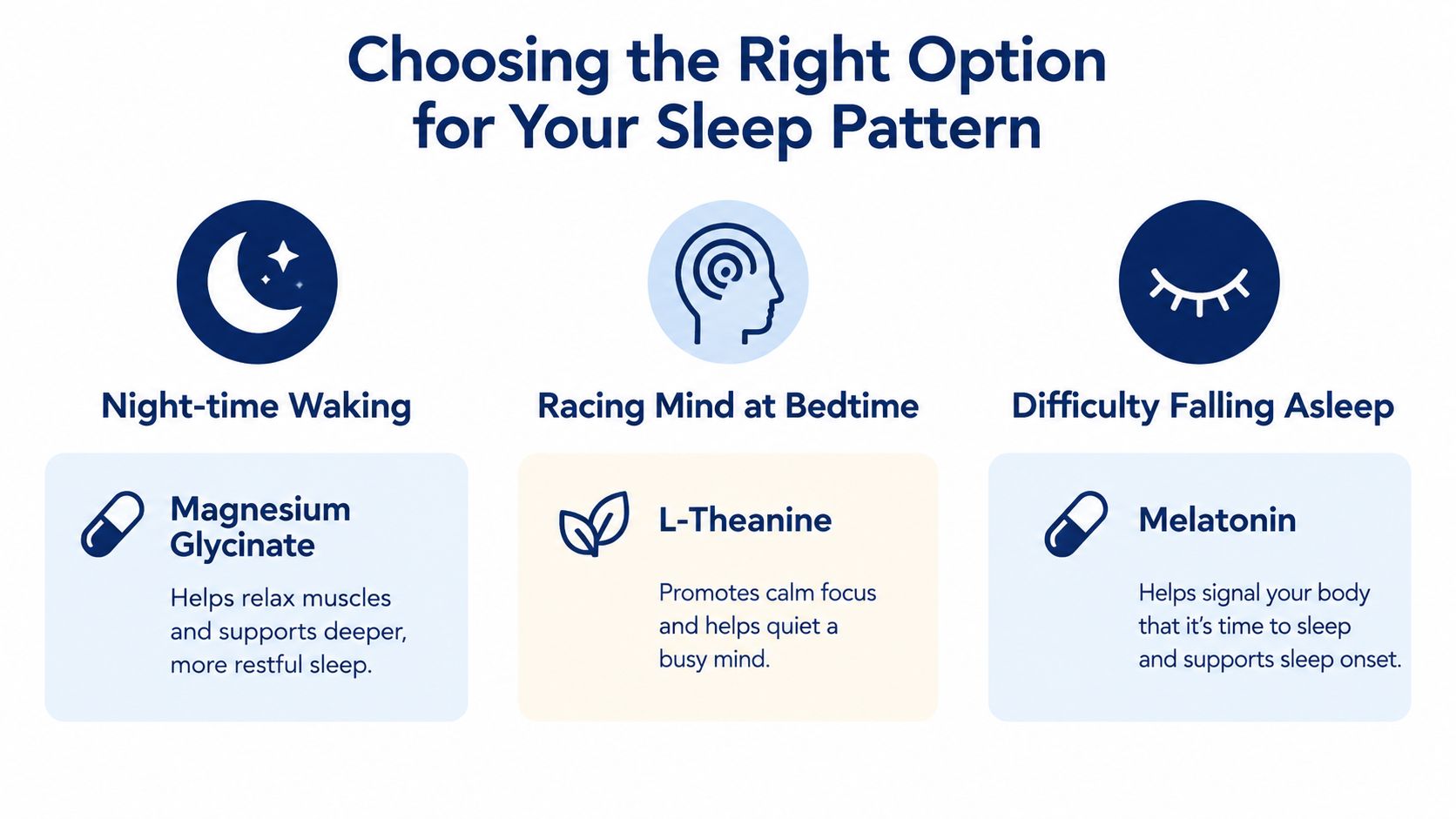
The 3 a.m. wake-up
A perimenopausal woman who wakes at 3 a.m. should not assume melatonin is appropriate just because it is sold as a sleep aid. Temperature changes, hormonal symptoms, anxiety, alcohol, pain, and sleep-disordered breathing can all disturb sleep maintenance. Magnesium may be reasonable to consider for evening relaxation, but repeated waking calls for attention to the underlying pattern, especially if it continues.
This sleep maintenance insomnia guidance is relevant when awakenings are frequent or begin affecting daytime function. Melatonin may help with circadian timing, but it is not a general solution for chronic insomnia.
The racing-mind sleeper
A stressed adult who lies awake rehearsing conversations or planning the next day has a different bottleneck. L-theanine is the more logical supplement to evaluate when the goal is calmness or improved subjective sleep quality, rather than shifting circadian phase, as noted in the earlier evidence review. Avoid adding several sedating herbs at the same time. A complex formula makes both benefit and side effects difficult to interpret.
The shift worker and the social drinker
A rotating-shift worker has the clearest reason to consider melatonin because the problem involves a disrupted sleep-wake schedule. Timing should match the intended sleep episode, not an inherited bedtime routine. The practical question is “for whom, and when?” A larger serving is not automatically a better choice.
Alcohol-related sleep disruption requires a separate judgment. Supplements cannot reliably cancel alcohol's effects on sleep continuity, and combining alcohol with sedating products may increase impairment. Address the drinking pattern first, then reassess whether a supplement still has a clear role.
The tracker optimizer
A tracker-driven sleeper should focus on outcomes that matter outside the device, including sleep-onset time, awakenings, morning alertness, and daytime function. A small change in estimated sleep stages should not justify increasing the dose when the person feels no better.
The cleanest test uses one ingredient, one timing plan, and one defined outcome. That approach makes it easier to distinguish a useful response from measurement noise, normal night-to-night variation, or an adverse effect.
Your Next Step Plan for Better Sleep Support
The most defensible way to test the best sleep support supplements is to treat the process like a small personal experiment, not a hunt for the strongest product.
- Name the failure point: Is the issue sleep onset, repeated waking, a shifted schedule, or mental overactivation?
- Choose one candidate: Use melatonin for a plausible circadian problem, L-theanine for a racing-mind pattern, or magnesium for an evening relaxation goal.
- Set the timing first: Follow the label, account for the specific sleep schedule, and don't respond to one disappointing night by doubling the dose.
- Track useful outcomes: Record sleep onset, awakenings, final waking, next-day alertness, and any side effects.
- Review the result: If the person sees no meaningful improvement, stop and reassess the problem rather than automatically combining products.
A product collection such as Sleep All Nite's sleep formulas can be evaluated using the same criteria as any other option: transparent ingredients, clear serving information, appropriate warnings, and a formula that matches the sleep pattern. The label matters more than the promise on the front of the package.
Persistent insomnia, severe daytime sleepiness, breathing symptoms, medication conflicts, pregnancy, breastfeeding, or complex medical conditions call for professional guidance. The right supplement is the one that fits the actual problem, can be used safely, and produces a noticeable improvement without creating a larger one.
Sleep All Nite offers a focused collection of sleep-support formulas for people comparing options such as melatonin, magnesium, calming amino acids, and botanicals. Visit Sleep All Nite to review the brand and receive an opening update when the storefront becomes available.


