
Perimenopause Sleep Problems: What Actually Works


A familiar version of this starts the same way. She gets into bed tired enough to think sleep won't be a problem. She falls asleep reasonably well. Then she wakes in the dark, often between 2 and 4 a.m., suddenly alert, warm, uncomfortable, or just wide awake for no obvious reason.
By morning, the question isn't only “Why am I so tired?” It's also “Is this stress, hormones, aging, bad habits, or something else entirely?” That confusion is part of why perimenopause sleep problems get dismissed so easily.
They are common, but common isn't the same as normal. Normal sleep still means the brain and body can get a stable, restorative night most of the time. Perimenopause can disrupt that. It does not mean a woman should accept broken sleep as the new baseline.
Research now treats sleep disturbance in the menopausal transition as a major health issue, not a minor side note. An NIH review estimated sleep disturbance during perimenopause at 39% to 47% and noted persistent insomnia symptoms across yearly follow-up intervals in 31% to 42% of perimenopausal women in the Journal of Clinical Sleep Medicine review.
What matters most is pattern recognition. Perimenopause sleep problems often aren't mainly about falling asleep. They're about staying asleep. That difference changes what usually helps, what wastes time, and when it makes sense to push for a sleep-specific evaluation.
Table of Contents
- The 3 a.m. Wake-Up Most Women Don't Expect
- How Shifting Hormones Rewrite Your Sleep
- Maintenance Insomnia as the Dominant Pattern
- What Is Actually Waking You Up at Night
- Evidence-Based Ways to Sleep Better
- Building Your Two-Week Reset Plan
- When Perimenopause Sleep Loss Needs a Clinician
The 3 a.m. Wake-Up Most Women Don't Expect
A very typical night looks like this. She falls asleep around 11. Then she opens her eyes at 3:07 a.m. There may be heat in the chest or neck, a need to throw off the blanket, a racing mind that wasn't there at bedtime, or a vague sense that the body has switched itself back on. Sleep doesn't return quickly.
This pattern catches women off guard because it doesn't feel like classic insomnia. She may not lie awake for an hour at the start of the night. She may feel sleepy at bedtime and drift off without much trouble. The problem arrives later.
Why this timing feels so strange
For many women still having periods, though often less predictably, this starts in the perimenopausal years rather than after periods stop completely. The key confusion is that the wake-up can look psychological when it's being triggered upstream by physiology.
A woman may assume she is “just anxious now” because the mind becomes active after the awakening. Often the sequence is reversed. The body wakes first. The thoughts come second.
Sleep that breaks at the same time night after night usually deserves more curiosity than blame.
Many readers looking for answers end up searching broad questions such as why they wake up at 3 a.m.. That's understandable. But in perimenopause, the timing often points less to poor discipline at bedtime and more to a repeatable maintenance-sleep problem.
Common does not mean harmless
Perimenopause is widely recognized as a peak period for insomnia-type complaints. A review of the clinical and population evidence reported that 26% of perimenopausal women met DSM-IV criteria for insomnia in one classic survey, while broader sleep disruption estimates often place the burden at roughly one-third to one-half of women in this stage in this review on sleep problems during the menopausal transition.
That still doesn't make it something to shrug off. “Common” only means many women experience it. It doesn't mean the body is getting what it needs.
A useful starting question is not “How do I knock myself out faster?” It is “What is waking the brain up after sleep has already started?”
How Shifting Hormones Rewrite Your Sleep
The core hormonal story in perimenopause is instability, not a smooth decline. Estradiol and progesterone don't drop in a straight line. They fluctuate. That's why sleep can feel almost normal one week and oddly fragile the next.

Estradiol changes the temperature system
Estradiol helps regulate thermoregulation. When it fluctuates, the brain's heat-control system becomes less steady. A woman may become more likely to experience hot flashes, night sweats, or smaller heat events that don't soak the sheets but still disturb sleep.
Not every hormonally driven wake-up looks dramatic. Some women never notice obvious sweating. They wake, shift covers, feel a surge of warmth, and remain alert too long afterward.
Progesterone changes the arousal system
Progesterone has a calming relationship with the brain and also affects respiratory stability during sleep. When progesterone drops, some women feel more “tired but wired.” Sleep becomes lighter. The threshold for waking can become less predictable.
That doesn't always produce trouble falling asleep first. It often shows up as a night that starts normally and then fragments.
A related practical issue is stress biology. Some women describe it as feeling like their body gets a second wind in the middle of the night. The hormone story and stress response often overlap, which is why articles about cortisol and sleep problems resonate with this stage.
Hormone effects on sleep architecture
| Hormone Shift | Physiological Effect | Sleep Architecture Impact |
|---|---|---|
| Fluctuating estradiol | Less stable thermoregulation and greater vasomotor vulnerability | More sleep fragmentation and heat-related arousals |
| Declining progesterone | Less calming neurosteroid support and less respiratory stability | Lighter sleep and more frequent awakenings |
| Erratic cycling rather than steady decline | Unpredictable night-to-night physiology | Good nights mixed with abruptly broken nights |
An NIH and PMC review links perimenopausal sleep disturbance to fluctuating estradiol and progesterone as well as vasomotor events that can fragment sleep architecture without fully waking the patient, and the North American Menopause Society notes that hormone therapy can improve sleep when bothersome nighttime vasomotor symptoms are driving awakenings in this review on menopause and sleep disorders.
Practical rule: If sleep was reliable for years and then becomes erratic during cycle changes, the pattern deserves a hormone-aware explanation before it gets labeled “just stress.”
In the supplement category, some women use products such as Deep Rest, which is designed to help unwind and ease into a restful night and contains melatonin, magnesium, vitamin B6, GABA, L-theanine, ashwagandha, 5-HTP, and a botanical blend. That kind of tool may fit a broader plan, but it doesn't identify the actual driver of repeated awakenings by itself.
Maintenance Insomnia as the Dominant Pattern
The most useful distinction in perimenopause sleep problems is this one: sleep-onset insomnia means trouble falling asleep, while maintenance insomnia means waking after sleep begins and struggling to stay asleep or get back to sleep.
Perimenopause tends to lean toward the second pattern.
The signature pattern is wake after sleep onset
A peer-reviewed NIH review reported that about 56% of perimenopausal women experienced sleep discontinuity compared with 32% of similarly aged premenopausal women, with the phenotype marked by more nightly awakenings and greater wake after sleep onset, or WASO, rather than mainly longer time to fall asleep in this NIH review of sleep in perimenopause.
That matters because many standard sleep tips are built for the wrong problem. A long wind-down routine, dim lights, and a consistent bedtime can help with sleep onset. They do much less if the problem is repeated arousal after midnight.
Why some nights still seem fine
Women often get confused here. Sleep may not be bad every night. Some cycles bring a few decent nights that make the whole issue feel random or self-inflicted.
It usually isn't random. It reflects fluctuation.
When the pattern is maintenance insomnia, the right question changes from “How do I make myself drowsier at 10:30?” to “What keeps crossing the threshold to wake the brain at 2:30 or 3:30?”
A quick sorting guide helps:
- If bedtime is the main battle, sleep-onset strategies deserve attention first.
- If the night breaks open after several hours of sleep, maintenance insomnia is the better frame.
- If both are happening, the later awakenings still need separate attention because the driver may be different.
A woman can be genuinely sleepy at bedtime and still have hormonally fragmented sleep later. Those are not contradictory stories.
This is also why products aimed at unrelated goals shouldn't be expected to fix the pattern. For example, Hangover Strips are dissolvable oral strips made with plant extracts inspired by traditional Ayurvedic practice and are intended to support mental clarity, normal fluid levels, and relaxation for restful sleep. They are not a targeted response to maintenance insomnia in perimenopause unless a specific morning-after context is also part of the picture.
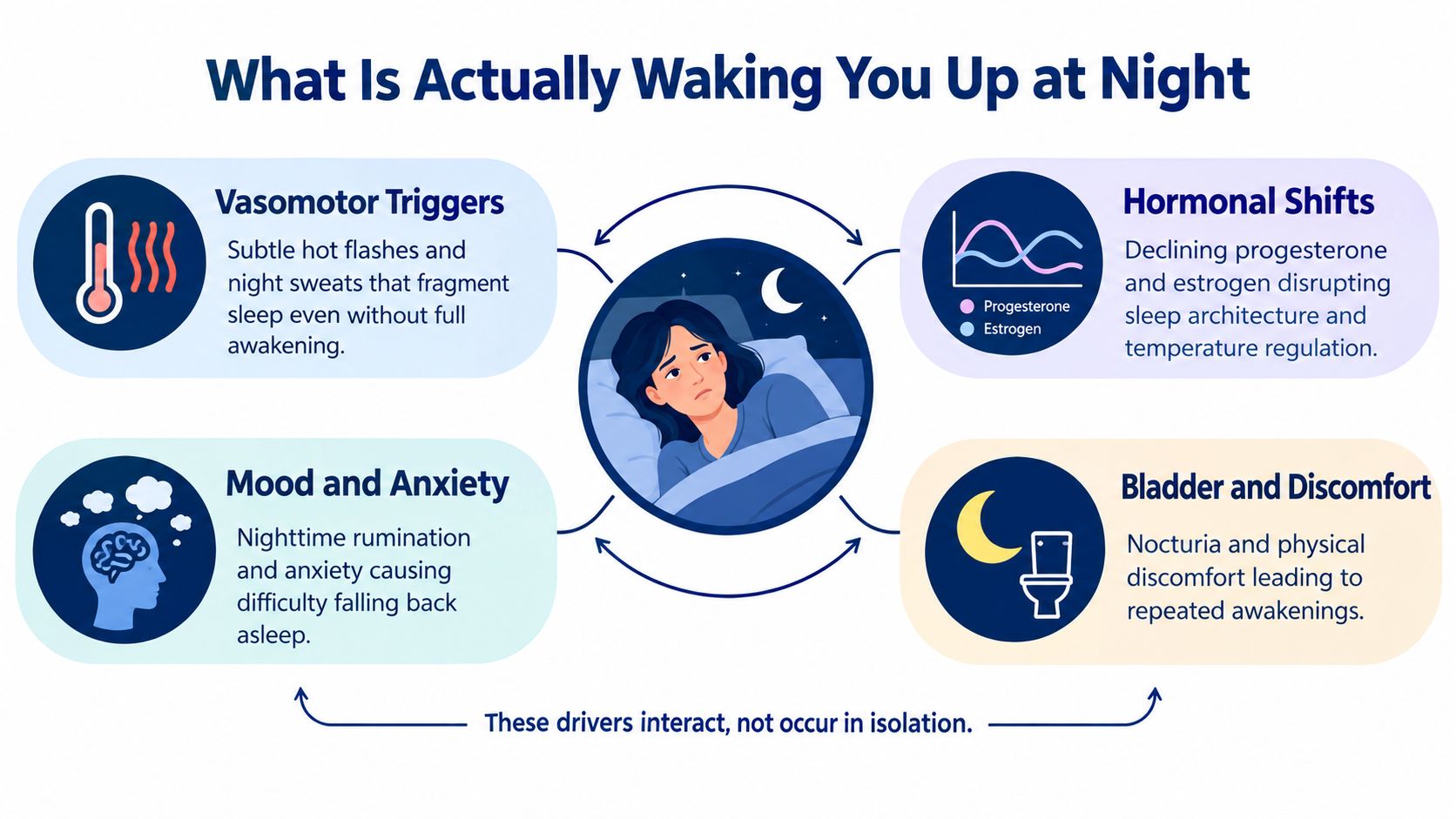
What Is Actually Waking You Up at Night
A woman doesn't need a perfect diagnosis on night one. She does need a decent first guess. Most perimenopause sleep problems cluster around a few recognizable nighttime drivers.
A simple visual helps frame the possibilities.
Vasomotor waking
This is the hot-flash and night-sweat pattern. The woman may wake suddenly warm, throw off bedding, notice sweating, or feel a heat surge that disappears quickly. Sometimes the heat event is subtle enough that she only notices the aftermath, which is being abruptly awake.
What tends to point in this direction:
- Heat before thought. The body feels warm before the mind starts spinning.
- Chest, neck, or face warmth rather than a full-body anxious jolt.
- Relief with cooling such as lighter layers, a fan, or getting one foot out from under the covers.
When this is the main driver, treatment usually works best when it addresses the vasomotor symptom rather than trying to sedate over it.
Mood-related waking
This pattern often features alertness, rumination, dread, or mental looping once awake. The difference is in what seems to come first. If the first awareness is thought rather than heat, mood may be playing a larger role.
Harvard's Apple Women's Health Study update noted that participants with more severe bladder, joint, heart discomfort, or depressive symptoms also had more disruptive sleep in the Apple Women's Health Study sleep update.
A few clues:
- The mind starts problem-solving immediately.
- The body doesn't feel especially hot.
- Low mood, anxiety, or emotional exhaustion are present in the day as well.
Pain-driven waking
Pain is an under-discussed culprit. Joint pain, muscle aches, migraines, breast tenderness, and general physical discomfort can all produce repeated awakenings.
This driver often leaves a different fingerprint. The woman changes position frequently, wakes with body discomfort already noticeable, or sees the pattern cluster around certain phases of the cycle.
A small test can help. If the first clear awareness on waking is “my hips,” “my shoulders,” “my head,” or “my breasts hurt,” pain may be upstream of the insomnia rather than secondary to it.
A short clinician-led overview can help some readers connect these overlapping symptoms:
Bladder-driven waking
Nocturia can become part of perimenopause sleep disruption. She wakes with the urge to urinate, goes to the bathroom, and then can't get back to sleep. Sometimes the bladder issue is obvious. Sometimes it blends with lighter sleep and the woman only realizes afterward that the urge was what tipped her fully awake.
Look for these signs:
- The bladder is the first signal, not heat or thought.
- The wake-up recurs at similar times after evening fluids or alcohol.
- The trip is brief but the return to sleep is not.
A useful self-triage question is simple. On waking, what was noticed first: heat, thoughts, pain, or bladder pressure? That first signal is often more informative than what happens ten minutes later.
Evidence-Based Ways to Sleep Better
Many women get handed the same generic advice: lower the thermostat, stop screens, try melatonin, reduce stress. Some of that helps. None of it is specific enough on its own.
The better approach is matching the tool to the pattern.
Start with baseline measures, but don't stop there
Sleep hygiene still matters. A cool room, regular wake time, less alcohol, and less caffeine late in the day can reduce extra strain on a hormonally sensitive sleep system. But hygiene is a foundation, not a full treatment for maintenance insomnia.
If the problem is repeated waking from heat, bladder urgency, pain, or rumination, good habits won't fully solve it by themselves.
CBT-I often fits the maintenance pattern well
Cognitive behavioral therapy for insomnia, or CBT-I, is often one of the strongest non-drug options for persistent insomnia. It can help women who spend too much awake time in bed, become conditioned to fear nighttime wakefulness, or fall into compensations that keep the cycle going.
CBT-I is especially relevant when the pattern has shifted from occasional disruption to a learned nightly struggle. It doesn't erase hot flashes or pain, but it can reduce the spiral that follows a wake-up.
Melatonin needs more nuance than most women get
Melatonin is often treated as if more is automatically stronger or better. In practice, the fit depends on the sleep problem. Lower doses are often discussed for circadian timing support, while higher doses are commonly sold as more sedating bedtime products.
That distinction matters in perimenopause. A woman whose main problem is waking at 3 a.m. may not get what she needs from taking a large dose at bedtime. It may make her sleepy initially without addressing the later trigger that wakes her.
Readers comparing over-the-counter options can use a practical ingredient lens, and guides such as best sleep support supplements can help separate bedtime support from true maintenance-sleep treatment.
Prescription and hormone-based options
When vasomotor symptoms clearly drive the problem, menopause hormone therapy can be a strong option because it addresses the waking trigger rather than only the sleep symptom. The North American Menopause Society specifically notes that hormone therapy can improve sleep in women with bothersome nighttime vasomotor symptoms by reducing nighttime awakenings, as noted earlier in the hormone section.
For women who cannot or prefer not to use hormone therapy, clinicians may consider nonhormonal prescription options depending on the dominant pattern. If pain, mood symptoms, or severe hot-flash-related waking is prominent, the right medication choice usually follows that phenotype.
Management options for perimenopause sleep problems
| Option | Best for | Key trade-off |
|---|---|---|
| Sleep hygiene | Everyone as a baseline | Usually not enough alone for maintenance insomnia |
| CBT-I | Conditioned insomnia, prolonged wakefulness after nighttime awakenings | Requires consistency and can feel counterintuitive at first |
| Melatonin | Sleep timing support or bedtime sleepiness in some cases | May not address the reason a woman wakes later |
| Prescription sleep aids | Short-term symptom control in selected cases | Side effects and next-day concerns need clinician review |
| Nonhormonal symptom treatment | Mood, pain, or hot-flash patterns when those are dominant | Must match the main driver to help |
| Menopause hormone therapy | Vasomotor-driven sleep disruption | Requires individualized risk-benefit discussion |
The best treatment is usually the one that targets what wakes her, not the one that simply makes her drowsy at bedtime.
Building Your Two-Week Reset Plan
A reset plan works better when it is narrow enough to follow and specific enough to learn from. The point isn't to try ten changes at once. The point is to identify the dominant driver and then test the right response.
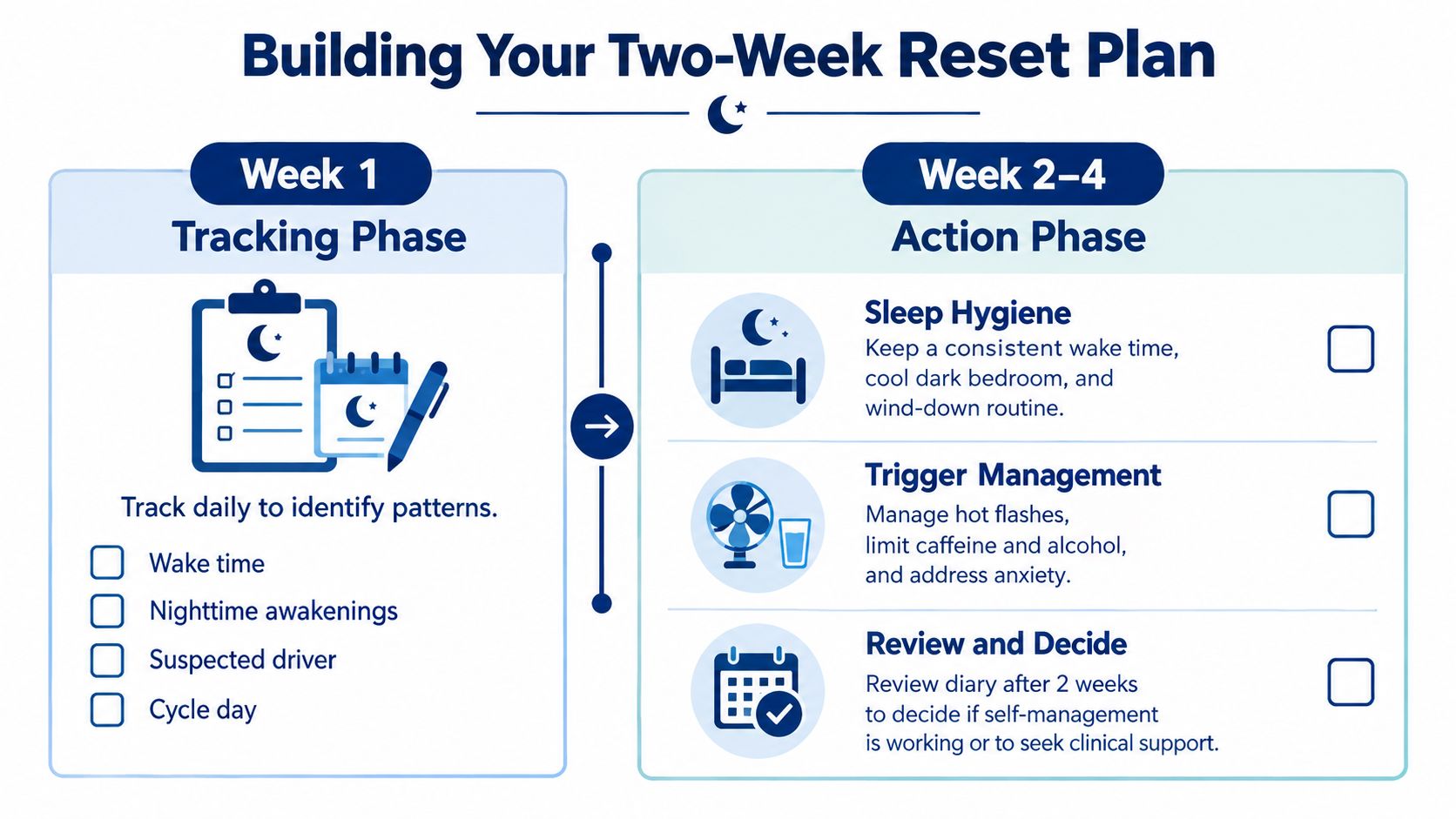
Week one uses observation, not guesswork
For seven nights, track only a few things:
- Bedtime and wake time
- Approximate time of each awakening
- First thing noticed on waking such as heat, thought, pain, or bladder pressure
- Cycle day or bleeding pattern
- Anything unusual such as alcohol, a late meal, a stressful evening, or more physical pain than usual
This doesn't need to become a spreadsheet project. A note on paper or in a phone works fine if it is brief and honest.
Week two adds one targeted change
The key is one main intervention based on the pattern, plus baseline sleep hygiene.
Examples:
- If heat events dominate, focus on cooling strategies, lighter sleepwear, and a clinician discussion if hot flashes are substantial.
- If the woman wakes and then lies alert for a long time, use CBT-I style principles such as a steady wake time and avoiding long periods of frustrated wakefulness in bed.
- If bladder urgency is the first signal, reduce late-evening fluids and review bladder symptoms rather than only treating it as insomnia.
- If pain is the first signal, address positioning, pain timing, and clinician evaluation if needed.
- If nighttime rumination leads the story, mood support may matter as much as any sleep aid.
Small gains count. Earlier return to sleep, fewer fully alert awakenings, or less dread at bedtime all mean the plan is moving in the right direction.
A short checklist worth saving
- Track first, don't overhaul everything on day one.
- Name the first waking signal, not just the general feeling of “bad sleep.”
- Choose one dominant target for the next week.
- Keep the wake time steady even if the night was rough.
- Escalate to a clinician if no pattern becomes clear or nothing improves.
The reset plan is not about being perfect. It is about reducing noise so the pattern becomes visible.
When Perimenopause Sleep Loss Needs a Clinician
One of the most unhelpful messages women hear is that broken sleep in this stage is just something to push through. That advice misses two problems. First, persistent insomnia deserves treatment. Second, not every sleep complaint in perimenopause is “just hormones.”
A sleep-specific evaluation becomes more important when nighttime awakenings keep happening despite consistent self-management, when sleep remains unrefreshing even with adequate opportunity to sleep, or when snoring, breathing pauses, morning headaches, restless legs, pain, or worsening mood are part of the picture.
The literature now describes a real care gap. A 2026 review noted that sleep disorders affect 50% to 55% of perimenopausal women worldwide and highlighted a notable absence of diagnostic and therapeutic protocols specifically for sleep disorders in menopause and perimenopause guidelines in the European Journal of Endocrinology review.
What a good visit usually includes
A useful appointment is more specific than “sleep is bad.” It often includes:
- A sleep-focused history with pattern, timing, and associated symptoms
- Screening for sleep apnea, restless legs, mood symptoms, and pain
- Review of medications, cycle changes, and vasomotor symptoms
- Basic lab work when clinically appropriate to rule out contributors such as thyroid or iron issues
- Referral for sleep testing or sleep medicine if another disorder is suspected
Women do not need to wait until they are completely depleted to ask for that level of care. Recognizing the limit of self-triage is part of managing perimenopause sleep problems well.
Sleep All Nite offers goal-based nighttime wellness products in several formats, including capsules, oral strips, gummies, and night skin care, for women trying to sort out whether they need help falling asleep, staying asleep, winding down, or waking up clearer. For readers who want to compare sleep-support options alongside the kind of phenotype-based approach described here, a visit to Sleep All Nite can be a practical next step.


