
Stress Insomnia: Why It Happens and How to Break the Cycle


At 2 a.m., the laptop is still glowing beside the bed. A meeting, difficult conversation, or unfinished task keeps replaying, while the body feels exhausted but strangely alert. The clock turns sleep into a calculation, and every passing minute seems to confirm that tomorrow will be harder.
That pattern often points to stress insomnia, but stress doesn't affect every sleeper in the same way. For some people, the mind keeps solving problems. For others, the jaw, shoulders, chest, or stomach remain tense. Some people become highly sleep-reactive, meaning stress continues to disturb sleep even when the stressful day has ended. Identifying the dominant pattern makes the response more precise.
Table of Contents
- What Stress Insomnia Actually Feels Like
- The Stress-Sleep Loop Inside the Body
- Three Faces of Stress Insomnia and Why the Difference Matters
- When Stress Is Sudden and Sleep Falls Apart
- Chronic Stress Insomnia and the 3 A.M. Wake-Up Pattern
- A Calm-Down Routine You Can Start Tonight
- What Does Not Work and Why
- When to Bring In a Professional
What Stress Insomnia Actually Feels Like
A person with stress insomnia may fall asleep normally on an ordinary night, then lie awake after a demanding day. The mind replays a conversation, predicts everything that could go wrong at work, or builds a detailed plan for the next morning. The body may be still, but the brain behaves as if an urgent decision must be made immediately.
The physical experience can be just as distinctive. The jaw stays clenched, the shoulders hover near the ears, and the stomach feels tight or unsettled. A person may notice a fast heartbeat, shallow breathing, fidgeting, or an uncomfortable sense that the body can't fully settle. This creates the classic wired-but-tired state, where exhaustion is present but alertness keeps winning.
Practical rule: A tired body doesn't always mean a quiet nervous system.
Stress insomnia can resemble other sleep problems, but the timing offers useful clues. Circadian misalignment tends to follow an inconvenient sleep schedule or a mismatch between the internal clock and the desired bedtime. Pain-driven insomnia centers on discomfort that repeatedly wakes the sleeper. Sleep apnea may involve loud snoring, gasping, or persistent unrefreshing sleep, while restless legs can create an urge to move that becomes strongest during rest.
A stress-linked pattern often changes with emotional load. A person might sleep more easily after a calm day, then struggle after conflict, deadlines, uncertainty, or prolonged responsibility. Population research supports the close relationship between stress and insomnia. A review of stress and insomnia research notes that insomnia symptoms affect about one-third of adults each year, while clinically significant insomnia is commonly estimated at 6% to 10% of adults. The same review describes a study in which 78% of insomnia patients reported a connection between stressors and their insomnia.
Tonight, the first step is naming the cluster rather than judging it. A person can write one sentence describing the dominant worry, place it outside the bed area, and dim screens well before trying to sleep. That small act tells the brain that the problem has been recorded and can wait until daylight.
The Stress-Sleep Loop Inside the Body
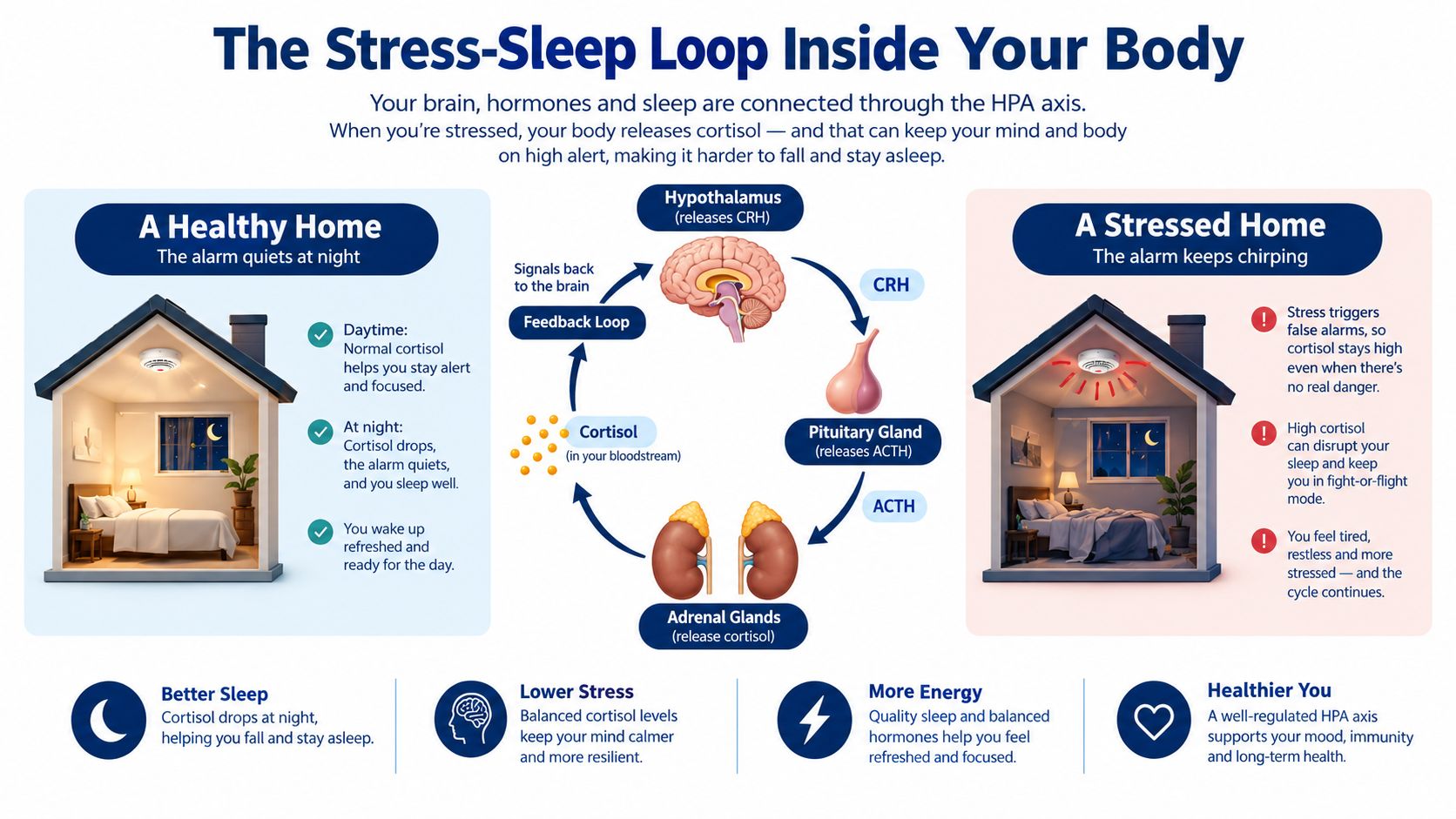
The body doesn't treat stress as a purely mental event. It activates a coordinated system called the hypothalamic-pituitary-adrenal axis, or HPA axis, which helps organize the response to perceived threat.
The smoke detector analogy
The hypothalamus begins the chain by releasing corticotropin-releasing hormone, or CRH. The pituitary then releases adrenocorticotropic hormone, or ACTH, which signals the adrenal glands to release cortisol. During acute stress, sympathetic activation also supports the release of adrenaline and other signals associated with alertness.
A smoke detector offers a useful comparison. In a healthy home, the alarm quiets when night arrives and no danger is present. Under sustained stress, the detector becomes overly sensitive and keeps chirping. The body receives repeated signals to stay prepared, even though the bedroom is safe.
Cortisol is more than a measurement of stress. It can promote alertness, influence energy availability, and make it harder to transition into sleep when evening or early-night levels stay high. Reviews of insomnia physiology report high 24-hour ACTH and cortisol in people with objectively fragmented sleep, particularly during the evening and early night. The relationship between cortisol and sleep problems helps explain why a person can feel physically depleted while the nervous system continues scanning for danger.
Why the loop continues overnight
The relationship runs in both directions. Stress hormones can delay sleep and increase awakenings, while fragmented sleep can activate the HPA axis and produce additional cortisol release. Abrupt changes in sleep timing can also disrupt the daily cortisol rhythm, making regularity an important part of recovery.
This doesn't mean every person with stress insomnia has a completely reversed cortisol rhythm. Chronic insomnia can involve a 24-hour elevation in ACTH and cortisol while the basic circadian pattern remains present. That combination helps explain the feeling of being tired but wired rather than fully awake all night.
A practical response should reduce signals of danger instead of demanding sleep by force. A cooler, darker room, lower evening stimulation, and a written boundary around problem-solving can help the body receive fewer wakefulness cues. For a person considering a supplement, Deep Calm provides magnesium as magnesium glycinate, with 275 mg of magnesium per serving, and the product information describes magnesium's role in normal nerve function, muscle health, muscle relaxation, and healthy sleep patterns.* A healthcare professional should review supplements when pregnancy, medical conditions, or medication use is relevant.
Tonight, cooling the body, dimming light, and postponing major decisions until morning gives the HPA system fewer reasons to keep sounding its alarm.
Three Faces of Stress Insomnia and Why the Difference Matters
“Stress” describes the trigger, not always the mechanism. Two people can face the same deadline and develop completely different sleep problems. One may lie awake planning, another may hold tension in the body, and a third may sleep lightly for several nights because the nervous system reacts strongly to disruption.
A practical comparison
| Subtype | Hallmark Signs | What Maintains It | Best First-Line Fix |
|---|---|---|---|
| Cognitive rumination | Replaying conversations, forecasting problems, planning in bed | Open mental loops and fear of forgetting something | Written worry processing, cognitive defusion, structured problem-solving earlier in the day |
| Somatic tension | Tight jaw, raised shoulders, shallow breathing, unsettled stomach | Muscular guarding and ongoing physical arousal | Progressive muscle release, slower breathing, gentle movement, warmth before bed |
| High sleep reactivity | Sleep deteriorates disproportionately after stress or schedule disruption | Learned sensitivity to poor sleep and irregular timing | Consistent sleep-wake timing, stimulus control, and CBT-I |
Cognitive rumination responds poorly to vague instructions such as “relax.” The mind needs a defined place to put unfinished material. A brief written list can separate actionable tasks from hypothetical worries, while cognitive defusion helps a person notice a thought without treating it as an instruction.
Somatic tension can persist even when the person doesn't feel consciously worried. A clenched jaw or tight abdomen may keep sending danger signals to the brain. Body-based techniques therefore matter more than another attempt to reason with the thoughts.
High sleep reactivity requires a different lens. Preliminary findings presented by a University of Notre Dame sleep lab at SLEEP 2025 suggested that day-to-day stress swings weren't clearly tied to sleep onset or maintenance problems in their sample, while higher baseline sleep reactivity was linked to less total sleep and more time awake. The researchers suggested that stress effects may build up over time rather than show up after a single stressful day (conference report on sleep reactivity). It's early, unpublished work, but it challenges the assumption that every bad night has one obvious cause.
The reader can identify the dominant pattern by observing what happens during wakefulness. If the mind produces paragraphs, cognitive tools come first. If the body feels braced, physical downshifting comes first. If sleep remains fragile across changing stress levels, regular scheduling and CBT-I deserve priority.
Tonight, the most useful question is not “How can the person relax?” It is “Which system is still activated, the mind, the body, or the sleep response?”
When Stress Is Sudden and Sleep Falls Apart
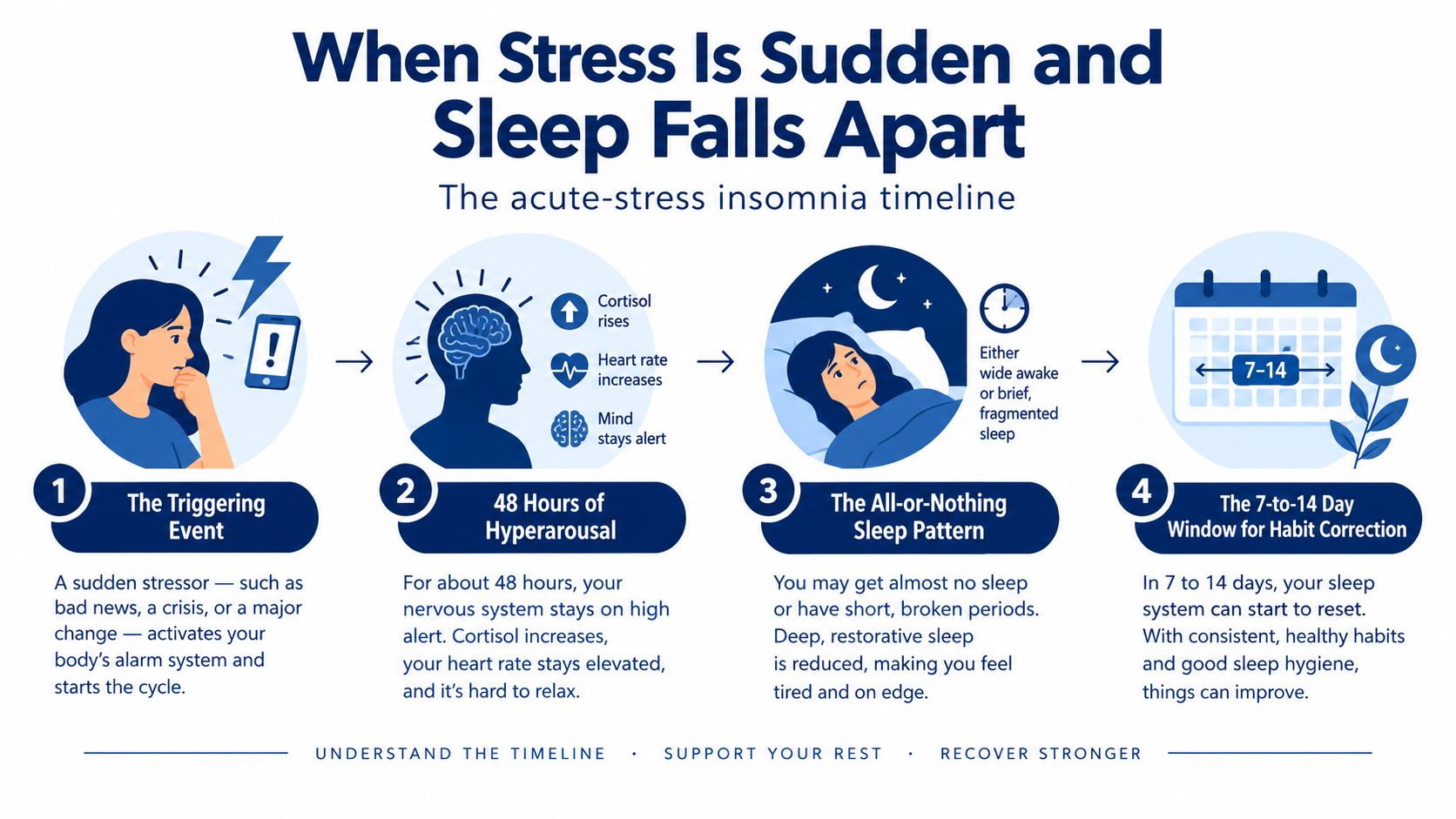
A sudden stressor can change sleep quickly. Job pressure, an argument, a frightening message, travel, or a deadline may leave the nervous system in a state of heightened readiness. The first nights can feel unpredictable, with one night of very little sleep followed by a night of heavy exhaustion and then another period of wakefulness.
The danger isn't only the original event. After a difficult night, the person may begin monitoring sleep, fearing the next bedtime, or extending time in bed to compensate. That effort can make the bed feel like a place for evaluation rather than sleep.
Protecting the sleep system early
A short-term response should reduce mental carryover and preserve the body's timing signals:
- Schedule worry earlier: Set aside a defined period before the wind-down routine to write concerns, possible actions, and questions that can wait.
- Protect the wake time: Keep a stable morning rising time after a poor night rather than repeatedly shifting the schedule.
- Use morning light: Outdoor light soon after waking gives the circadian system a strong daytime cue.
- Move caffeine earlier: A person with acute insomnia can avoid using caffeine late in the day to chase fatigue, since stimulation can prolong evening alertness.
- Stop sleep accounting: Counting every missed minute often turns normal wakefulness into a perceived emergency.
The aim isn't to force perfect sleep while the stressor remains active. It is to prevent short-term disruption from becoming a learned pattern of fear, irregular timing, and prolonged bed-wakefulness. Sedating products also deserve caution. Any over-the-counter or prescription sleep aid should be discussed with a healthcare professional, and a person shouldn't extend use only because the original stressor hasn't resolved.
A short-term sleep problem may settle as the nervous system recovers, but persistent worsening, unsafe daytime sleepiness, or escalating reliance on medication calls for clinical guidance.
The embedded video offers another explanation of how stress can affect sleep:
Tonight, the protective move is simple: keep the morning anchored, move worry out of bed, and avoid turning one difficult night into a verdict about the next one.
Chronic Stress Insomnia and the 3 A.M. Wake-Up Pattern
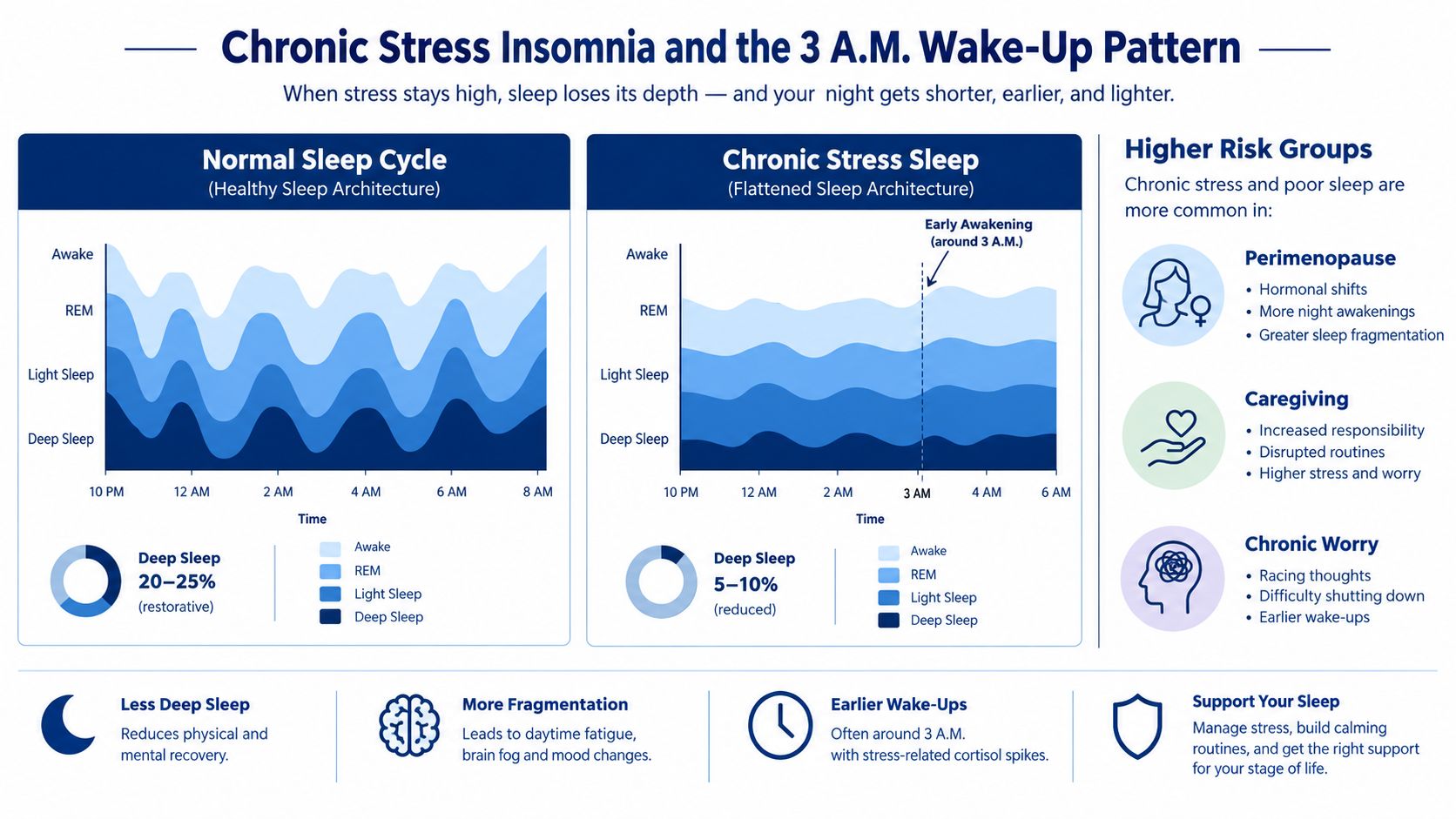
Chronic stress insomnia often changes the shape of the night. A person may fall asleep from exhaustion, then wake in the early morning when sleep becomes lighter and the body's alerting systems become more influential. The awakening may arrive with a racing mind, a warm body, a tight chest, or an immediate sense that sleep is over.
Perimenopausal changes, caregiving demands, burnout, and persistent uncertainty can make this pattern especially disruptive. Research on stress physiology describes a feedback loop in which sleep fragmentation raises HPA activity, while increased HPA activity makes further fragmentation more likely. In some people, the problem appears less as difficulty falling asleep and more as repeated or early waking.
Three behavioral levers
A stable wake time gives the circadian system a dependable anchor. A generous wind-down period creates distance from work, conflict, and digital stimulation. Stimulus control then teaches the brain that the bed is for sleep rather than worrying, checking the clock, or reviewing the day.
A person who wakes at 3 a.m. shouldn't conduct a full analysis of the next day's consequences. If wakefulness becomes prolonged, leaving the bed for a quiet activity in dim light can reduce the association between the mattress and frustration. Returning only when sleepiness returns protects that association.
Supplement decisions require a separate level of care. Magnesium glycinate may be relevant to muscle relaxation when intake or individual needs make it appropriate. L-theanine, glycine, melatonin, ashwagandha, and tart cherry are often discussed in nighttime routines, but their usefulness depends on the person's pattern, health history, other medicines, and the reason for the awakening. Melatonin is more closely aligned with circadian timing than with every form of stress-driven wakefulness, and changing the dose without guidance can add confusion.
A detailed explanation of why some people wake up at 3 a.m. can help a reader distinguish a recurring sleep pattern from an isolated bad night. A healthcare professional should become involved when early waking persists, daytime function declines, mood symptoms appear, or hormonal, respiratory, pain, or medication-related contributors seem possible.
Tonight, the priority is a consistent rising time, a protected pre-bed transition, and a bed that no longer doubles as a workstation for worry.
A Calm-Down Routine You Can Start Tonight
A useful routine works on the three systems that stress can activate: thoughts, physical tension, and the sleep environment. The sequence matters because a written boundary can quiet the mind, body-based work can reduce guarding, and environmental changes can stop adding new stimulation.
Close the open loops
The routine begins with a short brain-dump outside the bed. A person can write the worry, the next practical action, and the earliest time that action can happen. For concerns without an immediate action, the page can record that the issue will be revisited during daylight.
Then comes a body reset. Extended-exhale breathing, such as a gentler exhale that lasts longer than the inhale, can give attention something neutral to follow. Progressive muscle release can move from the forehead and jaw through the shoulders, hands, abdomen, thighs, and calves. A warm shower or foot bath may also help the body transition toward sleep as the skin later cools.
A useful boundary: Bedtime isn't the place to solve tomorrow's problems.
Remove competing signals
The room should support sleep rather than alertness. Dim lights after sunset, reduce noise with steady white or pink noise if necessary, and keep the phone away from the bed when possible. A person can also prepare water, medication approved by a clinician, and any morning essentials before getting under the covers, so practical concerns don't become reasons to get back up.
If wakefulness becomes frustrating, leaving the bed for a quiet activity in low light is more helpful than repeatedly checking the time. The return to bed should happen when sleepiness appears, not merely because the person believes enough time has passed.
The guide to sleeping when the brain is racing reinforces the value of addressing mental activation before the head reaches the pillow. A final scan can take the form of three slow observations: the jaw is loose, the shoulders are lower, and the breath is unforced.
Tonight, the complete routine is a written release, a few minutes of physical downshifting, and an environment that asks for less vigilance.
What Does Not Work and Why
“Just relax” fails when the dominant problem is cognitive arousal. The instruction adds another performance demand, and the person may begin judging whether relaxation is happening correctly. A written worry boundary and cognitive defusion work better because they change the relationship with the thought instead of demanding its immediate disappearance.
Alcohol can make a person drowsy at first, but sedation isn't the same as stable sleep. It can fragment the later part of the night and make early waking more likely, especially when the original problem already involves sleep maintenance. Replacing alcohol with a consistent wind-down sequence targets the transition into sleep without creating another source of nighttime disruption.
Melatonin also isn't a universal stress treatment. It may be more useful when the internal clock is delayed or disrupted by travel, while a person whose main problem is hyperarousal may need stimulus control, regular timing, and cognitive work instead. Taking more after an unsuccessful night can turn the routine into a cycle of experimentation and worry.
Sleep trackers create a similar trap. A person may feel reasonably rested but become alarmed by a device's estimate, then spend more time in bed trying to produce a better score. The replacement is to use daytime function and a simple sleep log as broader signals, not to treat one number as a diagnosis.
The underlying principle is consistent: match the intervention to the mechanism. Rumination calls for mental boundaries, body tension calls for physical release, and bed-related frustration calls for stimulus control.
When to Bring In a Professional
Self-help can be appropriate for a brief reaction to a clear stressor, particularly when daytime function remains intact. A professional evaluation becomes more important when sleep trouble occurs at least three nights a week for at least three months, which is how both the DSM-5 and the International Classification of Sleep Disorders define chronic insomnia, when daytime impairment affects work or driving, or when anxiety, depression, or trauma symptoms appear alongside the sleep problem (2026 study summarizing these diagnostic criteria).
A clinician may review a sleep diary, current medicines and supplements, alcohol or caffeine habits, breathing symptoms, pain, mood, and hormonal changes. Screening matters because sleep apnea, restless legs, medication effects, depression, and perimenopausal symptoms can resemble stress insomnia or intensify it.
CBT-I is a central professional option because it addresses the thoughts, behaviors, timing, and bed associations that maintain insomnia. A clinician may also discuss short-term medication under supervision or refer for evaluation of mood, trauma, thyroid, or hormonal contributors when appropriate.
The practical next step is to book an appointment with a primary care provider or behavioral sleep medicine specialist and bring a sleep log covering the recent pattern. The log should record bedtime, estimated sleep periods, awakenings, final rising time, daytime sleepiness, caffeine, alcohol, and notable stressors without turning the record into another nightly performance test.
Sleep All Nite offers goal-based nighttime products, including a melatonin-free magnesium option, alongside educational guidance for winding down and managing disrupted sleep routines. Readers can review the available options at Sleep All Nite and discuss any supplement choice with a qualified healthcare professional.
*These statements have not been evaluated by the Food and Drug Administration. These products are not intended to diagnose, treat, cure, or prevent any disease.
This article is for general education and isn't medical advice. Talk with a healthcare professional before starting a supplement, especially if you're pregnant or nursing, under 18, managing a medical condition, or taking prescription medication.


