
How to Sleep Better During Perimenopause


A woman can go to bed exhausted, fall asleep quickly, and still find herself awake at 3 a.m. with the sheets kicked onto the floor, skin hot, thoughts racing, and the ceiling becoming impossible to ignore. Ninety minutes later, sleep still hasn't returned. By morning, the problem feels like a personal failure, so she searches for another tea, supplement, sound machine, or bedtime rule.
That diagnosis is usually wrong. Perimenopausal sleep trouble is often a sleep-maintenance problem, driven by repeated awakenings and difficulty returning to sleep. The practical answer isn't another oversized sleep-hygiene list. It's a layered plan that identifies the dominant sleep pattern, uses CBT-I as the clinical backbone, adapts the bedroom and evening routine to symptom triggers, and treats supplements as optional tools rather than the main event.
Table of Contents
- Why Perimenopause Wrecks Your Sleep
- The Three Sleep Patterns Most Women in Their 40s Fall Into
- CBT-I The Treatment That Actually Moves the Needle
- Hormone Aware Sleep Hygiene That Goes Beyond the Basics
- Melatonin Magnesium and Herbs Without the Hype
- Building a Realistic Evening Routine You Will Actually Follow
- When to Stop Self Managing and Talk to a Clinician
Why Perimenopause Wrecks Your Sleep
At 3 a.m., a hot flash may wake you, but heat rarely explains the entire night. Your body becomes alert, your mind starts calculating how little sleep remains, and the effort to force sleep keeps arousal high. Clock-checking, worrying about tomorrow, and cycling through increasingly elaborate fixes can turn one awakening into hours of wakefulness.
That pattern is sleep fragmentation, a sleep-maintenance problem rather than simple difficulty falling asleep. Research repeatedly identifies trouble staying asleep as a frequent insomnia pattern during perimenopause, although early waking and delayed sleep onset also deserve attention. In a large SWAN analysis, 37.3% of women aged 40 to 55 reported difficulty sleeping. A longitudinal follow-up found insomnia symptoms in 31% at year 1 and 42% at year 10 (review of perimenopausal sleep research).
Why symptoms matter more than age
Perimenopause changes the conditions that once supported predictable sleep. Fluctuating reproductive hormones can occur alongside hot flashes, stress sensitivity, pain, urinary symptoms, and mood changes. These factors create different insomnia patterns. One woman falls asleep quickly and wakes drenched. Another remains awake for hours before sleep starts.
Hot flashes deserve direct attention. Research found sleep disruption in 61.7% of U.S. perimenopausal women with vasomotor symptoms, compared with 38.0% without them (research on menopause, vasomotor symptoms, and sleep). Treating night sweats and treating insomnia may therefore need to happen together.
Practical rule: A repeated 3 a.m. awakening deserves an insomnia assessment, not automatic acceptance as “normal menopause.”
Start by identifying the dominant driver: heat, mental arousal, early waking, breathing problems, or leg discomfort. Then use CBT-I to rebuild a reliable connection between bed and sleep. Adjust the room and evening routine for temperature control and circadian timing. Consider supplements only after defining their purpose, risks, and intended sleep target. Melatonin shopping should not replace a clear clinical plan.
The Three Sleep Patterns Most Women in Their 40s Fall Into
Perimenopausal sleep disturbance is common, but “common” is not a treatment plan. The useful question is what happens during the night. One woman falls asleep easily, wakes overheated, and stays awake for an hour. Another lies down exhausted, then starts mentally reviewing work, family obligations, and tomorrow's problems. A third wakes before dawn with no obvious hot flash and cannot return to sleep.
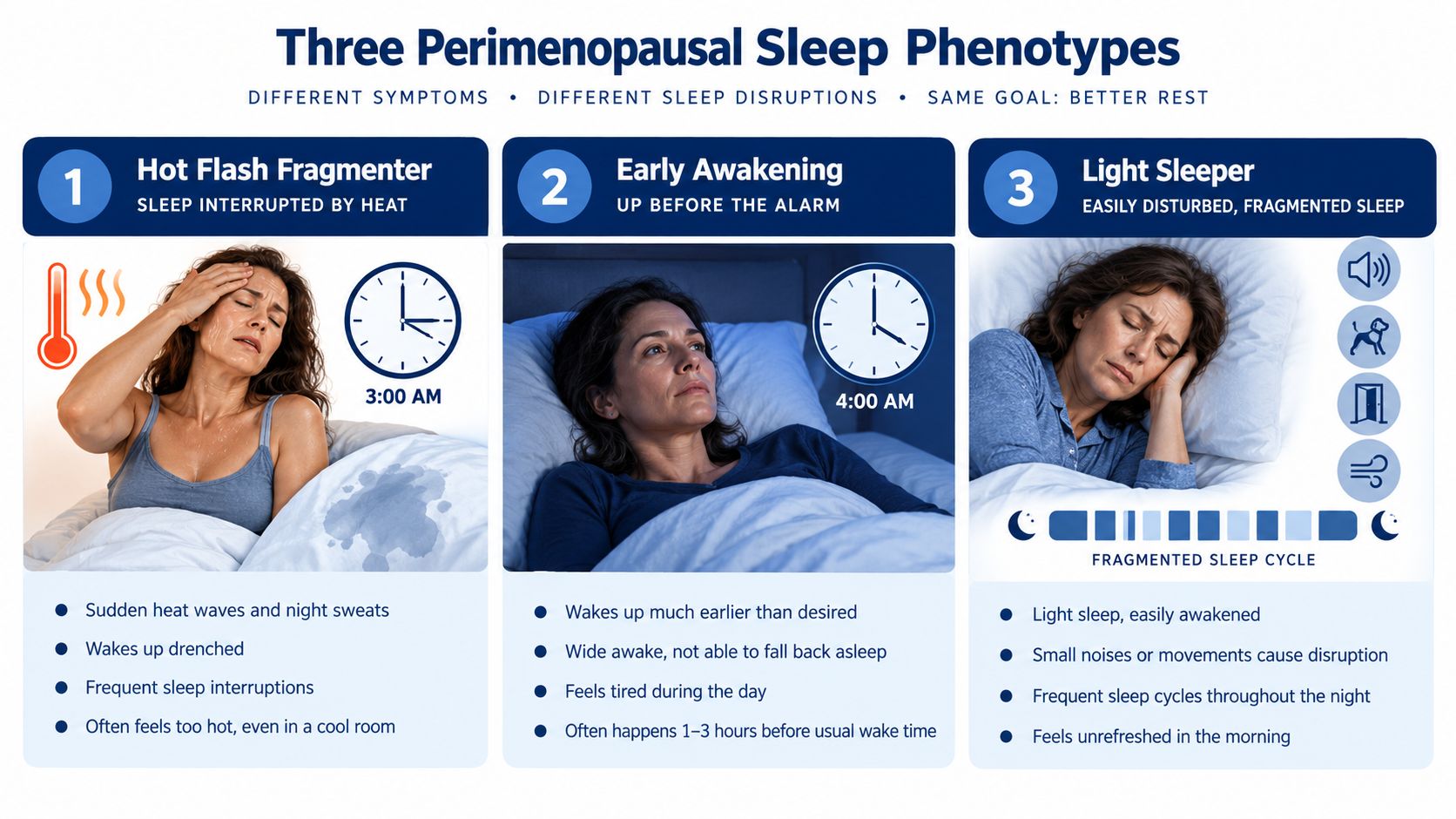
Pattern one is the hot flash fragmenter
The hallmark is a sudden awakening with heat, sweating, sheet-kicking, or a need to change clothing. Sleep onset may be easy. The actual problem is the long return-to-sleep period after the symptom passes.
Start with symptom tracking alongside sleep tracking. Record the awakening time, heat intensity, alcohol, late meals, room temperature, and how long sleep takes to resume. This record shows whether temperature is the main trigger or only one part of the problem.
If falling asleep is easy but staying asleep is not, review this guide to sleep-maintenance insomnia. Repeated awakenings deserve a defined insomnia pattern, not automatic acceptance as a normal cost of menopause.
Pattern two is the racing-mind insomniac
This woman may lie down exhausted, then become mentally activated as soon as the lights go out, or again after a middle-of-the-night awakening. Work worries, family responsibilities, health fears, and anticipation of another poor night keep the nervous system engaged.
The first intervention is stimulus control and cognitive work, not a larger supplement stack. Remove work, scrolling, clock-watching, and problem-solving from the bed. If the mind has learned that bed is the place to rehearse tomorrow's disasters, restoring the bed as a cue for sleep requires consistent behavioral practice.
Pattern three is the early-morning waker
Sleep ends too early, often with clear alertness rather than a dramatic hot flash. Mood changes, stress, and hormonal transition may contribute, but persistent terminal insomnia still deserves assessment.
Set a consistent wake time, use morning light, and follow a CBT-I plan that addresses time awake in bed. If early waking comes with low mood, loss of interest, or changes in appetite, raise that with a clinician, because early waking is also a common feature of depression.
Many women have a hybrid pattern. Identify which pattern dominates the worst nights, then target that pattern first. This clinical decision is more useful than shopping for another sleep aid.
CBT-I The Treatment That Actually Moves the Needle
CBT-I, or cognitive behavioral therapy for insomnia, deserves priority because it treats the learned cycle that keeps awakenings going. It doesn't promise that hot flashes will disappear. It teaches the brain and body to return to sleep more reliably after disruption.
A randomized clinical trial in menopausal women with insomnia and hot flashes found that an 8-week telephone CBT-I program reduced Insomnia Severity Index scores by a mean of 9.9 points, compared with 4.7 points with menopause education. The between-group difference was 5.2 points, and the reported statistical result was P < .001 (randomized clinical trial of CBT-I for menopausal insomnia). At eight weeks, 70% of CBT-I participants were in the no-insomnia range, compared with 24% of controls.
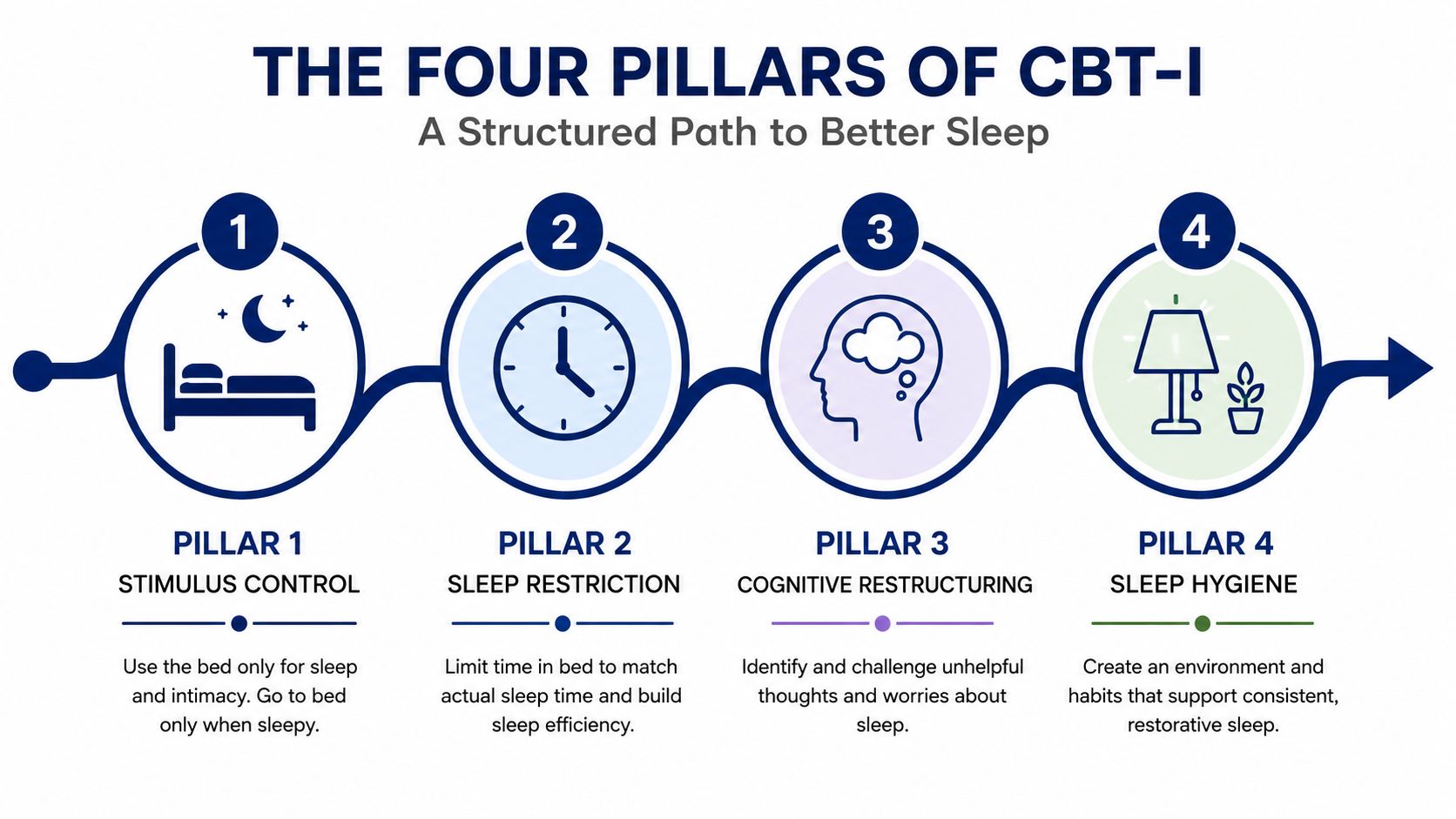
The four working parts
Stimulus control breaks the association between bed and wakefulness. The bed is reserved for sleep and intimacy, not scrolling, clock-watching, work, or anxious problem-solving. If wakefulness persists, the person leaves the bed for a quiet activity in dim light and returns only when sleepy. The exact timing should follow a clinician's or program's instructions rather than becoming another rigid rule.
Sleep restriction sounds severe, but it means matching time in bed more closely to actual sleep. This builds sleep drive and reduces long periods of frustrated wakefulness. It should be prescribed carefully, particularly when a woman has bipolar disorder, untreated sleep apnea, seizure risk, or another condition that makes sleep loss unsafe.
Cognitive restructuring targets thoughts such as “tomorrow will be ruined” or “the body has forgotten how to sleep.” Those thoughts feel factual at 3 a.m., but they increase arousal. CBT-I replaces them with more accurate, less threatening interpretations.
Sleep hygiene supports the other pillars. A cool room, regular wake time, light exposure, and sensible caffeine and alcohol habits matter, but hygiene alone rarely fixes conditioned insomnia.
An eight-week working outline
A structured plan can begin with a sleep diary and baseline assessment, followed by several weeks of stimulus control and clinician-guided sleep scheduling. The final phase gradually expands time in bed as sleep becomes more consolidated. Digital CBT-I programs and therapist-led treatment can both provide structure, accountability, and reassessment.
The highest-yield investment is usually retraining sleep before adding another sedating product.
The evidence also explains why generic advice disappoints. Education may improve awareness, but it doesn't directly change the behaviors and beliefs that maintain insomnia. CBT-I does. It should be discussed before prescription hypnotics or a growing shelf of supplements.
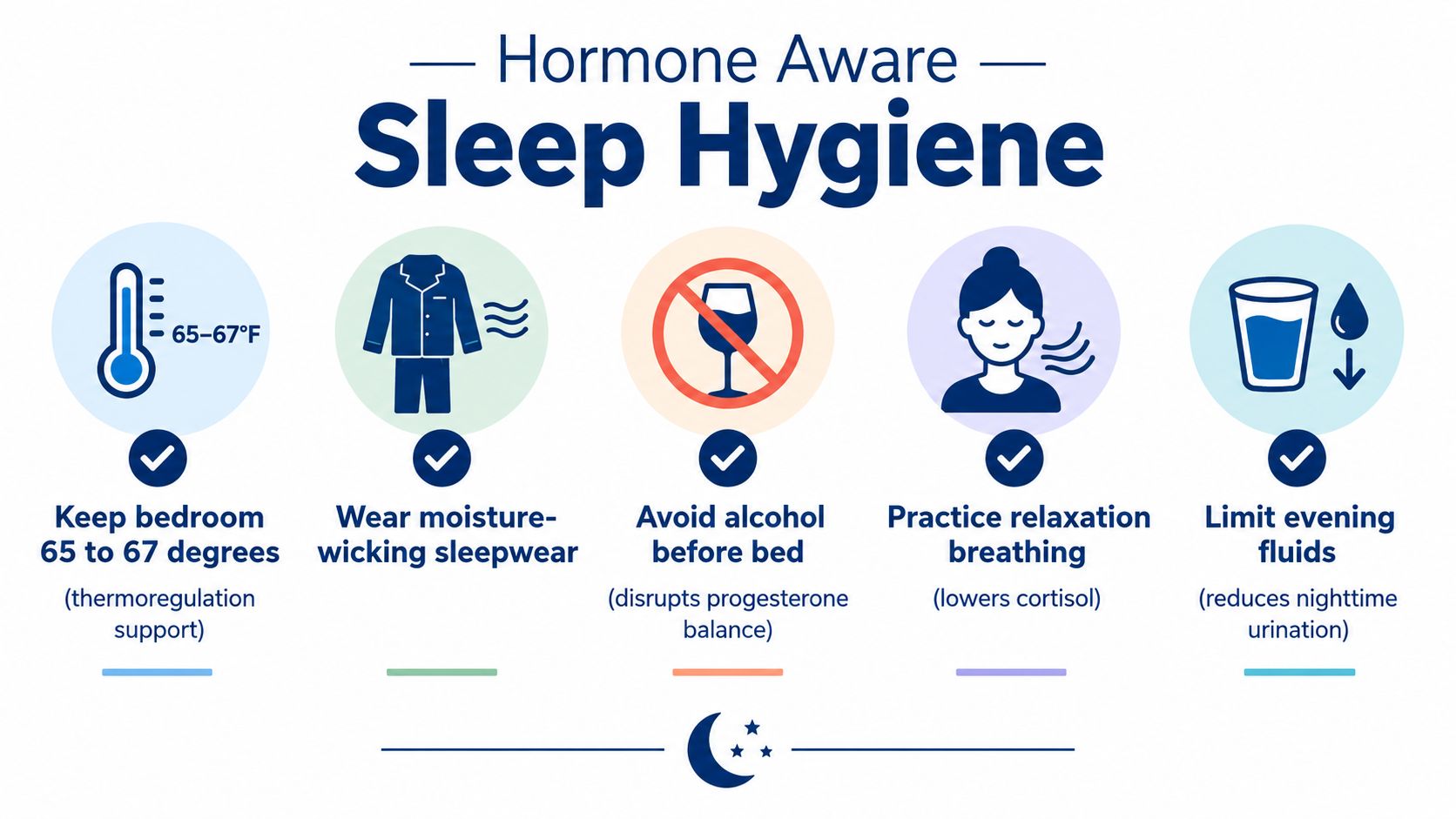
Hormone Aware Sleep Hygiene That Goes Beyond the Basics
Generic sleep hygiene tells everyone to keep a schedule and avoid screens. That advice isn't useless, but it misses the reason a perimenopausal woman may wake hot, alert, and unable to settle. The bedroom needs to support temperature regulation, while the daily routine needs to strengthen circadian timing.
A cool room is a practical starting point. Lighter layers, the most breathable bedding you already have, a fan if one is available, and a spare layer within reach can reduce the disruption caused by sweating. The room should feel cool enough for comfort without creating a new reason to wake.
Timing beats perfection
A final substantial meal is usually better placed several hours before bed than immediately before lying down. Evening fluids should be moderated when nighttime urination is part of the pattern, but daytime hydration shouldn't be sacrificed. Caffeine deserves an honest audit, especially when a woman reports racing thoughts or light sleep despite feeling tired.
Morning light is another high-value habit. Outdoor light soon after waking helps anchor the sleep-wake system, especially when the wake time is consistent. Readers who want a deeper explanation of timing and light can review circadian rhythm disruption and sleep.
Alcohol also deserves a direct test. A drink may make sleep onset feel easier while increasing the chance of fragmented sleep later. A two-week alcohol-free comparison, with the same bedtime and wake time, gives a clearer answer than guessing.
Match the routine to the night
On a night with hot flashes, cooling and symptom notes take priority. On a night without heat, the focus should shift toward stimulus control, mental decompression, and a stable wake time. The same routine doesn't need to carry every possible intervention.
A sleep diary should record what happened before the awakening, not just how bad the night felt. That distinction can reveal whether heat, alcohol, late food, stress, bathroom trips, or an unrelated sleep disorder is the main disruptor. Objective tracking has also linked the menopausal transition with increased wake after sleep onset, so repeated waking shouldn't be written off automatically as an unavoidable life stage (Harvard analysis of sleep patterns during perimenopause).
Melatonin Magnesium and Herbs Without the Hype
Supplements can have a place, but they shouldn't outrank CBT-I, symptom assessment, or treatment for sleep apnea and restless legs. The strongest consumer mistake is choosing a product by the length of its ingredient list. A long formula doesn't prove that it addresses the dominant sleep phenotype.
| Supplement | Best for | How to dose | Dose trap to avoid | Watch out for |
|---|---|---|---|---|
| Melatonin | Sleep timing and, for some people, sleep onset | Start with the lowest labeled amount and assess response | Assuming more produces deeper sleep | Morning grogginess, interactions, and use with blood thinners |
| Magnesium glycinate or threonate | Relaxation or correcting inadequate intake | Use a clinician or product-label range | Treating it as a direct insomnia cure | Kidney disease, gastrointestinal effects, and medication interactions |
| Ashwagandha | Stress-related arousal | Use a standardized product at its labeled amount | Treating marketing claims as proof for menopausal insomnia | Thyroid medication, pregnancy, nursing, and medical conditions |
| Herbal blends with valerian, lemon balm, or L-theanine | A calming bedtime ritual and possible sleep-onset support | Follow the formula's labeled serving | Combining several sedating blends at once | Sedation, allergies, medication interactions, and unclear ingredient amounts |
What earns a trial
Melatonin is more relevant to sleep timing than to repeated hot-flash awakenings. Magnesium may make sense when muscle tension, dietary inadequacy, or clinician guidance points in that direction, but it isn't a substitute for behavioral treatment. Ashwagandha deserves extra caution for anyone taking thyroid medication. Herbal blends have mixed evidence and can make it difficult to identify which ingredient caused benefit or side effects.
A woman considering a blend should check the full label, avoid stacking multiple sedating products, and run the plan past a pharmacist when prescription medication is involved. Anyone taking a blood thinner should ask a clinician before using melatonin. The product label matters more than an influencer's dose recommendation.
As one example of reading a label this way, Nite Cap is a capsule blend of valerian, chamomile, GABA, L-tryptophan, lemon balm, and passion flower with 2 mg of melatonin. By the logic above, a blend like this fits a timing-focused evening routine better than it fits hot-flash awakenings, and it should be tried on its own rather than stacked with other sleep products.
The sensible ranking is straightforward:
- CBT-I first, especially when insomnia has become a repeated pattern.
- Targeted medical evaluation next, when hot flashes, mood symptoms, breathing, or leg sensations dominate.
- A single supplement trial, only when the purpose is specific and the safety screen is clear.
A focused guide to sleep support supplements can help organize options, but it shouldn't turn sleep into a shopping project.
Building a Realistic Evening Routine You Will Actually Follow
A workable routine doesn't need special lighting, multiple journals, or an elaborate wellness setup. It needs a few actions that remain possible on a workday when the household is still active and the woman is already tired.
The essentials are a consistent wake time, a bedroom that stays comfortable, and a plan for leaving the bed during prolonged wakefulness. Everything else is a layer. A warm shower, breathing practice, reading, or a supplement can support the routine, but none should become a condition for sleep.
A worknight version
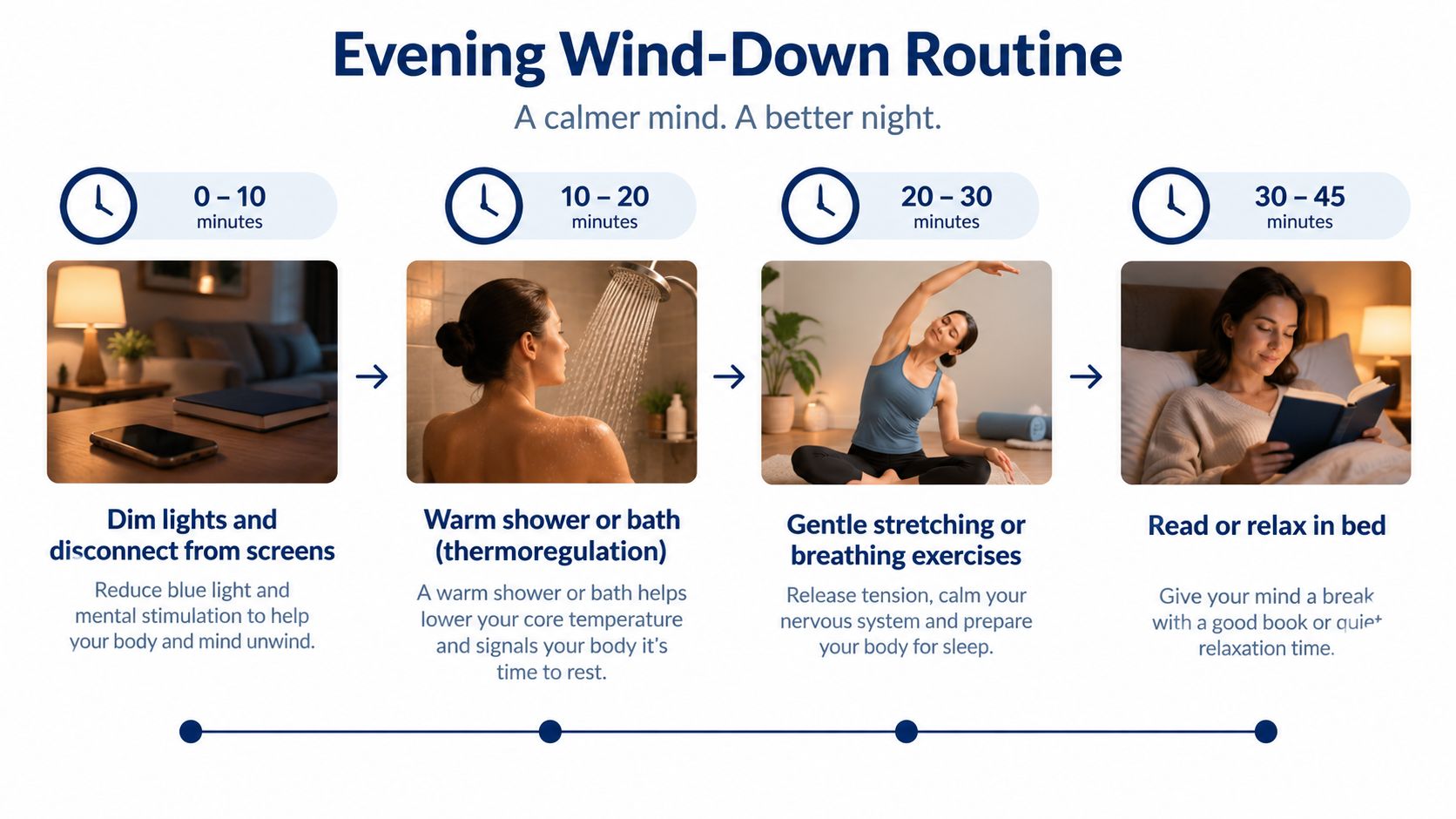
Thirty to forty-five minutes before bed, the sequence can look like this:
- Set the room first. Cool the bedroom, lay out lighter sleepwear, dim the lights, and remove the phone from the bed area.
- Empty the mental inbox. Write down unfinished tasks and the next practical action for each one. The purpose is containment, not perfect journaling.
- Use a quiet transition. Read something undemanding, stretch gently, or practice slow breathing.
- Apply stimulus control. Go to bed only when sleepy. If wakefulness becomes sustained, leave the bed and return when sleepiness returns.
- Add one optional experiment. A woman testing magnesium should test it alone. A woman testing melatonin should use the lowest labeled amount and reserve it for a clear timing reason.
A weekend reset
A weekend routine should preserve the wake time instead of compensating with a long lie-in. Morning outdoor light, ordinary daytime movement, and a familiar wind-down sequence are more useful than trying to erase the week in one night.
When a hot flash has already happened, the response should stay boring and efficient. Cool the body, change damp clothing if needed, avoid checking the clock, and leave the bed if wakefulness persists. The aim is to prevent one symptom from becoming a full night of conditioned alertness.
Repeatability matters more than a perfect routine. A simple plan followed consistently will teach more than a complicated plan abandoned after a difficult night.
When to Stop Self Managing and Talk to a Clinician
Self-management is reasonable when symptoms are occasional and daytime function remains intact. It stops being sufficient when sleep disruption becomes persistent, distressing, or suspicious for another condition.
A clinician should be involved when any of these signals appears:
- Repeated nightly disruption: Awakenings continue regularly and daytime concentration, energy, or mood are changing.
- Possible sleep apnea: Loud snoring, gasping, witnessed breathing pauses, morning headaches, or marked daytime sleepiness deserve evaluation.
- Possible restless legs syndrome: An urge to move the legs, unpleasant sensations, and worsening symptoms during rest or at night point beyond ordinary insomnia.
- Mood or anxiety changes: Persistent anxiety, low mood, panic, irritability, or loss of functioning should not be treated with sleep supplements alone.
Before an appointment, a woman can note whether the STOP-BANG questions raise concern for obstructive sleep apnea, whether the International Restless Legs Syndrome questions fit her symptoms, and whether the PHQ-9 or GAD-7 would capture mood or anxiety problems. These tools organize a conversation. They aren't diagnoses.
Ask for a treatment sequence
The first request should be a sleep-focused history that covers awakenings, hot flashes, alcohol, caffeine, medications, pain, nocturia, breathing, leg sensations, and mood. A validated insomnia or sleep-quality questionnaire can make the pattern easier to describe.
Next, ask about a CBT-I referral, either digital or therapist-led. If vasomotor symptoms are prominent, discuss whether hormone therapy is appropriate based on medical history, risks, preferences, and symptom burden. Prescription hypnotics belong in a careful shared decision, not as an automatic response to a difficult week.
Primary care is a sensible first stop for triage. A menopause-certified clinician can address hormone-therapy questions, while a sleep specialist is the right escalation for suspected apnea, restless legs, or persistent insomnia that hasn't responded to a structured plan. Recent menopause guidance emphasizes individualized assessment of insomnia, depression, anxiety, pain, nocturia, and sleep-disordered breathing rather than treating every complaint as a hot-flash problem (menopause society reporting on CBT for menopausal insomnia).
Sleep All Nite offers nighttime wellness products in capsule, gummy, and dissolvable-strip formats, organized by nighttime goal and including melatonin-free options. If you add a supplement alongside a CBT-I and clinician-guided plan, you can compare formats and ingredient amounts at Sleep All Nite.
*These statements have not been evaluated by the Food and Drug Administration. These products are not intended to diagnose, treat, cure, or prevent any disease.
This article is for general education and isn't medical advice. Talk with a healthcare professional before starting a supplement, especially if you're pregnant or nursing, under 18, managing a medical condition, or taking prescription medication.


