
How to Treat Insomnia: Evidence-Based Relief for 2026


Melatonin gummies, prescription sleeping pills, and elaborate bedtime hacks are usually the first answers people find when they search for how to treat insomnia. They're also often the wrong place to start. Persistent insomnia rarely comes from a simple shortage of one supplement. It usually involves a learned association between bed and wakefulness, an unstable sleep schedule, anxious thoughts, or an untreated condition that keeps the nervous system alert.
The more reliable approach is to identify the mechanism, rebuild sleep pressure, and retrain the brain's response to the bedroom. Supplements and medication can have a role, but they shouldn't replace a structured plan, especially when insomnia is chronic or distressing.
Table of Contents
- Why CBT-I Comes First for Insomnia Treatment
- The Five Core CBT-I Techniques Explained
- Melatonin and OTC Options What the Data Actually Shows
- Lifestyle and Environmental Adjustments That Actually Work
- Building Your Personalized Insomnia Treatment Plan
- When to Seek Professional Help for Insomnia
- What Recovery Looks Like Realistic Expectations
Why CBT-I Comes First for Insomnia Treatment
Cognitive behavioral therapy for insomnia, or CBT-I, is the evidence-based starting point for chronic insomnia. The American College of Physicians recommends it as the initial treatment. Guidance from the American Academy of Sleep Medicine and the U.S. Veterans Affairs and Department of Defense also places behavioral care ahead of melatonin for chronic insomnia, as summarized by the National Center for Complementary and Integrative Health.
CBT-I is a structured treatment for the habits, thought patterns, and sleep timing that keep insomnia going. It may include stimulus control, sleep scheduling, sleep restriction, cognitive restructuring, sleep hygiene, and relaxation training. Used together, these methods reduce the time spent awake in bed and rebuild a more dependable connection between the bedroom and sleep.
Access is the practical obstacle. A trained CBT-I clinician may not be available nearby, insurance coverage can be limited, and regular appointments may not fit someone's schedule. Telehealth, group treatment, and validated digital programs can widen access, but people with complex symptoms or an unclear diagnosis may still need direct clinical assessment.
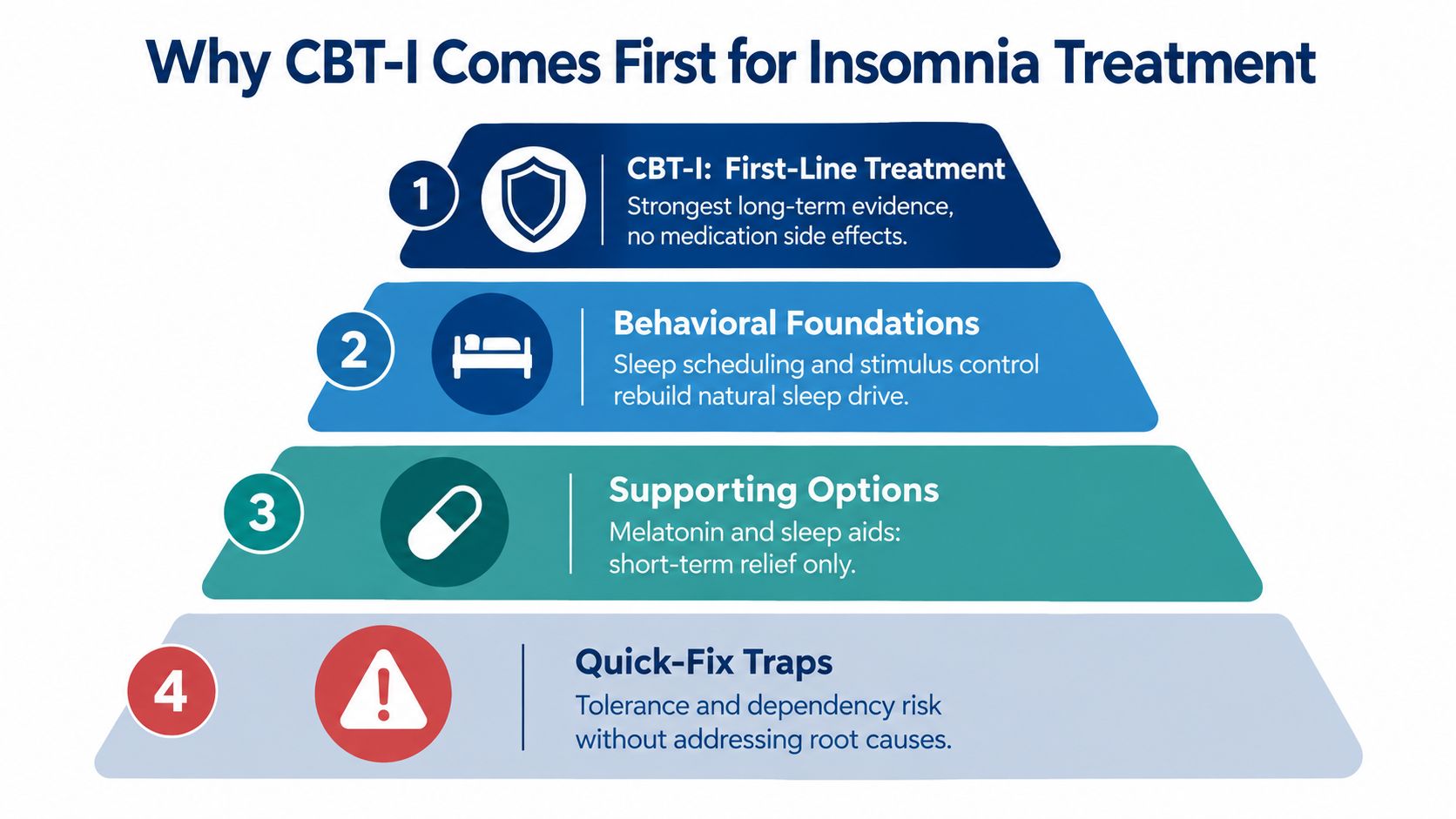
Why behavioral treatment beats a quick fix
A sleeping pill may provide short-term relief, but it does not necessarily change the conditioned alertness, irregular schedule, or worry that brings wakefulness back the following night. Medication can fit a specific clinical situation, yet long-term use requires medical supervision because benefits, side effects, tolerance, interactions, and withdrawal risk differ among drugs.
CBT-I targets the pattern itself. Clinical guidance supports meaningful improvement for many patients, while research also shows that some people do not reach remission and may need additional assessment or treatment. One meta-analysis reported 36.0% remission after treatment compared with 16.9% in controls, with the findings published in JAMA Internal Medicine.
Practical rule: Consider a sleep aid for a specific short-term need, but treat chronic insomnia with a plan designed to change the sleep pattern.
What the first steps look like
Treatment commonly starts with a sleep diary covering bedtime, estimated sleep time, awakenings, out-of-bed time, naps, and daytime effects. A clinician uses that record to set a realistic sleep window instead of extending time in bed and creating more opportunity for wakefulness.
The early phase can feel counterintuitive. Keeping a consistent wake time and adjusting time in bed may temporarily challenge expectations, especially after several poor nights. The purpose is to consolidate sleep and restore confidence in the routine, not to restrict sleep indefinitely.
CBT-I also gives people a repeatable response to a bad night, racing thoughts, or early awakening. That practical skill is what makes it more durable than relying on a new supplement whenever sleep deteriorates.
The Five Core CBT-I Techniques Explained
CBT-I works because each technique targets a different part of the insomnia cycle. One method changes what the bed means to the brain. Another rebuilds sleep drive. Another reduces the mental pressure that turns one bad night into a bigger problem. Used together, they give people a repeatable system instead of a rotating list of sleep aids.
Stimulus control
Stimulus control is often the first technique that changes the night in a noticeable way. It is straightforward on paper and harder in real life, because it asks a tired person to stop chasing sleep in bed.
- Go to bed when sleepy: A fixed bedtime can backfire if the body is not ready for sleep.
- Reserve the bed for sleep and sex: Work, television, scrolling, and worry teach the brain that bed is a place for alertness.
- Leave the bed during prolonged wakefulness: If sleep does not come after roughly 15 to 20 minutes, get up, keep the lights dim, and do something quiet until sleepiness returns.
- Keep a fixed wake time: The morning rise time anchors the sleep-wake rhythm.
- Avoid naps that weaken sleep drive: Daytime sleep often makes the next night harder, especially after poor sleep.
The person staring at the ceiling at 2 a.m. is usually trying harder and harder to make sleep happen. That effort becomes part of the problem. Stimulus control breaks that link and rebuilds the association between bed and sleepiness.
Sleep restriction
Sleep restriction is the part of CBT-I that many people resist at first, and it is often the part that changes the pattern fastest when done correctly. The idea is simple. Time in bed should match actual sleep more closely, rather than giving insomnia more hours in which to show up.
A clinician usually sets the initial sleep window from sleep diary data. The goal is not sleep deprivation for its own sake. The goal is to build enough sleep pressure that sleep becomes more consolidated and long awake periods shrink.
A common working target is sleep efficiency around 85%. If efficiency rises above about 90%, the sleep window is often increased by 15 to 20 minutes. If it drops below 80%, the window may be tightened by a similar amount. Many programs also avoid pushing time in bed too low, because excessive daytime sleepiness creates safety problems and makes the plan harder to follow.
This is not a technique to improvise if someone has untreated sleep apnea, bipolar disorder, severe daytime sleepiness, or safety-sensitive work. In practice, the fixed wake time is just as important as the bedtime. People who keep shifting mornings around usually do not get the full benefit.
Cognitive restructuring
Insomnia is rarely just a nighttime problem. It is also the stream of predictions that starts as soon as the person notices they are awake. “If I do not fall asleep now, tomorrow is ruined.” “I will never function.” “Something is wrong with me because I am still awake.”
Cognitive restructuring teaches people to catch those thoughts and answer them more accurately. It does not ask anyone to pretend poor sleep feels fine. It reduces the extra fear and performance pressure that keep the nervous system activated.
A better response might be, “Tomorrow may be harder, but one rough night is manageable,” or, “Rest still has value even if sleep is delayed.” That shift sounds small. In practice, it can make the difference between an hour of frustrated effort and a calmer return to sleepiness.
Sleep hygiene
Sleep hygiene matters, but it is often oversold. A cooler, darker bedroom, a regular routine, sensible caffeine and alcohol habits, daytime movement, and a wind-down period all support better sleep. On their own, they usually do not resolve chronic insomnia.
That distinction matters. Many people have already tried blackout curtains, white noise, herbal teas, and new pillows by the time they look for real help. Those changes can help at the margins. They do not replace stimulus control and sleep scheduling, which address the pattern that keeps insomnia going.
Relaxation training
Relaxation methods reduce physical arousal before bed and during nighttime wakefulness. Slow breathing, progressive muscle relaxation, guided imagery, and body scan exercises can all help. They work better as skills practiced regularly than as an urgent command to “relax” in the middle of panic about not sleeping.
The techniques are complementary. Stimulus control handles the bed. Sleep restriction handles timing. Cognitive restructuring handles fear. Sleep hygiene handles avoidable disruption. Relaxation training handles arousal.
This video walks through how the protocol looks in practice:
Melatonin and OTC Options What the Data Actually Shows
Melatonin is popular because it sounds like a direct, natural answer to sleeplessness. The evidence is more modest. A review of 12 studies involving 2,666 people with insomnia found that melatonin improved sleep-onset latency and daytime sleepiness, but didn't improve sleep quality or time awake during the night, according to the NCCIH summary of sleep-disorder research.
A meta-analysis of 19 studies with 1,683 participants reported an average reduction in time to fall asleep of about 7 minutes and an increase in total sleep time of about 8 minutes compared with placebo (meta-analysis of melatonin for primary sleep disorders). Those are measurable effects, but they're modest. They don't support presenting melatonin as a high-impact treatment for persistent insomnia.
Why guidelines remain cautious
The American Academy of Sleep Medicine's 2017 guideline and the VA/DoD 2019 guideline recommended against melatonin for chronic insomnia because the evidence wasn't strong enough. That position makes sense when the goal is durable treatment rather than a small average change in sleep timing.
Melatonin may fit better when the primary problem involves sleep timing or circadian disruption, rather than generalized chronic insomnia. Timing, dose, interactions, age, pregnancy status, medical conditions, and other medications all matter. A higher dose isn't automatically stronger or more appropriate, and taking more can increase the chance of unwanted effects without addressing the cause of wakefulness.
A useful comparison looks like this:
| Option | What it may offer | Main limitation |
|---|---|---|
| Melatonin | Support for sleep timing and modest help with sleep onset | Not a first-line treatment for chronic insomnia |
| Magnesium | A supplement some people use as part of relaxation | Evidence for insomnia varies, and it doesn't substitute for CBT-I |
| L-theanine | A possible wind-down option for people who feel mentally activated | It isn't established as a stand-alone treatment for chronic insomnia |
| Herbal blends | A combination approach that may fit a bedtime ritual | Multi-ingredient formulas make individual effects harder to judge |
| Prescription medication | Clinician-supervised short-term or situation-specific support | Side effects, interactions, tolerance, and dependence concerns require oversight |
Readers comparing ingredients can review this guide to sleep support supplements, but supplement labels shouldn't be mistaken for clinical treatment plans. A person taking medication, managing a medical condition, pregnant or nursing, or considering a supplement for a child should ask a clinician first.
The practical hierarchy is clear. CBT-I comes first for chronic insomnia. OTC products may serve as limited adjuncts or temporary options when a clinician considers them appropriate. They shouldn't become a way to postpone evaluation of sleep apnea, circadian disruption, pain, mood symptoms, or medication effects.
Lifestyle and Environmental Adjustments That Actually Work
Lifestyle changes work best when they reinforce the body's timing and reduce unnecessary alerting. They're less effective when someone treats them as a collection of superstitions, changes everything at once, and then panics after one imperfect night.
Morning light is a strong daily anchor. Spending time in bright outdoor light soon after waking can help reinforce a stable circadian schedule, while dimmer light and less screen exposure in the evening reduce stimulation before bed. A rotating-shift worker may need a different light strategy from someone with a standard daytime schedule, which is why a fixed plan matters more than generic advice.

Make the bedroom boring and predictable
The bedroom should support sleep rather than invite alertness. A cool, dark, quiet room, comfortable bedding, and covered clocks can reduce sensory triggers. A fan or a free white-noise app may help someone who wakes easily to unpredictable sound.
Exercise supports sleep pressure and stress regulation, but intense activity immediately before bed can leave some people physiologically activated. Earlier exercise is usually easier to integrate, while the right timing depends on the person's response. The relevant question isn't whether exercise is universally good. It's whether the chosen timing leaves the body ready to settle.
The alcohol myth deserves direct attention. Alcohol may make falling asleep feel easier, but it can fragment sleep later in the night. Someone who regularly wakes at 3 a.m. after drinking should treat alcohol as a possible contributor rather than as a sleep aid.
A workable evening sequence
A realistic routine can be short:
- Close the day: Write down unfinished tasks and tomorrow's priorities before entering the bedroom.
- Reduce stimulation: Dim lights, stop work, and move the phone away from the bed.
- Use a repeatable cue: Read something calm, take a warm shower, or practice slow breathing.
- Go to bed when sleepy: Don't use an early bedtime to compensate for a poor night.
- Leave if wakefulness persists: Return only when sleepiness comes back.
The compensation trap is common. After a bad night, someone goes to bed much earlier, sleeps later, naps, and spends more time awake in bed. That response feels protective, but it weakens sleep drive and can destabilize the next night. A consistent wake time usually does more to restore rhythm than adding extra time in bed.
People whose sleep timing changes with travel, night work, or irregular schedules can learn more about the issue in this guide to circadian rhythm disruption. The right plan may involve a clinician when timing problems overlap with persistent insomnia.
Building Your Personalized Insomnia Treatment Plan
A useful plan begins with the sleep pattern, not the product shelf. A recent disruption after stress, travel, illness, or a schedule change may improve with a steady wake time, morning light, less evening stimulation, and careful stimulus control. Persistent insomnia with daytime impairment calls for a structured CBT-I pathway, even when access is inconvenient.
Match the response to the situation
Use the following framework to choose the next step:
- Recent and situational: Keep the morning schedule steady, remove clear evening disruptions, and avoid converting a few poor nights into a permanent bedtime change.
- Persistent and distressing: Start a sleep diary and pursue CBT-I through a trained clinician, telehealth service, or credible digital program.
- Access is limited: Use a self-guided CBT-I workbook or digital program while seeking professional support. Self-guided treatment still demands consistency, particularly when sleep restriction is part of the plan.
- Circadian or shift-work pattern: Get advice on light exposure, wake timing, and carefully timed interventions instead of treating every problem as ordinary difficulty falling asleep.
- Possible medical contributor: Arrange an evaluation before adding more supplements.
Access remains a practical barrier. A 2026 study of the U.S. insomnia patient journey found that clinicians and patients alike describe too few trained providers, high costs, time demands, and weak primary-care integration as obstacles to CBT-I, with medication often used instead (study of the insomnia patient journey). Digital delivery and stepped care may broaden access, but engagement and coverage still need attention.
Track the variables that matter
A sleep diary should record more than a sleep score. Note when you get into bed, estimated time asleep, awakenings, final wake time, naps, caffeine, alcohol, exercise, medication, and daytime alertness. Wearables can add context, but their sleep-stage estimates should not outweigh symptoms or a clinician's assessment.
Judge progress by fewer prolonged periods of wakefulness, a steadier schedule, less fear of bedtime, and better daytime function. Perfect sleep every night is not the target. Review the practical measures in this guide to sleep quality improvement when deciding which changes deserve attention.
Stop self-adjusting and seek clinical advice if a plan causes severe sleepiness, unsafe driving, mood destabilization, or worsening symptoms.
Insomnia phenotypes also influence treatment choices. Repeated 3 a.m. awakenings, rotating shift work, or symptoms suggesting sleep apnea may require a different evaluation from conditioned arousal at bedtime. A review of phenotype-based and circadian insomnia treatment describes this direction while noting that evidence on adherence, burden, and cost-effectiveness remains limited.
When to Seek Professional Help for Insomnia
Self-management is reasonable for a mild, recent sleep disruption. It becomes inadequate when insomnia persists, causes significant daytime impairment, or keeps returning despite consistent behavioral changes. Professional support is particularly important when sleep problems occur alongside depression, anxiety, bipolar symptoms, pain, medication changes, loud snoring, gasping, or suspected sleep apnea.
Alcohol and unprescribed medication are warning signs, too. Using either to force sleep can hide the underlying pattern and create new risks. A clinician can review the full medication list, medical history, mood, work schedule, sleep habits, and possible breathing disorders rather than treating wakefulness in isolation.
What an evaluation may include
A sleep specialist or primary-care clinician may ask for a sleep diary and a detailed account of bedtime, awakenings, wake time, naps, substances, and daytime symptoms. A sleep study may be appropriate when symptoms suggest sleep apnea or another sleep disorder. The purpose is to find the cause before choosing treatment.
Patients can prepare by asking:
- Is CBT-I available through this practice or by referral?
- Could medication, pain, mood symptoms, menopause-related changes, or shift work be affecting sleep?
- Are there signs that a sleep study is needed?
- What is the intended duration and monitoring plan for any prescription?
- What should happen if the first treatment doesn't work?
Cost, insurance coverage, wait times, and discomfort discussing sleep can delay care. A sleep diary, a written list of medications and supplements, and a clear description of daytime effects can make a short appointment more productive. When access to a specialist is limited, asking about telehealth, digital CBT-I, group treatment, or a trained behavioral health provider may open another route.
The strongest request isn't “give something to knock me out.” It's “help identify what is maintaining the insomnia and provide an evidence-based plan.” That framing keeps the focus on durable function rather than sedation alone.
What Recovery Looks Like Realistic Expectations
Recovery rarely follows a straight line. The first phase of sleep scheduling can feel difficult, and a person may have setbacks after travel, illness, stress, alcohol, or a change in work hours. That doesn't mean the treatment has failed.
The useful signs are gradual: less time awake in bed, fewer catastrophic thoughts at night, a more stable wake time, and renewed confidence that sleep can return without escalating supplements or medication. CBT-I guidance commonly describes programs lasting four to eight sessions, and durable improvement depends on practicing the methods consistently rather than chasing perfect nights, as outlined by the Cleveland Clinic CBT-I guide.
Even when specialist access is limited, behavioral techniques, a stable environment, and carefully considered OTC use can provide a practical starting point. The goal isn't to win a nightly battle. It's to make sleep less forced, less frightening, and more automatic again.
Sleep All Nite offers nighttime wellness products in formats including dissolvable oral strips, capsules, gummies, and a topical night cream, with options organized around goals such as winding down and a consistent bedtime routine. Visit Sleep All Nite to review the available products and choose an option that fits alongside, rather than replaces, an evidence-based insomnia plan.
*These statements have not been evaluated by the Food and Drug Administration. These products are not intended to diagnose, treat, cure, or prevent any disease.
This article is for general education and isn't medical advice. Talk with a healthcare professional before starting a supplement, especially if you're pregnant or nursing, under 18, managing a medical condition, or taking prescription medication.


