
Sleep Quality Improvement: Your Complete Blueprint


CBT-I is the best-evidenced route to better sleep, and the size of its effect is worth knowing precisely. A landmark meta-analysis in the Annals of Internal Medicine found pooled improvements of about 19 minutes in sleep onset latency, 26 minutes in wake after sleep onset, and roughly 10 percentage points in sleep efficiency, while total sleep time barely moved, gaining under 8 minutes (CBT-I meta-analysis in Annals of Internal Medicine). That last figure is the interesting one. Better sleep, measured properly, comes from reducing sleep effort and engineering the right timing, not from spending more hours in bed.
Generic sleep hygiene gets too much credit. A cooler room, fewer notifications, and a soothing routine help, but they can't fully correct a delayed body clock, rotating shifts, hormone-linked awakenings, or the anxiety created by watching the minutes pass. Sleep quality improvement is a systems problem, built around light, timing, arousal, environment, and the reason sleep is breaking down.
Table of Contents
- Rethinking Sleep Quality Improvement
- Designing Your Circadian Foundation
- The Evening Wind-Down Routine
- Navigating Supplements and Melatonin Myths
- Using Data to Refine Your Protocol
- Tailoring the Approach for Your Lifestyle
- Safety Notes on Sleep Supplements
Rethinking Sleep Quality Improvement
Sleep quality improvement fails when bedtime becomes a nightly test of willpower. Exhausted adults may avoid heavy meals, use blackout curtains, silence their phones, and get into bed early, yet remain alert for hours. More rules do not solve a system running on poor timing or excessive arousal.
The central distinction is sleep effort versus sleep readiness. Sleep effort means checking the clock, predicting tomorrow's fatigue, testing for drowsiness, and forcing relaxation. That surveillance keeps the brain involved in the task. Sleep readiness develops when consistent timing cues, sufficient sleep pressure, low stimulation, and a sleep-associated bedroom work together.
CBT-I provides the clearest evidence-based framework for breaking this cycle. Its protocol combines sleep restriction and stimulus control, while tracking sleep latency, wake after sleep onset, and sleep efficiency to assess progress (evidence on CBT-I outcomes and methodology). It addresses insomnia as a learned, conditioned pattern, not a failure to relax. The practical lesson is direct: stop adding effort when effort itself has become part of the problem.

Stop treating the night as the only problem
A confused sleep system cannot be repaired at 11 p.m. with extra determination. Shift workers need a deliberate light and wake-time plan. Perimenopausal women need a strategy that accounts for temperature changes and awakenings. People exhausted by failed melatonin experiments need better timing and stronger behavioral anchors, not automatically another supplement.
Stable wake time and appropriately timed light shape the day that precedes sleep. Evening choices then reinforce or disrupt that rhythm. This approach treats sleep as one system, rather than a collection of isolated symptoms.
Practical rule: Aim to make sleep biologically plausible, not to produce unconsciousness on demand.
Ask when bright light occurs, what keeps the nervous system alert, and what the bedroom predicts. Those answers create a usable protocol and reduce the pressure to force sleep tonight.
Designing Your Circadian Foundation
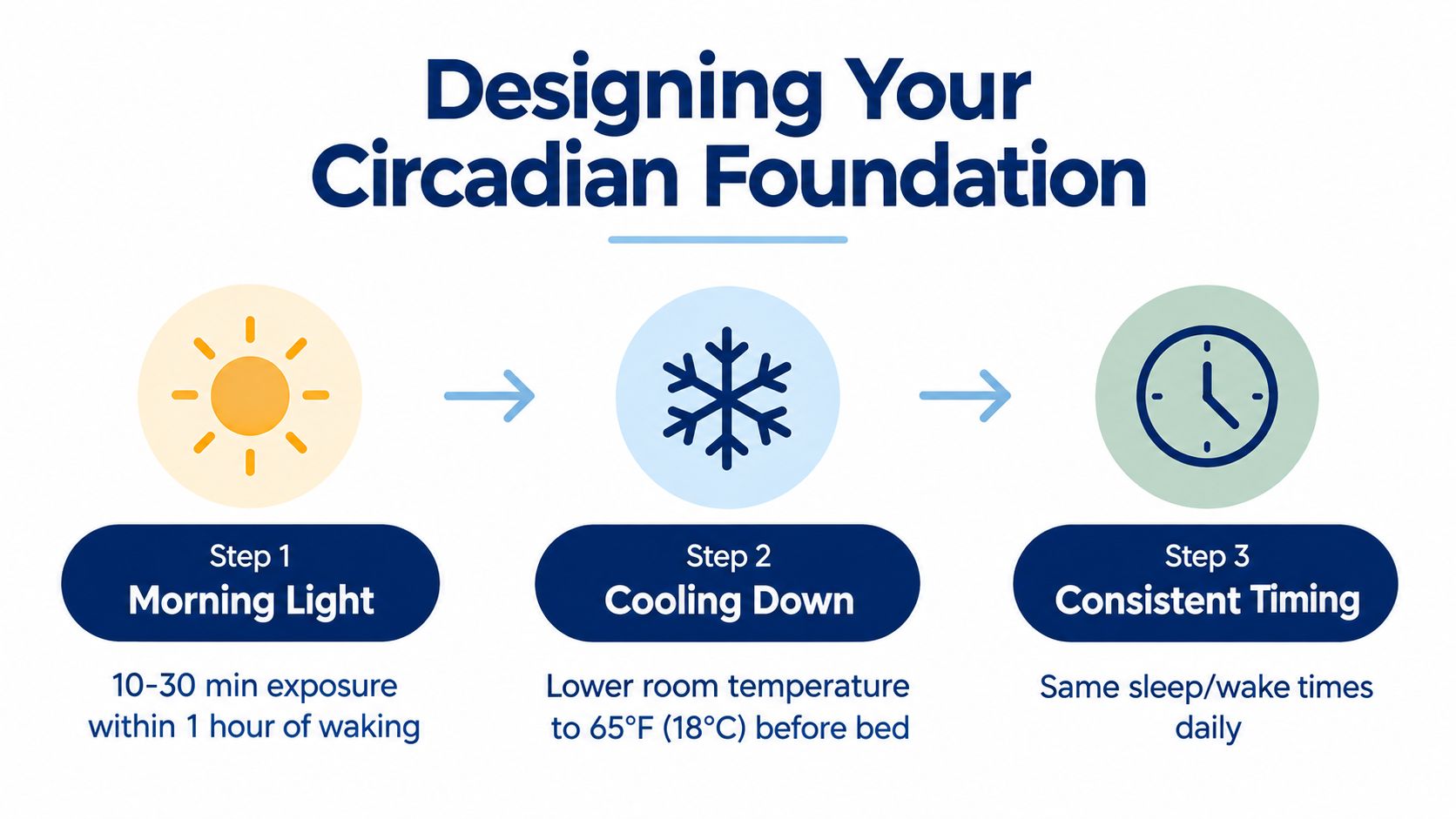
Sleep quality improves when the internal clock receives clear, repeatable cues. Morning light is the strongest practical lever for shifting a delayed sleep schedule earlier, especially when it arrives soon after waking. An outdoor walk usually beats an evening walk for this purpose because it delivers light at the point in the day when the clock can use it to establish daytime.
Anchor the morning first
The routine should begin with a consistent wake time, including days off whenever possible. Within the first hour, the sleeper should go outdoors rather than relying only on indoor lighting. Cloudy conditions still provide useful environmental brightness, and movement adds a separate daytime cue without turning the routine into a complicated treatment plan.
The evening should then become progressively less stimulating. Screens don't need to be treated as forbidden objects, but brightness, proximity, emotionally activating content, and endless scrolling all work against sleep readiness. Dimmer lighting and a predictable transition are more useful than obsessing over one wavelength of light while ignoring a stressful work message or a late-night argument.
Build the bedroom around cooling
The body naturally loses heat as sleep approaches. A warm shower or bath can support that transition because the subsequent cooling period may act as a useful bedtime signal. The bedroom should feel cool, dark, and quiet, with bedding adjusted for personal comfort rather than a rigid universal temperature.
A practical foundation looks like this:
- Morning light: Spend time outside soon after waking, preferably while walking.
- Evening dimming: Lower household lighting and reduce stimulating screen use before bed.
- Temperature transition: Use a warm shower, then sleep in a room that doesn't trap excessive heat.
- Timing consistency: Keep wake and sleep times stable enough for the body to anticipate them.
The relationship between stress hormones and fragmented sleep deserves separate attention, particularly for people who feel tired but wired. The guidance on cortisol and sleep problems can help identify when arousal, rather than a simple lack of tiredness, is keeping the system active.
For someone who wants a precisely defined supplement format within a bedtime routine, Drift Off is a raspberry-flavored oral strip that dissolves on the tongue and provides 1 mg of melatonin alongside valerian root, lavender, chamomile, and hibiscus extracts. It should be treated as one optional component, not a replacement for circadian timing, and because melatonin causes drowsiness it belongs at home rather than before driving.
The following visual walkthrough reinforces the sequence of light, cooling, and consistent timing.
The Evening Wind-Down Routine
The “crash and pray” method keeps a person active until exhaustion takes over, then expects the brain to switch off instantly. It fails because physical fatigue and mental deactivation aren't the same event. A structured 60-minute buffer gives the nervous system a gradual descent instead of demanding an abrupt stop.
The first part of the buffer should reduce incoming stimulation. Work email, heated conversations, online shopping, and news can wait. A phone can remain available for essential contact, but it shouldn't be the center of the bedroom. The room itself should signal one purpose, with unnecessary light, clutter, noise, and work materials removed.
Empty the mind before the pillow
Racing thoughts often become louder when the day finally becomes quiet. A short written “mental dump” works because it moves unfinished tasks out of working memory and gives them a defined place for tomorrow. The list should contain concrete actions, not a long emotional analysis.
A useful format is simple:
- Tomorrow's tasks: Write the next physical action for each unfinished item.
- Current worries: Name the concern without trying to solve it at night.
- Open decisions: Record when and where the decision will be handled.
- Sleep response: If wakefulness continues, leave bed briefly for a quiet activity under dim light.
The last point matters. Staying in bed while frustrated teaches the brain that the mattress is a place for alertness. The practical guidance on sleeping when the brain is racing supports this shift away from wrestling with thoughts in the dark.
Treat dinner and drinks as sleep inputs
Late caffeine can preserve alertness long after the person feels ready for bed. Nicotine can also activate the system, while alcohol may make sleep onset easier but can contribute to later wakefulness. The direct recommendation is to move caffeine earlier, avoid nicotine close to bedtime, and stop using alcohol as a sleep aid.
Dinner should be satisfying without becoming a large, uncomfortable event immediately before bed. Carbohydrates don't need to be demonized, and an overly restrictive evening can create hunger that becomes its own sleep disruptor. A steady meal pattern is more useful than chasing a supposedly perfect sleep food.
For people who prefer a chewable, melatonin-free evening option, Nite Bites contain reishi extract, L-theanine, lemon balm, passion flower, and valerian root. They can fit a wind-down ritual, but supplements shouldn't replace the behavioral cues that make the ritual effective.
Navigating Supplements and Melatonin Myths
Melatonin isn't a universal sedative, and more isn't automatically better. Recent evidence includes a personalized intervention study in which melatonin supplements didn't significantly improve sleep duration or sleep quality, while a scoping review grouped doses as low, medium, and high because the optimal dose remains uncertain (recent melatonin findings and dose uncertainty).
That makes high-dose self-escalation a poor default. Someone who feels groggy, vivid-dreamed, or no better after increasing the dose shouldn't respond by increasing it again. The first question is whether the complaint involves timing, difficulty falling asleep, repeated awakenings, or anxiety. Each pattern points toward a different intervention.
Compare the options by the problem
Melatonin makes the most sense when circadian timing is the suspected issue, not when the main problem is conditioned arousal. Immediate-release products are conceptually better suited to a timing signal near sleep onset, while sustained-release products are designed around a longer release pattern. Neither format can correct rotating shifts, irregular wake times, or a bedroom that keeps the brain alert.
Magnesium is a non-hormonal option some adults consider for relaxation, particularly when muscle tension or dietary insufficiency is part of the broader picture. It isn't a substitute for CBT-I, and people with medical conditions or medication concerns should consult a clinician before using it.
Herbal ingredients and amino acids can be part of a calming routine, but “natural” doesn't mean universally appropriate. Valerian, lemon balm, passion flower, L-theanine, and other botanicals can interact with medications or create unwanted sedation in some people. Product labels and professional review matter more than a long ingredient list.
A sensible decision sequence is:
- Correct timing and environment first.
- Use stimulus control and a stable wake time when insomnia persists.
- Choose a supplement only for a defined purpose, with one change at a time.
- Route persistent or complex symptoms toward CBT-I or medical evaluation.
Sleep All Nite groups its nighttime products by goals such as falling asleep, staying asleep, and winding down, and includes melatonin-free formats alongside oral strips, gummies, and capsules. That kind of goal-based selection is more rational than choosing the strongest-looking label, but the sleep support supplement guide shouldn't be treated as a substitute for clinical advice.
A better supplement question: “What specific sleep problem is this meant to address?” If the answer is unclear, the product is probably being used as a ritual of hope rather than a targeted tool.
Pregnant or nursing adults, people under medical care, anyone taking medication, and people with persistent sleep complaints should consult a qualified clinician before using dietary supplements. A prescription discussion also becomes reasonable when insomnia is severe, prolonged, or connected to another suspected condition.
Using Data to Refine Your Protocol
Sleep data earns its place only when it changes your next decision. A wearable may estimate sleep stages, but those readings are not a diagnosis. Use them to spot repeatable patterns, not to grade every night or increase sleep effort.
Track three measures:
| Metric | What it shows | How to use it |
|---|---|---|
| Sleep latency | Time needed to fall asleep | Check whether timing or mental arousal is blocking sleep |
| Wake after sleep onset | Time awake after first falling asleep | Look for links with heat, alcohol, stress, or schedule changes |
| Sleep efficiency | Sleep compared with time in bed | Avoid adding more time in bed when wakefulness is already high |
These are the measures CBT-I research moves most, with the pooled gains concentrated in sleep latency, wake after sleep onset, and sleep efficiency rather than in raw hours slept (CBT-I evidence and tracking approach). Those are study-level averages, not a guaranteed personal result. The practical lesson is clear: build sleep readiness by adjusting timing and conditions, rather than trying harder to force sleep.
Use a weekly review, not nightly judgment
Keep a simple diary with bedtime, estimated sleep onset, awakenings, final wake time, caffeine timing, alcohol, unusual stress, exercise, and bedroom temperature. Review it once a week. Look for changes that repeatedly precede better or worse sleep, especially when your schedule shifts or hormonal symptoms alter the night.
A falling sleep-efficiency pattern usually calls for compressing time in bed, not extending it. Formal sleep restriction can be unsuitable for some medical or psychiatric conditions, so a clinician or trained CBT-I provider should guide this adjustment when insomnia is persistent, severe, or complicated.
One poor wearable score means little if you feel restored the next day. Repeated daytime impairment, frequent awakenings, or a stable pattern of difficulty deserves more attention than a single algorithmic result. Shift workers should compare data within similar shift blocks, while perimenopausal sleepers should record heat and awakenings instead of blaming themselves for poor sleep hygiene.
Use the record to make one controlled change at a time. Data should support clinical judgment, not replace it.
The best sleep metric is the one that produces a safer, clearer action tomorrow.
Tailoring the Approach for Your Lifestyle
A stable routine works differently for a night-shift nurse, a perimenopausal woman waking at 3 a.m., and an adult whose thoughts accelerate the moment the lights go out. The protocol has to match the biological obstacle instead of forcing every sleeper into the same bedtime template.
Shift workers need protected timing
For shift workers, generic sleep hygiene is too weak. Guidance from the American College of Chest Physicians on shift work sleep disorder recommends a 30-minute nap before a shift and short operational naps of under 30 minutes during the second half, along with bright light at 10,000 lux, 1 to 2 feet from the face, for 2 hours in the first half of the shift, and notes that clockwise shift rotations suit workers better than counterclockwise ones (shift-work sleep guidance). That light figure describes a therapy-box protocol rather than ordinary room lighting, so it belongs in a conversation with an occupational health contact rather than a DIY setup.
Beyond the formal guidance, sleep clinicians commonly favor shorter runs of consecutive nights, shifts closer to eight hours than twelve, and a few days of recovery after a night block. Those are rules of thumb rather than published guideline numbers, and most workers do not control their own rota in any case.
Daytime sleep needs physical protection: blackout conditions, an eye mask, earplugs or white noise, and a clear household agreement that the sleep window is not available for errands. Stimulants should be avoided later in a shift if they disrupt morning sleep. Frequent rotation is a major practical problem because it prevents a stable sleep window from forming.
Perimenopausal awakenings need a different explanation
A 3 a.m. awakening isn't automatically poor sleep hygiene. Perimenopause can involve hormone-linked sleep fragmentation, temperature dysregulation, and anxiety-driven awakenings. A global sleep survey commissioned by ResMed reported that 48% of women struggled to fall asleep against 38% of men, with 42% of women naming stress or anxiety as a key barrier (survey coverage of sleep difficulty and women's barriers). That is industry survey data about women generally rather than perimenopause specifically, so read it as background on the gender gap rather than as evidence about this life stage.
Cooling bedding, breathable sleepwear, reviewing evening alcohol and caffeine timing, and using a brief relaxation response can reduce the secondary arousal after waking. Recurrent or disruptive symptoms deserve a clinician's assessment rather than another generic bedtime checklist.
For the racing mind, the instruction is equally direct: stop solving tomorrow at 3 a.m. Write the concern down, leave the bed if wakefulness becomes frustrating, and return only when sleep readiness returns. Persistent insomnia, loud snoring, breathing pauses, severe daytime sleepiness, or medication-related concerns warrant medical evaluation.
Safety Notes on Sleep Supplements
Supplements sit at the end of this protocol for a reason, and a few cautions belong with them.
- Melatonin causes drowsiness. Do not take it before driving or operating machinery.
- Valerian compounds sedatives. It can add to the effects of alcohol and prescription sedatives.
- Chamomile is a ragweed relative. Anyone with that allergy should approach chamomile-containing products carefully.
- Botanicals interact. Lemon balm, passion flower, L-theanine and reishi are not inert, and “natural” is not the same as compatible with your prescriptions.
Anyone who is pregnant or nursing, under 18, taking prescription medication, or managing a medical condition should talk to a clinician before starting a supplement. Persistent insomnia deserves a medical conversation of its own rather than an indefinite run of over-the-counter products.
These statements have not been evaluated by the Food and Drug Administration. This product is not intended to diagnose, treat, cure, or prevent any disease.
Sleep All Nite offers goal-based nighttime products, including melatonin-free gummies and capsules, a low-dose melatonin oral strip, and other formats for people who don't want pills or water. Readers can compare those options with the timing, wind-down, and tracking protocol at Sleep All Nite, then choose whether a supplement has a clear role in their sleep quality improvement plan.


