
Best Sleep Aid: How to Match It to Your Sleep Problem


The best sleep aid is not the strongest one on the shelf. It's the one that matches the actual problem, because trouble falling asleep, 3 a.m. waking, and racing thoughts at bedtime are different issues and they don't respond to the same formula. More melatonin does not automatically mean better sleep, and the market's favorite shortcut is often the wrong one.
| Sleep problem | Better fit | What it's trying to do |
|---|---|---|
| Racing mind at bedtime | Calming, melatonin-free formulas and a wind-down routine | Quiet mental arousal before lights-out |
| Trouble falling asleep at the usual time | Low-dose melatonin, well timed | Signal sleep time without overwhelming the system |
| 3 a.m. wake-ups | Finding the trigger first, with any melatonin taken before bed, not after waking | Address what's breaking sleep rather than adding a stronger dose |
| Shift-work schedule changes | Timing-based circadian support | Reset the body clock around an unusual sleep window |
| Sensitivity to melatonin | Melatonin-free options | Support relaxation without adding melatonin |
| Tense, overworked evenings | Magnesium-forward formulas | Support normal muscle and nervous system function |
Table of Contents
- Why the Universal Sleep Aid is a Myth
- Understanding Sleep Aid Categories and Mechanisms
- Comparing Efficacy and Safety Across Sleep Solutions
- Matching Sleep Aids to Specific Use Cases and Life Stages
- Navigating Melatonin Dosages and Smart Alternatives
- Building a Goal-Based Nighttime Routine
Why the Universal Sleep Aid is a Myth
The biggest mistake in sleep supplements is treating every bad night like one problem. A person who can't fall asleep because their mind won't shut off needs something different from someone who wakes up at 3 a.m. and stares at the ceiling. One sleep aid can't solve both issues equally well, because sleep onset and sleep maintenance aren't the same thing.
More milligrams is not the answer
Melatonin's popularity makes the confusion worse. It's the most popular sleep aid in consumer surveys, with 49% of adults saying they've used it, according to the Sleep Foundation. Among users, 88% say it helps them fall asleep faster, but that doesn't mean higher doses are smarter or that the same product fits every night pattern.
A better way to think about sleep support is by bottleneck. If the brain is still in work mode, the problem is usually wind-down. If the body wakes too early, the problem may be maintenance. If the schedule is upside down, the issue may be circadian timing.
Practical rule: The best sleep aid is the one that matches the disruption, not the one with the biggest number on the label.
Why personalization beats maximization
Clinical history backs up the idea that melatonin can help, but it also shows why dose needs discipline. A 2001 MIT study reported that a physiologic 0.3 mg dose improved sleep in adults over 50 (MIT News). That's a useful result, but it does not justify turning every sleep issue into a high-dose melatonin problem.
The cleanest recommendation is simple. Start with the sleep complaint, not the marketing claim. A targeted choice beats a generic stack when the goal is to fall asleep faster, wind down, or wake up without feeling drugged.
Understanding Sleep Aid Categories and Mechanisms
Sleep aids fall into a few broad categories, and the label matters more than the branding. Some products are trying to shift circadian timing, some are trying to blunt nervous system arousal, and some lean on sedative side effects or prescription-strength chemistry. If the mechanism doesn't match the problem, the formula will feel disappointing even if it's popular.
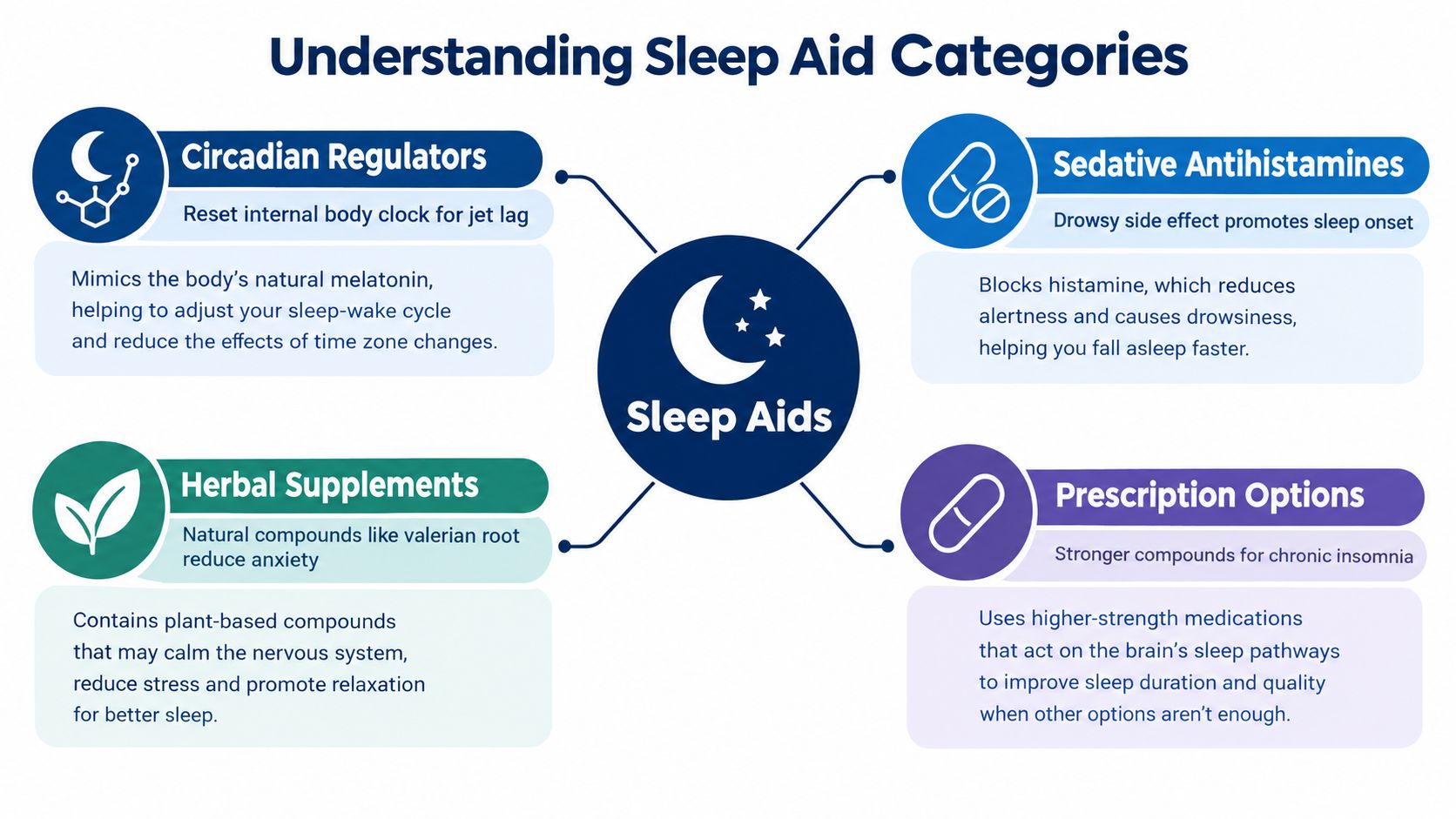
Circadian regulators and calming blends
Melatonin belongs in the circadian-regulator category. It's useful when the issue is timing, not just tension, which is why it's often paired with jet lag, late bedtimes, or a sleep schedule that has drifted off course. The best-supported use case is sleep-onset support, not brute-force sedation.
That's also why format matters. A quick-dissolving strip can suit someone who wants a simple bedtime cue, while a capsule or blend may be better for people who prefer a fuller ritual. Drift Off is one example of a raspberry oral strip that dissolves on the tongue and combines 1 mg of melatonin with valerian root, lavender, chamomile, and hibiscus extracts, which makes it a straightforward low-dose bedtime format.
Relaxation ingredients versus sedative products
Magnesium, L-theanine, and botanical blends work differently. They're usually chosen for relaxation, tension relief, or help transitioning out of a wired state, not for forcing sleep. That makes them attractive to people who dislike the foggy feel that can come from stronger sedating ingredients.
Prescription options sit in another category entirely. They're designed for more serious insomnia and bring a different risk-benefit profile, which is why they should be treated as a separate decision, not an upgrade path from every supplement aisle product. The useful takeaway is simple, calming a nervous system is not the same as inducing sleep.
Here's the basic language to use when reading labels:
- Circadian regulators: Good for sleep timing problems and schedule shifts.
- Relaxation blends: Better for stress, tension, and pre-bed unwinding.
- Sedative options: More likely to create next-day effects, even when they help sleep onset.
- Prescription therapies: Best reserved for persistent insomnia that needs medical supervision.
Comparing Efficacy and Safety Across Sleep Solutions
Melatonin has real evidence, but it doesn't outrank stronger prescription options. A network meta-analysis of insomnia medications found that benzodiazepines, eszopiclone, zolpidem, and zopiclone were more efficacious than melatonin, ramelteon, and zaleplon, with standardized mean differences ranging from 0.27 to 0.71, as summarized by Oxford Health NHS. That's a clear reminder that anyone with severe insomnia should stop expecting an over-the-counter supplement to perform like a prescription hypnotic.
What melatonin does well and where it stops
Melatonin's best-supported role is modest but real. Across 19 studies with 1,683 subjects, it reduced sleep latency by 7.06 minutes and increased total sleep time by 8.25 minutes versus placebo (PubMed). A newer dose-response analysis also suggested the effect may peak around 4 mg/day, and that timing may matter as much as dose, with 3 hours before the desired bedtime outperforming the commonly used 2 mg taken 30 minutes before bed (Journal of Pineal Research).
That's useful, but it's not a universal fix. Melatonin is better framed as a tool for sleep onset, circadian shifting, and mild sleep trouble than as a replacement for prescription treatment in severe sleep-maintenance problems. High-dose gummies are often sold like stronger means better, and that story doesn't hold up well.
A smarter sleep purchase starts with the complaint, not the dose. If the issue is tension, choose relaxation support. If the issue is timing, choose circadian support.
A clean use-case matrix
| Ingredient Category | Primary Mechanism | Best Suited For |
|---|---|---|
| Melatonin | Supports circadian timing and sleep onset | Trouble falling asleep, schedule shifts |
| Magnesium-forward blends | Supports normal muscle and nervous system function | Physical tension, unwinding at night |
| Botanical relaxation formulas | Traditional calming support | Racing mind, pre-bed relaxation |
| Prescription hypnotics | Stronger sleep induction or maintenance support | Persistent or severe insomnia under medical care |
Sleep Support Supplement Guide is useful reading for anyone comparing lower-intensity categories before jumping to stronger options. The main point is not that supplements are weak, it's that they're directional. They work best when the sleep problem is clearly defined.
If sleep trouble is severe or persistent, that's a conversation for a clinician. If the issue is mild sleep onset trouble, an OTC approach can be reasonable. The danger is treating every restless night like it calls for the same answer.
Matching Sleep Aids to Specific Use Cases and Life Stages
Sleep problems change with life stage, and the sleep aid should change with them. A 30-something with a racing mind, a perimenopausal woman waking at 3 a.m., and a rotating-shift worker all have different patterns. Recommending the same gummy to all three is lazy advice.
The 3 a.m. wake-up problem
Perimenopausal sleep disruption often looks like repeated or early waking, not simple trouble falling asleep. A 2026 review in Obstetrics & Gynecology points to multiple drivers, including hot flashes and night sweats, shifting reproductive hormones, mood changes, and a rising risk of obstructive sleep apnea through the menopausal transition (review of menopausal sleep disruption). That matters because a generic sleep supplement may be aimed at the wrong target entirely.
For this group, the first question is whether the issue is hormonal transition, fragmented sleep, or an underlying clinical sleep problem. If the pattern is repeated 3 a.m. waking, finding the trigger matters more than any product, and a big melatonin dose at bedtime is unlikely to fix it. If symptoms suggest hormone-transition disruption, sleep supplements may be too small a tool.
The racing mind at bedtime
Stress-driven sleeplessness is usually a wind-down problem. The person is physically exhausted but mentally still online, replaying emails, bills, conversations, or tomorrow's schedule. That pattern usually responds better to calming ingredients and a predictable pre-bed routine than to high-dose melatonin.
A melatonin-free blend can work well for people who want relaxation support without adding melatonin to the night. Nite Bites fit that role: blackberry gummies with reishi mushroom extract, L-theanine, lemon balm, passion flower, and valerian root, made for winding down.* A low-dose strip can also fit when the goal is a simple bedtime signal without a heavy feel.
The schedule-shift or travel problem
Night-shift workers and rotating-shift workers need timing, not just sedation. Their challenge is often that the body clock and the sleep window are out of sync, so the sleep aid should help mark a new sleep opportunity rather than create drowsiness. Melatonin is more useful here than many people realize, but timing still matters more than loading up the dose.
Direct rule: If the sleep problem follows a clock problem, choose circadian support. If it follows tension, choose relaxation support. If it follows waking in the middle of the night, look for the cause, and get a medical evaluation if it keeps happening.
Older adults deserve separate attention too. Medication interactions and fall risk matter more with age, so a clinician check makes sense before adding any sleep aid, including an over-the-counter one.
Navigating Melatonin Dosages and Smart Alternatives
High-dose melatonin has become the default retail answer, and that's backward. Clinical references note that 0.1 to 0.3 mg can produce near-physiological melatonin levels, while 0.6 to 5 mg is the range commonly used for sleep problems (NCBI Bookshelf). There is no universal best dose, and many people do better starting low instead of reaching for the biggest gummy on the shelf. The practical lesson is blunt, dose escalation is not a sleep strategy.
Start low, or skip it entirely
A low dose can be enough for people whose issue is just getting the body's bedtime cue back on track. The published evidence also supports the idea that dose isn't the only variable, because timing can outperform raw milligrams in some cases (Journal of Pineal Research). That's why people who keep increasing melatonin often end up with more vivid dreams, more next-day fog, or a sense that the product has stopped helping.
For melatonin-sensitive users, melatonin-free products are often the better move. Magnesium-heavy formulas suit people with physical tension. Botanical relaxation blends suit people whose problem is mental arousal. The right pick depends on the sleep profile, not the trend.
Read the format, not just the ingredient
Oral strips, capsules, and gummies are not interchangeable. Strips are easier for people who travel, hate swallowing pills, or want a simple no-water routine. Capsules suit people who want a more traditional supplement format. Gummies often feel friendlier, but they can also encourage dose creep because they taste like candy.
A few practical choices stand out:
- Low-dose melatonin strip: Best for bedtime cueing and fast, simple use.
- Magnesium-focused capsule: Better for tension, stiffness, or a body that won't unclench.
- Melatonin-free botanical blend: Better for users who feel off on melatonin.
- Higher-dose capsule: Better reserved for people who already know they tolerate melatonin and are targeting a specific need. Deep Rest, for example, contains 10 mg of melatonin per serving plus a botanical blend that includes St. John's Wort, which interacts with many prescription medicines, so check with a clinician or pharmacist first.
If a user wants a melatonin-free route, Too Much Melatonin is a useful reference point for understanding why some people move away from high-dose products. The core message is not anti-melatonin. It's anti-one-size-fits-all.
Building a Goal-Based Nighttime Routine
A sleep aid should fit into a routine, not replace one. The timing of the product, the format you choose, and what happens after the supplement all affect whether the night improves. A person who takes the right product at the wrong time still gets poor sleep.
Match the timing to the goal
Sleep-onset support belongs near bedtime, while wind-down support can start earlier in the evening. That's the cleanest way to avoid turning a relaxing ritual into a half-baked rescue attempt at midnight. If the goal is falling asleep faster, the product should be simple and close to lights-out.
The routine should also be built around consistency. People who travel, shift schedules, or wake up groggy often do better when their supplement format is easy to repeat anywhere. That's one reason a flat oral strip or a compact capsule can beat a bulky bottle when the goal is consistency, not novelty.
Build the routine around the body, not just the brain
Sleep support works better when it also includes cues that the day is over. That can mean a skincare step, a light stretch, a shower, or a calm room that stops sending work signals. Sleep Quality Improvement Tips fits this mindset because the sleep environment matters as much as the supplement itself.
A goal-based routine is straightforward:
- For sleep onset: Use a low-dose or circadian-targeted formula close to bedtime.
- For stress unwind: Use a calming, melatonin-free option earlier in the evening.
- For 3 a.m. waking: Look for the cause first, and keep any melatonin to the evening rather than after waking.
- For travel: Keep a portable format that doesn't depend on water or a big bedtime setup.
- For recovery nights: Pair the supplement with a quiet room, low light, and a repeatable wind-down cue.
That approach beats chasing a stronger pill every time sleep gets messy. The right answer is usually more specific, not more intense.
Sleep All Nite organizes sleep and nighttime products by the goal you're working on, not by hype. Its lineup includes low-dose, melatonin-free, and format-driven options, so a shopper can match the product to winding down, a consistent bedtime cue, or waking up clear. Visit Sleep All Nite to compare the options and choose the format that fits instead of guessing.
*These statements have not been evaluated by the Food and Drug Administration. These products are not intended to diagnose, treat, cure, or prevent any disease.
This article is for general education and isn't medical advice. Talk with a healthcare professional before starting a supplement, especially if you're pregnant or nursing, under 18, managing a medical condition, or taking prescription medication.


