
Non Habit Forming Sleep Aid Guide That Works


You wake up at 3 a.m., check the clock, and immediately start doing sleep math. If you take something tonight, will you feel foggy tomorrow, need it again tomorrow, or drift into a habit you didn't want in the first place? That's the problem behind the search for a non habit forming sleep aid. People usually don't want a miracle. They want help that works, doesn't snowball into dependence, and fits the actual sleep problem in front of them.
The best choices are usually the most specific ones. Melatonin makes sense for some sleep-onset and circadian problems, melatonin-free relaxation ingredients can suit people who mainly want to wind down, and behavioral strategies often matter more than the bottle itself when insomnia is chronic. That's why the useful question isn't “what's strongest,” it's “what's the sleep job right now.”
| Option | Best fit | Evidence pattern | Main trade-off |
|---|---|---|---|
| Melatonin | Falling asleep, circadian timing, shift work | Modest but real effects, dose matters | Timing and dose can make or break results |
| Melatonin-receptor agonists | Prescription sleep-related disorders | Clinically approved drugs in the U.S. | Medical supervision required |
| Valerian and other herbs | Wind-down and perceived calm | Mixed and weaker evidence | Benefits are less predictable |
| Antihistamines | Rare, occasional sleepless nights | Drowsiness is the main effect | Next-day grogginess can be an issue |
| Behavioral approaches | Maintenance insomnia, early waking, chronic patterns | Address the cause rather than sedation | Takes consistency, not just one dose |
Table of Contents
- Introduction to Non Habit Forming Sleep Aids
- How Non Habit Forming Sleep Aids Work Overview
- Detailed Comparison of Non Habit Forming Sleep Aid Options
- Melatonin Dosing and Safety What Evidence Shows
- Choosing the Right Non Habit Forming Sleep Aid for Your Situation
- Behavioral Strategies That Make Any Sleep Aid Work Better
- Our Recommendation for Different Sleep Goals
- Safety Notes Worth Reading Before You Buy
Introduction to Non Habit Forming Sleep Aids
A sleep aid can be labeled non habit forming and still leave a person groggy the next morning, poorly timed, or dependent on a bedtime routine to feel like it works. The label matters less than the mechanism and the sleep problem it is being used for.
Melatonin is the clearest example of the gap between common use and clear purpose. It is widely recognized as a non habit forming sleep-aid ingredient, but it is not FDA-approved for any indication in the United States. Prescription melatonin-receptor agonists such as ramelteon and tasimelteon are FDA-approved for insomnia-related sleep disorders (NCBI Bookshelf). Adult use in the U.S. has climbed steadily over the past two decades, to the point where melatonin is now among the most commonly used supplements in the country. That shows how ordinary the category has become, not that every product or dose fits every person.
What “non habit forming” really means
Clinically, the term means the product is not intended to create the dependence cycle associated with habit-forming hypnotics. It does not mean it cannot be overused, mistimed, or matched to the wrong problem. It also does not mean a supplement is always the right answer.
Practical rule: match the aid to the sleep problem, not to the strength of the label.
Four broad groups come up most often in real choices. Melatonin and melatonin-receptor drugs work through circadian signaling. Antihistamines cause sleepiness through histamine blockade. Herbal options such as valerian aim more at calm than sedation. Behavioral approaches such as CBT-I and consistent routines target the conditions that keep sleep broken in the first place.
The better choice depends on the goal. Some people need help falling asleep and do well with a low-dose strip or capsule. Others want a melatonin-free wind-down because their problem is nighttime overstimulation, not sleep onset. Others need a clinician because insomnia tracks with mood, medication timing, shift work, or repeated 3 a.m. awakenings. The safest way to choose is to start with the sleep pattern, then work backward to the ingredient.
How Non Habit Forming Sleep Aids Work Overview
A sleep aid works best when it matches the problem in front of you. A person who needs help falling asleep is not looking for the same mechanism as someone waking at 3 a.m., and neither is the same as someone who mainly needs a calmer bedtime routine. That is why a low dose can be enough for one person, while another feels only side effects.
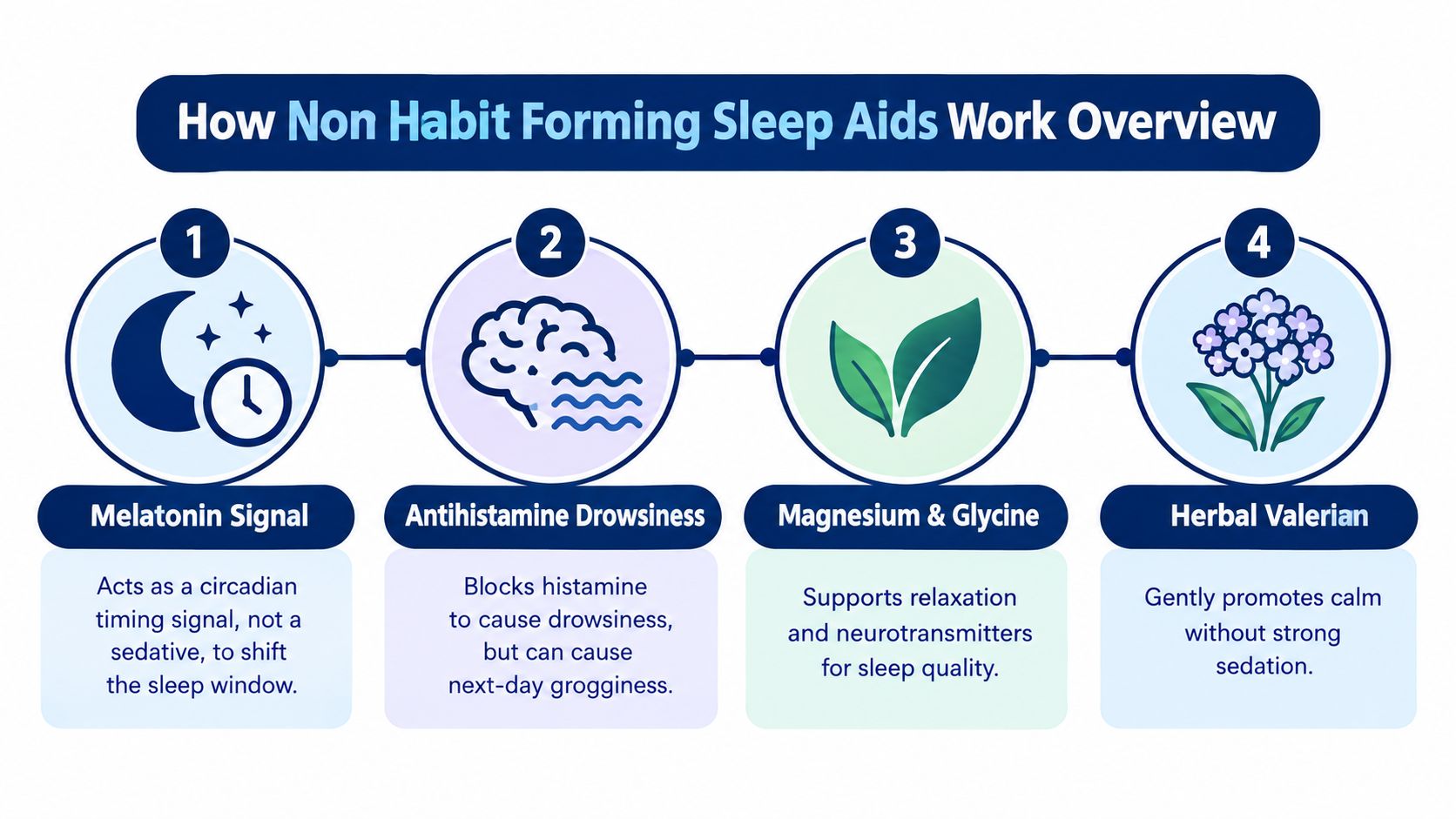
The main mechanisms in plain English
Melatonin works as a timing signal. It does not act like a classic sedative, so it is usually a better match for sleep-onset trouble, jet lag, or shift work than for a person who wants to stay asleep all night. Evidence from the NCBI Bookshelf summary shows modest effects, which is the right expectation for a hormone that nudges timing rather than forcing sleep.
Antihistamines take a different route. They block histamine, which can increase drowsiness, but the same effect can leave some people foggy the next morning if the dose or timing is off. That makes them a poor fit for nightly use, even if they can help with an occasional rough night.
Herbal options and minerals sit closer to the relaxation end of the spectrum. A PMC review found valerian evidence to be weak and mixed, so the honest claim is calm support, not reliable sedation. Magnesium and glycine are also used to support relaxation and sleep quality, but they do not behave like sleeping pills.
Behavioral approaches such as CBT-I, light timing, and steady wake times do not sedate at all. They change the conditions that keep sleep broken, which is why they often matter most for maintenance insomnia and early waking.
Dose discipline matters as much as ingredient choice. A low-dose melatonin strip can fit someone who wants help falling asleep without feeling drugged the next day. A melatonin-free magnesium product may fit a person whose main issue is winding down rather than shifting sleep timing. A botanical gummy can suit a bedtime routine, while a capsule may be easier for someone who wants a simple, no-frills format.
A factual example is Drift Off, a raspberry-flavored oral strip that dissolves on the tongue and pairs 1 mg of melatonin with valerian root, lavender, chamomile, and hibiscus extracts. That makes it a low-dose bedtime option, not a strong sedative, and that distinction matters more than ingredient hype when the goal is to match the product to the sleep problem.
Detailed Comparison of Non Habit Forming Sleep Aid Options
The clearest comparison starts with the problem you are trying to solve. Help for falling asleep, help for staying asleep, and help for winding down are not the same target, so the product should match the goal.
| Option | Best For | Evidence Strength | Onset and Duration | Key Safety Note |
|---|---|---|---|---|
| Low-dose melatonin | Falling asleep, circadian timing, shift work | Moderate, with modest effect sizes | Usually taken before bed, effects depend on timing and formulation | Next-day drowsiness can happen if timing is off |
| Higher-dose melatonin | Sometimes used when lower doses fail | Not clearly better for many people | Same general window, but more is not automatically more effective | Higher doses widen the safety discussion rather than guaranteeing better sleep |
| Valerian | Relaxation and perceived calm | Weak-to-mixed | Often used at night, but response is inconsistent | Evidence is inconclusive, so claims should stay modest |
| Antihistamines | Rare occasional sleeplessness | Symptom relief, not sleep quality correction | Often acts the same night | Grogginess and tolerance concerns make nightly use a poor fit |
| Behavioral sleep treatment | Chronic insomnia, early waking, sleep maintenance issues | Strong for insomnia management | Builds over time, not a one-night fix | Requires consistency and attention to routine |
| Prescription melatonin agonists | Clinician-guided insomnia-related sleep disorders | Established in medical care | Timed use under medical direction | Needs prescription-level oversight |
The pattern is clear. Low-dose melatonin is a timing tool, not a knockout agent. If the issue is shifting sleep onset earlier, a smaller dose taken at the right time often fits better than a larger dose that lingers longer. If the issue is staying asleep, a timing-focused product may disappoint, because the underlying problem is different.
A practical example is non-drowsy sleep aid options. That category is most useful when the goal is bedtime support without heavy next-day sedation, which is a different use case from a product meant to force sleep.
Valerian sits in a less certain place. The review linked above describes the evidence as weak and mixed, with inconsistent results across randomized trials and methods too uneven to support a firm conclusion. That makes valerian a reasonable calm-support ingredient for some people, but not a dependable fix for sleep onset. Anyone searching for valerian for sleep should read the claims on a label with that uncertainty in mind.
Antihistamines solve a narrower problem. They may help someone get sleepy for an occasional rough night, but that effect comes with trade-offs, especially grogginess and a poor fit for regular use. They are better viewed as short-term symptom relief than as a true sleep strategy.
Behavioral sleep treatment belongs in the same comparison because it addresses a different layer of the problem. It does not sedate, and that is the point. For chronic insomnia, early waking, or repeated sleep maintenance problems, changing the routine often matters more than choosing a stronger ingredient.
For product pages, the most useful filter is plain language. Claims about a dramatic knockout effect usually run ahead of the evidence. Descriptions that emphasize calm, bedtime routine support, or low-dose timing are closer to what these options can realistically do. A good starting point for broader matching is this sleep support supplement guide, especially for readers trying to separate a relaxation aid from a sleep-onset aid.
Melatonin Dosing and Safety What Evidence Shows
Dose is where melatonin decisions usually go wrong. More milligrams do not automatically mean better sleep, and the better choice often depends on whether the goal is falling asleep, staying asleep, or shifting the bedtime routine.
Why low-dose positioning matters
There is no official U.S. consumer dose, because melatonin is sold here as a dietary supplement rather than a regulated medicine. The UK is a useful reference point precisely because melatonin is a prescription medicine there. The NHS lists a usual adult starting dose of 2 mg slow-release taken 1 to 2 hours before bedtime for short-term insomnia, typically for 1 to 4 weeks and in some cases up to 13 weeks, with the dose increased to a maximum of 10 mg daily where a clinician judges it necessary (NHS). That guidance is worth reading whole rather than in part. It puts a low starting dose at the center of clinical practice, but it does not cap real-world use at 1 or 2 mg, and it assumes medical oversight that an over-the-counter supplement does not come with.
Dose-response findings are mixed, which is the point. A 2024 systematic review and dose-response meta-analysis in the Journal of Pineal Research estimated peak efficacy for sleep onset at around 4 mg/day (Journal of Pineal Research), while a separate 2022 meta-analysis of melatonergic agents found that 0.3 mg and 1 mg shortened sleep latency, and 2 mg and 5 mg did not show a significant effect, in healthy and psychiatric participants (meta-analysis of melatonergic agents). Those two results do not line up neatly, and that is the honest state of the evidence. For a reader choosing between products, it means the best dose is not automatically the biggest one. It is the one that matches the sleep job and the timing window.
Safety and product quality are part of the dose discussion
Public-health concern has focused on safety and access. A U.S. poison-center analysis published by the CDC reported 260,435 pediatric melatonin ingestions from 2012 to 2021, a 530% increase over the decade, rising from 8,337 cases in 2012 to 52,563 in 2021 (CDC/MMWR). That does not argue against melatonin use. It argues for clear dosing and safer storage.
Product variability is a separate problem. A 2023 research letter in JAMA tested 25 melatonin gummy products sold in the U.S. and found 22 of them, or 88%, were inaccurately labeled. Actual melatonin content ranged from 74% to 347% of the labeled amount, or roughly 1.3 mg to 13.1 mg per serving. Five products also declared CBD, and one contained no detectable melatonin at all alongside 31.3 mg of CBD (JAMA). If the serving is imprecise, the actual dose can drift far from what the label suggests.
Practical rule: if the goal is sleep onset, start with the smallest dose that fits the timing window, then judge response before increasing.
That rule helps explain why product format matters. A 1 mg strip, a 2 mg capsule, and a 10 mg option are not interchangeable just because they share the same ingredient name. Timing matters too, because melatonin can cause next-day drowsiness, so formulation and dosing time are part of the effect, not afterthoughts. For readers comparing melatonin against broader sleep-support options, this sleep support supplement guide is a useful way to separate a relaxation aid from a sleep-onset aid.
Choosing the Right Non Habit Forming Sleep Aid for Your Situation
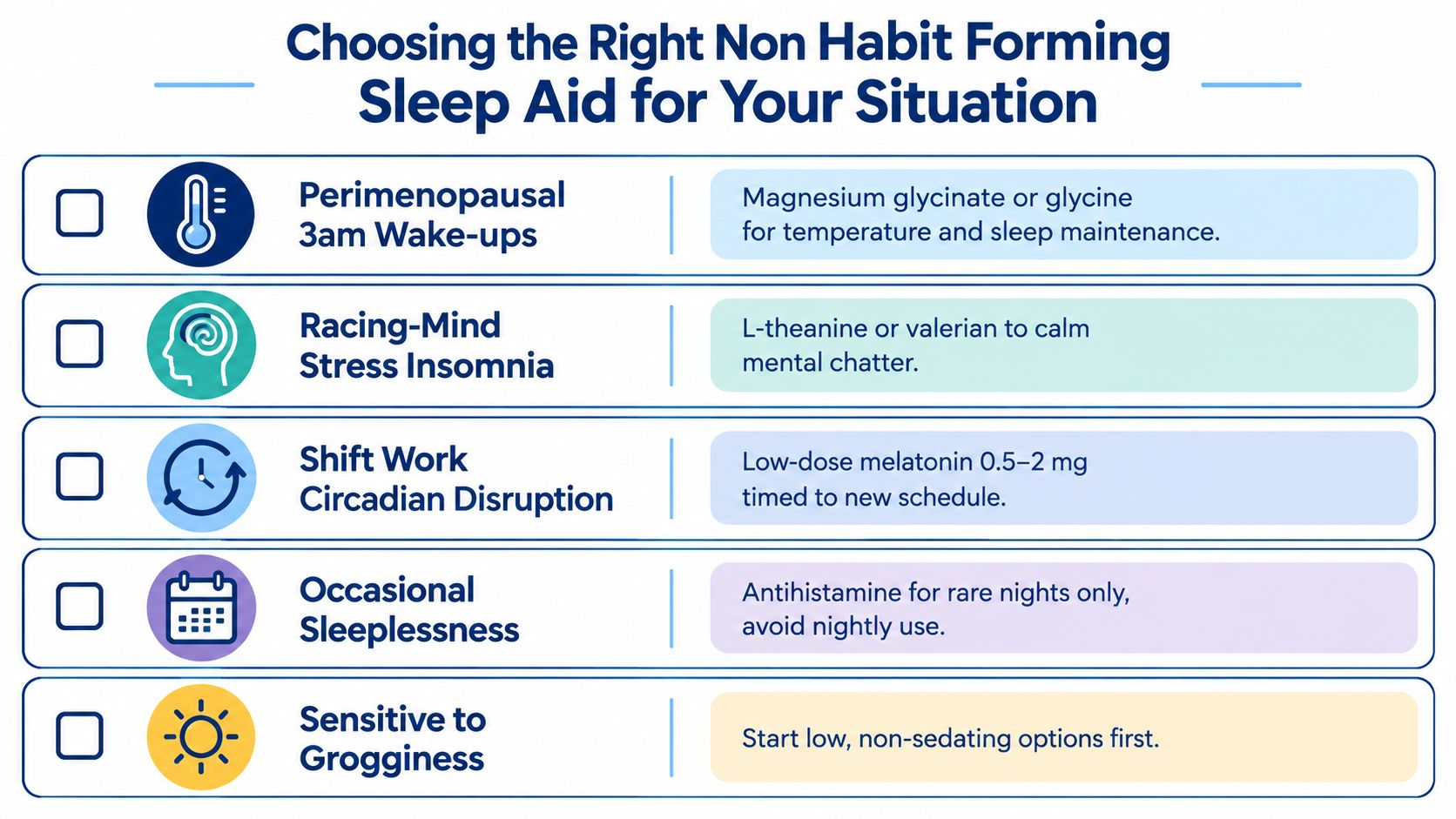
The right choice shifts with the sleep problem. Waking at 3 a.m., working overnight, and wanting a calmer bedtime are different targets, so the product should match the job instead of the label. That cut-down approach reduces trial and error.
Match the format to the sleep job
Perimenopausal 3 a.m. wake-ups usually need help staying asleep. A maintenance-first plan makes more sense here than a stronger bedtime sedative, especially if the person falls asleep fine but wakes too early. Relaxation-oriented minerals or clinician-guided sleep support fit that pattern better than a product aimed only at sleep onset.
Racing-mind stress insomnia calls for wind-down support. Valerian, lavender-style relaxation blends, or a melatonin-free evening routine can fit that need better than a high-dose melatonin product. The goal is to quiet mental chatter before bed, not to force sleep.
Shift work or circadian misalignment is the clearest case for low-dose melatonin used at the right time. The point is timing discipline, not ingredient intensity, and that is why low-dose formats often fit this situation better than stronger ones (Journal of Pineal Research). Higher is not automatically better if the goal is shifting the clock.
People who felt flat or foggy on melatonin may need a lower dose, or no melatonin at all. A bad response to 5 mg or 10 mg does not prove melatonin will never help, it may mean the dose was too heavy for the goal. Lower-dose formats and melatonin-free options can be more useful than increasing the amount.
Pill-averse or travel-focused users often care about format as much as formula. Dissolvable strips remove the need for water and are easier to keep by the bed or pack in a carry-on. If the main issue is falling asleep, a low-dose strip fits that use case more naturally than a large capsule.
One example is Nite Cap, a capsule blend that pairs 2 mg of melatonin with valerian, chamomile, GABA, L-tryptophan, lemon balm and passion flower, which Sleep All Nite groups under staying asleep. Worth following the logic on that one: at 2 mg the melatonin is still a timing-level dose rather than a sedating one, so what the formula leans on overnight is the botanical and amino-acid side rather than the melatonin. For people who want a melatonin-free route, the catalog also includes magnesium-focused and botanical wind-down options that fit a “relax first, sleep second” mindset. In each case, timing and the person's main sleep goal should drive the choice, not the loudest ingredient on the label.
Behavioral Strategies That Make Any Sleep Aid Work Better
A sleep aid works better when the rest of the night is organized. That isn't motivational advice, it's mechanics. If the room is bright, bedtime drifts, caffeine runs late, and the clock gets checked repeatedly, even a decent product gets asked to do too much.
The most useful behavioral tools are the boring ones people skip. A consistent wake time anchors the sleep drive. Dimmer light at night helps the brain stop treating bedtime like afternoon. If the mind races, a written wind-down routine works better than hoping the brain will just stop talking.

What actually helps chronic insomnia
CBT-I principles matter because they treat insomnia as a pattern, not a one-night event. People with maintenance insomnia and early-morning awakening often improve more from structured behavioral work than from changing the supplement brand. That's also why sleep trackers can be useful for patterns, but frustrating when they turn every wake-up into a diagnosis.
A simple approach usually looks like this. Keep the sleep window consistent. Use a low-dose or melatonin-free aid only as part of a repeatable routine. Reassess after a short stretch instead of stacking products endlessly.
Good target: use the smallest effective aid alongside the most consistent routine, not the other way around.
For people whose brain won't switch off, the article on sleeping when your brain is racing is a more useful companion than another supplement comparison because it deals with the mental loop directly. That's where many sleep aids fail, they can't outwork unstructured evenings.
The video below reinforces the same point from a different angle, a calmer pre-sleep routine often does more than a stronger dose.
If insomnia comes with snoring, mood changes, or persistent early waking, the issue may be bigger than bedtime habits. That's the point where a clinician should weigh in, because a sleep aid that doesn't fit the cause only delays the fix.
Our Recommendation for Different Sleep Goals
For sleep-onset trouble, keep the dose low and the timing consistent. A low-dose melatonin option fits best when the main goal is to fall asleep sooner, especially for people who want something light rather than sedating. If the goal is nightly wind-down without melatonin, magnesium or a botanical formula is usually the better match.
For fragmented nights, one product may not solve the whole pattern. A sleep-onset aid can help with getting to sleep, while a separate approach may fit staying asleep, but only if the pattern clearly calls for it. If insomnia is chronic, behavioral treatment should stay part of the plan instead of being replaced by supplements.
Sleep All Nite groups products by goal rather than ingredient hype. That can help shoppers compare a low-dose strip, a melatonin-free option, or a stronger formula only after a clinician review. The practical check is simple, serving size, timing, format, and whether the product matches the actual sleep problem.
Safety Notes Worth Reading Before You Buy
“Non habit forming” describes a category, not a guarantee that any given product is right for you. A few practical cautions are worth carrying into the decision.
- Melatonin causes drowsiness. Do not take it before driving or operating machinery, and give it a full night before the next morning's commute.
- Valerian adds to sedatives. It can compound the effects of alcohol and prescription sedatives.
- Chamomile is a ragweed relative. People with that allergy should approach chamomile-containing products carefully.
- Antihistamines are not a nightly tool. Next-day grogginess and tolerance make them a poor fit for regular use.
- Storage matters. The pediatric ingestion data above is the reason to keep any melatonin product child-resistant and out of reach.
Anyone who is pregnant or nursing, under 18, taking prescription medication, or managing a medical condition should talk to a clinician before starting a supplement. Persistent insomnia is worth a medical conversation in its own right rather than an indefinite run of over-the-counter products.
These statements have not been evaluated by the Food and Drug Administration. This product is not intended to diagnose, treat, cure, or prevent any disease.


