
Low Dose Melatonin: A Practical Sleep Guide


Most advice gets melatonin backward. People treat it like a stronger sleeping pill, then keep increasing the dose when the issue is often timing, not force. Low dose melatonin works better when it's used as a circadian signal, a gentle cue that tells the brain night has arrived, rather than as a hammer meant to knock someone out.
That shift matters because melatonin is tied to the body's clock, not just to drowsiness. A small amount can fit the body's nighttime pattern more closely than a heavy dose, which is why many sleep experts keep coming back to physiological dosing instead of escalation. The goal is simpler sleep, not a foggy morning.
Table of Contents
- Why Less Is Often More for Sleep
- The Science Behind Physiological Dosing
- Who Benefits Most From a Lower Dose
- Timing Versus Dosage for Better Sleep
- Avoiding the Next-Day Grogginess Trap
- Building a Complete Nighttime Routine
- Finding Your Ideal Sleep Strategy
Why Less Is Often More for Sleep
The most common mistake is assuming more milligrams means more sleep. That logic works for pain relievers sometimes, but melatonin isn't a blunt sedative, it's a time cue. When the dose gets too high, the body may still feel the signal, but the experience can turn muddy instead of restful.
Melatonin works like a signal, not a knockout
A low dose is closer to the body's own nighttime rhythm. The 2023 safety review summarizing randomized trials described one meta-analysis with 37 RCTs and 2,130 participants ages 1 to 93 using 0.15 to 15 mg/day, and found no substantial difference in adverse-event types or frequencies versus placebo, while another pooled 50 controlled trials with 3,803 participants and reported no significant difference in adverse-event rates, with an odds ratio for tolerability of 1.06 (95% CI 0.29–3.86) (review summary). Those findings don't prove every dose feels the same, but they do support a cautious, conservative starting point.
Practical rule: If the goal is to feel sleepy at night and clear in the morning, the smallest effective amount usually makes more sense than a bigger one.
That logic matches how melatonin is used in real life. Reviews have continued to describe 0.3 mg and 1 mg as low or physiologic amounts, especially when the aim is sleep timing rather than heavy sedation (review discussion). When readers ask for the “strongest” option, the better question is often, “What dose best matches the body's natural signal?”
The Science Behind Physiological Dosing
Tiny doses can fit the body's nighttime pattern
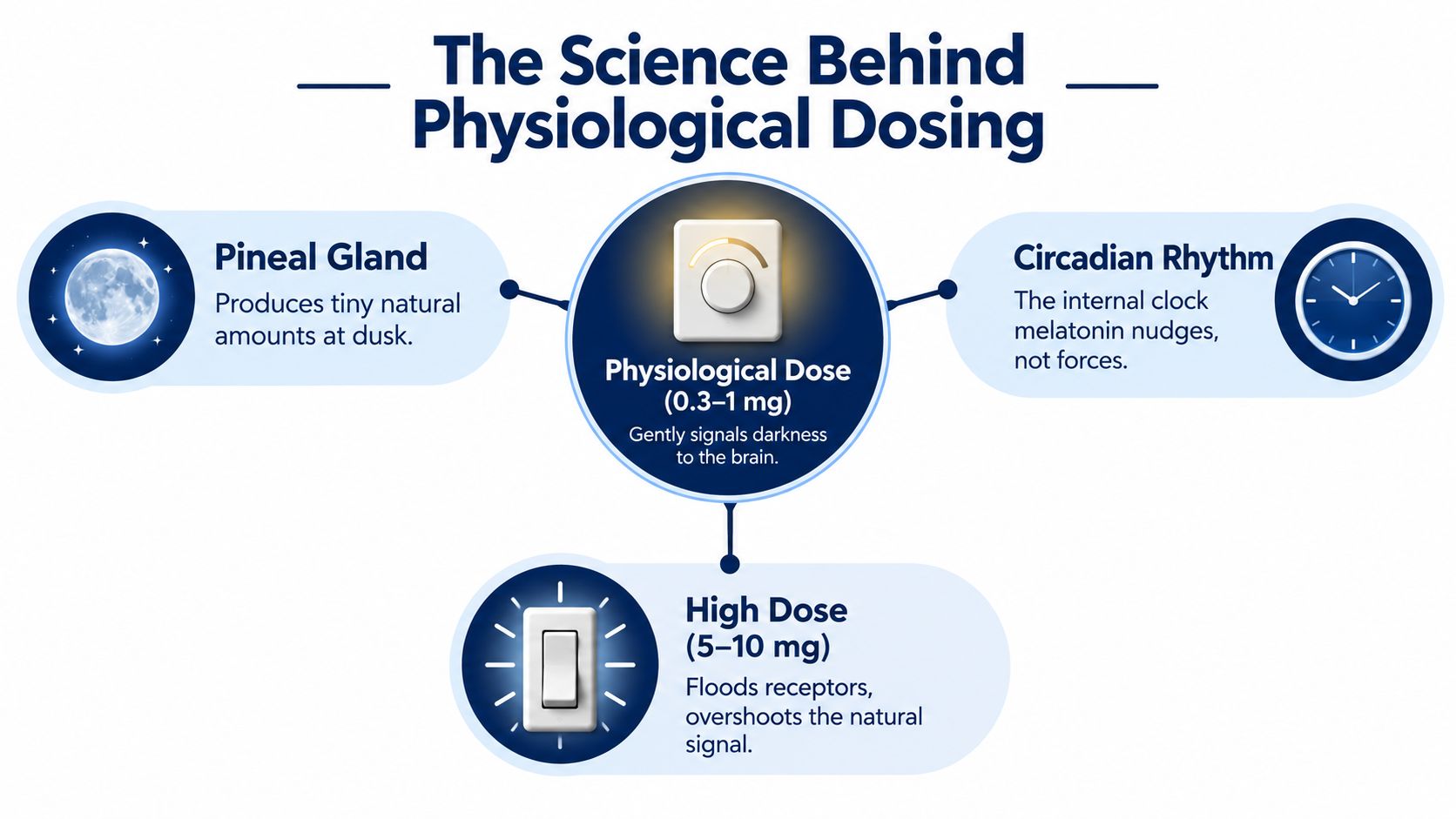
The body does not need a flood of melatonin to register darkness. Expert reviews note that 0.1 to 0.3 mg/day can produce near-physiological melatonin concentrations for circadian synchronization, while 0.6 to 5 mg/day is commonly used in sleep-disorder settings (NCBI Bookshelf). That gap is the point of physiological dosing, because melatonin works more like a dimmer switch than a knockout pill.
Oral melatonin also follows a variable path through the body. It reaches peak plasma concentration in about 50 to 60 minutes, and bioavailability can range from roughly 10% to 56%, with a mean of about 33%. That helps explain why one person feels a small dose clearly, while another gets a better result from changing the timing instead of raising the milligrams.
A simple form can make that timing easier to manage. Drift Off is a raspberry-flavored oral strip that dissolves on the tongue, and each strip pairs 1 mg of melatonin with valerian root, lavender, chamomile, and hibiscus extracts.
Sleep-focused guidance on supplement choices also tends to separate immediate sleep onset from overnight support, as covered in Sleep All Nite's supplement guide. That framing keeps the focus where it belongs, on matching the product to the sleep problem instead of treating melatonin like a generic sedative.
Who Benefits Most From a Lower Dose

The people who usually do better by starting small
A lower dose tends to help people who already feel sensitive to sleep aids. That includes the person who wakes at 3 a.m. and doesn't want a heavier dose hanging over the next morning, and the shift worker who needs a nudge, not a knockout. It also fits the sleeper whose main issue is a late internal clock, because the problem is often alignment, not sedation.
A common example is the tired client who says, “It helped once, then I felt off the next day.” In that case, the issue may not be that melatonin failed, it may be that the timing or amount didn't match the sleep problem. For people who track sleep metrics, that mismatch can be especially obvious when morning alertness drops even though bedtime felt easier.
Another group benefits from a gentler approach for a different reason, they're already juggling other nighttime habits. A melatonin-free option like Deep Calm uses magnesium glycinate, a form of magnesium bound to glycine, and is designed to support healthy levels of this essential mineral. That kind of option can make sense when someone wants relaxation support without adding more melatonin to the routine.
Some sleepers don't need more sedation. They need a cleaner signal and a simpler routine.
The pattern is easy to spot in practice. If the goal is to ease into rest, keep the dose low. If the goal is to change the body clock, pay even closer attention to timing, because a small dose used at the wrong moment can be less helpful than no supplement at all.
Timing Versus Dosage for Better Sleep
The clock matters as much as the capsule
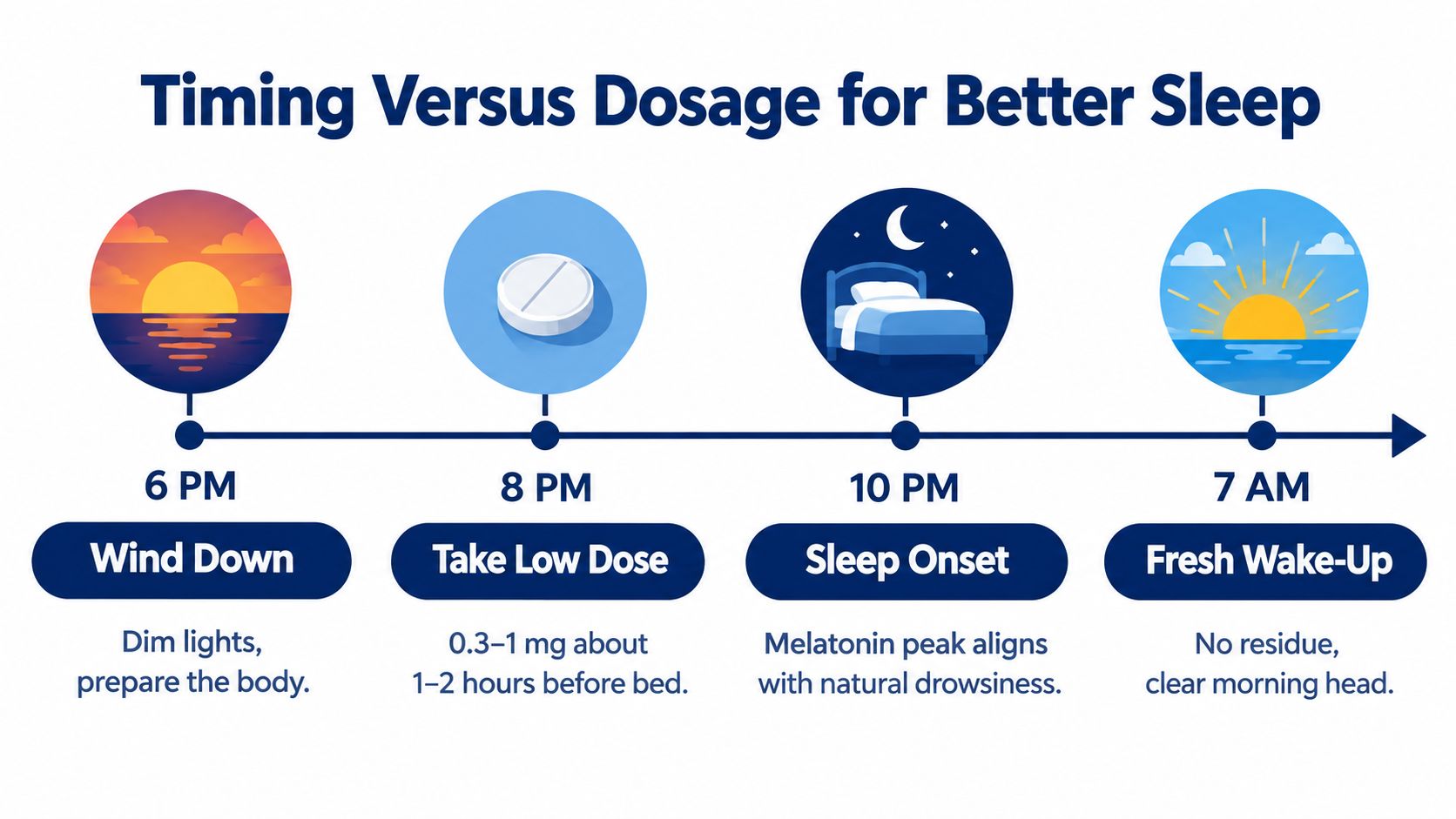
Melatonin works best when the timing matches the goal. For sleep onset, authoritative sources describe taking a low dose 30 to 60 minutes before bed. For circadian shifting, some protocols use it 3 to 6 hours before the target sleep period (NCBI Bookshelf). That gap matters because melatonin is not only a bedtime cue, it is also a timing signal for the body clock.
A newer clinical review also found stronger sleep-promoting effects when melatonin was taken about 3 hours before bedtime and at 2 to 4 mg, rather than the common 2 mg taken 30 minutes before bed (Wiley review). The point is not that everyone should take more. It is that a well-timed smaller dose can do a different job than a later, heavier one.
The distinction becomes clearer in real life:
- Falling asleep faster: use the smallest effective amount closer to bedtime, after the lights go down.
- Shifting a delayed schedule: move the timing earlier, especially if the issue is drifting later night after night.
- Travel or rotating shifts: pair the dose with the sleep window you want the body to accept, not just the moment you get into bed.
A quick wind-down routine helps the signal land. Dim lights, reduce screens, and keep the bedroom boring enough that the body does not get mixed messages. The supplement can only do so much if the room still looks like a workday.
For people who want a straightforward bedtime format, the goal is repeatable timing. Strips, capsules, and other simple delivery forms can make that easier. Write down the dose and the clock time for three nights before changing anything.
Avoiding the Next-Day Grogginess Trap
Why the morning after can feel worse than the night before
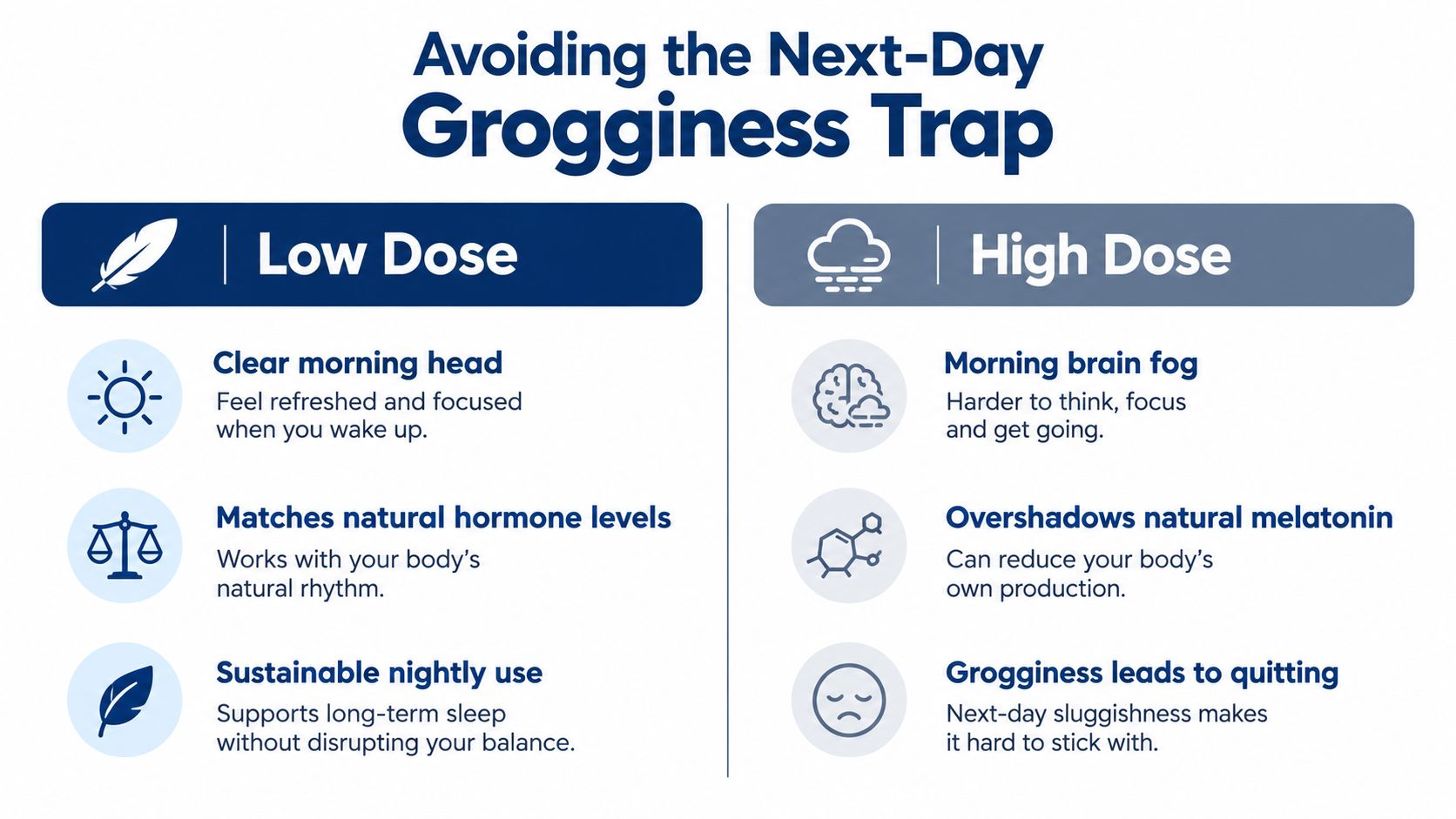
Grogginess is the complaint that sends many people away from melatonin entirely. The problem is often not melatonin itself, it's the way a large dose can outlast the bedtime window and make the next morning feel heavy. When someone wakes up still feeling sedated, the supplement starts competing with the day instead of supporting the night.
That's why higher doses aren't automatically better. A review on jet lag reported that 0.5 mg to 5 mg can be similarly effective, with higher doses mainly adding more hypnotic effect rather than clearly better sleep outcomes (jet lag review). The practical takeaway is simple, if the smaller amount works, there's little reason to push upward just to chase a stronger feeling.
A few sleep habits make grogginess more likely:
- Taking it too late: the signal arrives when the sleep window is already closing.
- Stacking it with alcohol: drowsiness can deepen into a rougher morning.
- Using it when the body is already ready to sleep: the extra dose adds more residue than benefit.
For that reason, many people do better with the lowest dose that reliably helps them fall asleep. The too-much-melatonin guide is useful for anyone trying to recognize the line between useful support and too much of a good thing.
The morning standard should be clear head, not recovery mode. If a supplement makes sleep easier but the alarm clock feels punishing, the dose or timing deserves a reset.
Building a Complete Nighttime Routine
Melatonin works best inside a calmer system
Melatonin is stronger when the rest of the evening cooperates. A body that's still amped up from stress, screens, or a late meal won't respond to a tiny dose the same way a settled body does. That's why many people pair melatonin with relaxation habits and complementary ingredients that help the nervous system downshift first.
Botanicals such as valerian root, chamomile, and lavender are often used in nighttime routines for that reason. In Sleep All Nite's lineup, Nite Bites sits on the melatonin-free side of that idea, using reishi mushroom extract, L-theanine, lemon balm, passion flower, and valerian root for winding down. The point isn't that every routine needs more products, it's that sleep usually improves when the body gets multiple cues to soften the transition into night.
Skincare can fit into that same rhythm too. The face and neck often become part of the bedtime ritual, and a calming topical step can signal that the day is ending. Sleep quality improvement matters here because a better routine usually beats a harsher dose.
A strong routine tells the body the same story in several ways, light goes down, stimulation ends, and the night begins.
That consistency helps the low dose do less work. When the environment already feels like sleep, melatonin doesn't have to fight for attention.
Finding Your Ideal Sleep Strategy
A simple way to test what actually works
The safest starting point is the lowest dose that seems plausible for the goal. If the issue is sleep onset, begin with a conservative amount and keep the timing consistent for several nights before changing anything. If the issue is delayed sleep or shift work, adjust the clock first, then revisit the dose only if the sleep window still feels misaligned.
A useful checklist keeps the process grounded:
- Set the sleep target. Decide whether the problem is falling asleep, staying asleep, or shifting the body clock.
- Clean up the evening. Dim lights, reduce stimulation, and stop sending mixed signals to the brain.
- Track the morning. Notice whether the next day feels clear, heavy, or unchanged.
- Change one variable at a time. Adjust dose or timing, not both at once.
- Stop chasing stronger effects. If a lower dose works, there's no prize for going higher.
That approach fits the biology. Melatonin is a timing tool first, a sleep aid second. The best routine usually looks boring on purpose, because predictability is what lets the body relax and trust the signal.
For readers who want a low-dose format that's easy to use at night, Sleep All Nite offers options built around specific nighttime goals, from low-dose melatonin strips to melatonin-free relaxation support and overnight skincare. Start with the smallest change that matches the problem, then adjust only if the morning still feels wrong.


