
Magnesium Chelated Blend: What It Is and How It Compares


A magnesium chelated blend is magnesium bound to another molecule such as glycine, intended to be gentler on digestion, but “chelated” doesn't by itself guarantee better sleep outcomes on current evidence. In one clinical trial, magnesium diglycinate absorption was 23.5%, compared with 22.8% for magnesium oxide across the full group, so the form alone isn't a universal promise of superior absorption.
“Chelated” has become one of the most persuasive words on a magnesium label. It can suggest a smoother digestive experience, stronger absorption, and better nighttime support all at once. The chemistry is real, but the leap from chemistry to a guaranteed sleep result isn't.
For adults who wake around 3 a.m., feel wired at bedtime, or are comparing magnesium glycinate with citrate or oxide, the useful question isn't, “Is this chelated?” It's which compound is present, how much elemental magnesium it supplies, how the finished formula was tested, and whether it fits the person's health situation and medications.
This guide translates those details into practical label-reading decisions without treating one magnesium form as a universal winner. It also separates plausible mechanisms from demonstrated sleep outcomes, because a supplement label should make comparison easier, not turn uncertainty into a promise.
Table of Contents
- What Chelated Magnesium Actually Means
- Why Compound Claims Change
- Chelated Blend vs Citrate vs Glycinate vs Oxide
- What the Sleep Research Actually Shows
- Dosing, Upper Limits, and Side Effects
- Choosing a Format That Fits Your Routine
What Chelated Magnesium Actually Means
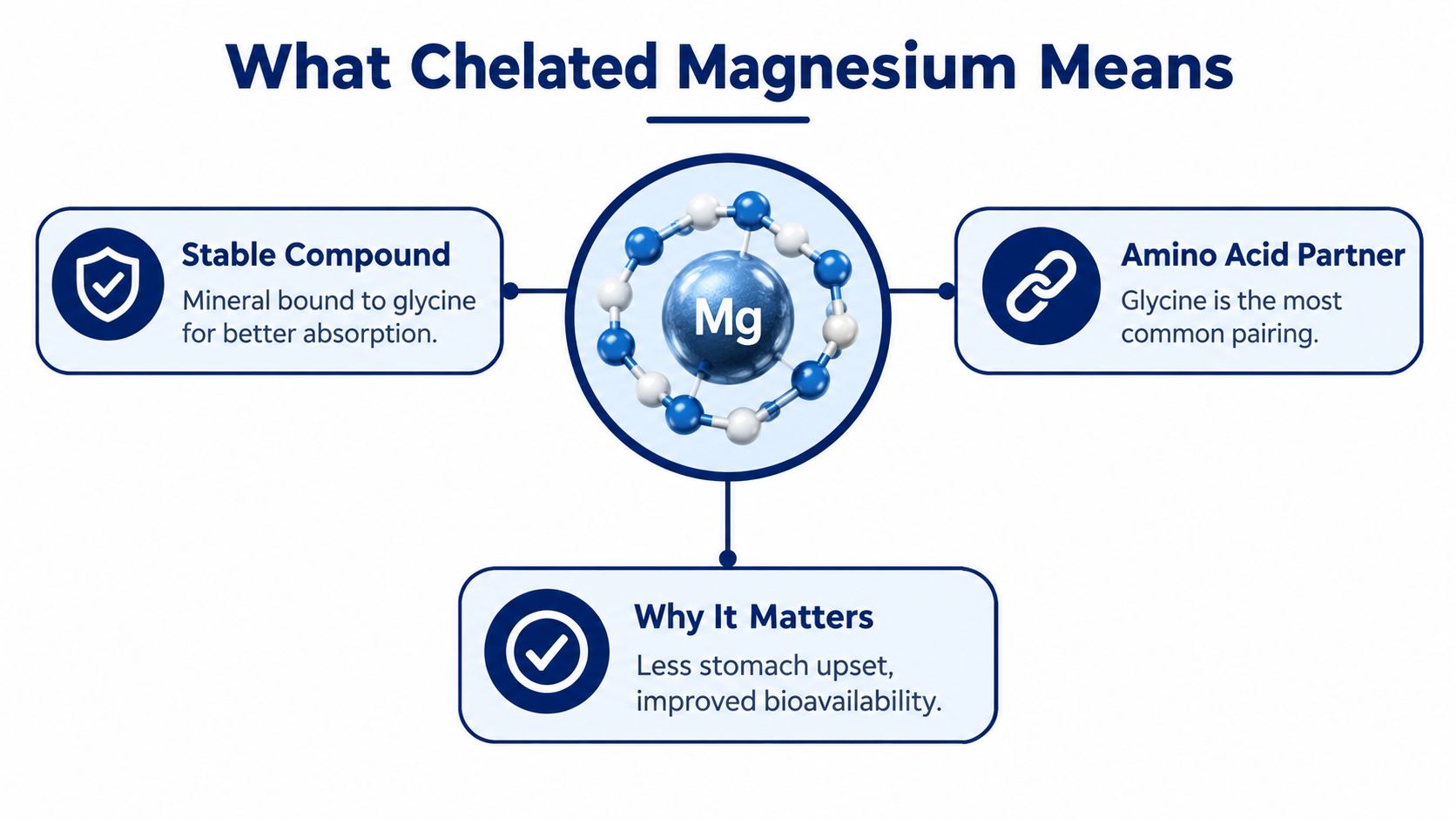
Chelated magnesium is a chemistry description, not a guarantee. The word refers to magnesium being attached to another molecule, often an amino acid such as glycine, to create a compound with properties different from a simple magnesium salt.
A useful mental picture is magnesium wearing a backpack. The mineral is still magnesium, but the attached molecule changes the weight of the compound, its chemical structure, and how it may behave in the digestive tract. In magnesium glycinate or bisglycinate, glycine is the partner molecule. The Supplement Facts panel, however, is concerned with the amount of elemental magnesium, not the full weight of magnesium plus glycine. The NIH explains this distinction in its magnesium fact sheet for health professionals.
Why formulators use chelation
A chelated form may be developed to influence tolerability, transport, or absorption. That intention matters, particularly for people who find certain magnesium salts uncomfortable. It doesn't mean every chelate behaves identically, or that every finished product has clinical evidence behind its specific blend.
A double-blind, randomized crossover trial involving 12 patients with ileal resections compared a 100 mg dose of magnesium diglycinate with magnesium oxide using magnesium-26 tracing. Across the full group, absorption was 23.5% for the chelate and 22.8% for magnesium oxide, a difference that wasn't statistically significant. Among the four participants with the greatest impairment while taking magnesium oxide, absorption reached 23.5% with the chelate versus 11.8% with oxide, a significant within-subgroup difference. The PubMed record reports the trial's formulation-specific findings.
The chelated form also reached peak isotope enrichment approximately 3.2 ± 1.3 hours earlier than magnesium oxide, and its overall enrichment exposure was significantly greater. All participants tolerated the chelate better in that study. Those findings support the possibility that some diglycinate can be absorbed intact through peptide-transport mechanisms, but they don't establish that every magnesium chelated blend is superior to every other form.
Practical rule: “Chelated” tells readers how magnesium is packaged. It doesn't tell them what the finished formula will do for sleep.
That distinction prevents two common errors. First, a reader might assume a chelate is automatically better absorbed. Second, a reader might assume a formulation designed for digestive comfort has been proven to shorten sleep onset or prevent nighttime waking. Neither conclusion follows from the word alone.
Why Compound Claims Change
“500 mg” on a magnesium label can describe the compound, not the magnesium itself. The ingredient statement may name 500 mg of magnesium glycinate, while Supplement Facts lists a smaller amount of elemental magnesium, the magnesium portion that contributes to the stated dose.
The difference comes from chemistry. Glycinate includes glycine, so part of the compound's weight belongs to its amino-acid partner. Oxide has a different partner and therefore a different proportion of elemental magnesium. Two products can each mention 500 mg while supplying different amounts of magnesium itself.
A worked example makes the comparison clearer. If a product contains 2,500 mg of magnesium glycinate, it may provide roughly 275 mg of elemental magnesium. The remaining weight belongs to the glycinate portion. That example is why compound weight cannot be used to compare products directly.
Read the panel in the right order
Start with serving size. Then find the line labeled magnesium in Supplement Facts, and use that elemental amount for product comparisons. Labeling guidance distinguishes the declared nutrient amount from the weight of the ingredient supplying it.
Next, inspect the ingredient statement. Look for the named form, such as magnesium glycinate, magnesium bisglycinate, magnesium citrate, or magnesium oxide. A product described as a “blend” may contain several forms, and its front-label name may not show how much of each one is included.
Use this checklist:
- Serving size: Check whether the listed amount applies to one capsule, several capsules, a scoop, or another portion.
- Elemental amount: Compare the magnesium line in Supplement Facts.
- Specific form: Identify glycinate, bisglycinate, citrate, oxide, or another salt in the ingredient list.
- Multiple products: Add magnesium from other supplements and magnesium-containing medicines.
- Added ingredients: Review herbs, vitamins, and other active ingredients separately because they may affect safety considerations.
The label becomes easier to interpret when you treat compound weight and elemental magnesium as two different measurements. Compound weight describes the whole chemical package. Elemental magnesium describes how much magnesium that package contributes.
That distinction helps explain why a product listing a large amount of magnesium glycinate may supply a moderate elemental dose, while another product with a smaller compound weight may provide a similar or higher magnesium amount. The reliable comparison is elemental magnesium per serving. The compound name then adds context about the formulation, rather than serving as a quality guarantee.
Chelated Blend vs Citrate vs Glycinate vs Oxide
No single form deserves a universal crown. Magnesium glycinate and bisglycinate are chelated forms, magnesium citrate is an organic magnesium salt commonly used for its digestive effects, magnesium oxide is a different salt with a higher proportion of elemental magnesium by weight, and a chelated blend is a finished formula that may combine several chelated ingredients.
The best comparison depends on the intended use, bowel tolerance, elemental dose, and the strength of evidence for the specific outcome.
| Form | Typical Bowel Tolerance | Best-Fit Use Case | Evidence Strength |
|---|---|---|---|
| Magnesium glycinate or bisglycinate | Often selected when digestive gentleness matters, though individual responses vary | A single-form option for people prioritizing tolerability or a glycine-bound formulation | Sleep evidence is limited and form comparisons are lacking |
| Magnesium citrate | Can be more likely to affect bowel habits because unabsorbed magnesium draws water into the intestine | People considering magnesium alongside a bowel-regularity goal | Form-specific effects exist, but sleep superiority hasn't been established |
| Magnesium oxide | May cause gastrointestinal symptoms, especially as intake rises | A product where elemental content and cost are central considerations | Compared with diglycinate in a small, specialized absorption trial |
| Magnesium chelated blend | Depends on every salt, dose, and added ingredient in the formula | Readers who want a multi-form product and are willing to inspect the complete panel | Evidence must be tied to the exact finished blend, not inferred from one ingredient |
Glycinate and bisglycinate
Magnesium glycinate and magnesium bisglycinate are commonly used names for glycine-bound forms. Their appeal usually rests on tolerability and formulation design, not on proof that they improve every sleep outcome. The specialized clinical trial described earlier found better tolerance for magnesium diglycinate in its study group, but the participants had ileal resections, so the finding shouldn't be generalized automatically to every adult with sleep trouble.
Citrate and oxide
Citrate and oxide illustrate why “more elemental magnesium” and “better choice” aren't the same statement. A product can provide a substantial elemental amount while still causing loose stools or abdominal discomfort for a particular person. Magnesium oxide also appeared in the crossover comparison with diglycinate, but that trial doesn't establish a universal ranking for healthy adults or for sleep.
Laboratory evidence adds another layer. An Innophos supplier-sponsored in-vitro report found that an organically bound bisglycinate preparation produced greater membrane absorption than magnesium oxide under the tested conditions. The report described more than 60% of the tested bisglycinate passing through the membrane, corresponding to more than 90% bioaccessible magnesium, and reported five- to eightfold higher absorption for chelated compounds than magnesium oxide. Those are laboratory findings from an ingredient supplier, not direct human sleep outcomes, and they shouldn't be treated as a guarantee for every blend. The technical report describes the test conditions and limitations.
A person comparing a chelated blend with citrate or oxide should therefore ask: What is the elemental amount? Which forms are included? How does the gut respond? What outcome is supported? Readers looking at magnesium alongside broader sleep-product choices can also use this guide to sleep aids, while keeping magnesium's evidence separate from claims about other ingredients.
What the Sleep Research Actually Shows
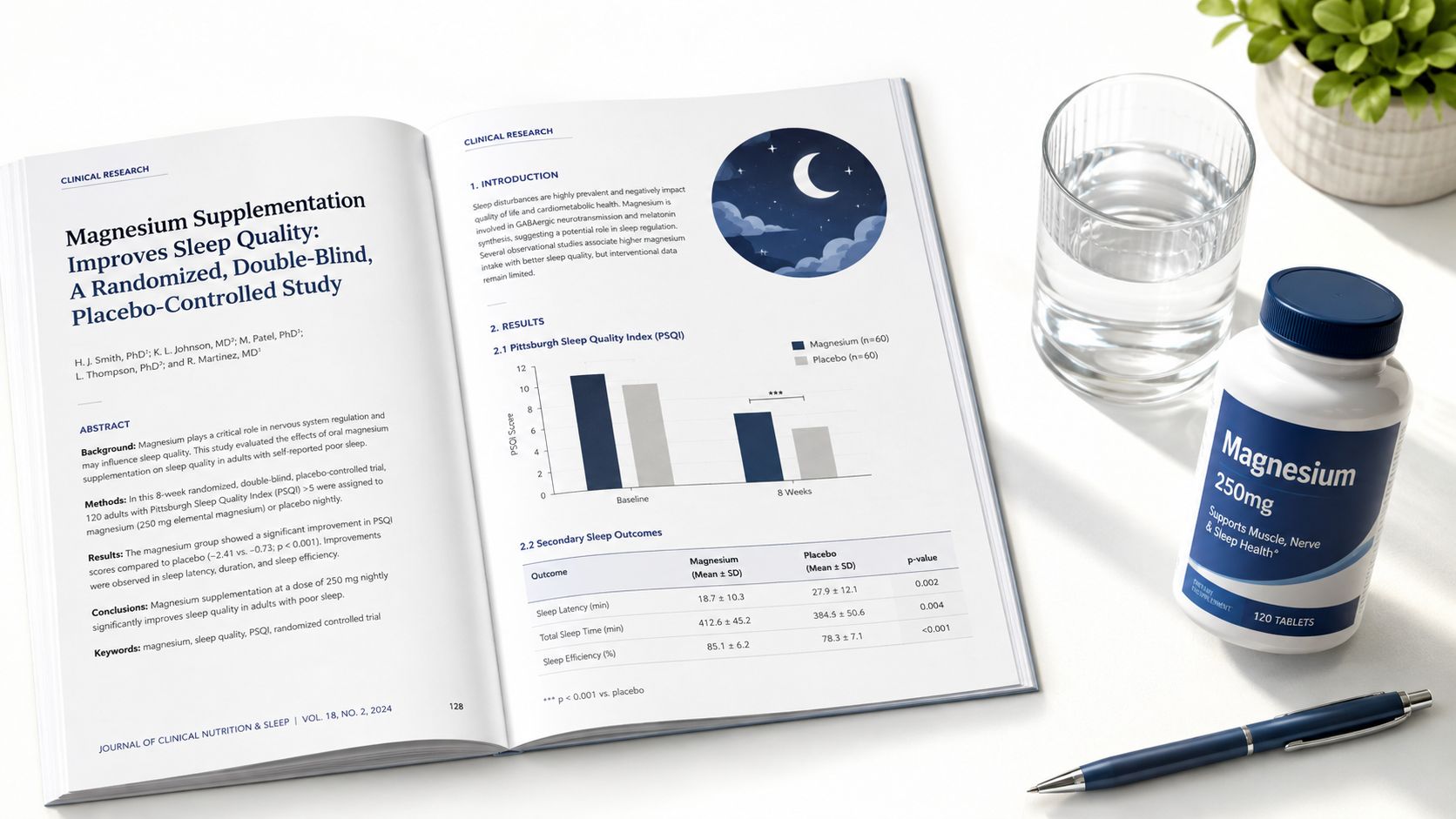
Magnesium is often presented as an obvious sleep solution, but the research calls for more careful language. A randomized, double-blind, placebo-controlled trial studied 155 adults aged 18 to 65 who reported poor sleep quality. Participants received 250 mg of elemental magnesium plus 1,523 mg of glycine daily for 28 days in the magnesium bisglycinate group.
The magnesium group had a greater reduction in Insomnia Severity Index scores than placebo, with a mean change of −3.9 points versus −2.3 points and a reported p-value of 0.049. The researchers described the benefit as modest, with an effect size of 0.2. Most improvement occurred during the first 14 days and remained through the study period. The published trial provides the participant details and outcome figures.
What that result does and doesn't establish
The trial supports describing magnesium bisglycinate as a potentially modest aid for adults with insomnia symptoms. It doesn't prove that every magnesium chelated blend will produce the same change, because blends can differ in elemental dose, magnesium form, added ingredients, and serving instructions.
The study also included glycine alongside magnesium. That makes it harder to treat the result as evidence for magnesium alone or for every glycine-bound product. A trial of one finished formula is more useful than a generic label claim, but it still has a defined population, dose, duration, and outcome.
A 2026 systematic review of randomized trials concluded that evidence for magnesium and sleep is mixed and generally low or very low certainty. The review found too few trials to determine whether bisglycinate, citrate, chloride, or other formulations are superior, and no eligible trial directly compared magnesium forms. The systematic review in the Journal of Dietary Supplements discusses the uncertainty and lack of head-to-head evidence.
That leads to a useful distinction:
- Potential support: A specific trial suggests a modest benefit under defined conditions.
- Proven superiority: Evidence shows one form consistently outperforms another for the same sleep outcome.
- Marketing inference: A product assumes that chelation alone predicts faster sleep onset, fewer 3 a.m. awakenings, or better sleep-tracker readings.
Only the first statement is supported by the available trial evidence. Adults with persistent sleep difficulty may benefit from discussing the pattern with a healthcare professional and learning about evidence-based approaches, including sleep support supplements, without treating a magnesium label as a diagnosis or treatment plan.
Dosing, Upper Limits, and Side Effects
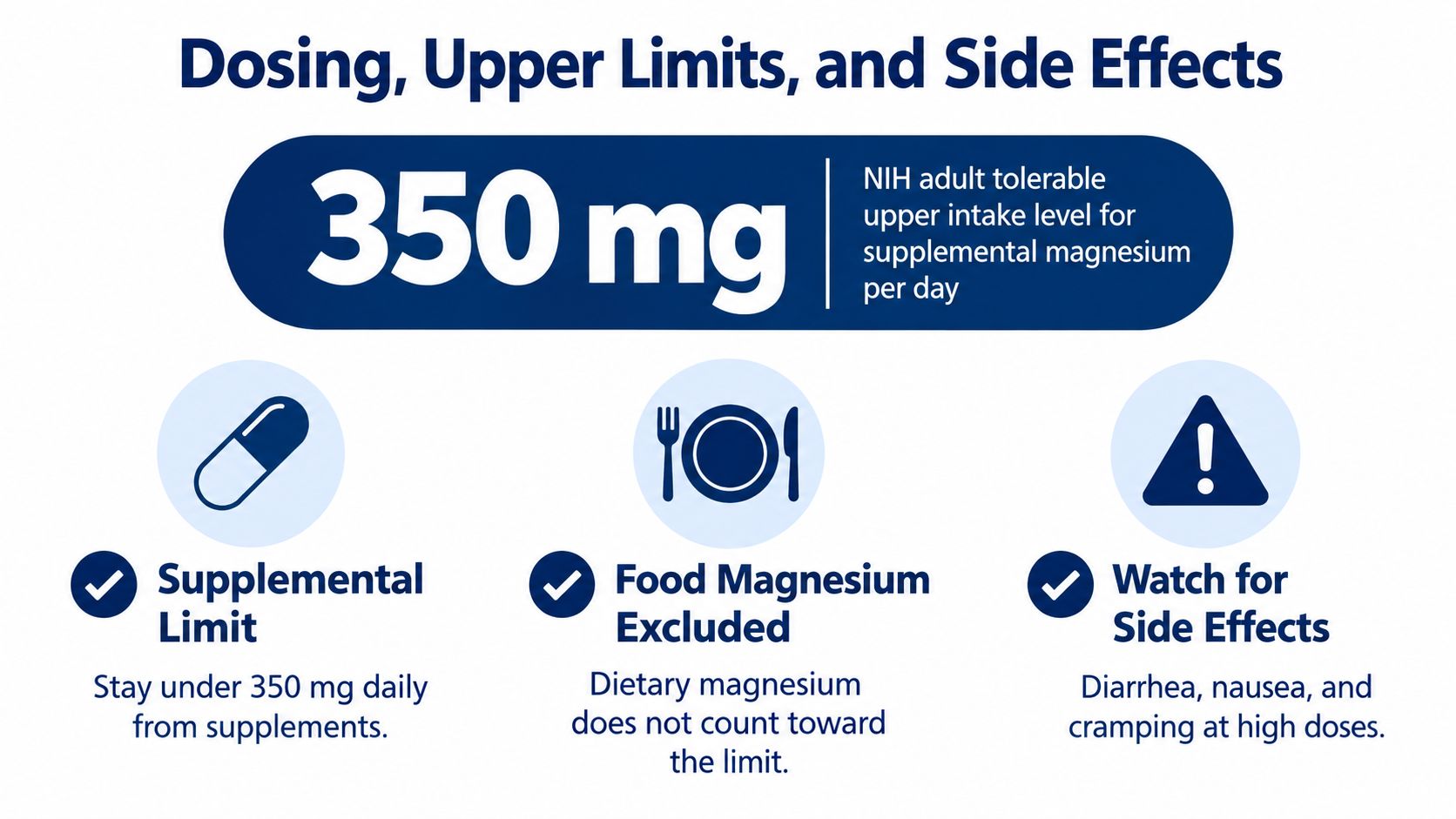
The number to track is elemental magnesium from supplements and medications, not the weight of the entire chelated compound. The U.S. National Institutes of Health sets the adult tolerable upper intake level at 350 mg per day for magnesium from dietary supplements and medications. Magnesium naturally present in food doesn't count toward that supplemental limit. The NIH consumer fact sheet explains the upper limit, side effects, and distinction from food magnesium.
The same 350 mg threshold applies to adolescents aged 9 to 18. The limits are 65 mg for children aged 1 to 3 and 110 mg for children aged 4 to 8. These are supplemental limits, not recommended total daily intakes from food and supplements combined.
Why side effects happen
Unabsorbed magnesium draws water into the intestine. That can lead to diarrhea, nausea, and abdominal cramping, particularly when the supplemental amount is high or a person is sensitive to the form. A chelated label doesn't remove that possibility.
Very high intakes can cause more serious toxicity, including irregular heartbeat and cardiac arrest, especially when kidney function is impaired. A person with kidney impairment, a history of significant gastrointestinal reactions, or a clinician's advice to limit magnesium shouldn't choose a product without professional guidance.
Safety check: Add the elemental magnesium from every supplement and magnesium-containing medicine before deciding whether a new blend fits.
Medication questions deserve a separate check
Magnesium can interfere with the absorption or use of certain medicines. The NIH fact sheet discusses interactions involving some antibiotics, bisphosphonates, proton pump inhibitors, and diuretics, so a pharmacist or healthcare professional can help determine whether timing or avoidance is appropriate.
A practical review includes:
- Total elemental magnesium: Count all supplemental sources, not only the newest bottle.
- Kidney function: Seek guidance before supplementing when kidney function is impaired.
- Digestive response: Treat diarrhea, nausea, or cramping as a reason to reassess the dose and form.
- Medication list: Ask a pharmacist about antibiotics, bone medicines, acid-reducing medicines, and diuretics.
- Household sharing: Don't assume an adult serving is appropriate for a child or adolescent.
Educational material about a supplement shouldn't replace individualized medication advice. Readers comparing options can also review this discussion of non-habit-forming sleep aids, while keeping safety checks specific to each ingredient and personal health history.
Choosing a Format That Fits Your Routine
“Chelated” describes how magnesium is chemically bound. It does not tell you whether a product suits your evening routine. Compare the elemental magnesium, other active ingredients, serving instructions, and physical format before choosing. One adult may want a melatonin-free mineral product, while another may prefer a broader evening formula or avoid capsules altogether.
A melatonin-free mineral option
A single-form product can make the label easier to interpret. Deep Calm is not a blend: it provides one form, magnesium glycinate (magnesium bound to glycine), with 275 mg of magnesium per serving from 2,500 mg of magnesium glycinate.* Its suggested serving is three capsules once daily, or as directed by a healthcare professional. The formula is described as supporting healthy magnesium levels, normal nerve function, and muscle health.*
The two figures describe different things. 275 mg is the elemental magnesium amount, the quantity used when comparing supplemental magnesium. 2,500 mg is the weight of the magnesium glycinate compound, which includes the magnesium and glycine bound together. Treating those numbers as interchangeable can make products appear stronger or weaker than they are.
A broader evening formula
A broader formula may fit someone who wants several evening ingredients in one product. Deep Rest contains 10 mg of melatonin, a small amount of magnesium (13 mg, as magnesium citrate), vitamin B6, GABA, L-theanine, ashwagandha, 5-HTP, St. John's Wort, chamomile, passion flower, and lemon balm. Its magnesium is a minor component rather than a magnesium dose comparable to the products discussed above. Because it combines multiple active ingredients, and St. John's Wort interacts with many prescription medicines, anyone taking medication should ask a healthcare professional or pharmacist to review the formula and possible interactions.
Melatonin is intended for use before planned sleep, not as a response to waking during the night. Anyone sensitive to higher melatonin amounts can discuss dose and timing with a healthcare professional rather than assuming that more will work better.
Convenience can be the deciding factor
Capsules are not the only option. Gummies and dissolving oral strips may be easier for adults who dislike swallowing pills or taking water at bedtime, although these formats can contain different ingredients and may provide no magnesium. Convenience affects whether a routine is practical, but it does not replace a Supplement Facts review.
Use this decision menu:
- Ingredient simplicity: A single-form magnesium product makes the mineral source and elemental amount easier to identify.
- Formula breadth: A multi-ingredient evening product calls for a wider interaction review.
- Physical format: Capsules, gummies, and oral strips create different practical routines. Check each product's serving size and active ingredients.
- Evidence: Match a study to the exact form and formula examined. Findings for one bisglycinate product do not automatically apply to every blend.
- Professional guidance: Pregnancy, nursing, being under 18, kidney concerns, medical conditions, and prescription medicines call for individualized advice.
A steady nighttime routine can also include dimmer evening light, a consistent wind-down period, and a plan for racing thoughts. Supplements are optional. For broader sleep habits, review this sleep-quality guide.
Sleep All Nite offers nighttime formats that include magnesium capsules and other supplement forms. Readers can compare ingredients, serving amounts, and delivery methods, then consult a healthcare professional before starting a supplement, particularly when prescription medicines or health conditions are involved.
*These statements have not been evaluated by the Food and Drug Administration. These products are not intended to diagnose, treat, cure, or prevent any disease.
This article is for general education and isn't medical advice. Talk with a healthcare professional before starting a supplement, especially if you're pregnant or nursing, under 18, managing a medical condition, or taking prescription medication.


