
Magnesium Glycinate vs Citrate for Sleep: A Practical Guide


The most popular advice about magnesium glycinate vs citrate for sleep is also the least precise: glycinate is “for sleep,” citrate is “for digestion,” and the decision is supposedly settled. It isn't. No eligible clinical trial has directly compared glycinate with citrate for sleep, so neither form has earned the title of proven winner (2026 systematic review).
The useful question is more practical: Which form fits the reader's stomach, schedule, elemental-magnesium target, and medication list? Glycinate is usually the more sensible nightly default when gastrointestinal calm matters. Citrate remains reasonable when bowel motility is welcome or when a person tolerates it well. Neither should be sold as a guaranteed answer for insomnia, 3 a.m. waking, perimenopause-related sleep disruption, or shift-work circadian problems.
Table of Contents
- Why These Two Magnesium Forms Get Compared for Sleep
- How Glycinate and Citrate Work in the Body
- What the Sleep Evidence Actually Shows
- Dosing, Tolerability, and the Laxative Question
- Which Form Fits Common Sleep Situations
- Choosing Your Form and Knowing When to Ask a Clinician
Why These Two Magnesium Forms Get Compared for Sleep
The label does not decide which magnesium form is better for sleep. Magnesium glycinate and magnesium citrate are compared because they combine magnesium with different compounds, and those pairings can affect digestion, dosing, and how easily a product fits an evening routine.
The practical choice is less about a sleep-specific winner and more about stomach response, schedule, and other medications. Citrate may suit someone who welcomes a bowel-motility effect. Glycinate is usually the cleaner nightly option when loose stools, urgency, or cramping would make a routine harder to maintain.
A 2026 systematic review, cited earlier, found no eligible head-to-head trial comparing glycinate with citrate for sleep. No formulation can therefore be called superior on current evidence. Differences between studies may reflect dose, participants, treatment length, sleep measures, and study quality rather than a genuine advantage for either salt.
Labels can also make the forms look more different than they are. Glycinate products often list a larger compound weight because the magnesium is attached to glycine, while citrate labels may show a different compound weight for the same general purpose. Compare the magnesium amount provided per serving, then judge whether that dose and the product's other ingredients suit the person taking it.
The practical decision behind the marketing
Use three checks:
- Dose: Is the serving appropriate for the person's intended intake?
- Digestive response: Does it cause loose stools, urgency, cramping, or nausea?
- Routine fit: Can it be taken consistently without disrupting bedtime or a medication schedule?
For a perimenopausal person waking at 3 a.m., glycinate is the more sensible starting point if digestive urgency could make the wake-up worse. Someone using melatonin may prefer the form that adds the fewest stomach problems to an existing bedtime routine. A shift worker should prioritize predictable tolerability around changing sleep times, rather than assume one form can correct circadian disruption.
Citrate remains reasonable when bowel motility is useful and the person tolerates it. Glycinate is the better default when gastrointestinal calm matters.
Practical rule: Choose the form that fits the stomach, schedule, and medication routine, not the one making the strongest sleep promise.
Magnesium can support a broader routine, but persistent insomnia, diagnosed sleep disorders, perimenopause symptoms, medication effects, and shift-related circadian disruption need appropriate clinical attention. Citrate versus glycinate is mainly a dosing-and-tolerance decision, not a proven sleep-performance contest.
How Glycinate and Citrate Work in the Body
Magnesium glycinate and magnesium citrate are different chemical pairings. Glycinate binds magnesium to glycine, an amino acid. Citrate binds magnesium to citric acid. The magnesium remains the mineral of interest, while the carrier can influence absorption, gastrointestinal effects, and how the product fits a person's routine.
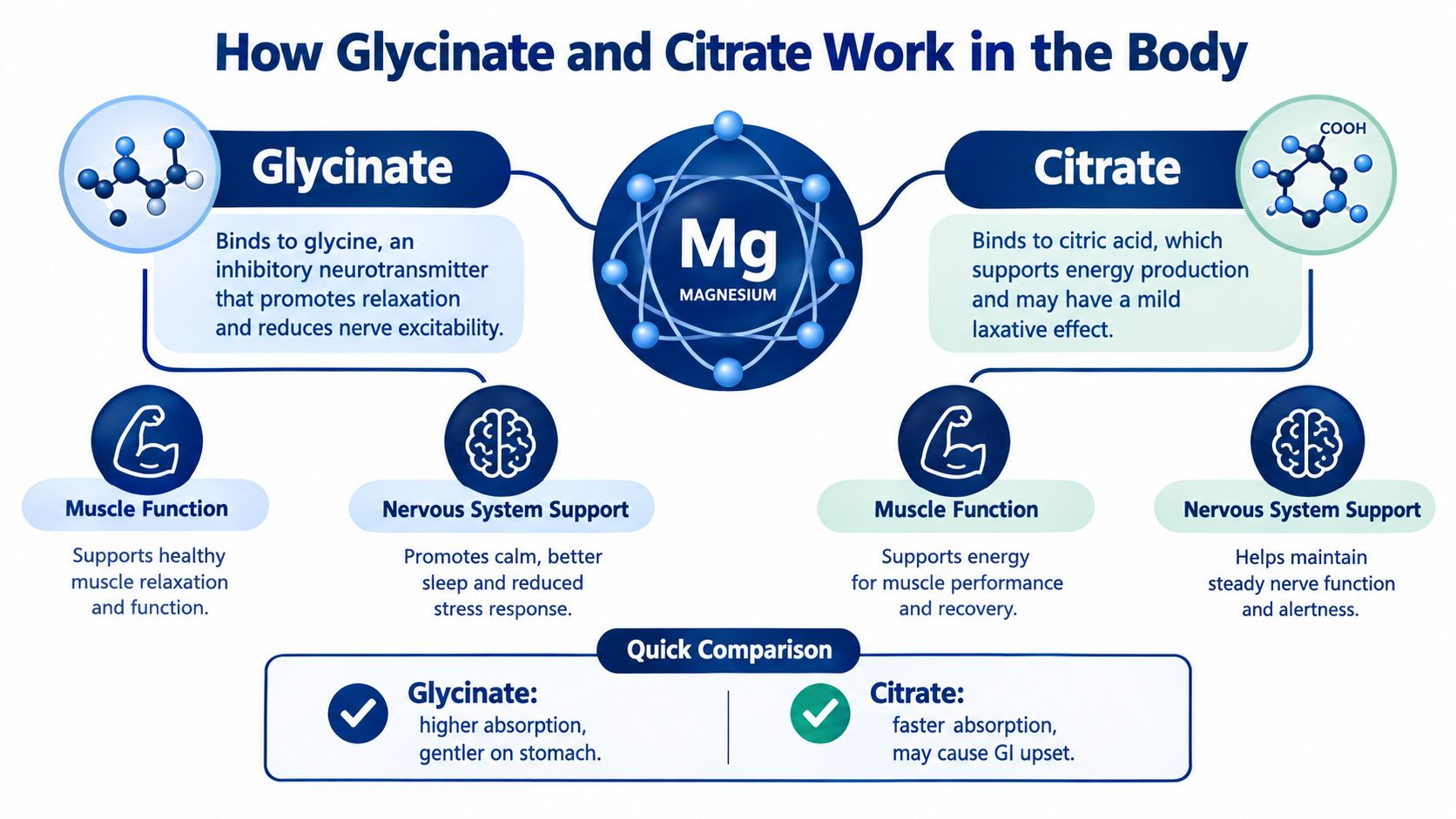
Magnesium itself is involved in normal nerve function, muscle function, and energy production. Those roles explain why people often consider supplementation when they're building an evening routine, but they don't prove that a particular magnesium salt improves sleep in a clinically meaningful way. A product's format, dose, and tolerability still matter.
What absorption evidence does and does not show
Citrate has documented absorption advantages over magnesium oxide. In a randomized crossover study of 20 healthy men, a single dose of magnesium citrate produced significantly greater 24-hour urinary magnesium excretion than magnesium oxide (randomized magnesium absorption study in BMC Nutrition). That supports a citrate-over-oxide finding. It does not prove that citrate absorbs better than glycinate, and it says nothing about which form produces better sleep.
Glycinate is valued in practice because many people find it gentler on the stomach. That practical reputation is more relevant to nightly use than an unsupported claim that it has a dramatic absorption advantage. A supplement that causes bowel urgency or cramping may be a poor fit even if the mineral itself is useful.
The glycine component deserves separate attention. Glycine has biological actions of its own, so a glycinate study can represent a magnesium-plus-glycine intervention, not a clean test of magnesium alone. That matters because sleep claims attached to bisglycinate may partly reflect glycine rather than the magnesium carrier by itself.
A product such as Deep Calm provides magnesium as glycinate, bound to glycine, with 275 mg of magnesium per serving. Its product information describes support for normal nerve function and muscle health, statements marked with an asterisk because they are structure or function descriptions rather than promises about treating a sleep disorder.*
The same logic applies to stress-related sleep disruption. Readers exploring the relationship between stress physiology and sleep can also review cortisol and sleep problems, but a magnesium form shouldn't be treated as a substitute for addressing the broader pattern.
What the Sleep Evidence Actually Shows
The human evidence is modest, and the distinction between magnesium for sleep and a specific magnesium form for sleep is essential. A systematic review of three randomized controlled trials involving 151 older adults found that oral magnesium reduced sleep-onset latency by 17.36 minutes versus placebo, with a 95% confidence interval of −27.27 to −7.44 and p = 0.0006 (systematic review of magnesium and insomnia). The same review found a 16.06-minute increase in total sleep time, but that result wasn't statistically significant.
Those findings suggest magnesium may help some people fall asleep somewhat sooner, particularly in the older adults represented by the trials. They don't establish a reliable effect for every adult, and they don't establish that citrate is better than glycinate. The review authors also identified small samples and methodological concerns, which limits how confidently the findings can guide product selection.
The most relevant modern form-specific trial
The strongest recent form-specific sleep benchmark identified here involved magnesium bisglycinate, not citrate. In a randomized, double-blind, placebo-controlled trial of 155 adults with self-reported poor sleep, participants took 250 mg of elemental magnesium daily for four weeks. Insomnia Severity Index scores fell by 3.9 points with bisglycinate versus 2.3 points with placebo, with a between-group p value of 0.049 and a small standardized effect, d = 0.2 (bisglycinate sleep trial in Nature and Science of Sleep).
Most of the improvement occurred during the first 14 days, but the result has an important limitation. The intervention also supplied approximately 1,523 mg of glycine daily, so the study can't isolate the effect of magnesium from the possible contribution of glycine. It would be inaccurate to use that trial as proof that magnesium glycinate outperforms magnesium citrate.
The honest interpretation
Glycinate has more directly relevant modern sleep data. Citrate doesn't yet have an equivalent established sleep benchmark, and no direct clinical comparison proves that either form is superior. That creates a reasonable preference for glycinate when sleep is the goal, but it doesn't justify calling glycinate a proven insomnia treatment.
A broader review from the National Center for Complementary and Integrative Health describes magnesium research as limited and inconsistent. It notes that a 2021 review of three studies with 151 participants suggested shorter sleep-onset latency in older adults, while a 2022 review of nine studies involving 7,582 participants found conflicting results for sleep quality and sleep disorders and called for larger trials lasting longer than 12 weeks (NCCIH overview of sleep disorders and complementary approaches).
A product comparison should therefore say exactly what the evidence supports: glycinate has a more relevant sleep trial, citrate has practical absorption evidence compared with oxide, and neither form has been proven superior to the other for sleep. A multi-ingredient product that lists a small amount of magnesium citrate, such as Deep Rest (13 mg of magnesium as citrate, alongside 10 mg of melatonin), shouldn't be presented as clinically equivalent to the bisglycinate trial or as a treatment for insomnia.
Dosing, Tolerability, and the Laxative Question
The label-reading step is simple but frequently missed. Compare elemental magnesium per serving, not the total weight of magnesium glycinate or magnesium citrate. For example, a label listing 275 mg elemental magnesium offers a directly comparable magnesium amount regardless of the carrier compound.
The adult tolerable upper intake level for magnesium from supplements and medications is 350 mg per day, unless a healthcare professional recommends otherwise (NIH Office of Dietary Supplements magnesium fact sheet). That limit applies to supplemental magnesium, not magnesium naturally present in food. Amounts above it make diarrhea, nausea, and abdominal cramping more likely, although individual response varies.
Glycinate and citrate side by side
| Attribute | Magnesium Glycinate | Magnesium Citrate |
|---|---|---|
| Carrier | Glycine | Citric acid |
| Sleep evidence | More directly relevant modern form-specific data, but not proof of superiority | No equivalent established form-specific sleep benchmark |
| Digestive profile | Generally the more practical choice when minimizing gastrointestinal disruption | More likely to be selected when a bowel-motility effect is acceptable |
| Absorption evidence | No eligible direct clinical comparison proving superiority over citrate | Greater urinary magnesium excretion than magnesium oxide in a randomized study |
| Label priority | Compare elemental magnesium per serving | Compare elemental magnesium per serving |
| Nightly fit | Often better suited to consistent evening use if tolerated | Reasonable if tolerated and digestive effects aren't disruptive |
Citrate's laxative question isn't a minor footnote. If a person takes it near bedtime and experiences loose stools, urgency, or cramping, the product may interfere with sleep and reduce consistency. That doesn't make citrate a bad form. It means the digestive effect is part of the product's practical profile.
Medication timing also deserves attention. Magnesium can interfere with absorption when taken alongside some oral medicines and supplements. Anyone taking antibiotics, bisphosphonates, or medicines that affect kidney function should ask a healthcare professional about the form, dose, and spacing rather than guessing from a bottle label. People with kidney disease need particular caution because magnesium clearance can be impaired.
A detailed guide to sleep support supplements can help with broader ingredient comparisons, but no supplement checklist replaces a medication review when prescriptions are involved.
Which Form Fits Common Sleep Situations
The same bottle can be a reasonable choice for one sleeper and an irritating choice for another. Magnesium glycinate vs citrate for sleep becomes clearer when the decision starts with the person's schedule and digestive response rather than with a universal ranking.

The racing-mind sleeper
For someone whose evening is dominated by mental replay, both forms can fit a relaxation routine, but glycinate is usually the more evening-friendly starting point. It supplies magnesium alongside glycine, and the direct bisglycinate trial makes it the more relevant form for a reader prioritizing sleep rather than bowel regularity.
That still doesn't make glycinate a treatment for anxiety or insomnia. A calmer pre-bed transition, lower stimulation, and a repeatable wind-down routine remain important. A person can choose a free breathing exercise, quiet reading, dimmer lighting, or a short written list of tomorrow's tasks before deciding whether a supplement belongs in the routine.
A reader comparing formats can also review best sleep aid options, especially when trying to distinguish melatonin products from melatonin-free supplements.
The perimenopausal 3 a.m. waker
For women in their 40s and 50s who wake at 3 a.m., gastrointestinal stability matters. An overnight bowel response can make an already-fragmented night feel worse, so glycinate is the more practical default when nightly consistency and minimal digestive disruption are the priorities.
Neither form should be presented as a way to stop middle-of-the-night waking. Readers can explore guidance on why waking at 3 a.m. happens, but persistent waking, hot flashes, medication changes, snoring, or other symptoms may require professional evaluation. Magnesium belongs in the larger routine, not in a promise that a capsule will keep someone asleep.
The melatonin user
A melatonin user considering magnesium should keep the roles separate. Melatonin belongs in the evening before intended sleep, not as a dose added after a night waking, while magnesium is a mineral supplement whose form should be chosen for elemental dose and tolerability.
Readers burned by high-dose melatonin don't need to assume that adding magnesium will make a large melatonin dose appropriate. A lower-complexity routine with careful timing is easier to evaluate than several new products started at once. Anyone considering a product that contains melatonin should check the label and discuss the plan with a healthcare professional.
The shift or rotating-shift worker
Neither glycinate nor citrate resets the circadian rhythm on its own. For a rotating-shift worker, the choice is primarily about avoiding stomach disruption during an irregular sleep window. Glycinate is often the cleaner practical choice if citrate's bowel effect could become inconvenient during a work block or daytime sleep period.
Shift workers may benefit from anchoring light exposure, caffeine timing, meals, and a wind-down period around the intended sleep window. Magnesium can be one optional part of that routine, but it shouldn't be treated as a circadian-reset button.
The following video can serve as a general visual resource while readers think through their own sleep schedule and supplement timing:
Choosing Your Form and Knowing When to Ask a Clinician
A practical decision can be made without pretending the evidence is stronger than it is.
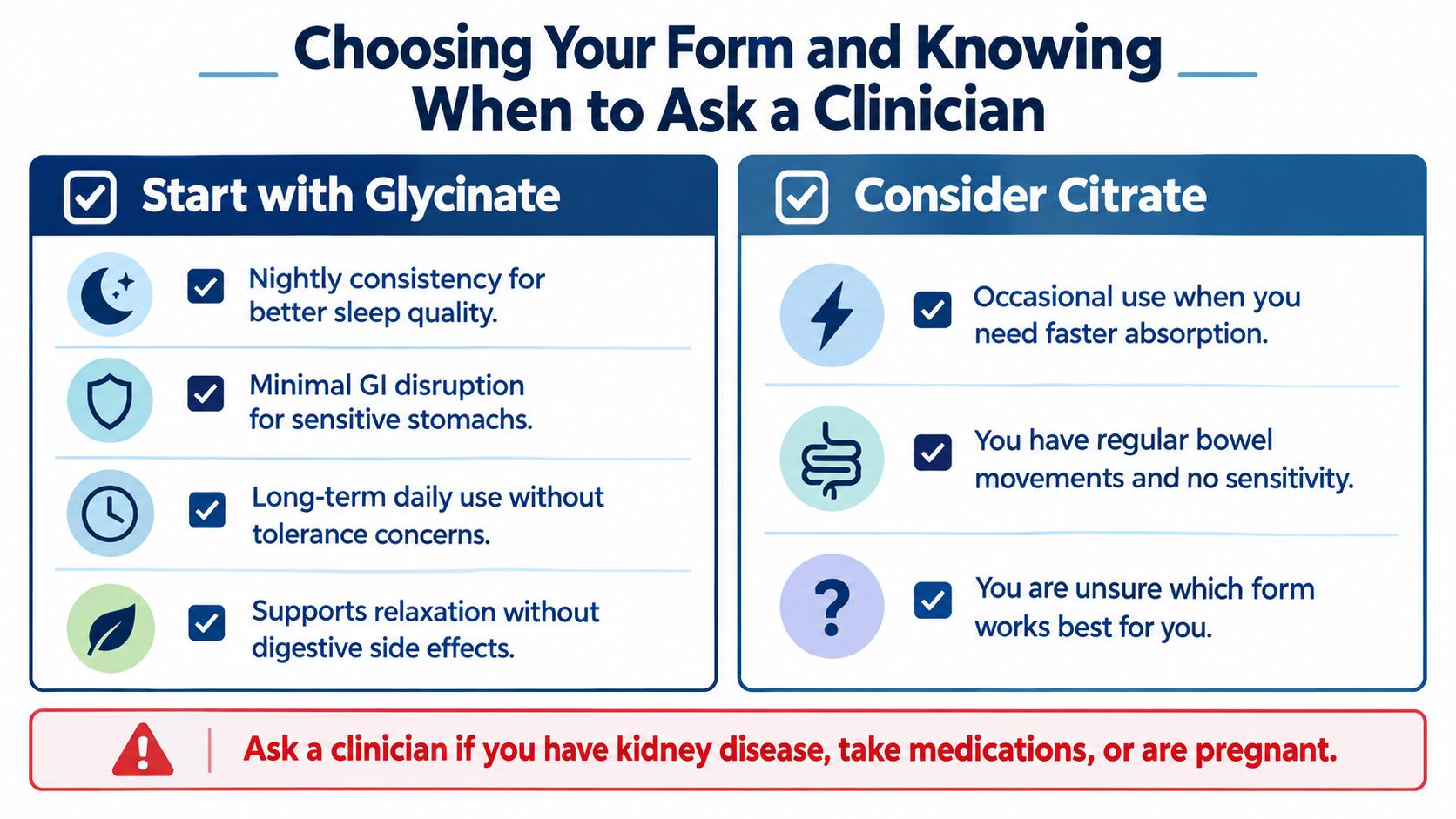
Choose magnesium glycinate first when the priority is a consistent evening routine, minimal gastrointestinal disruption, or a form with more directly relevant modern sleep research. That preference is practical, not proof that glycinate produces better sleep than citrate.
Consider magnesium citrate when occasional use is the plan, a bowel-motility effect is welcome, or the person already tolerates it without urgency, loose stools, or cramping. Citrate's absorption evidence is stronger against magnesium oxide than against glycinate, so marketing that turns this into a sleep advantage goes too far.
A short decision framework
- Sensitive stomach: Glycinate is the more sensible starting point.
- Digestive regularity matters: Citrate may fit, provided the effect is welcome and doesn't disturb sleep.
- Medication schedule is complicated: Ask a healthcare professional about spacing and interactions before choosing either form.
- Kidney disease is present: Obtain medical guidance before using supplemental magnesium.
- Pregnancy or nursing: Discuss supplementation with a healthcare professional first.
- A diagnosed sleep disorder exists: Use clinician-led care rather than trying to manage the condition with a mineral form.
A clinician should also be involved when sleep trouble persists, worsens, or comes with symptoms that suggest another cause. Readers can use when to see a doctor for insomnia as a starting point for recognizing when self-directed supplement decisions are no longer enough.
The clearest recommendation is straightforward: glycinate is the better practical default for nightly sleep routines when stomach comfort matters, while citrate is reasonable when its digestive effect is acceptable. The evidence doesn't justify calling either form superior for sleep, so the final choice should follow the label, the gut, the schedule, and the medication list.
Sleep All Nite offers melatonin-free magnesium glycinate in Deep Calm, alongside other nighttime formats with clearly listed ingredients and serving amounts. Readers can compare magnesium forms and elemental amounts at Sleep All Nite, then check with a healthcare professional before starting a supplement.
*These statements have not been evaluated by the Food and Drug Administration. These products are not intended to diagnose, treat, cure, or prevent any disease.
This article is for general education and isn't medical advice. Talk with a healthcare professional before starting a supplement, especially if you're pregnant or nursing, under 18, managing a medical condition, or taking prescription medication.


