
Melatonin Free Sleep Aid: Evidence and Options Compared


Switching to a natural supplement isn't automatically the safest answer to poor sleep. A melatonin-free sleep aid may offer relaxation-focused ingredients, but removing melatonin doesn't prove that the remaining formula works, suits someone's medicines, or addresses the reason sleep is difficult.
The useful starting point isn't which bottle looks gentlest. It's whether the problem involves sleep timing, difficulty winding down, repeated awakenings, or feeling unrefreshed despite enough time in bed.
Table of Contents
- What a Melatonin-Free Sleep Aid Is and Why Adults Look for One
- Melatonin-Free Ingredients Compared at a Glance
- How Melatonin-Free Ingredients Work and What Studies Measured
- Dosing, Safety and Label Checks Before You Buy
- Capsules, Gummies, Strips and Topicals Compared
- When a Melatonin-Free Aid Is Not the Right Next Step
- Choose Your Melatonin-Free Option in Five Steps
What a Melatonin-Free Sleep Aid Is and Why Adults Look for One
A melatonin-free label can sound like a guarantee of a gentler or more suitable product. It tells you only that the label lists no melatonin. Check what the manufacturer means by that wording, then assess each ingredient for sleep-specific evidence and safety.
Different sleep complaints need different questions
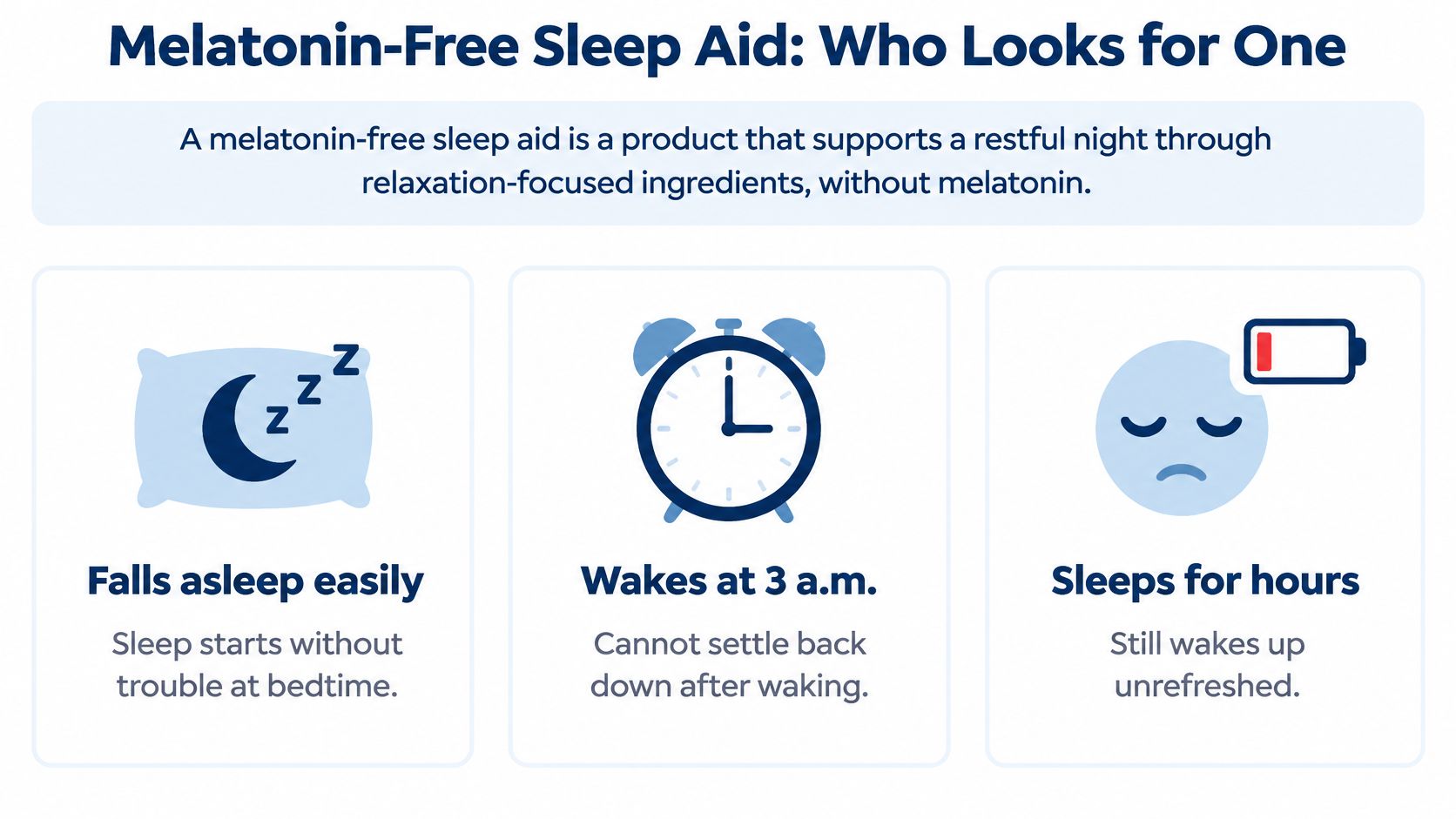
According to CDC National Center for Health Statistics findings for 2024, 30.5% of U.S. adults slept fewer than seven hours per day on average, while 18.1% had trouble staying asleep most days or every day. The same findings report that 15.4% had comparable difficulty falling asleep, and 54.8% usually woke feeling well-rested. The CDC findings show that these experiences are measured separately.
These patterns point to different questions. Trouble falling asleep may involve winding down, while repeated waking calls for attention to what disrupts sleep. Waking unrefreshed also deserves consideration on its own. A product aimed at relaxation may not address a timing problem or the reason sleep feels unrefreshing.
Why avoiding melatonin can be a preference
An NIH analysis of U.S. adults found reported melatonin-supplement use rose from 0.4% in 1999–2000 to 2.1% in 2017–2018. The analysis also noted that research has not consistently shown improvements in insomnia. Rising use does not establish that a supplement suits a particular person.
A preference to avoid melatonin can guide what you look for on a label, but it cannot establish that the remaining ingredients work or are safe for you. If sleep happens at an inconvenient time, learning about circadian rhythm disruption may help clarify whether the concern involves timing.
The central distinction: Melatonin-free describes an ingredient choice. It does not certify effectiveness, quality, or safety.
Melatonin-Free Ingredients Compared at a Glance
A “melatonin-free” label identifies what a product leaves out. It does not tell you whether its other ingredients have evidence for sleep. The table compares each ingredient by its usual role, sleep-specific support, common formats, and a practical label check.
Melatonin-free ingredients compared by role, sleep evidence and caution
| Ingredient | Typical role | Evidence for sleep | Common formats | Main caution |
|---|---|---|---|---|
| Magnesium glycinate | Nutritional and relaxation support | Findings for magnesium are inconsistent, with low to very low certainty; evidence does not establish a benefit specific to glycinate | Capsule, tablet, powder | Add up magnesium from food and supplements |
| L-theanine | Wind-down and racing-mind support | Modest improvements in subjective measures; studies include mixed formulations | Capsule, gummy, drink mix | Combination products make it hard to identify which ingredient contributed |
| GABA | Marketed for calm-state support | No human sleep trial cited here | Capsule, gummy | Treat sleep claims as unproven |
| Reishi mushroom extract | Traditional wellness use; marketed for calming | Sleep benefit is not established by evidence cited here | Gummy, capsule | Check the extract's identity and strength |
| Valerian root | Traditional bedtime herb | No ingredient-specific sleep evidence cited here | Capsule, tea, tincture | Check for other sedating ingredients |
| Chamomile | Traditional bedtime tea | The guideline below does not suggest it for chronic insomnia disorder | Tea, capsule | Check whether it is suitable given allergies |
| Passionflower | Traditional calming herb | The guideline below does not suggest it for chronic insomnia disorder | Capsule, gummy, tea | Check for combinations with other calming ingredients |
| Lemon balm | Traditional calming herb | No human sleep trial cited here | Capsule, gummy, tea | Review the full blend, not only this ingredient |
| Ashwagandha | Marketed for stress-related support | Sleep benefit is not established by evidence cited here | Capsule, powder | Ask about medication and medical-condition concerns |
How to interpret an evidence label
“Not established here” means the evidence presented does not support a sleep-benefit rating for that ingredient. It does not prove the ingredient has never been studied. Mixed means the findings are inconsistent. A favorable response on a sleep questionnaire also does not by itself show fewer objectively measured awakenings, improved next-day performance, or a benefit for every adult.
The 2025 VA/DoD clinical practice guideline does not suggest chamomile or passionflower for chronic insomnia disorder. That recommendation addresses treatment of a diagnosed disorder. It does not determine whether someone enjoys an evening cup of tea.
What the comparison can establish
Magnesium and L-theanine have the clearest review-level coverage among the ingredients listed. That makes their evidence easier to discuss, not their products automatic recommendations. The table does not rank every supplement on the market.
A product is not necessarily equivalent to a preparation studied elsewhere just because both contain the same ingredient. Serving amount, extract preparation, accompanying ingredients, and the population studied all affect how closely a product matches the evidence. Read the ingredient list and the specific sleep claim together.
No ingredient in this table is established as a treatment for chronic insomnia. A label can help you identify what is in a product, but it cannot establish benefit or safety on its own.
How Melatonin-Free Ingredients Work and What Studies Measured
Melatonin works more like a clock signal, helping communicate biological nighttime. Relaxation-focused approaches aim to reduce background arousal, more like turning down noise in a busy room than changing the time.
The American Academy of Sleep Medicine educational toolkit describes relaxation approaches as targeting worries, intrusive thoughts, and a racing mind. That behavioral framework doesn't establish that swallowing a calming ingredient produces the same result.
The bedroom illustration reflects a wind-down setting, not evidence that a particular environment or supplement guarantees sleep.

L-theanine findings need careful translation
A 2025 systematic review and meta-analysis in Sleep Medicine Reviews included 19 clinical studies involving 897 participants and found statistically significant improvements in subjective sleep-onset latency, SMD 0.15, 95% CI 0.01–0.29; daytime dysfunction, SMD 0.33, 95% CI 0.16–0.49; and overall subjective sleep quality, SMD 0.43, 95% CI 0.04–0.83.
A standardized mean difference, or SMD, puts results from different measurement scales onto a shared scale. It isn't a count of extra minutes asleep, and it can't be read as the percentage of people who improved.
The practical interpretation is cautious: participants reported generally modest improvements, but the studies differed and some used combination products. Those findings can't automatically be credited to isolated L-theanine or transferred to every gummy containing it.
A statistically significant result can still be too small, too uncertain, or too product-specific to predict an individual's experience.
Magnesium and other ingredients need narrower claims
Magnesium's role in the body doesn't establish a predictable sleep effect. Evaluating it requires separating subjective impressions from measurements such as brain-wave recordings, movement-based sleep estimates, and physiological markers.
GABA deserves a separate distinction. Its biological name or presence in a calming blend doesn't establish that an oral supplement delivers a clinically useful sleep effect.
Reishi mushroom extract also needs product-specific scrutiny. Traditional use, the word mushroom, and an impressive extract description aren't substitutes for a human trial using the same preparation.
Botanicals shouldn't be treated as a single interchangeable category. A finding involving one extract or a multi-herb formula doesn't validate another herb, another extraction method, or a different serving amount.
Measure the experience rather than the promise
A simple paper sleep diary can record estimated time to fall asleep, awakenings, total sleep time, and next-day alertness over several weeks. Notes about caffeine, alcohol, shift work, exercise, and medicines help prevent a changed routine from being mistaken for a supplement effect.
The useful question is whether a meaningful pattern improves without unwanted effects. A pleasant evening sensation alone doesn't establish better sleep, and a tracker score shouldn't outweigh daytime functioning.
Dosing, Safety and Label Checks Before You Buy
A shopper sees melatonin-free on the front of a package, assumes the formula must be gentle, and combines it with another calming product. The safer approach starts with the back label and a complete list of existing medicines and supplements.
Label checks before choosing a melatonin-free product
| Label item | What to check | Why it matters |
|---|---|---|
| Melatonin line | Read Supplement Facts and other ingredients; ask what the melatonin-free claim means | Front-label wording may not define the testing standard |
| Amount per serving | Identify every active amount and compare it with the preparation studied | A blend name doesn't establish an evidence-matched amount |
| Total magnesium | Add magnesium from all supplements; review dietary intake separately | Overlapping products can increase intake and gastrointestinal effects |
| Botanical extract strength | Look for plant part, standardization, or extract ratio | Equal weights don't necessarily mean equivalent preparations |
| Allergens and fillers | Read allergen statements, capsule materials, and gummy ingredients | Nonactive ingredients can affect suitability |
| Independent testing | Seek identifiable third-party verification or a published laboratory report | A vague tested claim doesn't explain what was checked |
| Medication fit | Have a clinician or pharmacist review the full ingredient list | Natural ingredients can still interact with medicines |
Verification is more useful than reassuring wording
A 2025 laboratory study of melatonin supplements analyzed 50 products and found 12% of samples from legal supply chains violated legislation; products obtained from rogue internet pharmacies contained particularly high amounts. The study examined melatonin products, not melatonin-free formulas, so it doesn't establish a defect rate for this category.
The relevant shopping lesson is narrower: labels and claims deserve verification. A laboratory report should identify the product, what was tested, and whether the findings concern identity, ingredient amounts, contaminants, or something else.
For magnesium specifically, a 2026 systematic review of 12 placebo-controlled trials in adults rated the certainty of evidence for sleep outcomes low to very low, and noted that many trials relied on self-reported sleep measures rather than objective ones. That supports caution about buying a larger serving just because the package emphasizes sleep.
A conservative dosing menu
- Begin conservatively: Use the lowest labeled serving after any necessary professional review, without exceeding label directions.
- Change one thing: Add only one new product at a time so benefits and unwanted effects remain easier to identify.
- Avoid overlap: Don't combine several sedating botanical blends or assume that different brand names mean different ingredients.
- Watch functioning: Drowsiness, stomach upset, and next-day impairment are reasons to reassess rather than increase the amount.
Professional advice should come first during pregnancy or nursing, for anyone under eighteen, or when medical conditions or prescription medicines are involved. The guide to when to see a doctor for insomnia can help prepare that conversation.
Capsules, Gummies, Strips and Topicals Compared
The best format is one that fits your routine and is easy to take as directed. Format tells you how a product is used; sleep-specific evidence depends on its ingredients and what studies measured. “Melatonin-free” is a label to verify, not proof of benefit or safety.
Supplement formats compared for daily use
| Format | How it is taken | Strengths | Trade-offs | Melatonin check |
|---|---|---|---|---|
| Capsule | Swallowed with water | Familiar routine; labeled amount per capsule | Can be large; needs water | Read Supplement Facts line by line |
| Gummy | Chewed | No water needed; flavored format | Check sugar, sweeteners, and serving size | Confirm active amounts and whether melatonin is listed |
| Oral strip | Dissolved on the tongue | No water; compact format | Ingredients and instructions require careful checking | Treat status as unknown until the label is reviewed |
| Topical | Applied to skin | Can fit a skincare step | Application isn't equivalent to an oral supplement serving; sleep benefit isn't established here | Check creams and oils for melatonin |
Two factual melatonin-free examples
Deep Calm is a melatonin-free capsule containing magnesium glycinate and providing 275 mg magnesium per three-capsule serving.* Check the declared magnesium amount, rather than the larger weight of the magnesium-containing compound.
Nite Bites is a melatonin-free blackberry gummy containing reishi extract, alongside L-theanine, lemon balm, passion flower, and valerian root, for winding down.*
These products use different formats and ingredient combinations, so they are not equivalent formulas. Deep Calm centers on a mineral, while Nite Bites combines several ingredients. If someone notices a change, the combination makes it harder to identify which ingredient may have contributed. Format alone cannot answer that question.
Choose by usability, not presumed potency
Before choosing capsules, check the full serving size. A serving may require more than the single capsule shown on the front, which can affect whether it feels manageable to take.
For gummies, read both the nutrition and ingredient panels instead of treating the product as candy. Flavor and chewability can make a format more convenient, but they do not make its ingredients better supported for sleep.
Oral strips and topicals also need a careful label check. A familiar-looking format or gentle application does not confirm that a product is melatonin-free. For a topical, application to the skin is not the same as taking an oral serving, and this comparison does not establish a sleep benefit.
The broader comparison of sleep-support supplements can help distinguish ingredient categories. Adults weighing next-day considerations can also read this guide to a non-drowsy sleep aid, while remembering that “non-drowsy” wording is not a guarantee.
When a Melatonin-Free Aid Is Not the Right Next Step
If sleep difficulty continues for several weeks, especially when it affects daytime functioning, consider clinical or behavioral support. A supplement label cannot explain persistent symptoms, and adding calming ingredients may not address their cause.
Behavioral care addresses more than bedtime habits
The American Academy of Sleep Medicine describes CBT-I as first-line treatment for chronic insomnia and states that sleep hygiene alone isn't sufficient treatment. Cognitive behavioral therapy for insomnia, or CBT-I, is a structured approach with specific skills, not just general bedtime advice.
Its components include stimulus control, which helps rebuild the association between bed and sleep; relaxation methods; and cognitive therapy for beliefs that disrupt sleep. Sleep restriction aims to consolidate sleep by adjusting time in bed to reflect time spent sleeping. A clinician or CBT-I provider can help set and adjust a schedule, rather than leaving you to sharply cut your sleep opportunity on your own.
Care checkpoint: If sleep difficulty persists, ask a clinician about CBT-I instead of assuming another ingredient will resolve it.
Symptoms that deserve clinical attention
- Breathing concerns: Loud snoring, gasping, or observed pauses in breathing.
- Leg discomfort: Uncomfortable nighttime urges to move the legs.
- Mood changes: Persistent changes in mood alongside sleep difficulty.
- Medication questions: Symptoms that begin or change after medicines are started or adjusted.
- Daytime impairment: Trouble functioning, staying alert, or carrying out ordinary responsibilities safely.
- Persistent difficulty: Sleep trouble that continues despite reasonable behavioral changes.
Night sweats that repeatedly wake you, including those related to menopause, are worth discussing with a clinician; the time of an awakening alone cannot identify its cause.
Melatonin is generally taken in the evening before bed, so waking overnight is not a reason to improvise another dose. Repeated awakenings call for attention to the pattern and its possible causes.
For mental activity that makes it hard to settle at bedtime, strategies for sleeping when the brain is racing offer a focused starting point.
Choose Your Melatonin-Free Option in Five Steps
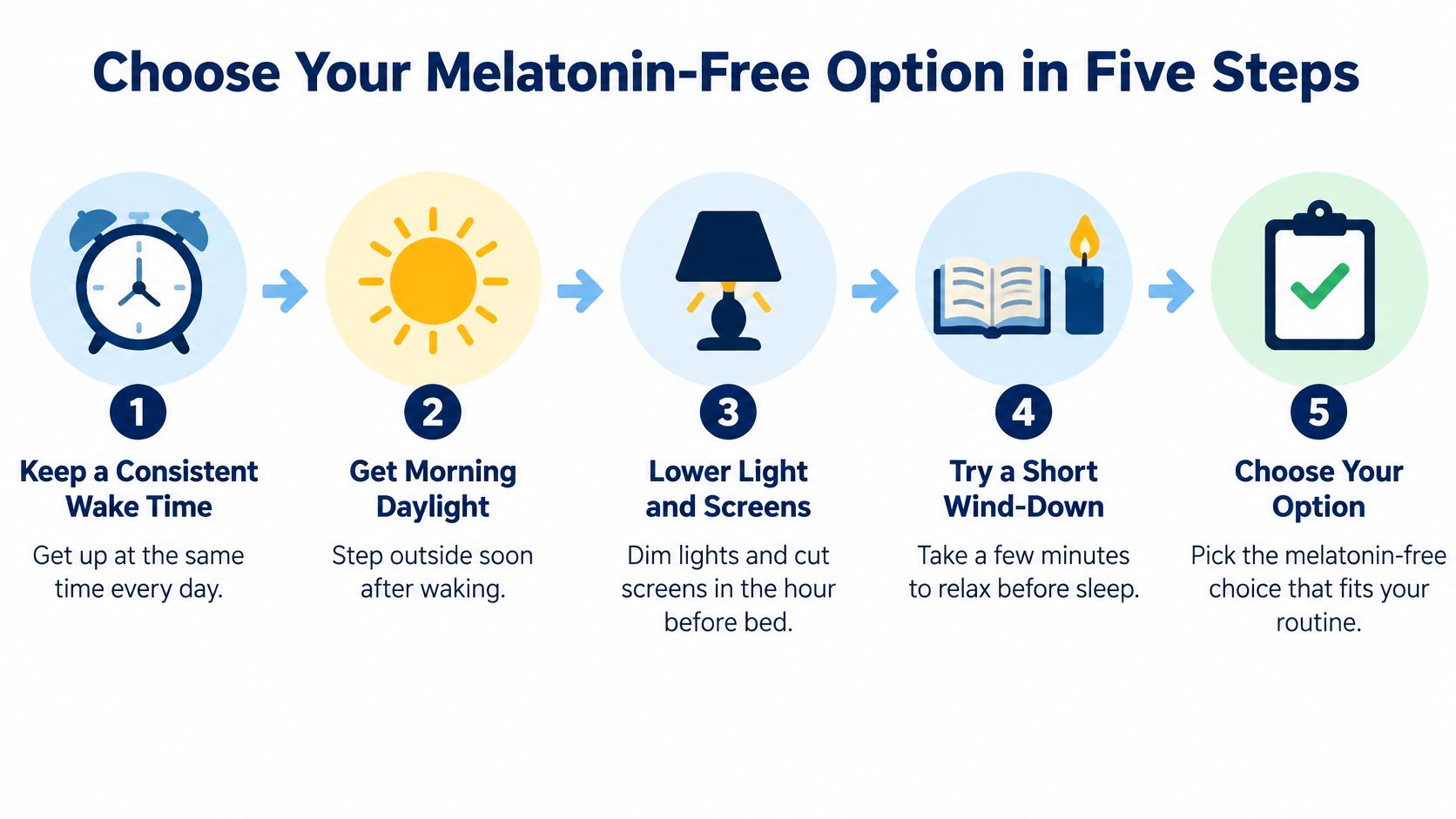
Start with one routine change you can repeat. A consistent wake time and morning daylight give the day a clear starting point, while lower evening light and fewer screens before bed can make the transition to sleep calmer. Reading, gentle stretching, or slow breathing may also fit, depending on what helps you settle.
If household noise is the problem, try a fan if one is available or a free white-noise app. These options do not require a new device or a redesigned bedroom.
A practical selection pathway
- Name the actual problem. Difficulty falling asleep, mental activity at bedtime, repeated awakenings, and waking unrefreshed are different patterns. Write down what happens rather than relying on the broad label “poor sleep.”
- Match expectations to evidence. Use the ingredient comparison to distinguish review-level findings from ingredients without cited sleep data. A longer ingredient list does not mean stronger evidence.
- Verify the formula and format. Check the stated amounts, extract details, other ingredients, and independent testing information. Then choose a format you can manage. “Melatonin-free” describes a label; it does not establish that a product works or is safe for you.
- Make one controlled change. Follow the conservative dosing menu and record the sleep-diary measures described earlier. Note other routine changes too, so you can see what changed instead of crediting every better night to a new supplement.
- Set a care checkpoint. Seek professional review if symptoms last several weeks, daytime functioning worsens, or a concerning symptom appears. If persistent sleep difficulty is the main issue, ask about CBT-I rather than continuing to shop through options.
Decide what would count as worthwhile
Choose a practical goal, such as an easier transition into bedtime, clearer next-day functioning, or less struggle with the evening routine. A supplement need not eliminate every awakening, and a perfect tracker score is not the measure of a useful choice.
Sleep All Nite offers melatonin-free capsule and gummy options with ingredient information for comparison. Adults considering optional support can visit Sleep All Nite to compare formats and ingredient amounts, then check suitability with a healthcare professional before starting a supplement.
Tonight, choose one routine change and write down what you want it to improve. If you consider a product, check its ingredients and amounts against that specific goal before deciding whether to buy.
*These statements have not been evaluated by the Food and Drug Administration. These products are not intended to diagnose, treat, cure, or prevent any disease.
This article is for general education and isn't medical advice. Talk with a healthcare professional before starting a supplement, especially if you're pregnant or nursing, under 18, managing a medical condition, or taking prescription medication.


