
Amino Acids Free Form: What They Are, How They Work


The most popular advice about amino acids free form sounds simple. Loose amino acids skip digestion, hit the blood fast, and therefore work better. That story skips the step that matters most. A faster rise in blood isn't the same as a proven effect, and free form describes chemistry, not quality.
Readers weighing a capsule for training, a powder for protein gaps, or a nighttime blend for winding down need three separate questions. What's the chemical form? How quickly does it appear in circulation? What outcome has been tested in people like the reader, at that dose? Blurring those questions turns a delivery format into a promise. Keeping them apart makes labels easier to read and claims easier to judge.
Table of Contents
- What Free-Form Amino Acids Are
- Free-Form Versus Peptide-Bound Amino Acids
- Common Supplement Forms and How to Read Their Labels
- Sleep-Relevant Amino Acids and What Research Shows
- Safety Limits, Dosing and Clinician Checks
- Building Your Routine Menu
What Free-Form Amino Acids Are
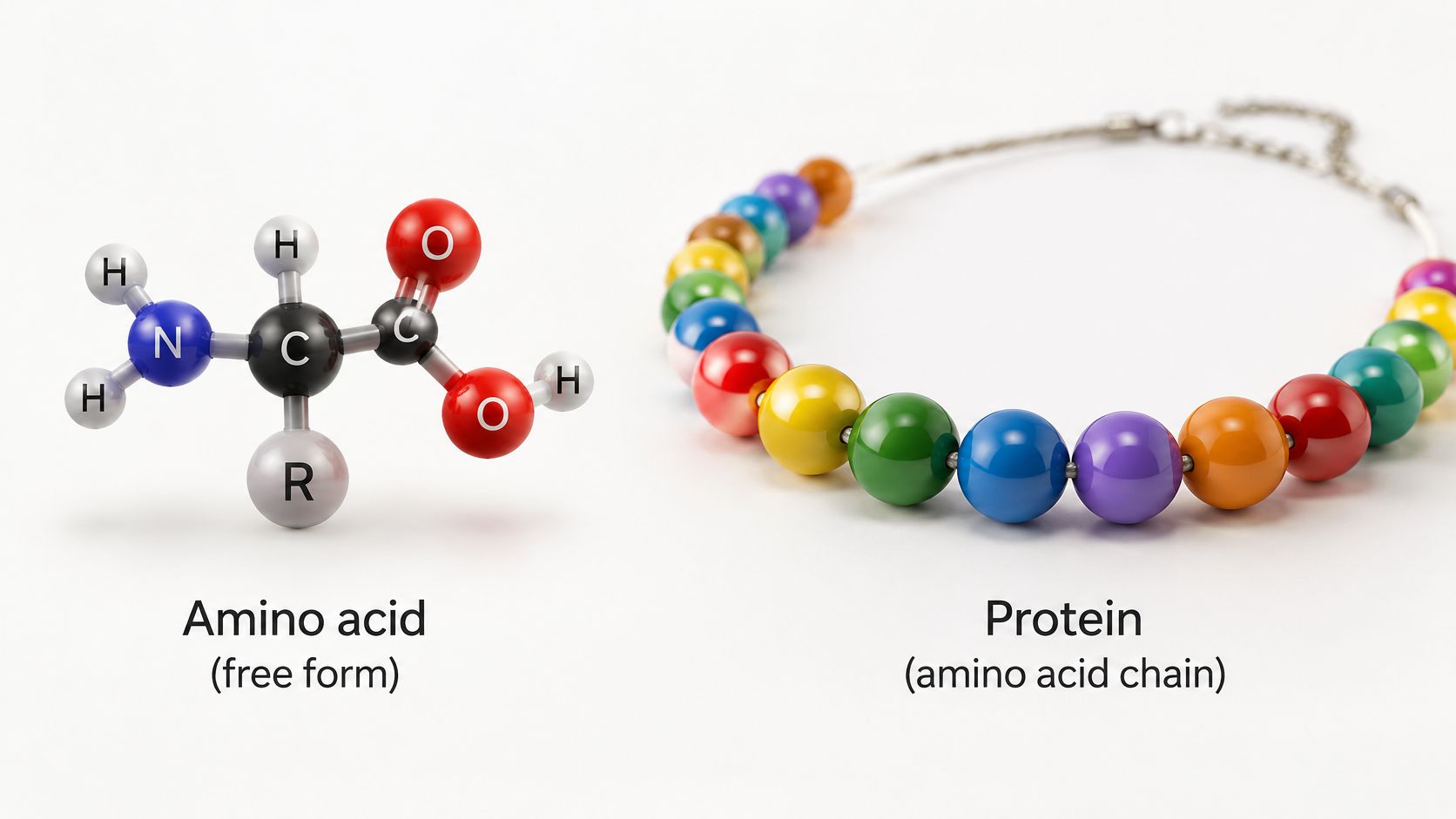
Free-form amino acids are single molecules not linked into a peptide or protein chain. A protein is like a necklace of connected units; a free-form amino acid is one unit on its own. That describes its chemical structure, not its quality. The same amino acid may be present on its own in a capsule or as part of a protein in food, and the body processes those starting forms differently.
How Large the Free Pool Is
The body's free amino-acid pool is small compared with the amount already built into proteins in tissues. Most of the body's amino acids are locked into structural and working proteins at any given moment, and skeletal muscle is a major site of amino-acid storage and exchange.
Blood plasma has a different role. It carries amino acids between tissues rather than serving as the main storage tank. A quick rise in a blood test shows amino acids moving through circulation. It does not show that they remain there or reveal what the body does with them.
A quick rise in blood shows delivery speed. It doesn't show where amino acids end up or what they do next.
After uptake, tissues allocate amino acids according to current needs. Cells use some to build proteins, convert some into other metabolites, and oxidize some for energy. Exercise, fasting, and illness can also shift amino-acid levels, so the pool is continually changing.
For amino acids free form products, the practical point is that a free amino acid is a changing metabolic input, not a small serving of dietary protein. It provides a single unit; a formula supplies the full set of amino acids only if it includes them. Once absorbed, an amino acid may be used, transformed, or broken down rather than remaining unchanged in circulation.
Free-Form Versus Peptide-Bound Amino Acids
Free-form and peptide-bound amino acids compared
| Feature | Free-form amino acids | Peptide-bound amino acids |
|---|---|---|
| Chemical state | Single molecule, not bonded to others | Bonded into a peptide or protein chain |
| Digestion needed first | Little or none beyond intestinal transport | Stomach acid and pancreatic enzymes must break it down first |
| Intestinal uptake | Carrier systems for free amino acids | Free amino acids via carriers; small peptides via PEPT1, then broken down inside the cell |
| Typical product type | Single-ingredient capsules and multi-amino blends | Protein powders, collagen, and hydrolysates |
The chemical difference is the starting point, not a quality score. A free-form amino acid is already a single molecule; protein supplies amino acids joined in chains that digestion must cut apart. Once digestion and absorption are underway, both forms contribute amino acids to the body, though their routes and timing differ.
The Path From Protein to Blood
- Stomach acid unfolds the protein. Acid denatures dietary protein, loosening the necklace so enzymes can reach the links.
- Pancreatic enzymes cut the chain. Trypsin, chymotrypsin, elastase, and carboxypeptidase break protein into shorter fragments.
- Intestinal surface enzymes finish the cutting. Those enzymes produce dipeptides, tripeptides, and single amino acids.
- Transporters move pieces across the intestinal wall. Free amino acids use carrier systems, while small peptides enter through PEPT1 and are broken down inside the cell.
- Blood carries amino acids onward. Portal blood delivers them to the liver and other tissues.
- Tissues decide the next use. Amino acids are incorporated into proteins, broken down, or used to build compounds such as creatine.
A free-form supplement starts beyond the protein-unfolding and chain-cutting stages. It still has to cross the intestinal wall. Transporters have limited capacity and preferences, so amino acids taken together can compete for uptake. The free-form label describes the molecule's chemical state, while absorption speed depends on what happens after ingestion.
Peptides have a parallel route. Dipeptides and tripeptides can enter intestinal cells through PEPT1 before they are fully broken down outside the cell. Hydrolysates, proteins already partly cut into smaller pieces, can supply such peptides. So the comparison is not single molecules against chains: small peptides also have a route across the intestinal surface.
What Faster Appearance Did and Didn't Do
Free-form amino acids bypass the protein digestion needed for intact protein and often lead to a faster, larger rise in plasma amino acids. In a double-blind randomized trial in young adults comparing free amino acids with an equivalent amount of intact milk protein, the rise in plasma amino acids was significantly greater with free amino acids (P < 0.001). That result describes how quickly and how much amino acid appeared in blood, not whether the body built more muscle.
The same study found mixed-muscle protein synthesis rose from 0.037 ± 0.015%/h to 0.053 ± 0.014%/h with free amino acids, versus 0.039 ± 0.016%/h to 0.051 ± 0.010%/h with milk protein, with no significant treatment difference (P = 0.629). The quicker rise in circulation therefore did not translate into greater acute muscle anabolism in that comparison.
Practical rule: Judge a format by the tested outcome, not by the height of the blood spike alone.
Timing is one property; tested effect is another. Free-form delivery tends to create a sharper rise and faster decline, while intact protein releases amino acids more gradually. A smaller serving, rapid delivery, or precise dosing of one amino acid may suit a free-form product. For everyday protein coverage, complete protein is usually the more rational choice.
The serving also changes what arrives with the amino acids. A protein meal provides energy, other nutrients, and a full amino-acid profile. A capsule with one or three amino acids supplies only those compounds. If the body lacks another amino acid needed to build a particular protein, a rapid supply of the included amino acids cannot fill that gap.
Tolerance is part of the practical comparison. Concentrated free amino acids may be harder for some people to tolerate, especially at high combined doses or on an empty stomach. Dissolution, time to peak, peak concentration, and tolerability help describe how a product behaves in use, but none alone proves a health or performance benefit. A product that causes nausea or bloating may be difficult to take consistently, regardless of its theoretical speed.
The conclusion is specific: amino acids free form names a delivery format, not a higher grade of protein or proof of a better outcome. To choose between formats, consider the job, whether faster appearance could help, and whether the formula provides the amino acids needed in amounts that can be assessed.
Common Supplement Forms and How to Read Their Labels
Common amino acid supplement forms and label checks
| Form | What It Usually Contains | Typical Reason to Choose It | Label Check |
|---|---|---|---|
| Single amino acid capsule or tablet | One free amino acid, such as L-theanine or L-tryptophan | Targeted dosing of one compound | Amount per capsule and whether it is a single ingredient |
| Multi-amino acid powder or capsule | Several free amino acids, often sold as essential or branched-chain blends | Protein gaps or training support | Amount of each amino acid, since high combined doses can compete for transport |
| Protein powder or hydrolysate | Intact or partly broken-down protein, delivering peptides and free amino acids | Everyday protein intake | Grams of protein per serving and the protein source |
| Multi-ingredient sleep blend capsule | Amino acids such as GABA and L-tryptophan mixed with herbs, sometimes with melatonin | Wind-down routines | Melatonin content, per-serving amounts, and interaction warnings |
| Gummy or oral strip | Chewable or dissolving formula, often combining amino acids with herbs | People who dislike swallowing capsules | Per-serving amounts and whether melatonin is included |
Free-form describes the chemical format, not a quality grade. A capsule, powder, or gummy tells you how a product is taken; it does not tell you how much of each ingredient it contains or whether the formula has a proven effect. Start with the label.
Three Label Habits
- Find each amount per serving: A total blend weight does not show how much of any single amino acid is present.
- Watch proprietary blends: A blend name without individual amounts hides information needed to compare products or discuss them with a clinician.
- Count melatonin separately: A nighttime blend may include melatonin alongside amino acids and herbs. Check its amount as a distinct ingredient.
A longer ingredient list does not mean a stronger product. More ingredients may leave less room for each one, increase the chance of intolerance, or duplicate ingredients in other products taken the same day. Clear amounts are more useful than a long list.
Compare the label with the delivery format. Nite Cap is a capsule blend containing valerian, chamomile, 100 mg of GABA, 100 mg of L-tryptophan, lemon balm, passion flower, and 2 mg of melatonin per two-capsule serving. It's made for a nighttime routine to support restful sleep.*
Nite Bites is a melatonin-free blackberry gummy with L-theanine, reishi extract, lemon balm, passion flower, and valerian root. It is positioned for winding down, with ingredients traditionally used for relaxation.* The label provides a different format and ingredient mix; those details alone do not establish an effect.
If mental overdrive at bedtime is the concern, the guide to quieting a racing mind at bedtime covers non-product strategies. For any capsule or gummy, read the amounts and ingredients first. The form tells you how it is delivered, while evidence about an effect is a separate question.
Sleep-Relevant Amino Acids and What Research Shows
The three jars below name the amino acids readers meet most often in nighttime formulas.
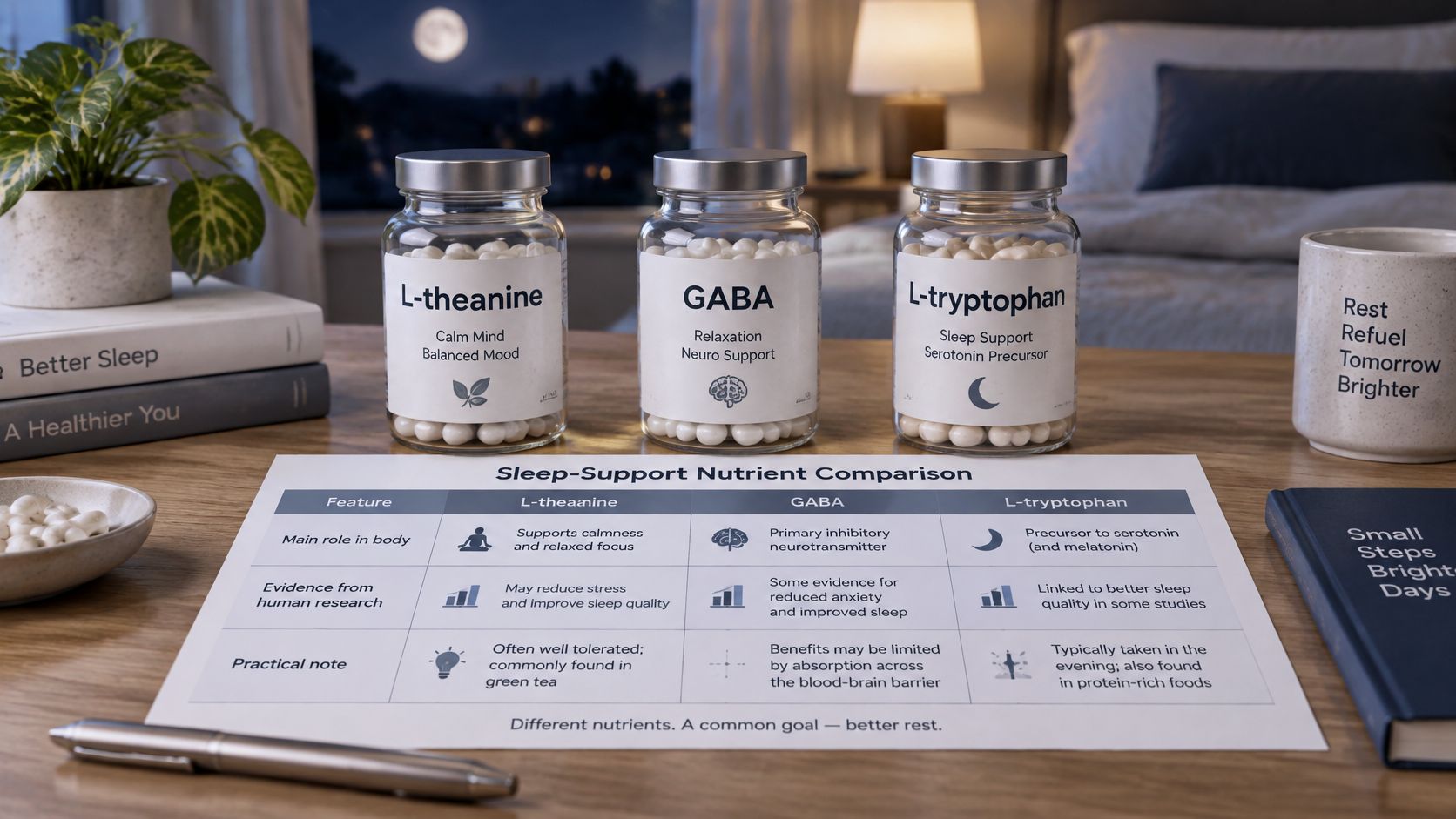
Sleep-relevant amino acids at a glance
| Amino Acid | Role in the Body | Research Status | Practical Note |
|---|---|---|---|
| L-theanine | Amino acid found in tea, studied for calm and focused states | Small human studies; results are mixed | Often blended with lemon balm or passion flower; check the per-serving amount |
| GABA | Main inhibitory messenger in the brain | Whether oral GABA reaches the brain in meaningful amounts is debated | Confirm the amount per serving and whether it is a standalone or blended ingredient |
| L-tryptophan | Building block for serotonin, which the body can convert to melatonin | Strongest evidence comes from dietary and sleep research; supplement trials are limited | Discuss with a clinician if taking antidepressants or other serotonergic medicines |
L-Theanine, the Tea Amino Acid
L-theanine is best pictured as the calm-focus compound from tea. It isn't a sedative in the drug sense, and research so far comes from small human studies with mixed results. Formulas often pair it with lemon balm or passion flower, which makes it hard to credit any one ingredient when a blend is studied as a whole. The honest summary is limited and mixed evidence, not proof.
GABA, the Brake Pedal Question
GABA acts as the brain's main inhibitory messenger, closer to a brake pedal than an accelerator. The open question is delivery. Whether oral GABA reaches the brain in meaningful amounts is debated, so a capsule containing GABA can't borrow certainty from GABA's role inside the brain. Evidence for oral GABA products remains limited, and labels should be read with that gap in mind.
The short video below walks through how these ingredients are commonly presented, which helps readers separate mechanism talk from tested outcomes.
L-Tryptophan, the Raw Material
L-tryptophan works like lumber delivered to a workshop. The body uses it to make serotonin, and serotonin can then be converted into melatonin. Supplying lumber doesn't guarantee the workshop builds more furniture on demand, because enzymes, timing, light exposure, and competing pathways all shape the result. Supplement trials are limited, and dietary research doesn't automatically transfer to a capsule dose.
5-HTP appears in some blends and sits one step downstream from tryptophan. It isn't an amino acid used to build protein, even though it's made from one. That distinction matters when a label groups every ingredient under an amino-acid banner.
Melatonin itself is a separate topic with its own timing rules, and it belongs in the evening, before bed. Readers comparing nighttime formulas can review the broader range in the best sleep support supplements guide. Evidence for one amino acid can't be assumed for another, and amino acids free form status doesn't strengthen weak evidence. It only changes delivery.
Safety Limits, Dosing and Clinician Checks
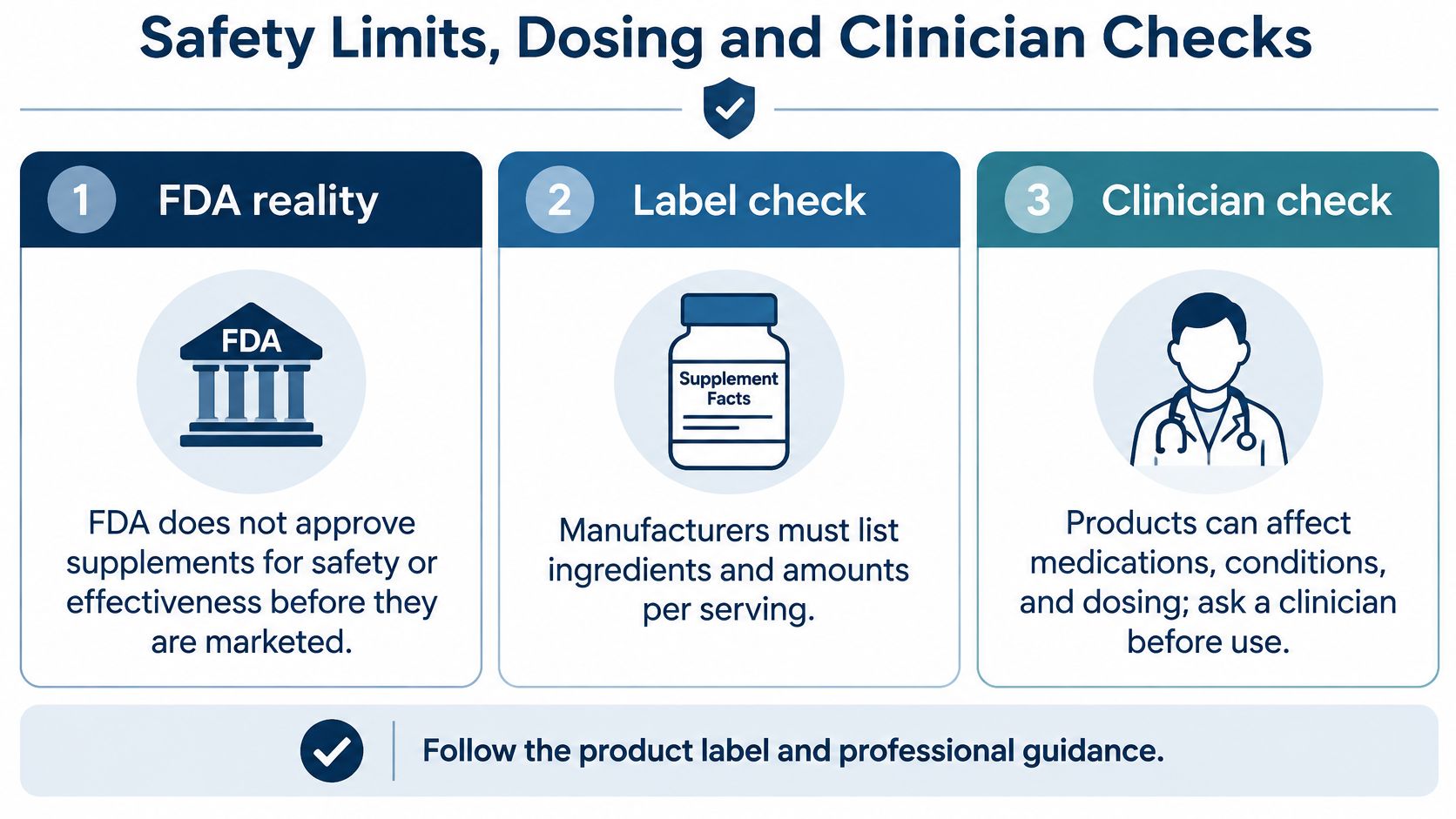
A supplement label can describe a product without proving that it is safe or effective. The FDA dietary supplement consumer update explains that supplements are not approved before marketing for safety or effectiveness. Products may cause harm at high amounts, with long-term use, or in combination with medicines or foods. Labels must list dietary ingredients and amounts per serving, but listing an amount is not proof that the product works.
Manufacturing rules set requirements for production, not expected results. The FDA questions and answers on dietary supplements says a new dietary ingredient generally requires notification at least 75 days before interstate commerce. Companies must also follow current good manufacturing practices covering identity, purity, quality, strength, and composition. These requirements shape how products enter the market and are made; they do not establish whether a specific supplement will help you.
A Four-Question Checklist
- Could it interact with current medicines? Sedatives, antidepressants, and other prescription drugs raise questions a product label alone cannot resolve.
- Does the amount match a studied dose? An ingredient name may be familiar, while the amount in a capsule differs from amounts tested in research.
- Are all amino acid amounts listed? Without those amounts, it is harder to compare products, check overlap, or ask a clinician for advice.
- Could a health condition affect its use? Kidney, liver, or metabolic conditions can affect how amino acids and protein loads should be managed.
Combination research also needs careful reading. If a study tests a compound containing several ingredients, its results cannot identify which herb, vitamin, or amino acid produced an apparent benefit. Evidence for one ingredient does not automatically apply to a blend, and a blend result does not establish the effect of each ingredient on its own.
Dose Stacking and Total Exposure
A serving of amino acid blend at dinner, protein powder after training, and a melatonin capsule before bed all contribute to total daily exposure. Each product may look modest by itself, while the amounts across the evening add up. Check the serving amounts on each label rather than judging one container in isolation.
Count the whole evening, not one bottle at a time. Overlap can hide across powders, gummies, and capsules.
The same care applies to melatonin in nighttime blends. A 0.5 to 1 mg amount is a reasonable low starting point for melatonin, as covered in the low-dose melatonin guide. More does not necessarily mean a stronger effect, and higher amounts may leave next-day grogginess as the main result.
Take melatonin in the evening before bed. That timing applies to melatonin inside a blend as well as to a standalone product. If you wake during the night, taking it then is not the same as using it before bed. Persistent waking is a reason to review habits, timing, and possible medical causes during the day.
Talk with a clinician before starting a supplement if you are pregnant or nursing, are under 18, have a medical condition, or take prescription medication. Persistent sleep problems despite routine changes also warrant a conversation. A pharmacist can help check possible interactions when given a complete medication list. Bring the product label, including amounts per serving, so the discussion can focus on actual ingredients and doses. The relevant safety questions are how much you take, how long you take it, what else you combine it with, and your health status.
Building Your Routine Menu
A routine works best as a menu, not a prescription. Free options come first, because they cost nothing and help regardless of supplement choices. Protein from regular meals covers amino-acid needs for most readers, a consistent wake time anchors the body clock, and a free white-noise app can mask household sounds if that suits the sleeper. A fan is optional, only if one is already available.
Menu Choices to Pick From
- Pick one format that's realistic. Capsules, gummies, powders, and strips differ mainly in convenience, so the format a reader will take beats the format with the boldest claim.
- Check one label properly. Amounts per serving, blend transparency, and melatonin counted separately turn a guess into a decision.
- Keep melatonin in the evening. Any melatonin, including melatonin inside a blend, belongs before bed.
- Set a review point. A routine that isn't helping after a fair trial should change, and persistent sleep problems should go to a clinician.
Small experiments beat wholesale overhauls. Changing one variable at a time, such as wake time or a single product, shows what helped and what didn't. Changing five things at once leaves no usable answer.
Readers focused on overall sleep quality rather than a single ingredient can work through the sleep quality improvement guide for habit-based options that don't require a purchase. Amino acids free form products then take their proper place. They're one optional input inside a broader routine, judged by clarity of dose, fit with medicines and health status, and honest evidence, not by how fast a blood level rises.
Readers ready to compare nighttime formats side by side can review ingredient amounts per serving at Sleep All Nite, where capsules, gummies, and oral strips list their formulas in full. That comparison works best alongside a healthcare professional's input, especially when prescription medicines or medical conditions are part of the picture. Bringing a short list of candidate labels to that conversation keeps the decision specific and safe.
*These statements have not been evaluated by the Food and Drug Administration. These products are not intended to diagnose, treat, cure, or prevent any disease.
This article is for general education and isn't medical advice. Talk with a healthcare professional before starting a supplement, especially if you're pregnant or nursing, under 18, managing a medical condition, or taking prescription medication.


