
How to Fully Wake Up: A Step-by-Step Morning Guide


The alarm has stopped, coffee is brewing, and the same email still takes several attempts to understand. After a night interrupted by bathroom trips, warmth, or racing thoughts, getting out of bed doesn't necessarily mean feeling ready for the day.
Learning how to fully wake up starts with treating morning grogginess as a transition, not a motivation problem. A useful routine leaves room for that transition, fits the person's schedule, and puts safety ahead of rushing.
Table of Contents
- How to Fully Wake Up in the First Hour
- What Fully Awake Actually Means
- Protect the Sleep Before You Set the Alarm
- Use Morning Light at the Right Time
- Caffeine Timing Without Costing Tonight's Sleep
- Adjusting the Routine for Shift and Irregular Schedules
- Choose Your Next Step and When to Ask a Clinician
How to Fully Wake Up in the First Hour
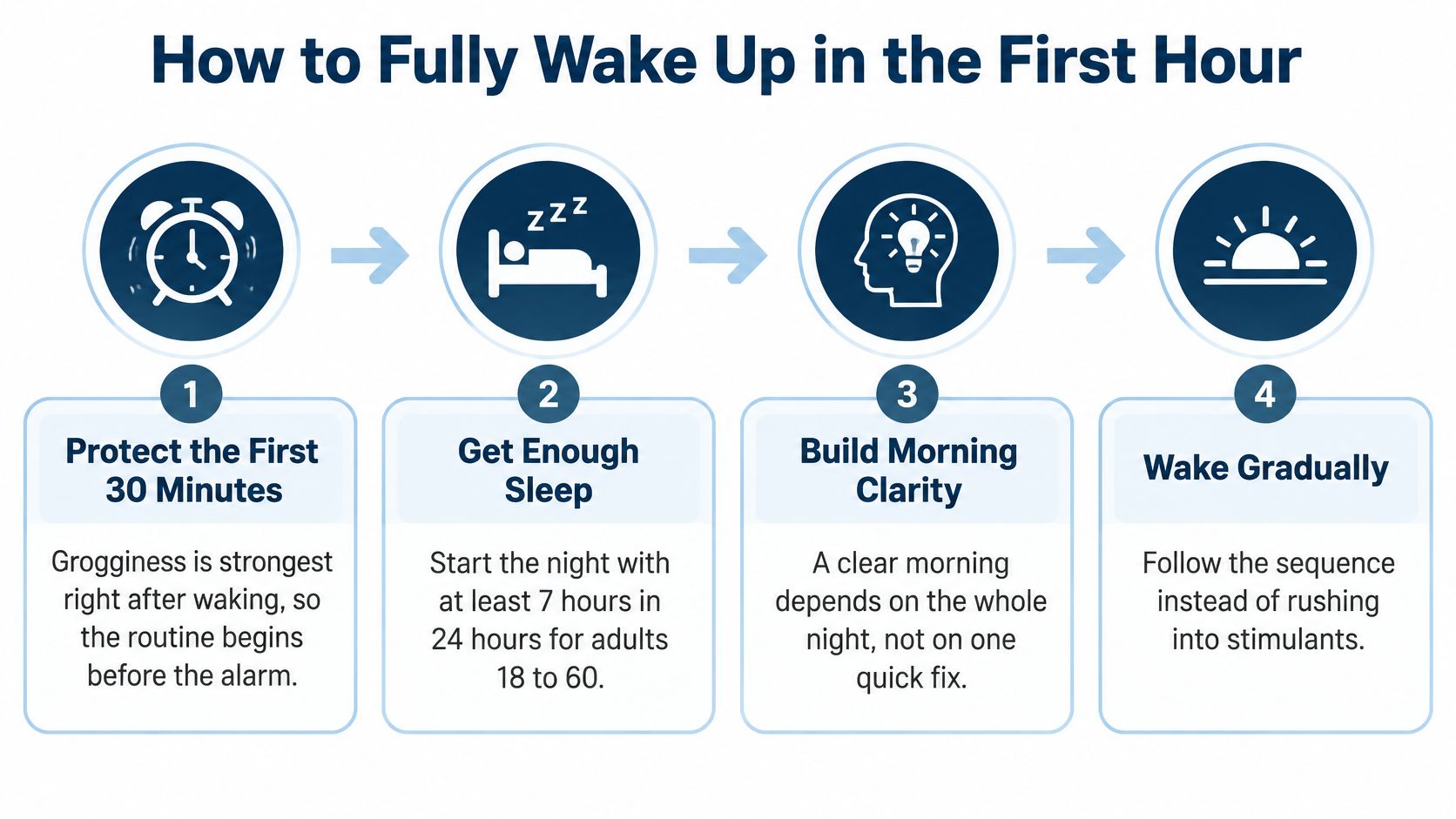
A useful wake-up sequence protects the first half-hour, when grogginess is generally strongest according to a review of sleep inertia, and starts with adequate sleep rather than an alarm or stimulant.
- Wake at the planned time and sit up. A brief pause before standing allows a gradual change from lying down to moving around. Anyone who feels dizzy should stay seated until steady.
- Find some daylight. Standing near a window or stepping outside offers a straightforward starting point. Light supports body-clock timing, but it isn't an instant alertness switch.
- Drink a glass of water. Several hours may have passed without fluids. Water addresses thirst, not the underlying need for sleep.
- Eat if hungry. A light option such as toast, yogurt, or fruit may feel easier than a large meal. There's no need to force breakfast solely to become alert.
- Choose gentle movement. Stretching, getting dressed, or taking a slow walk provides a manageable transition into activity. An intense workout isn't required.
- Protect the transition before demanding tasks. A cautious routine leaves at least the initial half-hour before driving or concentrated work, consistent with the impairment window described in the review cited above. Continued grogginess calls for more time, not permission to proceed because a timer has ended.
- Check readiness. Clear thinking and steady movement matter more than just being upright. The self-check below provides practical warning signs, though it can't certify driving fitness.
Repeated snoozing can break the final stretch of sleep into interruptions without creating a useful transition period. If it becomes a daily pattern, the planned wake time or bedtime may need adjustment.
How long grogginess lasts varies from person to person and from one morning to the next. Some people feel clear within minutes, while others need much longer, so a slower start isn't a personal failure.
A flexible morning checklist
These steps are a menu, not a test that requires perfect completion. Safety precautions remain important even when breakfast or a walk doesn't fit.
- Get upright safely.
- Find comfortable daylight.
- Address thirst and hunger.
- Move gently if practical.
- Check alertness before demanding tasks.
What Fully Awake Actually Means
Fully awake means alert enough for the task ahead, especially when a mistake could cause harm. Open eyes, conversation, or a warm drink do not show that attention and reaction speed have returned to normal. Waking up is a transition, and the time it takes varies from morning to morning.
Sleep inertia is the temporary drop in alertness, reaction time, and thinking after waking. A large Korean adult study published in PLOS ONE of 2,355 adults found that it lasted 15.8 minutes on average, with substantial variation. Longer inertia was associated with evening chronotype, insomnia, excessive daytime sleepiness, and anxiety.
Short or disrupted sleep can make the transition harder. Waking from deeper sleep, or during the body's biological low point, can also leave someone less ready than the clock suggests. Use the table as a planning floor, and expect some mornings to need longer.
Typical grogginess phases after waking
| Time after waking | What is typically happening | Practical rule |
|---|---|---|
| 0 to 30 minutes | Sleep inertia can reduce alertness, reaction time, and clear thinking | Build in time for this transition before safety-critical tasks |
| 30 minutes onward | Grogginess often fades, but short or disrupted sleep can prolong it | Begin demanding tasks when the readiness check feels normal |
| Beyond the usual window | Lingering grogginess despite enough sleep and a steady routine | Talk with a clinician |
A practical readiness check
Check whether ordinary actions feel normal. These signs can help identify difficulty, though they cannot certify fitness to drive:
- Recall: Can you remember the day's plans without repeatedly losing the thread?
- Steadiness: Is walking comfortable and coordinated?
- Conversation: Can you answer a simple question clearly, in a normal voice?
- Attention: Can you read and understand a short message without repeated attempts?
Feeling awake can come before performing normally. A self-check may reveal difficulty, but passing it does not prove that driving is safe.
Heavy eyelids, drifting attention, or difficulty staying awake are reasons to wait before a safety-critical task. Treat the timing as a guide, not a deadline. Some mornings take longer to feel clear.
Protect the Sleep Before You Set the Alarm
The CDC's sleep guidance recommends at least 7 hours of sleep per 24-hour period for adults aged 18–60. Time in bed needs to leave room for falling asleep and any awakenings, rather than matching only the desired sleep total.
A clear morning also depends on sleep quality. According to the National Center for Health Statistics, 54.8% of U.S. adults reported waking up well-rested most days or every day in 2024. Feeling unrefreshed is common, but persistent difficulty still deserves attention.
Free changes worth choosing from
- A consistent bedtime window: Keep the evening reasonably predictable rather than alternating very early and very late nights.
- Less brightness before bed: Dim unnecessary room lighting and reduce bright screen exposure during the wind-down.
- A comfortable sleeping space: Adjust bedding, reduce avoidable noise, and use a fan if one is available and comfortable.
- Sound management: A free white-noise app may help mask unpredictable noise. Keep the volume comfortable and necessary alarms audible.
A late alcoholic drink can fragment sleep even when it initially feels relaxing. The CDC's sleep and heart-health guidance recommends avoiding alcohol and stimulating light close to bedtime, alongside regular sleep and wake times.
Practical rule: An earlier alarm doesn't create more recovery. The evening schedule needs to make the intended wake time realistic.
Repeated night waking deserves its own look rather than an increasingly elaborate morning routine. The guides to why waking at 3 a.m. happens and improving sleep quality provide background for reviewing nighttime patterns.
A calmer evening doesn't require a purchased device or a separate bedroom. A small change that works in the actual household is more useful than an ideal setup that can't be maintained.

Use Morning Light at the Right Time
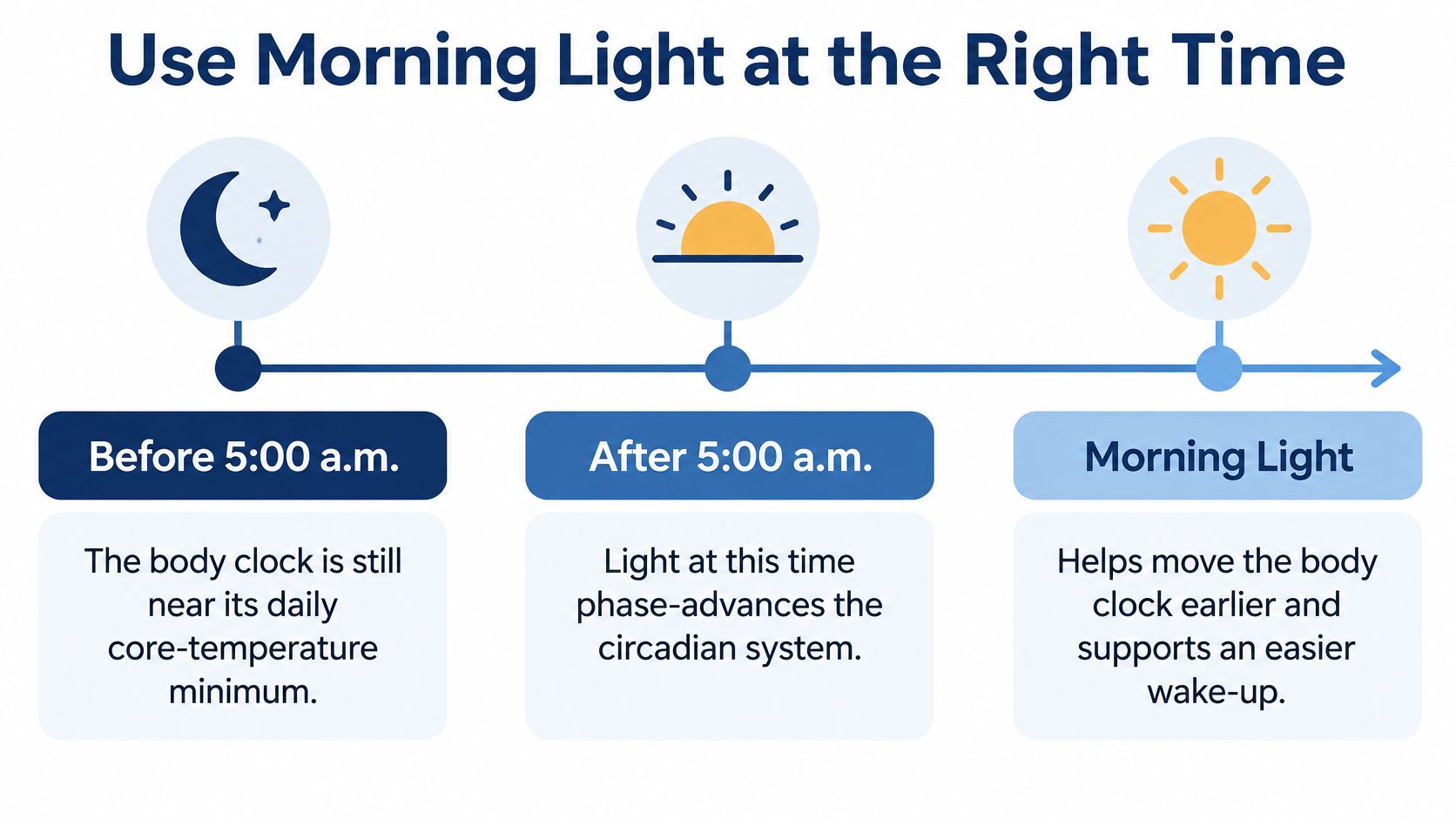
Light helps set the timing of sleepiness and wakefulness. A review of light and circadian physiology explains that light after the daily core-temperature minimum, which usually falls in the early morning hours, tends to shift the body clock earlier; it also describes effects on brain activity and reaction-time performance while awake.
That pattern isn't a universal instruction to seek bright light at a particular clock time. Internal timing differs, especially for people working nights or sleeping on irregular schedules. Evening and nighttime brightness generally tends to shift sleep timing later.
A daylight-oriented timeline
For someone who sleeps at night, these are accessible options:
- After waking: Choose a window seat, an outdoor walk, or breakfast in a naturally bright spot. Looking directly at the sun isn't necessary.
- During the evening: Reduce unnecessarily bright screens and overhead lighting as bedtime approaches.
- During a nighttime bathroom trip: Use enough light to move safely without making the room brighter than needed.
The timing relationship is illustrated below, but individual sleep schedules matter more than a single clock label.
What light can't promise
A 2025 randomized real-world study presented at the SLEEP meeting found that light delivered at habitual wake time didn't improve sleep inertia, and reaction speed was slightly slower with the light on, possibly because glare affected screen visibility. That finding supports caution about treating brightness as an immediate fix.
The National Heart, Lung, and Blood Institute describes morning light-box use as an option for shifting sleep and wake times earlier. A clinician can help determine whether deliberate light therapy fits an unusual schedule; purchasing a light box isn't necessary for an ordinary daylight routine.
The guide to circadian rhythm disruption explains why the same light exposure can have different effects at different biological times.
Caffeine Timing Without Costing Tonight's Sleep
If you wake and reach for coffee, remember that it takes time to affect alertness. The American Medical Association's caffeine guide notes that caffeine is typically absorbed within about 45 minutes. Plan your first cup around when you need to feel more alert, rather than expecting it to clear morning grogginess at once. Some mornings take longer, so allow a transition that fits your schedule.

Plan backward from bedtime
The typical caffeine half-life is four to five hours, though the AMA guide notes it can range from about an hour and a half to as much as nine hours. Half-life means the time it takes for the body to clear half the caffeine, not all of it. Clearance varies, and genetics, oral contraceptives, and smoking can affect it. That is why someone else's coffee timing may not suit you.
According to the American Medical Association's caffeine guide, the FDA considers less than 400 milligrams daily safe for most adults, and one physician quoted in the guide suggests having caffeine no later than about 2 p.m. Treat those as general guides, not a target or a guarantee that sleep will be unaffected.
- Count all sources: Coffee, tea, energy drinks, and some workout products can add to your caffeine intake.
- Notice sensitivity: Jitteriness, anxiety, or trouble settling at bedtime can happen below the general limit.
- Avoid rapid top-ups: A second serving before the first takes effect can add more stimulation than intended.
Keep coffee optional
Using caffeine to push through poor sleep can create a cycle: later stimulation may make bedtime harder, leaving you more likely to reach for caffeine the next morning. Food, gentle movement, and an unhurried transition can also be part of your wake-up routine.
Coffee cannot replace adequate sleep or consistent wake timing. If you do not enjoy it, you do not need to start drinking it to learn how to fully wake up.
Adjusting the Routine for Shift and Irregular Schedules
A nurse finishing a shift at 6 a.m. may need to drive home an hour later. Their waking period begins before work, while the commute follows a full night on duty. The routine should fit that sequence: the key question is when alertness is needed for safety, not whether the clock says morning.
Night and rotating-shift work
On workdays, a reasonably consistent wake time can make the schedule easier to anticipate. For daytime sleep, use existing curtains to reduce light, choose comfortable bedding, and arrange quieter periods when possible. These steps help protect the sleep that must happen outside conventional nighttime hours.
At the start of the waking period or shift, consider when light exposure fits the work and sleep schedule. For rotating shifts, deliberately changing light exposure may require individual advice, since a conventional morning-light pattern can conflict with daytime sleep.
Before commuting, leave time to transition after waking or napping. If marked sleepiness persists, delay driving or arrange another ride. A short nap does not guarantee immediate readiness to drive, so use alertness, not the clock alone, to judge whether it is safe to leave.
For caffeine timing around planned sleep, see the guidance on caffeine timing. For help arranging rest after a night shift, read the guide to sleeping after working a night shift.
Early family schedules and changing sleep
- Parents and caregivers: When possible, shift bedtime and wake time gradually rather than abruptly. Setting out clothes, breakfast ingredients, or school bags ahead of time can reduce decisions during a foggy start.
- Caregivers starting early: If you begin caring for a relative at 6 a.m., move a walk to after the shift, when your responsibilities allow.
- Perimenopausal readers: Familiar wake-up habits may still help, while changing sleep may need discussion rather than self-blame. The guide to perimenopause sleep problems offers background for that conversation.
Melatonin belongs in the evening, before intended sleep. It isn't a morning or middle-of-the-night reset.
For someone sleeping during the day, intended bedtime may come after a night shift. Discuss supplement timing with a healthcare professional instead of copying a daytime worker's routine. Some mornings, or post-shift periods, take longer to feel clear.
Choose Your Next Step and When to Ask a Clinician
The most useful change is one that can be repeated without making mornings harder. Someone deciding how to fully wake up might start with a predictable wake time, comfortable daylight, and a protected period before demanding work rather than attempting every available habit.
A simple log can distinguish occasional slow starts from a pattern that deserves assessment. It doesn't need a wearable, an app subscription, or a numerical sleep score.
A one-week test
Choose two or three manageable elements and try them for one week. This is a practical observation period, not a medical threshold or a promise of improvement.
- Record the schedule: Note bedtime, wake time, and remembered interruptions.
- Describe light exposure: Record whether the waking period began outdoors, near a window, or in a dim room.
- Track caffeine timing: Include the last caffeinated drink before intended sleep.
- Check alertness: Note how thinking felt at the half-hour mark and whether the first task went smoothly.
- Mark safety concerns: Record unintended dozing, difficulty keeping the eyes open, or any decision to delay driving.
The aim isn't to produce a perfect week. Notes about a disrupted night or an unusually early shift may be more informative than a neatly completed checklist.
When professional input matters
A clinician should assess grogginess that keeps lingering despite adequate sleep opportunity and a steady routine. Ongoing difficulty falling or staying asleep, daytime sleepiness despite enough time in bed, or suspected medication effects also warrant discussion.
Loud snoring, witnessed breathing pauses, or waking gasping should be mentioned explicitly. Anxiety, changes in sleep timing, and other health issues may also contribute; a morning routine can't identify the cause.
The guide to when to see a doctor for insomnia can help prepare for that conversation. Bringing the week's notes makes it easier to describe what happens, rather than relying on a general impression of always feeling tired.
This article provides general education and doesn't replace diagnosis or treatment advice. Severe sleepiness affecting driving or other safety-sensitive activities deserves prompt professional attention, not a more forceful alarm.
Sleep All Nite offers nighttime supplements in formats including capsules, gummies, and dissolvable oral strips. For anyone considering an optional addition to a bedtime routine, Sleep All Nite provides formats and ingredient amounts to compare; a healthcare professional can help check suitability before use.
*These statements have not been evaluated by the Food and Drug Administration. These products are not intended to diagnose, treat, cure, or prevent any disease.
This article is for general education and isn't medical advice. Talk with a healthcare professional before starting a supplement, especially if you're pregnant or nursing, under 18, managing a medical condition, or taking prescription medication.


