
Can Melatonin Cause Vivid Dreams? What Changes


A person takes melatonin before bed, sleeps for a longer stretch, then wakes with a dream still vivid enough to feel unsettling. The colors, emotions, or strange details seem unusually clear, and the immediate question is whether the supplement caused it.
Can melatonin cause vivid dreams? It can be associated with vivid, abnormal, or disturbing dreams, but the best controlled evidence suggests this is an uncommon effect, not something that happens to everyone. A dream that feels unusually real is not, by itself, proof that melatonin has caused harm.
The useful distinction is between remembering a dream more clearly and having a frightening nightmare. Dose, timing, sleep interruptions, other ingredients, and individual sensitivity can all change what someone notices. Those factors matter more than a simple yes-or-no answer.
Table of Contents
- Can Melatonin Cause Vivid Dreams
- Why Melatonin Can Change Dream Recall
- What Studies Say About Dream Side Effects
- Who Notices Stronger Dreams and When
- How to Ease Vivid Dreams From Melatonin
- Choosing a Lower Dose or a Melatonin-Free Option
- What to Do Next If Dreams Stay Intense
Can Melatonin Cause Vivid Dreams
A systematic review of randomized, placebo-controlled trials found that the most frequently reported adverse events included daytime sleepiness at 1.66%, headache at 0.74%, other sleep-related effects at 0.74%, dizziness at 0.74%, and hypothermia at 0.62%. Nightmares were among a small number of events the authors flagged as potentially clinically significant, alongside agitation, fatigue, mood swings, skin irritation, and palpitations, though none were judged life-threatening. Most adverse events resolved on their own within a few days, either without a dose change or after melatonin was stopped, and the authors described the events as generally mild to moderate while noting that long-term evidence remains limited (2019 systematic review of melatonin safety).
Those figures describe trial participants as a group. They aren't a personal risk calculator and don't mean that an individual's experience is imaginary. A person may notice more vivid dreams after taking melatonin, especially if sleep becomes longer or more consolidated, or if an awakening makes a dream easier to recall. Controlled trials don't establish that vivid dreams are universal or reliably occur at every dose.
Vivid dreams aren't all the same
A vivid dream is clear or memorable. A bizarre dream may include impossible changes or unusual events. A nightmare is frightening or distressing. These experiences can overlap, but they aren't interchangeable, and a colorful or strange dream isn't automatically a harmful side effect.
That distinction can help after a rattling morning. A single vivid dream, without ongoing distress or daytime problems, is different from persistent nightmares, confusion, falls, or unusual behaviors during sleep. The latter deserve a conversation with a healthcare professional.
The next question is why a timing supplement might change what a person remembers, even though it isn't designed to create dream content.
Why Melatonin Can Change Dream Recall
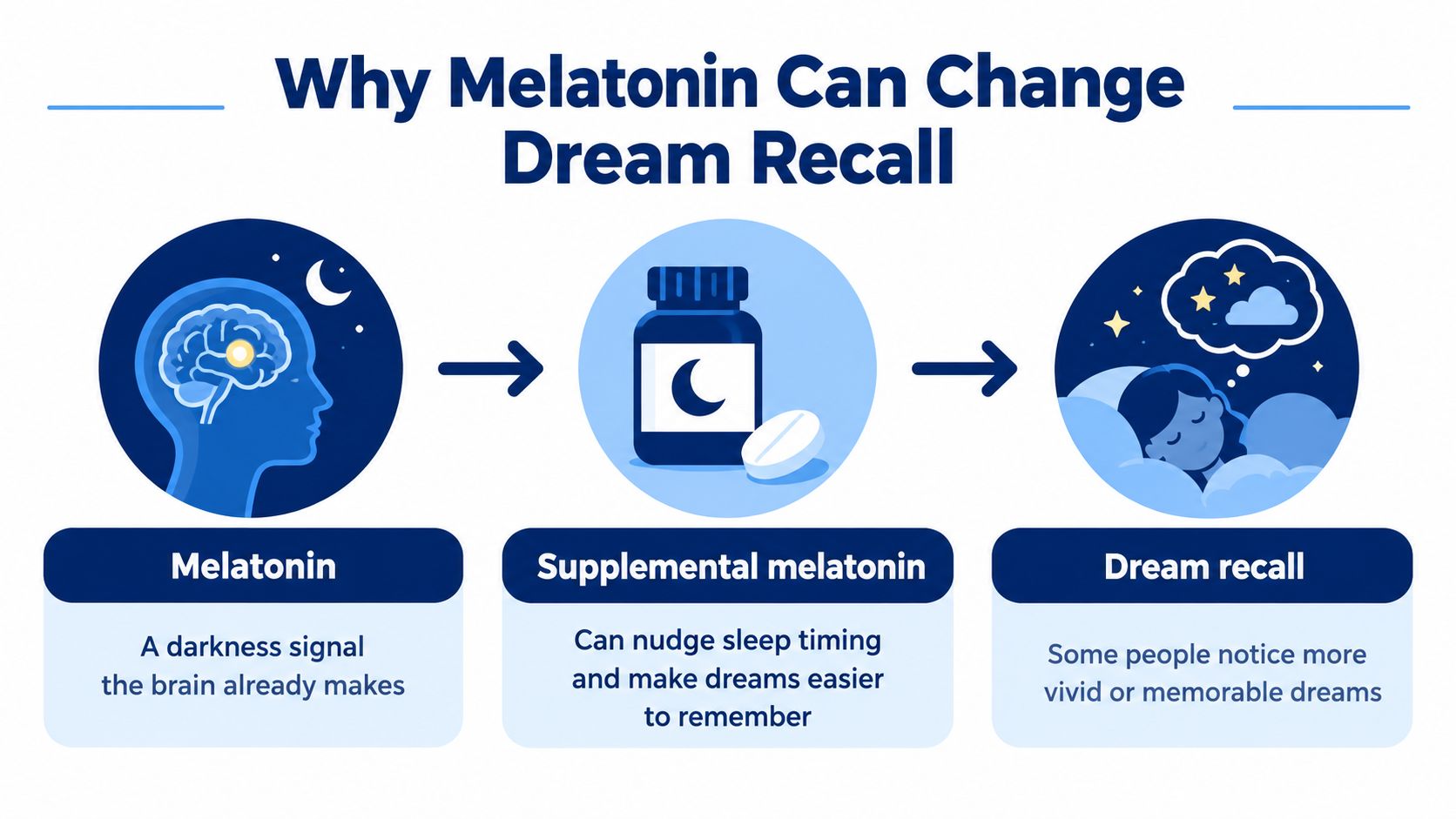
The body makes melatonin as a signal associated with darkness. A supplement adds to that evening signal. It's better understood as a cue that can influence sleep timing than as a drug that writes a dream's plot.
A useful analogy is a film that plays mostly during rapid eye movement, or REM, sleep. Dream recall is like catching the credits as the film ends. A person can remember more of the film if they wake at a moment when a dream is still fresh, even if the film itself hasn't become more dramatic.
Sleep architecture may affect what stays in memory
The leading proposed explanation is that melatonin may alter sleep architecture, meaning the pattern and timing of sleep stages. A small experiment involving 22 college students compared 6 mg of melatonin with placebo. Its findings were consistent with greater exposure to REM and stage-2 sleep, and less time in deeper stages where dream recall is less common. However, total REM percentage wasn't consistently higher, so the experiment doesn't show that melatonin creates more REM or more intense dreams (the small melatonin dream study).
The practical point is that a person may remember a dream more clearly because sleep timing or awakenings changed, not because melatonin produced a scarier story. Cleveland Clinic experts also describe the relationship between melatonin and bad dreams as uncertain, and the available evidence doesn't establish a dependable dose at which dreams suddenly intensify (Cleveland Clinic's explanation of melatonin and bad dreams).
An oral melatonin dose is also absorbed unevenly. Only a fraction of a swallowed dose reaches the bloodstream, and that fraction varies widely from person to person. That variability is one reason the same labeled amount may not feel identical for everyone. An evening dose acts as a clock signal, not a tool for taking after a night waking; melatonin timing for sleep offers more on when it belongs in the evening.
These proposed mechanisms help explain why people may notice dream changes. They don't answer how the evidence differs between controlled trials and safety reports.
What Studies Say About Dream Side Effects
A controlled trial and a safety-report database provide different kinds of evidence. Trials compare people assigned to melatonin or a placebo under study conditions. Safety databases collect events reported by users or healthcare professionals after a medicine is taken. Trials can reveal differences between groups; reports can flag patterns for further study, but cannot show how often an event occurs among all users.
In a 2024 pharmacovigilance analysis in the Journal of Pineal Research, nightmares and abnormal dreams appeared disproportionately in reports involving melatonin compared with reports for all other medicines. The adjusted reporting odds ratio was 4.90 for nightmares, with a 95% confidence interval of 4.37–5.49, and 3.68 for abnormal dreams, with a 95% confidence interval of 3.19–4.25.
Those ratios do not mean that 4.90% of melatonin users have nightmares. They describe the relative pattern among submitted reports, not the percentage of users affected. Nor can they establish that melatonin caused a particular person's dream.
Why a safety signal isn't a personal forecast
The analysis also found signals for accidents or injuries and falls when melatonin reports were compared with reports for all other medicines. The nightmare and abnormal-dream signals were not detected when the comparison was limited to other sleep medicines. The choice of comparison group changes the result, so the signal needs careful interpretation.
A safety report is a clue, not a diagnosis. Reporting bias can shape the record because some people are more likely to report an event, and unusual experiences may attract more attention. Confounding adds another layer: a person taking melatonin may also have insomnia or another sleep difficulty that affects sleep patterns and dream recall. Those factors make it hard to isolate the supplement's role.
Safety signals can justify paying attention. They can't tell one person their personal odds.
Controlled trials treat nightmares as recognized but uncommon side effects. Pharmacovigilance reports add a pattern worth noticing, without proving that melatonin caused any individual dream. Before changing a dose, check whether the amount taken matches the label: products may contain more melatonin than their labels state, as described in what too much melatonin can mean.
Who Notices Stronger Dreams and When
You wake from a detailed dream and wonder whether melatonin changed it. One small experiment offers a clue, but it cannot predict how every adult will respond.
In the study, 22 college students, 8 male and 14 female participants ages 18 to 25, took 6 mg of melatonin or a placebo for six nights during a two-week study. Each morning, they described their dreams and rated 17 aspects of dream bizarreness. Some features, including object transformations and overall transformations, changed significantly. The researchers said their hypotheses were only partly supported, and results differed by sex (details of the dream-bizarreness experiment).

The sample was small and young, so its findings may not apply to adults in midlife, people with insomnia, or people taking lower doses. A study can suggest a pattern without showing that it will occur in every person.
Several details can change what someone notices
Dose and timing may affect the experience. Taking melatonin later than intended could shift its timing relative to sleep, while waking near morning after a longer stretch of sleep may make a dream easier to remember. Combining sedating ingredients or changing products can also change what is in a serving or how it feels.
The words describe different experiences. Vivid means clear or memorable. Bizarre refers to unusual dream features. A nightmare is frightening or distressing. One person may remember an oddly detailed dream without feeling upset; another may wake shaken by a less elaborate nightmare.
The amount the body makes on its own is small, and lower supplemental amounts are often enough for a timing effect: the CDC's jet-lag guidance notes that 0.5 to 1 mg is often sufficient to shift the body clock. More isn't better, and researchers haven't established a reliable dose-response threshold for dream intensity. Check whether the amount you take matches the label: serving sizes and the number of units taken can differ. If you have taken more than intended, see this guide to what too much melatonin can mean.
A 3 a.m. awakening can have causes of its own. Taking melatonin after waking during the night is not a way to try to get back to sleep. Learn more about why waking at 3 a.m. happens.
The video below explains how melatonin timing may shape what people remember from dreams.
How to Ease Vivid Dreams From Melatonin
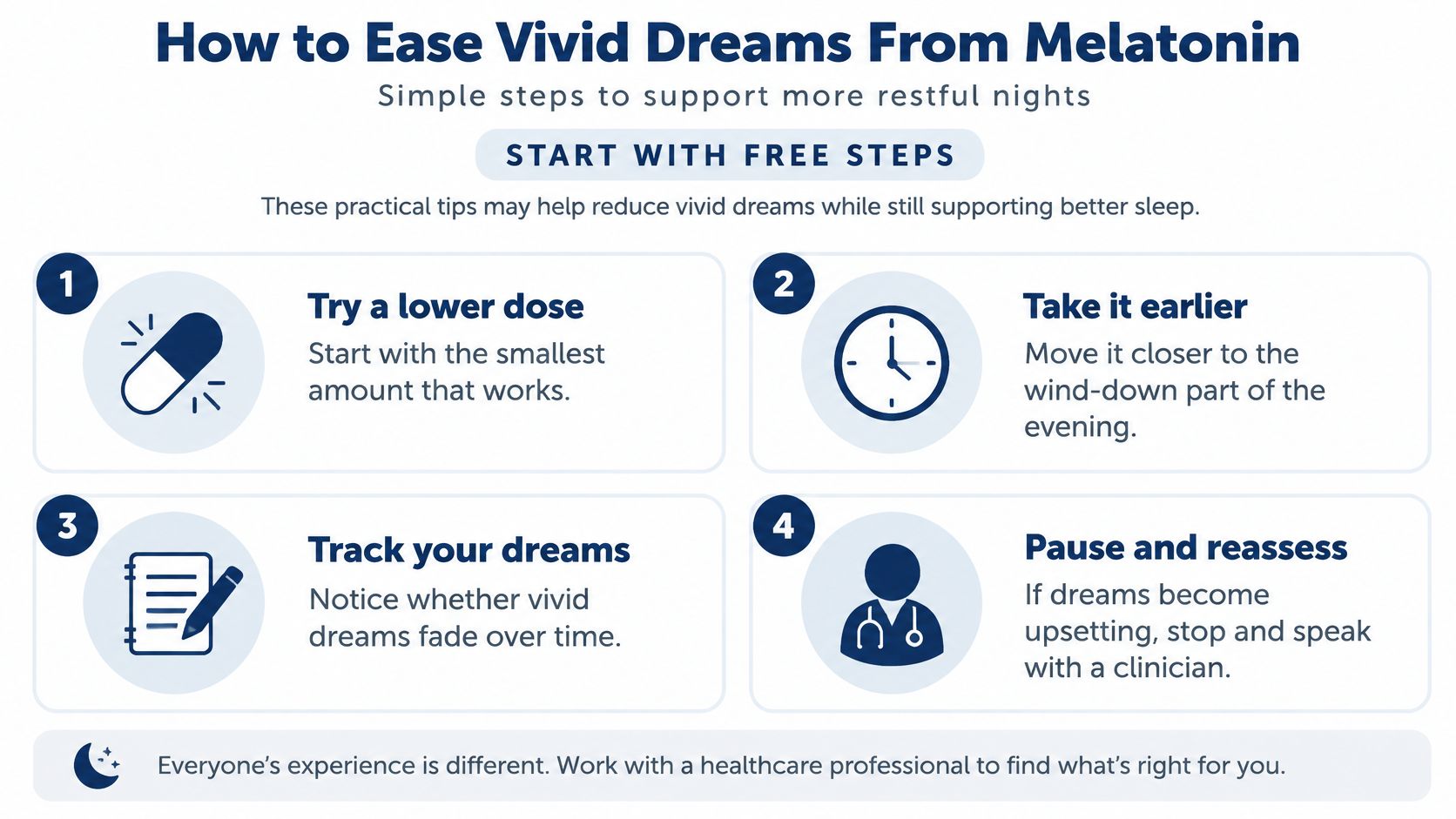
When dreams are mildly vivid but not frightening, the first step can be simple observation rather than an immediate dose increase or a complicated new routine. A short note of the amount taken and the clock time can help show whether dream intensity changes on nights when the timing or serving differs.
If dreams become disruptive, the practical choices are to consider a lower amount, take melatonin earlier in the evening, or pause it and reassess. Follow the timing on the product label. The right choice depends on the product and the person's situation, so a clinician or pharmacist can help when there are questions about medicines or health conditions.
An evening-only menu
These options are a menu, not a required routine:
- Keep a brief record. Note the serving, timing, and whether the dream felt vivid, bizarre, or frightening.
- Avoid stacking sedating products. Adding several sedating ingredients on the same evening can make it harder to identify what changed.
- Choose a manageable wind-down. Dimmer evening light, a consistent sleep window, or a quiet activity that doesn't require buying anything may suit some people.
- Consider pausing if nightmares persist. Persistent distress isn't something to out-dose, especially when another sedating ingredient is involved.
Melatonin belongs in the evening before bed. It shouldn't be taken after a night waking to get back to sleep. Increasing the amount because the previous night felt intense isn't a sound way to test the cause.
Stop and seek advice: Daytime sleepiness, confusion, falls, or unusual sleep behaviors are reasons to stop and talk with a clinician or pharmacist rather than troubleshooting alone.
People who want to compare a lower labeled amount, check product details, or consider a melatonin-free wind-down can start with information about lower-dose melatonin. A label is a starting point, not a substitute for checking what the serving contains.
Choosing a Lower Dose or a Melatonin-Free Option
A dream change that begins after a product switch may raise a practical question: what amount was taken? Testing has found variability in commercially available melatonin supplements, but that doesn't establish that inaccurate labeling causes vivid dreams.
A 2023 research letter in JAMA tested 25 melatonin gummy products sold in the US and found that their actual melatonin content ranged from 74% to 347% of the labeled amount. That one sample can't automatically be generalized to every product, and the findings don't prove a connection between label accuracy and dream content.
Before repeating or raising a serving, it makes sense to check the serving size, the number of pieces in a serving, and any other active ingredients. Switching from a gummy to a capsule, strip, or combination formula can change the amount and ingredients being taken, even when the product names sound similar.
Compare the choice, not just the format
| Choice | What it contains | When it may fit | What it does not do |
|---|---|---|---|
| Stay with a clearly low evening amount | A labeled melatonin amount taken before bed | When a person and clinician or pharmacist decide continued use is appropriate | It doesn't guarantee dreams won't change |
| Pause melatonin | No melatonin serving | When a person wants to see whether dream changes settle | It doesn't identify or address every possible cause of disturbing dreams |
| Use a melatonin-free wind-down option | Ingredients without melatonin, depending on the product | When avoiding melatonin is the preference | It isn't a substitute for medical advice or a guarantee about dreams |
For people comparing formats, Drift Off is a raspberry oral strip that dissolves on the tongue without water. Each strip contains 1 mg of melatonin with valerian root, lavender, chamomile, and hibiscus. The label says to take one strip any time before bed, with a maximum of one strip per day.*
Deep Calm is a melatonin-free capsule containing magnesium glycinate and 275 mg of magnesium per serving. It's described as supporting relaxation and normal nervous system function.*
Readers comparing formats and ingredients can also use this overview of sleep-support supplement formats. It's further reading about formats, not a ranking or a recommendation that one option suits everyone.
What to Do Next If Dreams Stay Intense
Some people notice more vivid dreams while taking melatonin, but controlled trials don't show that this happens to everyone. Dose, timing, awakenings, other ingredients, and product-label reliability can all shape what a person experiences. A dream can also be memorable without being a nightmare or a sign of harm.
For mild, occasional vividness, a person can track the serving and evening timing and consider whether a lower amount or a steadier schedule is appropriate. Melatonin shouldn't be used after waking at 3 a.m. to try to return to sleep. When a dream change appears after a product switch, checking the serving and active ingredients is a more useful first step than automatically repeating or increasing the amount.
When to bring in a healthcare professional
Disturbing dreams that continue deserve attention, particularly if they affect daytime functioning. Severe next-day sedation, confusion, falls, or unusual behaviors during sleep also warrant a conversation with a healthcare professional. A clinician or pharmacist can review the product and other medicines and help decide whether to stop or change anything.
Advice is especially important before starting or changing a supplement for anyone who is pregnant or nursing, under 18, managing a medical condition, or taking prescription medication. No one needs to decide from a dream alone that melatonin is dangerous, but persistent or severe symptoms shouldn't be dismissed.
The practical choice is to look at the pattern, not just the most frightening night: what was taken, when it was taken, whether the product or serving changed, and whether the dreams are continuing or causing daytime problems. That gives a healthcare professional more useful context than a simple label such as “bad dreams.”
Sleep All Nite offers supplement formats with different ingredients and labeled melatonin amounts, including a 1 mg strip and melatonin-free options. Readers can compare those details at Sleep All Nite and check with a healthcare professional before starting or changing a supplement.
*These statements have not been evaluated by the Food and Drug Administration. These products are not intended to diagnose, treat, cure, or prevent any disease.
This article is for general education and isn't medical advice. Talk with a healthcare professional before starting a supplement, especially if you're pregnant or nursing, under 18, managing a medical condition, or taking prescription medication.


