
Sleep Supplement Without Melatonin Explained


Another 3 a.m. wake-up, another glance at the clock, and the melatonin bottle no longer looks like a useful answer. Perhaps it left a groggy morning behind, or perhaps nothing seemed different at all. Searching for a sleep supplement without melatonin is understandable, but the most useful next step is identifying what kind of help is needed.
Table of Contents
- Why Look for a Sleep Supplement Without Melatonin
- How Non-Melatonin Ingredients Support Wind-Down
- What the Evidence Says About Common Ingredients
- Safety Doses and Who Should Be Careful
- When a Supplement Is the Wrong Next Step
- Melatonin-Free Formats and How to Choose
- A Flexible Evening Menu You Can Actually Keep
Why Look for a Sleep Supplement Without Melatonin
A familiar pattern is an adult who can finally stop working, caregiving, or managing the household, yet can't seem to settle into sleep. Another person falls asleep readily but wakes repeatedly. Both may search for the same supplement, even though their difficulties aren't necessarily asking for the same response.
A disappointing experience with melatonin can make a different ingredient appealing. The discussion of too much melatonin offers context for readers reconsidering their previous approach. Still, melatonin-free describes an absence, not a proven benefit.
Different problems need different questions
Before comparing labels, it helps to separate the job a reader hopes a supplement will do:
- A racing mind at bedtime: The question is whether a wind-down approach might make the transition out of daytime activity easier.
- Poor sleep alongside low mineral intake: The question is whether nutritional support is appropriate, rather than whether a stronger sedative is needed.
- Repeated night waking: The question is what's interrupting sleep and whether assessment would be more useful than another purchase.
Short sleep is widespread. In 2020, approximately one-third of US adults reported sleeping less than recommended, with short sleep generally defined as fewer than seven hours in a 24-hour period, according to the CDC's analysis of adult sleep duration. That population finding doesn't establish that a supplement is the answer for any individual.
A label can identify an ingredient. It can't identify the reason someone isn't sleeping.
Schedules, stress, caregiving, medicines, and medical conditions can all belong in the discussion. A reader trying to understand why waking at 3 a.m. keeps happening needs more than a list of calming ingredients.
The useful distinction is support versus treatment. An optional wellness product may fit an occasional wind-down routine, while persistent sleep difficulty calls for a closer look at its cause. Ingredient mechanisms, measured outcomes, safety limits, and format preferences matter, but none replaces that distinction.
How Non-Melatonin Ingredients Support Wind-Down
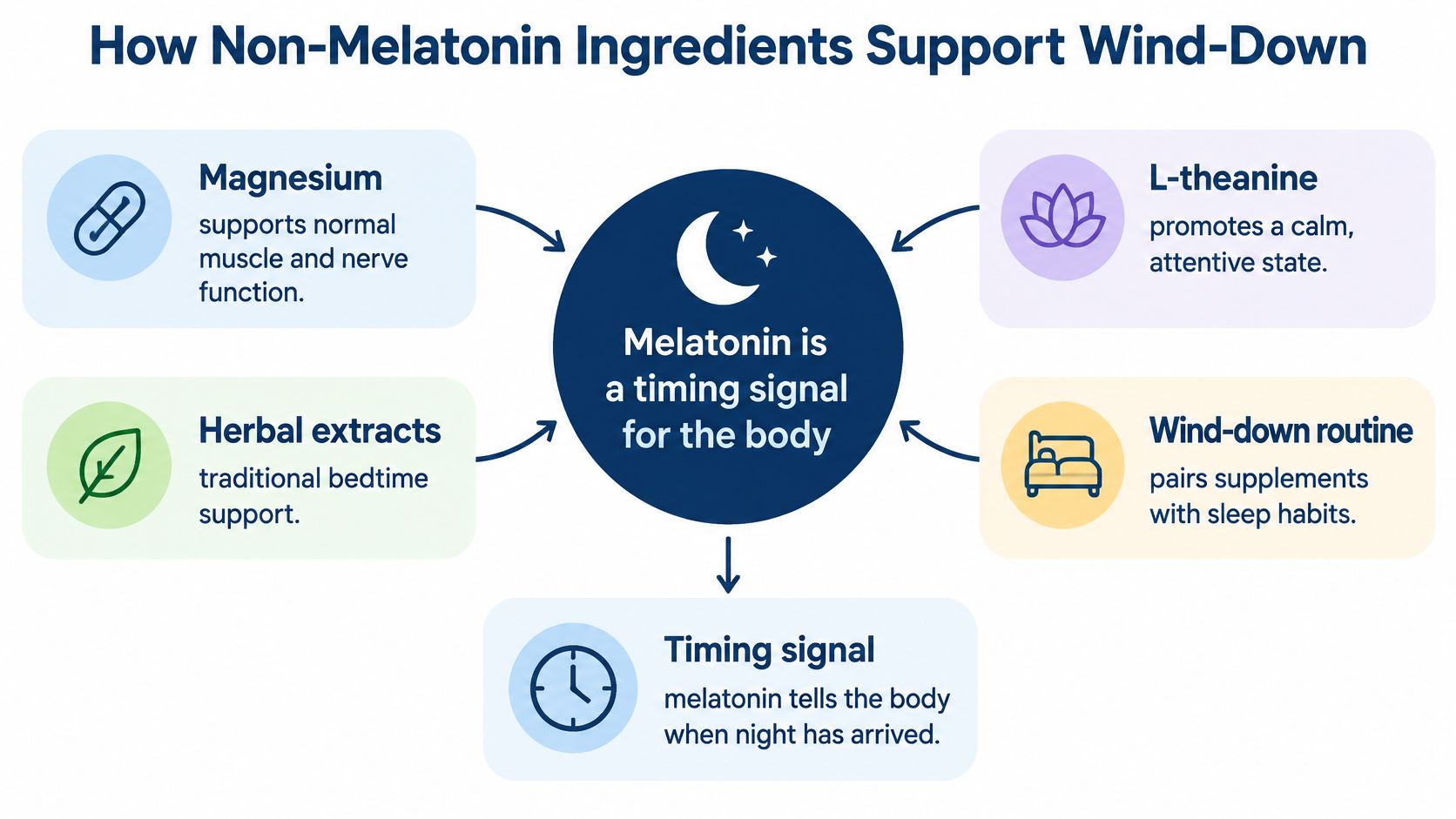
Melatonin and melatonin-free ingredients shouldn't be treated as interchangeable switches. Melatonin serves as a timing signal for the body clock. Many non-melatonin ingredients are instead discussed in relation to relaxation, mental arousal, or the feeling of settling down.
A dimmer-switch analogy helps: reducing the sense of mental or physical buzz isn't the same as changing the clock on the wall. A person may feel calmer without having corrected a mismatched sleep schedule.
The following visual separates timing cues from relaxation-oriented ingredients and habits.
Minerals and amino acids aren't clock cues
Magnesium glycinate or bisglycinate is a mineral form used in nighttime supplements. It's a plausible option to discuss when poor sleep accompanies low magnesium intake or physical tension, but the expected effect is modest, not a reliable sedative response. Evidence of a biological role also doesn't establish that adding more will improve sleep.
L-theanine is more relevant to questions about cognitive arousal and stress than to resetting circadian timing. Readers whose main difficulty is mentally replaying the day may find the distinction useful alongside practical approaches for sleeping when the brain is racing.
The broader review of dietary supplements for sleep describes variable clinical findings for commonly used ingredients. A plausible explanation for how an ingredient might work isn't the same as consistent evidence that it does.
Traditional use needs a separate evidence check
Lemon balm, passion flower, chamomile, and valerian appear in traditional wind-down approaches. Their presence in a bedtime blend shouldn't be read as proof of comparable effects. Different ingredients, preparations, and combinations require their own evaluation.
Reishi also appears as an extract in winding-down formulas. Its inclusion alone doesn't establish a sleep mechanism or a demonstrated clinical outcome.
- Mechanism: Describes a possible biological explanation.
- Measured benefit: Describes what participants experienced during research.
- Product claim: Requires evidence relevant to the finished formula, not merely a familiar ingredient name.
For anyone who still uses oral melatonin, it belongs in the evening before bed, not after a nighttime awakening. The discussion of melatonin timing for sleep provides additional timing context.
What the Evidence Says About Common Ingredients
An ingredient can be studied for winding down, perceived sleep quality, or insomnia symptoms, and those outcomes are not interchangeable. The useful question is what researchers measured, in whom, and how large the difference was. A change in how restful sleep feels does not necessarily mean a person falls asleep faster or has treated chronic insomnia.
Non-Melatonin Ingredients and What Studies Measured
| Ingredient | Dose or context in the research | What was found | What it does not establish |
|---|---|---|---|
| Magnesium bisglycinate | A randomized, double-blind, placebo-controlled trial enrolled 155 adults aged 18–65 with self-reported poor sleep and tested 250 mg elemental magnesium daily for 28 days. | Insomnia Severity Index scores fell 3.9 points versus 2.3 with placebo. The difference was statistically significant but small, with Cohen's d = 0.20, in the magnesium bisglycinate trial. | A guaranteed improvement, a strong sedative effect, or proof that magnesium treats clinical insomnia. |
| L-theanine | A 2025 systematic review and meta-analysis in Sleep Medicine Reviews included 19 randomized trials and 897 participants. | Results favored L-theanine for subjective sleep-onset latency, daytime dysfunction, and overall subjective sleep quality, with small to moderate effect sizes, in the L-theanine sleep meta-analysis. | A large objectively measured increase in sleep time, prevention of awakenings, or an established insomnia treatment. |
| Valerian | Clinical trials have produced inconsistent findings. | Its usefulness for insomnia hasn't been demonstrated, according to NCCIH's review of sleep disorders and complementary approaches. | That traditional use or inclusion in a bedtime blend proves effectiveness. |
The magnesium finding shows why statistical significance and practical importance aren't interchangeable. The placebo group also improved, and magnesium's additional average benefit was limited. A trial result is a group average, not a promise of what one person will experience.
L-theanine's results also need context. Meta-analyses often report a standardized mean difference, which lets researchers combine findings measured on different scales. It is not a percentage improvement or a count of extra minutes asleep.
Better perceived sleep is a meaningful outcome, but it doesn't prove that every aspect of sleep improved.
The study population matters
A 2025 systematic review of 13 L-theanine trials involving 550 participants reported beneficial effects across several sleep outcomes and concluded that 200–450 mg daily appears to be a safe way to support healthy sleep in adults. The authors also called for more high-quality trials, including in people with clinical insomnia. That supports measured expectations while leaving room for possible benefit.
Studies of otherwise healthy adults with poor sleep can inform a discussion of support. They do not, by themselves, establish treatment for a diagnosed disorder.
The same distinction applies to combinations. Evidence for magnesium alone does not automatically apply to a multi-ingredient capsule, and L-theanine findings do not validate every gummy that contains it. Ingredient amounts, preparation, population, and outcomes all matter.
Safety Doses and Who Should Be Careful
Safety screening comes before choosing a format. Check what else you take, whether your body can clear an ingredient, and how long you plan to use it. A calming label alone doesn't establish that a product is suitable for you.
Count the amount actually being consumed
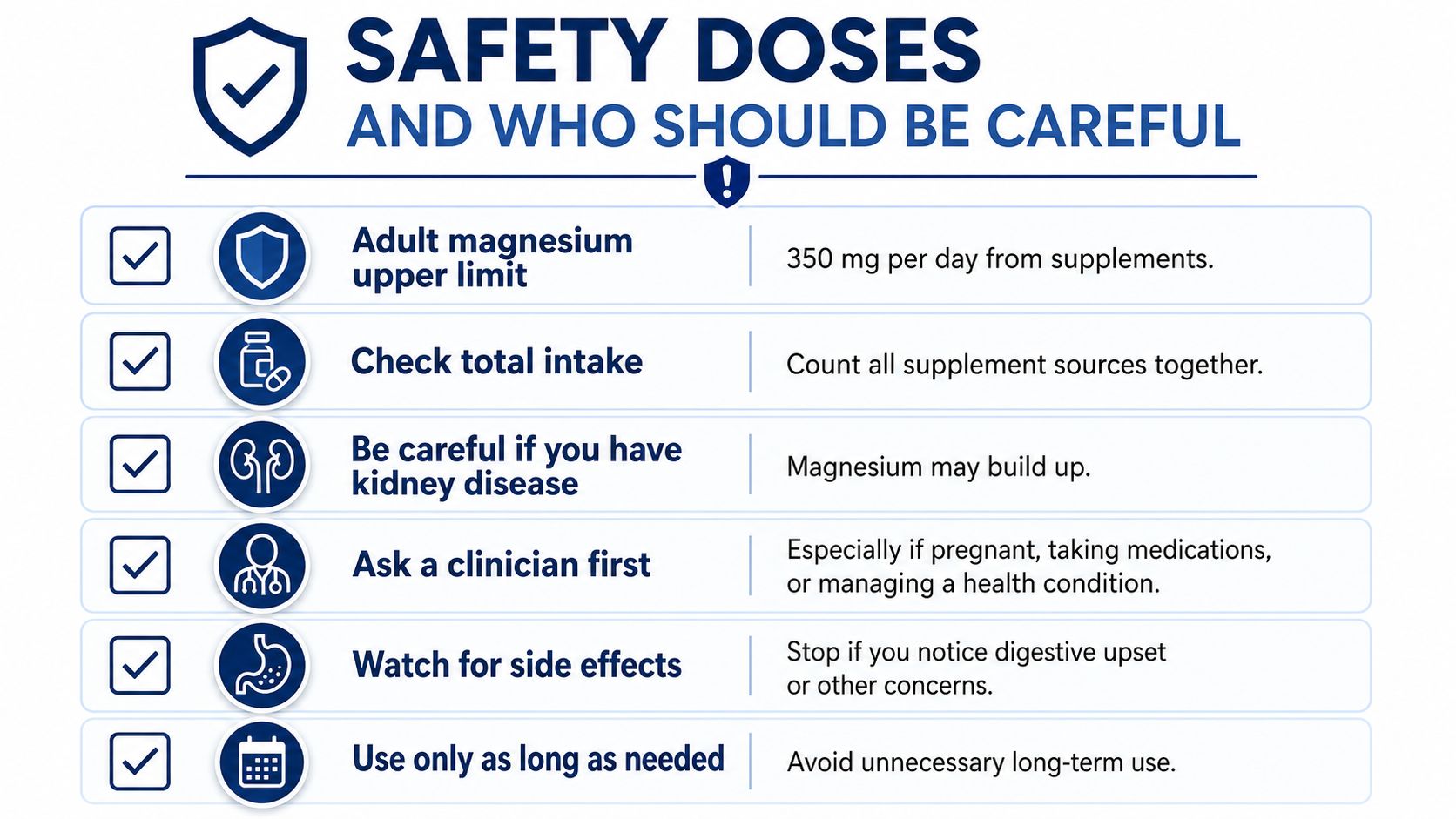
For adults, the upper limit for magnesium from supplements and medications is 350 mg daily, unless a healthcare professional recommends otherwise. Higher supplemental amounts can cause diarrhea, nausea, and abdominal cramping, according to the NIH Office of Dietary Supplements magnesium fact sheet.
Add up magnesium from all relevant products, not just the bedtime bottle. This limit applies to magnesium from supplements and medications, not food, and it is not a target everyone needs to reach.
Reduced kidney function can make magnesium harder to clear, so people with kidney disease should seek medical advice before using magnesium supplements. The magnesium bisglycinate trial excluded people with kidney or liver insufficiency, so its results don't apply to them. Raising the dose after a poor night does not replace that safety check.
The infographic below summarizes key questions to consider.
Calm ingredients can still cause unwanted effects
Human L-theanine trials commonly study approximately 200–400 mg daily, and study groups have generally tolerated it well. That finding does not establish safety for everyone, particularly people taking sedatives or combining several calming botanicals.
For valerian, the NCCIH notes it has been used with apparent safety at 300–600 mg daily for up to six weeks, though longer-term safety is unknown. Reported effects include headache, stomach upset, mental dullness, excitability, uneasiness, and vivid dreams.
The guidance also describes possible withdrawal symptoms after chronic use, including anxiety, irritability, heart disturbances, insomnia, and, rarely, hallucinations. Ask a healthcare professional before combining valerian with alcohol or sedatives.
A clinician or pharmacist can review individual risks:
- Pregnancy or nursing: Suitability needs individual assessment.
- Age under 18: Adult research may not apply.
- Prescription medicines: Reviewing the full medication list can help identify interactions.
- Alcohol use: Combining alcohol with calming substances calls for particular caution.
- Stacked products: Multiple blends may contain the same ingredient, making the total harder to track.
When a Supplement Is the Wrong Next Step
A bad melatonin experience doesn't automatically make another bottle the right answer. Persistent symptoms deserve a different decision process, particularly when sleep difficulty affects daytime functioning or repeatedly returns despite changes in routine.
Cognitive behavioral therapy for insomnia, or CBT-I, is treatment, not a list of bedtime tips. The American Academy of Sleep Medicine's behavioral-treatment guidance strongly recommends it for chronic insomnia. It combines cognitive strategies, education about sleep regulation, stimulus control, and sleep-restriction therapy.
Behavioral care is more than sleep hygiene
Practical components can include maintaining a consistent schedule and getting out of bed when sleep isn't happening instead of remaining awake in bed. Sleep-restriction therapy is a structured treatment component to discuss with a qualified professional, not an instruction to arbitrarily cut sleep.
The 2025 VA/DoD insomnia guideline recommends CBT-I for chronic insomnia and suggests against melatonin, chamomile, and sleep-hygiene education alone as treatment. The distinction matters: useful habits can support care without being sufficient treatment by themselves.
A more complicated supplement routine isn't necessarily a more appropriate response to a persistent sleep problem.
Readers considering how to treat insomnia can ask about access to behavioral care. Those noticing a close connection between worry and sleeplessness may also find the discussion of stress and insomnia useful without assuming that stress explains everything.
Reasons to seek assessment
The following situations favor evaluation rather than further supplement experimentation:
- Persistent symptoms: Repeated difficulty or ongoing daytime impairment deserves attention.
- Possible sleep apnea or restless legs: Suspected underlying sleep disorders need targeted assessment.
- Repeated 3 a.m. awakenings: Menopause-related symptoms, medicines, and circadian disruption may warrant discussion.
- Pregnancy or kidney disease: Supplement decisions require individualized safety advice.
- Medication interactions: A pharmacist or clinician can review the full combination.
- Shift-work schedules: A timing problem may need schedule-focused assessment rather than a calming blend.
The guide to when to see a doctor for insomnia can help readers prepare that conversation. Free changes to schedules and evening light can come before purchases, but they shouldn't become another reason to postpone needed care.
Melatonin-Free Formats and How to Choose
For adults who have completed the safety screen and want an optional supplement, format preference and ingredient transparency are practical comparison points. A capsule and a gummy can offer different experiences without either being stronger or more effective.
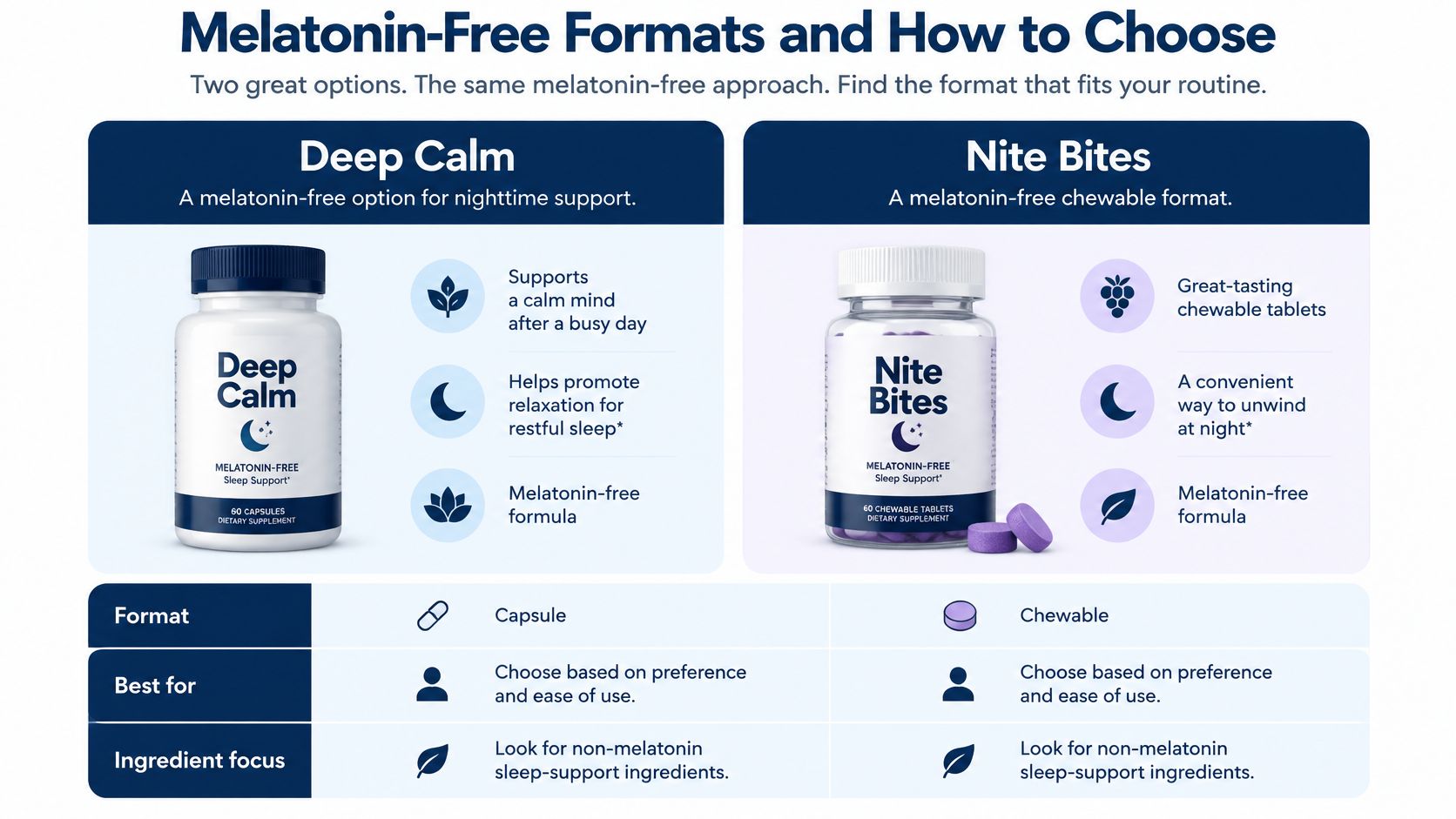
The visual provides a quick format comparison.
A stated mineral amount or a botanical blend
Deep Calm is a melatonin-free capsule containing magnesium glycinate and 275 mg magnesium per three-capsule serving, according to its product information. It is positioned to support muscle relaxation and normal nervous system function.*
That format may fit someone prioritizing a clearly stated magnesium amount near the research amount discussed earlier. However, proximity to a study dose doesn't establish that a finished product will reproduce the study's outcome.
Nite Bites are melatonin-free blackberry gummies containing 200 mg reishi extract per gummy, plus L-theanine, lemon balm, passion flower, and valerian root, according to the product information. The blend is intended for winding down.*
A gummy may suit someone who dislikes swallowing capsules, but its format doesn't establish clinical effectiveness. The valerian content also means the earlier cautions about alcohol, sedatives, and medication review remain relevant.
Read beyond the front label
Neither formula is extended-release, prolonged-release, or sustained-release. Neither should be selected with an expectation of staying asleep or supporting sleep maintenance.
- For a mineral-focused choice: Check the elemental magnesium amount rather than relying on the larger magnesium-compound weight.
- For a blend: Review each disclosed ingredient amount instead of assuming the combination matches research on isolated ingredients.
- For either format: Follow the labeled serving and avoid increasing it after a disappointing night.
The magnesium serving should also be checked against the supplemental upper limit already described and any magnesium obtained from other supplements or medications. A clear label makes that review possible; it doesn't replace it.
The accompanying video offers another way to review the comparison.
The most defensible choice is the format and ingredient profile that fits an adult's preferences and safety considerations, with expectations no broader than the evidence supports.
A Flexible Evening Menu You Can Actually Keep
A workable evening routine doesn't require a purchase, a spare room, or uninterrupted quiet. It can start with whatever is available in an ordinary household. The aim is a manageable transition, not another demanding project.
A flexible menu gives adults room to choose:
- A repeatable wind-down window: Select a recognizable point when daytime tasks begin to stop, while allowing for work and caregiving demands.
- Less bright evening light: Use existing dimmer settings or fewer lights where practical, without buying special equipment.
- A paper brain dump: Write unfinished tasks or recurring thoughts on paper so there's a place to return to them later.
- A different response to wakefulness: When sleep isn't happening, consider the previously discussed behavioral guidance rather than struggling in bed.
- Optional background sound: A free white-noise app or a fan already available may be worth trying if silence or household noise feels distracting.
Keep the routine small enough to repeat
Not every option needs to be used. Someone sharing a room may have little control over lighting or sound, while someone caring for a family member may not have a predictable evening. A routine can still be useful without looking the same every night.
The discussion of sleep quality improvement offers additional context for choosing manageable changes. A simple paper record of bedtime, awakenings, and next-day functioning can also give a healthcare professional a clearer description than a general report of bad sleep.
Practical rule: An optional supplement should add less complexity than it creates.
If magnesium or L-theanine is considered appropriate, expectations should follow the research timeframes rather than a verdict after a single night. The decision should include a plan to reassess usefulness, unwanted effects, and whether further evaluation is needed.
A sleep supplement without melatonin is one possible addition to an evening routine, not the foundation of every sleep plan. The better starting point is a clear job, a safety check, and permission to choose no supplement at all.
Sleep All Nite offers melatonin-free capsule and gummy formats with different ingredient profiles. Visit Sleep All Nite to compare formats and ingredient amounts, then check the choice with a healthcare professional before starting a supplement.
*These statements have not been evaluated by the Food and Drug Administration. These products are not intended to diagnose, treat, cure, or prevent any disease.
This article is for general education and isn't medical advice. Talk with a healthcare professional before starting a supplement, especially if you're pregnant or nursing, under 18, managing a medical condition, or taking prescription medication.


