
Does Valerian Root Help You Sleep? A Science-Based Guide


Valerian root may help some people feel calmer and fall asleep more easily, but the results vary a lot from one study to the next. It has not been shown to reliably solve sleep problems for everyone.
Table of Contents
- Does Valerian Root Help You Sleep Based on the Evidence
- What the Latest Research Shows About Valerian
- Why Valerian Evidence Still Looks Mixed
- Valerian Dosing, Timing, and How Long Effects Last
- Side Effects and Interactions to Know Before Bed
- Comparing Valerian Formats and Building Your Routine
- Frequently Asked Questions About Valerian and Sleep
Does Valerian Root Help You Sleep Based on the Evidence
Think of valerian as a dimmer switch rather than an on-off light. Any effect tends to be modest, and how much you notice depends on your body and your habits.
Valerian is a flowering plant, and its root shows up in plenty of sleep blends, from capsules to bedtime teas. It's sold as a supplement rather than a prescription drug, so it doesn't go through the same testing that medications do.
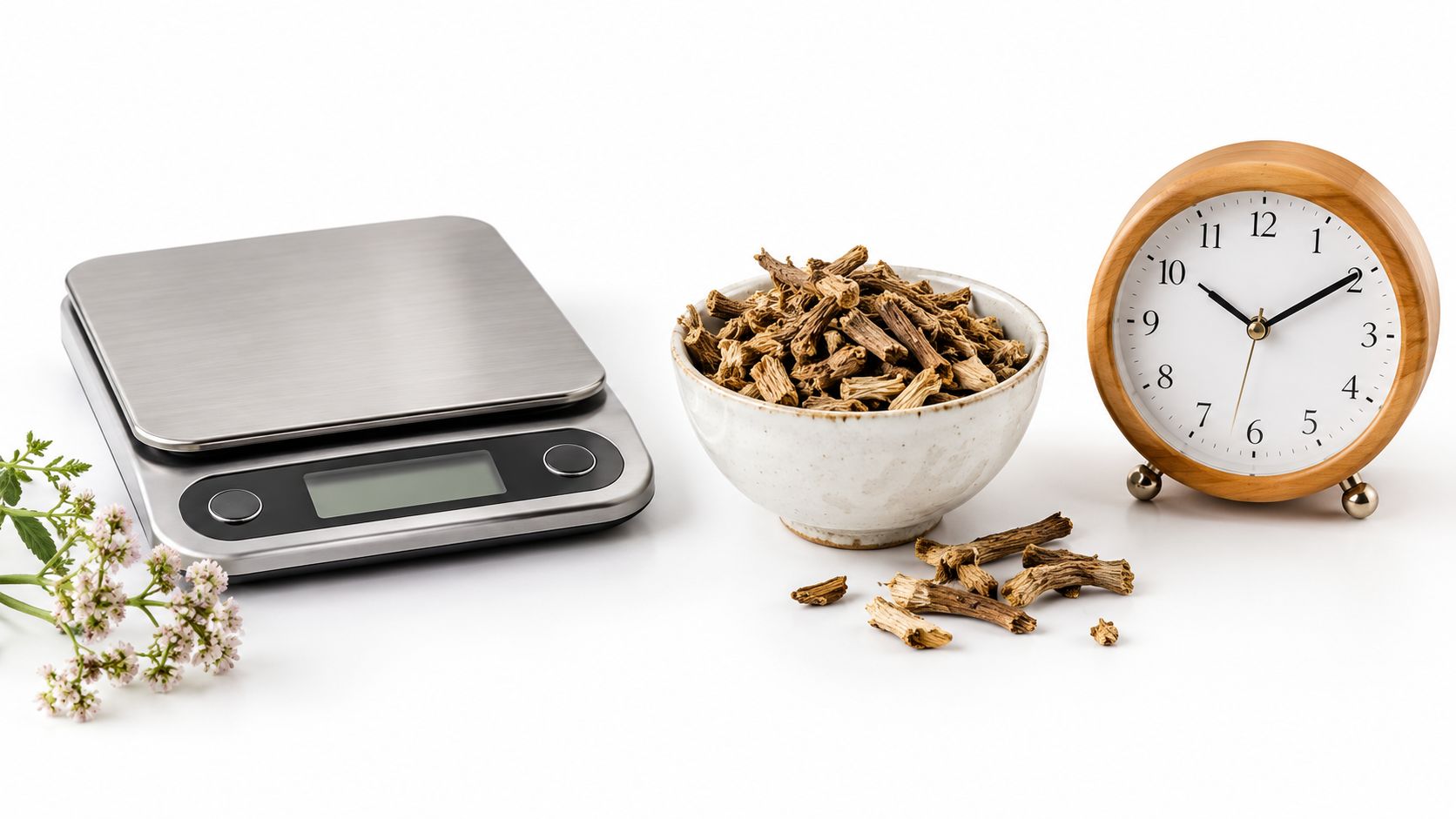
The photo below shows a typical bedtime setup with valerian nearby. You can read more about the plant's background and its long history as a traditional herb in the NCCIH valerian overview.

That long history is worth noting. Valerian has been used as a calming herb for centuries, but there is no single standard form. One capsule may contain a very different amount of root than another, which is a big reason why people's experiences differ so much.
Here's a quick summary of the main points.
| Topic | Summary |
|---|---|
| What valerian is | A flowering plant whose root has a long history as a traditional calming herb |
| What the evidence suggests | Some people report feeling calmer and falling asleep more easily |
| Where results vary | Trials differ in products, doses, and length, and many are small |
| What to keep in mind | It is not a guaranteed fix, so check with a healthcare professional first |
Key idea: Valerian may nudge your sleep in the right direction, but it isn't a switch that guarantees rest.
What a Modest Effect Looks Like
A modest effect might mean drifting off a little sooner on some nights, or waking up feeling slightly more rested. It doesn't mean a sudden knockout or a cure for every sleep problem.
People who notice a small benefit often describe things like:
- Easier drift: feeling a little less wired before bed
- Calmer evenings: a slower wind-down after dinner
- Mild rest: waking with a slightly better sense of being rested
Plenty of people notice no change at all, and that's a normal result too. Keeping a simple sleep log for a few weeks can help you judge whether valerian actually fits your routine or just sounds like it should.
The rest of this guide covers the research, dosing, safety, and bedtime routine ideas in more detail. Keep reading to see how each piece fits together.
What the Latest Research Shows About Valerian

One study can be interesting, but it's often small and short-lived. The more useful question is what happens when you gather many studies and look at them together. That's the job of a meta-analysis.
Why Pooling Results Matters
Picture a group of home cooks tasting the same soup. One person might be thrown off by a batch that came out too salty, or by having a bad day with their palate. But once you collect a dozen tasting notes, the overall picture gets much clearer.
A meta-analysis works the same way. It combines the results of many trials into one larger verdict.
Self-Reported Sleep Outcomes
A 2023 meta-analysis in Current Sleep Medicine Reports looked at randomized controlled trials, where people are assigned to either valerian or a placebo. Across 21 trials and 1,433 participants, the self-rated results leaned positive.
- Sleep quality: Participants were more likely to report better sleep than those taking placebo (risk ratio 1.37, 95% confidence interval 1.13–1.68)
- Sleep duration: Participants were more likely to report longer or improved sleep (risk ratio 1.27, 95% confidence interval 1.02–1.57)
These numbers are encouraging. Still, they reflect how people judged their own nights. Self-reports matter, but expectations can color them.
What Sleep Measurements Revealed
Objective measurements told a less upbeat story. Only time spent in deep, non-REM stage 3 sleep showed a statistically significant change. If you want the details, the original paper on valerian trials and sleep measurements walks through the methods and results.
Why the Wide Ranges Matter
Those confidence intervals are wide, and that's a signal in itself. It points to real variation between studies. Results don't line up neatly from one trial to the next.
Several factors seem to explain the differences:
- Extract type: Different root preparations contain different amounts of active compounds.
- Dose: Trials used a range of amounts, so one result rarely applies to every product label.
- Formulation: Capsules, tablets, and teas can deliver different amounts of the plant.
- Type of complaint: Trouble falling asleep and chronic insomnia are very different starting points.
- Length of use: Most trials ran for short periods, so long-term effects are still unclear.
What the Findings Do Not Prove
These results don't show that valerian alone will stop early-morning waking. They also don't show that it resolves chronic insomnia. In fact, the NCCIH notes that the American Academy of Sleep Medicine's 2017 guidelines recommended against using valerian for chronic insomnia in adults.
Key takeaway: Valerian may modestly change how people rate their sleep, but objective evidence is limited.
Keep that balance in mind when you wonder whether valerian root helps you sleep. The research points to an uneven effect, not a reliable fix.
Dosing, safety, and bedtime habits deserve attention too, since they can shape the outcome as much as the plant itself. Your own experience, tracked carefully over a few weeks, may be the most useful evidence you gather.
Why Valerian Evidence Still Looks Mixed
You may have read one article calling valerian a sleep saver and another calling it a waste of money. That contradiction isn't your imagination. The research really does point in more than one direction, and a big part of the reason has to do with which studies get published.
How Publication Bias Skews the Picture
Picture a restaurant review site that only shows five-star reviews. Anyone scrolling through would assume every meal is excellent, even though plenty of diners walked out disappointed. Science can fall into the same trap when studies with positive results get published more often than studies that found little or nothing.
A 2006 systematic review and meta-analysis looked at this problem head-on. It pooled 16 eligible studies involving 1,093 patients, and its authors found signs of publication bias. In other words, the published pool may lean more favorable than the full body of research. You can read the full paper at the 2006 valerian review.
What the Pooled Numbers Show
Six of those studies asked participants whether their sleep had improved. Across them, the relative risk of improved sleep came out to 1.8, with a 95% confidence interval of 1.2 to 2.9. On paper, that looks promising. But a range that wide also suggests the studies differed quite a bit from one another.
Here's the other side of the story. The same review noted that most of the included studies had significant methodological problems, and the publication bias it found means that pooled benefit may be overstated. Both signals show up in one review, and that's exactly why the overall picture feels so murky.
Why the 28-Day Trial Stands Out
One trial gets passed around more than the rest, and it's easy to see why. It ran for 28 days and gave 600 milligrams of dried valerian root each night to adults with non-organic insomnia.
Its results favored valerian over placebo, and the length of the trial and its clearly stated dose explain much of the attention it receives. Even so, a single trial is only one piece of a larger and uneven picture.
Why One Trial Cannot Settle the Question
Still, one study doesn't automatically apply to everyone. Its participants had a particular complaint, took a particular preparation, and were observed under controlled conditions. Your body, the product on your nightstand, and your sleep patterns may all be different.
Think of it like a recipe tested in one kitchen with one oven. It may turn out beautifully there and still come out differently in yours.
Reframing Valerian as Sleep Support
The evidence, taken as a whole, is mixed.
A more useful way to think about valerian is as a possible relaxation and sleep-support ingredient, not a guaranteed fix. Treat it as one piece of a broader bedtime routine rather than a standalone solution. If you want to compare other options, our guide on how to treat insomnia covers them in more detail.
Valerian Dosing, Timing, and How Long Effects Last
Picture a bakery testing a new bread recipe. The baker makes a small trial loaf to check the method, but nobody expects you to slice that loaf and call it dinner. Research doses work the same way. They show what scientists tested, not what fits your evening.
What Researchers Have Studied
Valerian studies have used a surprisingly wide range of amounts, and the figures are easy to misread. The table below lines up the numbers readers most often run into, along with what each one actually means.
Valerian Amounts Studied Compared With Label Context
| Study or Guidance | Amount Reported | What It Tells Readers |
|---|---|---|
| 28-day trial | 600 mg dried valerian root nightly | One notable trial, not a personal dose |
| NCCIH safety overview | 300–600 mg daily for up to 6 weeks | Range used with apparent safety in research, not a recommended dose |
Both entries describe what happened in controlled settings. Neither one is a prescription. Once you see that difference, the table becomes much easier to read.
The NCCIH valerian overview summarizes this range in plain language, and the image below captures the same idea.
The range shows daily amounts studied for up to six weeks. It does not point to a single dose that works for everyone.
Why Labels Do Not Match
Study preparations vary, and they don't always match the product on your shelf. That matters because a number on one bottle may not mean the same thing on another.
Two bottles can both say valerian and still differ quite a bit in strength. Compare the amount printed on the label, not the name on the front.
Onset and Duration Remain Unclear
The evidence reviewed here does not establish a reliable time to notice an effect, or how long any effect lasts. That gap is real, and it is worth being honest about it.
So if a blog post promises that valerian kicks in after 30 minutes and wears off by morning, treat that claim with caution. The label is a more dependable guide than a confident number online.
Key takeaway: The label sets the directions, and a clinician can help you decide whether valerian fits your situation.
Timing Lessons From Melatonin
Timing matters for other sleep ingredients too. Our guide on melatonin timing for sleep shows how researchers study when an ingredient is taken, and the same questions apply here.
If you want ideas for the hours before bed, how to sleep when your brain is racing covers habits that can fit into a wind-down routine.
Practical Checks Before Trying Valerian
Before you start, run through a few quick checks:
- Read the extract type on the label.
- Compare the listed amount with the research range above.
- Log your evenings for a few weeks so patterns become visible.
- Talk with a clinician first if you take other medicines or manage a medical condition.
Consistency matters more than people expect. If you change amounts from night to night, you won't be able to tell what, if anything, is helping. Keep the routine steady, follow the label's timing, and let your own notes guide the next conversation with your pharmacist or doctor.
Side Effects and Interactions to Know Before Bed

You've probably seen the "do not mix" warning on a bottle of household cleaner. Each product might be fine on its own, but combining them can cause real trouble. Valerian works in a similar way, because it is sedating. Stacking it with other calming substances can change how you feel the next morning.
Commonly Reported Side Effects
Many people who take valerian for a short time notice nothing unusual. When effects do show up, they tend to be mild. The NCCIH lists these reported side effects:
- Headache that appears after a dose
- Stomach upset or general digestive discomfort
- Mental dullness, a foggy feeling the next morning
- Uneasiness or excitability instead of calm
- Vivid dreams that may disrupt rest
If any of these appear, stop taking valerian. Then talk to a healthcare professional before you try it again.
What Long-Term Use Can Mean
Research on longer-term use is limited, and that gap deserves attention.
The U.S. National Center for Complementary and Integrative Health reports that valerian has been used with apparent safety at daily doses of about 300–600 milligrams for up to 6 weeks. Long-term safety remains unknown. Read the full NCCIH valerian safety overview.
The NCCIH also notes that some people may have withdrawal symptoms if they stop abruptly after long-term use. If you have used valerian nightly for weeks or months, ask a clinician whether you should stop and how to taper.
Key takeaway: Long-term safety has not been established. Treat valerian as a short-term option rather than a permanent bedtime habit.
Interactions That Call for Caution
Valerian can add to the sedation caused by other substances. The combination may feel much stronger than either one alone.
Avoid mixing valerian with alcohol or sedating medications unless a clinician has approved it. Social drinkers should be especially careful, since a single evening drink can change how you feel the next day. If you're considering prescription sleep medication, speak with your prescriber first.
People who are pregnant or nursing, under 18, or managing a medical condition should check with a healthcare professional before starting valerian.
Your Before-Bed Checklist
Run through these items before taking valerian in the evening:
- I have no alcohol planned for this evening.
- I am not taking sleep medication or other sedatives unless a clinician has approved the combination.
- I have read the label and checked the amount with my clinician or pharmacist.
- I can stop if headache, stomach upset, or unusual unease appears.
- I will not drive or operate machinery until I know how valerian affects me.
- I understand valerian is not a replacement for medical evaluation.
Comparing Valerian Formats and Building Your Routine
Picture a cup of coffee, a cup of tea, and a decaf. They all start from a plant, but what you add to them changes the experience. Milk, honey, or nothing at all can make each one feel different. Valerian products work the same way. The root is only part of the story.
Valerian Products Differ in Their Companions
Some products mix valerian with melatonin, while others leave it out entirely. If a product contains melatonin, treat it with the same care you would give any melatonin use. Read the label before you buy, not after.
Two of our own products show how much the details can differ. Both use valerian as one ingredient in a blend, in amounts well below the 300–600 mg studied on its own:
- Drift Off is a raspberry oral strip that dissolves on the tongue, so you don't need water. It contains 1 mg of melatonin alongside valerian root extract (50 mg), lavender, chamomile, and hibiscus. Take one strip any time before bed, with a maximum of one strip per day.*
- Nite Bites are melatonin-free blackberry gummies. Each gummy combines valerian root (25 mg) with reishi extract (200 mg), L-theanine, lemon balm, and passion flower, and they are designed for winding down.*
The ingredient list tells you what is in the bottle. The timing tells you when it belongs in your evening.
Melatonin belongs in the evening, close to bedtime. It is never something to take after you wake during the night. For more on why a higher dose isn't better, read our guide on too much melatonin.
Building a Routine from a Menu of Habits
Think of your bedtime routine as a playlist. You don't have to play every track, and skipping one won't ruin the album.
Each habit below can be added or left out. Pick the ones that feel doable tonight.
- Keep a consistent wind-down time. Start winding down at about the same hour each night so your body learns the cue.
- Dim the lights an hour before bed. Lower lamps signal to your brain that evening has arrived.
- Keep the room cool if you can. Open a window or run a fan if you have one. Skip this step if you don't.
- Try a free white-noise app. Steady background sound can soften sudden noises.
- Practice a short breathing exercise. A few minutes of slow, even breaths can quiet a busy mind.
- Write tomorrow's to-do list on paper. Getting tasks out of your head makes it easier to stop replaying them.
If your thoughts race at bedtime, how to sleep when your brain is racing offers more ideas to explore. If you want to see how other formats compare, take a look at our comparison of the best sleep support supplements.
What the Evidence Supports and What Remains Uncertain
The evidence points to a modest, inconsistent effect on how some people feel about falling asleep. Objective measurements are far less convincing, and long-term safety hasn't been established.
Feeling drowsier is not the same as sleeping better.
What remains unclear is who benefits, which dose suits them, and how long any effect lasts. The habits above are free to try, but they can't guarantee rest.
Talk with a healthcare professional if sleep trouble lasts for weeks. Check with one before trying valerian if you're pregnant or nursing, under 18, managing a medical condition, or taking prescription medication.
Frequently Asked Questions About Valerian and Sleep
Is Valerian Habit-Forming?
Valerian isn't generally described as habit-forming, but that doesn't make long-term use risk-free.
Some people who stopped abruptly after taking valerian for a long stretch have reported withdrawal symptoms. If you're planning nightly use over several months, a clinician can help you decide whether to continue and how to taper safely.
Can Valerian Be Combined With Melatonin?
Check the label for melatonin content before you mix the two. Both can promote drowsiness, and stacking them can add up faster than you expect.
Think of each sleep aid as a dimmer switch. Turn two of them up at once, and the room can get darker than you intended.
Talk with a clinician before combining them, especially if other sedating ingredients are involved, such as alcohol or sleep aids. Trying one product at a time makes it much easier to notice what, if anything, is actually changing.
What Should You Do When You Wake During the Night?
Melatonin is meant for the evening, before bed. It isn't something to reach for after you wake up in the middle of the night.
Waking at night is better treated as a signal to pause and reassess than a reason to grab a supplement. A few practical habits can help:
- Note the time and roughly how long you were awake
- Avoid screens and bright lights while you're up
- Keep the room cool, dark, and quiet
- Get up for a short while if you can't drift back to sleep
Frequent or persistent waking at night is worth discussing with a healthcare professional. A simple sleep log, noting when you wake and how long you stay up, makes that conversation far more useful.
For background on why it happens, read why do I wake up at 3 a.m.
Read also in our guide: when to see a doctor for insomnia, which outlines when a checkup makes sense.
Compare formats and ingredient amounts at Sleep All Nite at sleepallnite.com, and check with a healthcare professional before starting any supplement or sleep routine.
*These statements have not been evaluated by the Food and Drug Administration. These products are not intended to diagnose, treat, cure, or prevent any disease.
This article is for general education and isn't medical advice. Talk with a healthcare professional before starting a supplement, especially if you're pregnant or nursing, under 18, managing a medical condition, or taking prescription medication.


