
Drinking Affects Sleep: A Guide to Better Rest


You enjoy a few drinks with friends, fall asleep more quickly than usual, and then find yourself staring at the ceiling at 3 a.m. The night may feel broken even though bedtime seemed easy. By morning, sleep feels shallow, your energy is low, and the earlier sense of relaxation no longer seems worth it.
That pattern makes sense once drinking affects sleep is separated into two questions: how quickly someone falls asleep and how well the brain maintains normal sleep architecture afterward. Alcohol can make sleepiness arrive sooner while shifting REM sleep, increasing later wakefulness, and leaving some people fatigued the next day. Timing, dose, individual sensitivity, and breathing during sleep all matter.
This guide explains the difference between sedation and restorative sleep, why the second half of the night often feels worse, and how social drinkers can make practical adjustments without treating one drink as a guarantee of disrupted sleep. Readers who also notice irregular sleep timing can explore how circadian rhythm disruption affects sleep.
Table of Contents
- Introduction to Alcohol and Sleep
- Understanding Sleep Architecture and Alcohol
- Dose Effects on Sleep Stages
- Timing Effects on Sleep Maintenance
- Practical Harm Reduction Strategies
- Comparing Evening Routine and Supplement Options
- Conclusion and Next Steps
Introduction to Alcohol and Sleep
A common evening looks harmless. Dinner ends, a glass of wine becomes another drink during conversation, and bedtime arrives with heavy eyelids. The person falls asleep quickly, then wakes in the early morning with a dry mouth, a busy mind, or a sense that the body is tired but the brain is alert.
That experience doesn't mean alcohol failed to make the person sleepy. It means sleep onset and sleep continuity are different outcomes. Alcohol can shorten the time needed to fall asleep while disturbing the sequence of sleep stages later. The sedating feeling is real, but it doesn't prove that the night will be restorative.
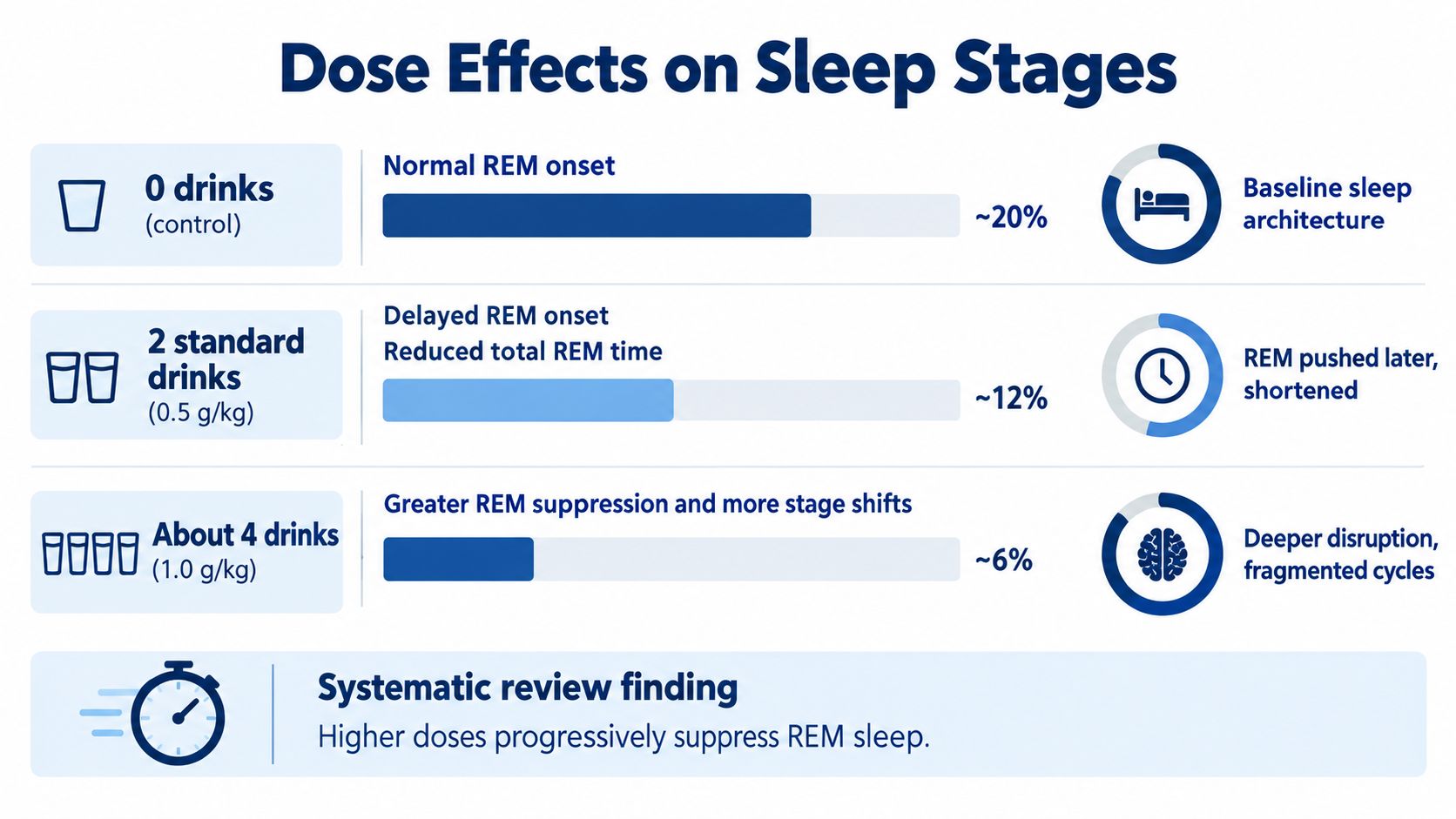
A systematic review in healthy adults found that even a low dose, defined as no more than 0.50 grams per kilogram of body weight, approximately two standard drinks, delayed REM-sleep onset and reduced total REM duration (systematic review of alcohol and subsequent sleep). The disruption became greater as the dose increased.
For a social drinker, the useful question isn't just, “Did alcohol help with falling asleep?” It's “What happened to awakenings, sleep stages, and next-day alertness?” Those measures tell a more complete story.
Understanding Sleep Architecture and Alcohol
Sleep architecture describes the changing pattern of non-REM and REM sleep across the night. Non-REM sleep includes stages 1 through 3, moving from lighter sleep toward deeper slow-wave sleep. REM sleep is a distinct stage associated with vivid dreaming and important processes involving memory and emotional processing.
A useful analogy is a multi-course meal. Stage 1 is the brief appetizer, stage 2 is a more substantial course, stage 3 is the slow, restorative main course, and REM is the later dessert that returns in repeated servings. A meal isn't improved just because the appetizer arrives quickly. Likewise, sleep isn't necessarily better because sedation moves someone into sleep faster.
Alcohol doesn't act like a uniform off switch. Its early effects can make the first part of the night feel heavy, while later metabolism changes arousal and the timing of sleep stages. The result can be a night that feels deep at first but less orderly and more interrupted toward morning.
Why the feeling of sleepiness misleads
The brain can register alcohol's depressant effect as relaxation and drowsiness. That subjective experience is valuable information about how the person feels, but it isn't a complete measurement of sleep quality. A person may fall asleep quickly and still experience altered REM regulation, more wakefulness, or a shortened sleep period.
Research also shows a longer-term continuum. A longitudinal twin study analyzed 13,851 participants and examined the association between drinking patterns and poor sleep quality over time (longitudinal twin study in Sleep Advances). Clinical and review literature also connects sustained heavy alcohol use with broader abnormalities in sleep timing and structure.
That distinction matters for adults who wake during the night. A fast transition into sleep isn't evidence that alcohol supports the full sequence of sleep needed for mental and physical recovery.
Dose Effects on Sleep Stages
Alcohol's effects change with dose, but the pattern isn't a simple line from “less is harmless” to “more is disruptive.” The 2024 systematic review and meta-analysis found that a dose of up to 0.50 grams per kilogram, about two standard drinks, delayed REM onset and reduced total REM duration (dose-response findings in the systematic review).
At a higher intake of approximately 0.85 grams per kilogram, roughly five standard drinks, sleep onset became shorter and entry into N3 slow-wave sleep happened sooner. That apparent early benefit came with more pronounced later disruption to REM sleep. In plain language, heavier drinking may push the brain rapidly into an initially deep-feeling state without preserving the normal architecture that follows.
The biphasic pattern
The mechanism is often described as biphasic. Early in the night, alcohol's central nervous system depressant effects can promote sedation and alter the balance of sleep stages. Later, as the body metabolizes alcohol, arousal regulation and REM timing can shift in the opposite direction.
That helps explain a frustrating sequence: sleep arrives easily, then the night becomes lighter or more fragmented. The first result is noticeable at bedtime. The second result may appear hours later, when the person wonders why they woke despite feeling exhausted.
Practical rule: Faster sleep onset is a comfort signal, not a quality score.
People tracking sleep shouldn't judge an alcohol night by latency alone. A better comparison records the last drink, bedtime, wake time, awakenings, and next-day alertness across alcohol-free and drinking nights with similar caffeine exposure. Readers focused on repeated awakenings can also review sleep maintenance insomnia and nighttime continuity.
Timing Effects on Sleep Maintenance
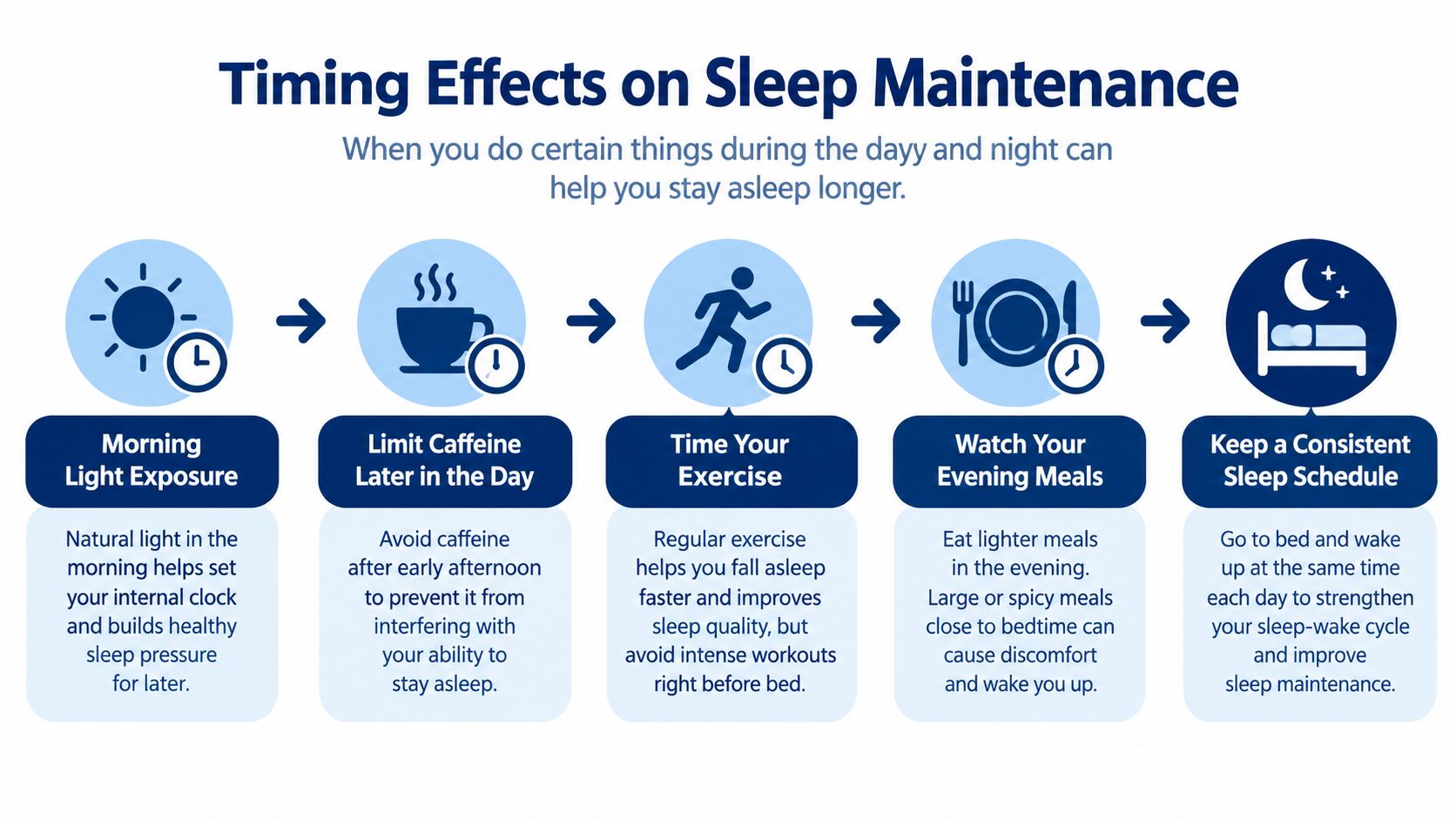
The clock changes the experience of drinking affects sleep. Alcohol consumed near bedtime is more likely to overlap with the part of the night when sleep naturally becomes lighter and REM periods become more prominent. As alcohol clears, rebound arousal and changes in breathing can make that later period especially vulnerable.
An actigraphy study of college students found that, among those who drank less than the group average, alcohol reduced total sleep time and increased wakefulness in the latter half of the night, with more fatigue on waking. (Read the actigraphy study in Alcohol and Alcoholism) The finding illustrates why someone can remember falling asleep quickly yet still experience an unsatisfying night.
Why late drinking feels different
The practical risk isn't limited to the total number of drinks. The alcohol-free interval before bed also matters because it creates more time between drinking and the sleep period. Finishing earlier may reduce the chance that alcohol's later effects coincide with the second half of the night, although individual responses vary.
Alcohol can also worsen sleep-disordered breathing. Anyone who snores heavily, has diagnosed obstructive sleep apnea, or is particularly susceptible to airway collapse should avoid alcohol near bedtime and discuss symptoms with a healthcare professional.
A person who wakes at 3 a.m. shouldn't assume that a clock time itself is the cause. Sleep stage timing, alcohol clearance, breathing interruptions, stress, and other factors can overlap. The guide to why waking at 3 a.m. can happen offers a broader way to assess that pattern.
Practical Harm Reduction Strategies
Social drinkers don't need an all-or-nothing framework to learn how alcohol changes their sleep. The most useful approach is a small personal experiment that separates dose from timing and measures more than the moment of falling asleep.
A simple sleep diary can record bedtime, wake time, last drink, approximate number of drinks, awakenings, and next-day alertness. A wearable or phone app can add another perspective, but subjective fatigue still matters because devices estimate sleep stages rather than directly measuring brain activity.
Make the alcohol-free window longer
The most direct adjustment is to finish drinking earlier rather than relying only on a lower total amount. Alternating an alcoholic drink with water can also slow the evening pace and increase the alcohol-free period before bed. These choices don't guarantee normal sleep, but they address timing and exposure separately.
Free or low-cost options can support the same experiment:
- Use a consistent bedtime: Keeping bedtime and wake time similar makes comparisons easier.
- Avoid evening caffeine: Caffeine can complicate the interpretation of a restless night.
- Try gentle wind-down cues: Stretching, quiet reading, or slow breathing can replace the role of a drink as a transition into the evening.
- Use sound strategically: A fan, if available, or a free white-noise app may mask sudden environmental sounds.
- Track the morning, not just the night: Fatigue, concentration, mood, and headache can reveal an effect that total sleep time hides.
A daily diary study of 392 nurses found that days with alcohol use were associated with about 4.2 minutes shorter sleep-onset latency, about 2.4 minutes more wake after sleep onset, and about 15.6 additional self-reported minutes of sleep (daily diary study of alcohol and sleep). Those findings show why a person can report more total sleep while still experiencing poorer continuity.
A useful experiment compares several alcohol-free nights with matched bedtimes, rather than treating one unusually good or bad night as a final verdict.
Readers wanting broader non-alcohol habits can explore what helps with staying asleep. Persistent sleep trouble, loud snoring, breathing pauses, or severe daytime sleepiness warrants professional evaluation rather than continued self-experimentation.
Comparing Evening Routine and Supplement Options
Supplements shouldn't be used to cancel out alcohol's effects or to encourage drinking closer to bedtime. If someone chooses an evening supplement on an alcohol-free or lower-alcohol night, the decision should account for format, ingredients, melatonin content, medications, pregnancy or nursing, and guidance from a healthcare professional.
Two different formats illustrate how a person might compare options without assuming that one is universally appropriate. Drift Off is a raspberry oral strip that dissolves on the tongue without water. It contains 1 mg melatonin, valerian root, lavender, chamomile, and hibiscus, and is taken before bed, with a maximum of one strip per day. It's made for a bedtime routine to support healthy sleep patterns and relaxation.*
Deep Calm is a melatonin-free capsule containing 275 mg of magnesium per serving from magnesium glycinate. Magnesium supports normal nerve function and muscle health.* Neither product should be presented as a treatment for insomnia or as a way to prevent alcohol-related awakenings.
| Format | Key Ingredients | Melatonin Content | Ideal Use |
|---|---|---|---|
| Raspberry oral strip | Valerian root, lavender, chamomile, hibiscus | 1 mg | A water-free evening format taken before bed |
| Capsule | Magnesium glycinate, 275 mg magnesium per serving | Melatonin-free | An evening option for people comparing a melatonin-free format |
Melatonin belongs in the evening, before bed, not after a night waking. Readers comparing timing and amounts can review melatonin timing guidance, and those considering supplements can read sleep support supplement options.
Conclusion and Next Steps
Alcohol can feel sedating while still disrupting REM organization and sleep continuity. Dose and timing work together, so a useful personal review tracks the last drink, bedtime, awakenings, and next-day function rather than sleep latency alone.
Starting with a longer alcohol-free window, water between drinks, and consistent sleep timing gives social drinkers practical ways to learn their pattern. If sleep trouble persists, or if breathing problems and marked daytime sleepiness appear, a healthcare professional can help identify the cause. Melatonin and other supplements belong in a considered evening routine, not as a strategy for drinking closer to bedtime or treating a medical condition.
Sleep All Nite offers oral strips, capsules, and melatonin-free formats with clearly listed ingredients and amounts for people comparing evening routines. Visit Sleep All Nite to compare formats, and check with a healthcare professional before starting a supplement, especially when alcohol, prescription medication, or an ongoing health concern is involved.
*These statements have not been evaluated by the Food and Drug Administration. These products are not intended to diagnose, treat, cure, or prevent any disease.
This article is for general education and isn't medical advice. Talk with a healthcare professional before starting a supplement, especially if you're pregnant or nursing, under 18, managing a medical condition, or taking prescription medication.


