
Insomnia Treatment Options: A Clinical Comparison


Cognitive behavioral therapy for insomnia is the initial treatment recommended for chronic insomnia, and the evidence shows it outperforms control conditions on remission, response, and time awake. Major guideline bodies keep returning to the same conclusion because CBT-I changes the sleep pattern itself, while medication mostly changes how sleepy a person feels that night.
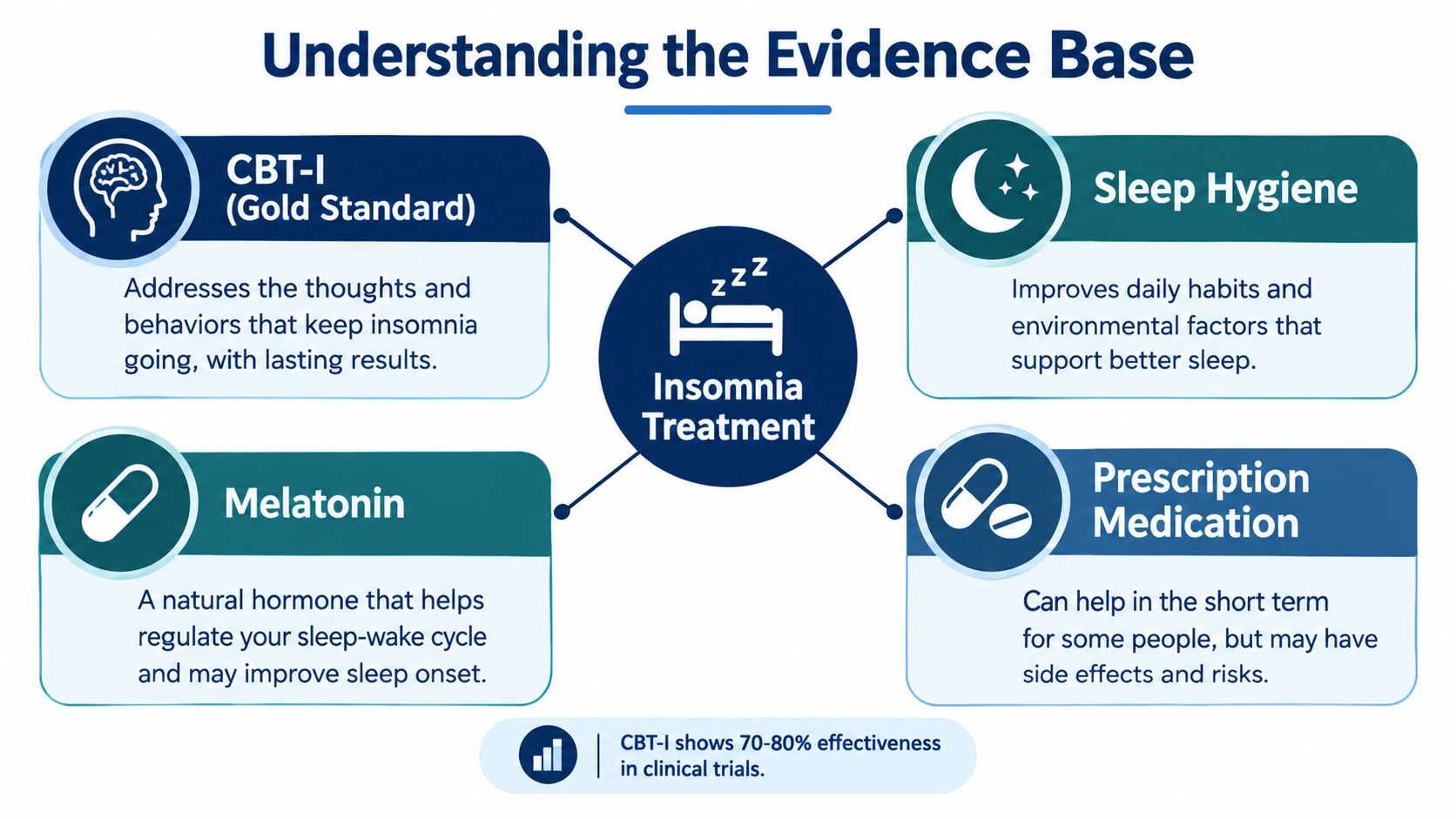
| Option | What it is best for | Main trade-off |
|---|---|---|
| CBT-I | Chronic insomnia, repeated awakenings, racing thoughts | Takes effort and structure |
| Sleep hygiene | General sleep habits and schedule support | Not enough as a standalone treatment for chronic insomnia |
| Melatonin | Circadian timing support, especially evening use | Weak fit for many maintenance problems |
| Prescription medication | Short-term symptom control when symptoms are severe | Side effects, tolerance, and phenotype-specific risks |
Table of Contents
- Understanding the Evidence Base for Insomnia Treatment Options
- Why Cognitive Behavioral Therapy Is the Guideline Standard
- Prescription Medications Compared by Insomnia Type
- The Melatonin Dilemma and Over-the-Counter Reality
- Supplement Options for Relaxation and Sleep Support
- Choosing the Right Insomnia Treatment Path for Your Pattern
Understanding the Evidence Base for Insomnia Treatment Options
Why the category is so crowded
Insomnia treatment options get grouped together because they all promise better sleep, yet they work through different mechanisms. Some aim to sedate, some retrain sleep behavior, and some mainly support timing or relaxation. That distinction matters most for adults whose problem is not just trouble falling asleep, but repeated waking or early-morning waking that did not improve with a sleeping pill.
The evidence base draws a clear line between chronic insomnia and short-lived sleep disruption. Chronic insomnia is the setting where guideline-based care matters most, because the problem is usually sustained by learned behaviors, conditioned arousal, and worry about sleep. In that context, sleep hygiene education can support the plan, but it does not function as a full treatment protocol.
Many adults search for the “best insomnia treatment,” when the more useful question is whether an option changes the mechanism keeping them awake.
Why the long view beats the quick fix
That long-view standard is why major guidance places CBT-I at the center of care. The American College of Physicians recommends it as the initial treatment for all adults with chronic insomnia, and the usual treatment model runs about 6 to 8 weeks with cognitive therapy, relaxation training, sleep education, stimulus control, and sleep restriction (NHLBI summary). The evidence reviewed for the ACP guideline found that CBT-I improved remission and treatment response compared with control conditions.
That same evidence base also found reductions in time spent awake after falling asleep compared with controls. Those findings matter because they point to durable change, not just night-to-night sedation. For readers comparing insomnia treatment options, that is the standard that should organize the rest of the decision.
What access looks like in practice
Access no longer means a sleep clinic visit or nothing at all. CBT-I can be delivered in person, by telephone, or online (NHLBI summary), which matters for adults balancing work, caregiving, menopause-related awakenings, or shift schedules. The question is not whether a format exists, it is whether the format retrains sleep enough to last longer than the short-term relief people get from sedating options.
For readers who want related practical context, sleep quality improvement is a useful adjacent topic, but quality improvement advice is not the same as a treatment plan. That difference is why the evidence base is easy to misread. Many adults look for the “best insomnia treatment,” when the more useful question is whether the option changes the mechanism keeping them awake.
Why Cognitive Behavioral Therapy Is the Guideline Standard
What CBT-I Changes
CBT-I is a structured intervention, not a bundle of generic sleep tips. It targets the thoughts and behaviors that keep insomnia going, including sleep anxiety, irregular bed timing, and spending too long awake in bed. In practice, that means stimulus control, sleep restriction or compression, cognitive restructuring, sleep education, and relaxation skills used as one plan rather than separate advice (ACP guideline).
Comparative randomized-trial evidence shows CBT-I typically shortens sleep-onset latency, increases total sleep time, and improves sleep efficiency. The more important point is durability. Across follow-up, those gains were generally sustained for months, while drug effects tended to fade (comparative effectiveness review). That pattern matters because it points to a change in the insomnia process, not just short-term sedation.
Racing thoughts at lights-out are one of the targets CBT-I addresses directly. For a consumer-side view of that problem, see how to sleep when your brain is racing.
Why Sleep Hygiene Alone Falls Short
That durability is why sleep-hygiene education does not sit on the same level as CBT-I for chronic insomnia. Sleep hygiene still has a role, especially for caffeine timing, light exposure, and routine regularity, but it does not challenge the conditioned pattern of wakefulness that chronic insomnia builds over time. Guidance based on the 2025 VA/DoD guideline advises against using sleep-hygiene education as a standalone intervention, which explains why many easy-fix guides leave readers stuck (VA/DoD-based provider guide).
CBT-I is not the most convenient option. It is the option that changes the problem chronic insomnia creates.
Who Needs Modification and Who Needs Evaluation
Digital or therapist-delivered CBT-I can include structured scheduling, cognitive work, and relaxation. Sleep restriction should be adapted carefully for people with bipolar disorder, seizure risk, severe sleep deprivation, or safety-critical jobs (AASM behavioral treatment guideline). That caution matters because a one-size-fits-all sleep plan can be risky in some situations. The therapy remains the foundation, but the details should be adjusted to the person, not forced into an internet template.
A common mistake is to treat CBT-I as a backup after supplements or medication fail. The evidence points the other way. For chronic insomnia, CBT-I is the benchmark that other insomnia treatment options should be measured against.
Prescription Medications Compared by Insomnia Type
Matching the drug to the symptom pattern
Prescription insomnia treatment options are not interchangeable. Someone who mainly cannot fall asleep has a different clinical problem from someone who wakes repeatedly during the night, and the trial data reflect that split. A large network meta-analysis found several benzodiazepines and nonbenzodiazepine hypnotics, including eszopiclone, zolpidem, zopiclone, and lemborexant, were more effective than placebo for acute insomnia, with standardized mean differences ranging from 0.36 to 0.83 (The Lancet).
The benefit comes with trade-offs. Benzodiazepines, eszopiclone, zolpidem, and zopiclone produced more reported side effects than placebo, while newer orexin antagonists showed a more favorable tolerability pattern in some comparisons (The Lancet). For clinical decisions, efficacy and burden have to be weighed together, not treated as separate questions.
How clinicians usually think about the main classes
Benzodiazepines can reduce acute distress, but they should not be treated as routine long-term solutions because of abuse, dependence, and adverse-effect risks (The Lancet). They fit poorly when tolerance, driving safety, or repeated dose escalation are major concerns. The more important question is whether a person needs temporary symptom control or a plan that reduces reliance on sedatives.
Nonbenzodiazepine hypnotics are often chosen for quick onset, but their usefulness depends on the symptom being targeted. They can help with sleep onset, and some agents have more maintenance coverage than others, but next-day impairment still matters, especially if the dose is taken late or combined with alcohol (FDA guidance on next-morning impairment). Orexin antagonists act through a different mechanism and may be better tolerated in some comparisons, which makes them relevant when classic sedatives are a poor fit.
For a concise consumer-facing overview of non-drowsy sleep aid, the key clinical point stays the same. If the main issue is awakenings rather than falling asleep, the medication choice should match that pattern instead of chasing sedation for its own sake.
Special cases that change the calculus
Low-dose doxepin is particularly suited to sleep-maintenance difficulty, while melatonin-receptor agonists and melatonin itself sit in a different category because they are not broad hypnotics (AASM pharmacologic treatment guideline). Safety also shifts with age, falls risk, respiratory disease, substance-use history, and driving demands. Those are not side issues, they are part of medication selection.
Supplements matter here too. Some over-the-counter sleep blends combine melatonin with ingredients such as St. John's Wort, which can interact with many prescription medicines. Sleep All Nite's Deep Rest, for example, contains 10 mg melatonin and St. John's Wort. That is a reminder that over-the-counter sleep products can create interaction issues when they are used alongside prescription treatment. Readers considering prescription options should bring every supplement to the same conversation, because interaction risk does not stop at the pharmacy counter.
The Melatonin Dilemma and Over-the-Counter Reality
Why more melatonin is not the answer
Melatonin is often treated like the universal answer to poor sleep, but that assumption breaks down quickly once the pattern is inspected. The American Academy of Sleep Medicine suggests that clinicians should not use melatonin for either sleep-onset or sleep-maintenance insomnia in adults, while the National Center for Complementary and Integrative Health notes that it may modestly improve time to fall asleep but does not reliably improve sleep quality or time awake during the night (NCCIH). That gap explains why people keep escalating dose and still wake at 3 a.m.
Melatonin is best understood as a timing signal, not a universal insomnia cure. If the underlying problem is a delayed body clock, evening use can fit the biology. If the problem is chronic insomnia with repeated awakenings, more melatonin usually just means more disappointment.
What to do when the night breaks at 3 a.m.
Melatonin belongs in the evening, before bed, not after a middle-of-the-night awakening. That detail matters because a 3 a.m. awakening often reflects something other than simple melatonin deficiency. Persistent awakenings can point to sleep apnea, restless legs syndrome, medication effects, alcohol-related disruption, or menopause-related symptoms, and those causes need evaluation instead of dose escalation.
The over-the-counter market gets misleading here. Products that are aimed at falling asleep are not built for sleep maintenance, and “more” is not necessarily better. The most useful next step is usually to decide whether the pattern looks more like circadian delay or chronic insomnia, then stop treating every wake-up as if it were the same problem.
Where the evidence lands on low-dose use
Low-dose melatonin can still have a place when timing is the issue and the dose stays modest, but it should not become a default night-after-night answer to every sleep complaint. For readers sorting through timing and dose questions, low-dose melatonin is the relevant consumer topic, not high-dose escalation. A product can be useful without being a treatment for chronic insomnia.
The larger clinical point is simple. If sleep is broken by repeated wake-ups, or if the awake period is the part that causes distress, the better comparison is not “which melatonin should be tried next.” The better comparison is whether the person needs CBT-I, medical evaluation, or a different symptom-matched approach entirely.
Supplement Options for Relaxation and Sleep Support
What supplements can and cannot do
Supplement options sit in a narrower lane than prescription treatment or CBT-I. They can support winding down, but they should not be framed as cures for insomnia. That distinction matters because a calm evening routine and a clinical treatment plan solve different problems.
Magnesium is often chosen when the body feels tense or wired. Botanicals such as valerian, chamomile, passion flower, and lemon balm are commonly used for relaxation support, while L-theanine and GABA are often selected for a calmer wind-down. The challenge is not naming ingredients, it is matching them to the reason sleep feels hard.
How to think about form and use case
A melatonin-free option can make sense for readers who are avoiding circadian signaling and only want a wind-down aid. For example, Deep Calm is a melatonin-free capsule with 275 mg of magnesium per serving, made to complement a nighttime routine and support a sense of calm rather than act as a bedtime hormone product.* That kind of structure is useful for adults who want a simpler supplement profile and prefer to keep melatonin separate from their routine.
Safety note: herbal blends are not neutral just because they're over the counter. They still deserve a medication review when a person uses prescription drugs, is pregnant, or manages a medical condition.
Consumers also need to think about consistency and quality. A supplement that feels soothing one night and irrelevant the next is not unusual, because these products vary in ingredient profile, dose, and intended use. The smart question is not “does it work for insomnia,” but “does it support a bedtime routine without creating new risks or masking a problem that needs evaluation?”
Choosing the Right Insomnia Treatment Path for Your Pattern
Match the path to the pattern, not the label
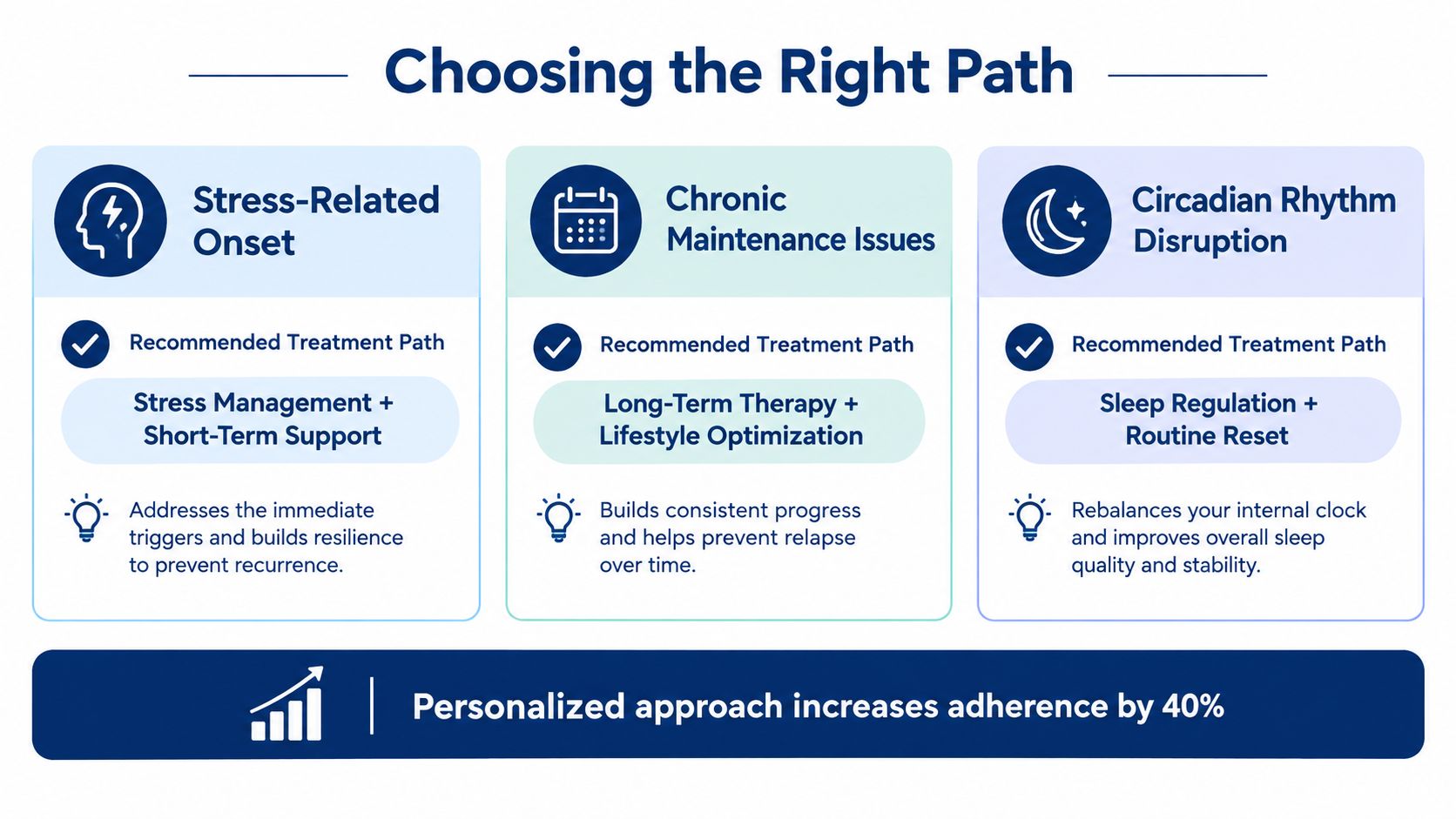
A person who lies awake from racing thoughts is not starting from the same place as someone who falls asleep easily but wakes at 3 a.m. or someone whose sleep shifted after schedule changes. That is why insomnia treatment options work better as a stepped-care menu than as one all-purpose ranking. The pattern should decide the first move.
If the main issue is chronic insomnia, CBT-I belongs first because it changes the sleep system rather than forcing sedation (ACP guideline). If the main issue is a short-term flare with severe symptoms, a clinician may choose a time-limited medication bridge while behavioral treatment is built in. If the pattern looks circadian, timing support matters more than a generic hypnotic.
A simple decision frame
- Trouble falling asleep: CBT-I first, then consider whether a short-term medication or a supportive evening routine is needed.
- Repeated awakenings: look harder at medical contributors, maintenance-focused treatment, and behavioral retraining rather than repeated dose escalation.
- Racing mind or stress: behavioral strategies, relaxation work, and structured wind-down support usually belong ahead of sedating products.
- Shift or clock disruption: timing, light, and schedule alignment matter more than a single bedtime pill.
A product can still be part of a routine when the goal is support rather than treatment. Sleep All Nite offers different formats and ingredient amounts for people comparing melatonin and melatonin-free options, which can help narrow what fits a bedtime routine. That comparison is still secondary to clinical evaluation when symptoms are persistent, severe, or changing.
When to escalate to a clinician
Persistent early-morning waking in midlife women deserves a closer look, especially when it comes with hot flashes, mood changes, medication effects, or symptoms that suggest another sleep disorder. The same is true when insomnia is paired with daytime impairment, snoring, restless legs, panic, substance use, or worsening mood. Those patterns are not proof that the problem is serious, but they are enough to justify evaluation.
The useful conclusion is not that one insomnia treatment option beats every other option in every situation. It is that CBT-I is the evidence-based foundation, medication is symptom-specific, and supplements are best treated as support tools within a broader plan. Readers who want help comparing formats and ingredient amounts can review the Sleep All Nite catalog, then bring the shortlist to a healthcare professional before starting anything new.
*These statements have not been evaluated by the Food and Drug Administration. These products are not intended to diagnose, treat, cure, or prevent any disease.
This article is for general education and isn't medical advice. Talk with a healthcare professional before starting a supplement, especially if you're pregnant or nursing, under 18, managing a medical condition, or taking prescription medication.


