
Melatonin Gummies for Adults: Dosing and Safety


The advice to choose a stronger gummy when sleep doesn't improve skips an important question: how much melatonin is being taken? Melatonin gummies for adults aren't automatically mild because they're chewable, and a larger number on the bottle isn't proof of a better choice. A careful decision starts with the serving size, the reliability of the label, and whether melatonin fits the sleep problem at all.
Table of Contents
- Why Gummy Melatonin Needs a Closer Look
- What Melatonin Gummies for Adults Are
- How to Choose a Low Starting Dose
- Compare Gummies, Strips, Capsules, and Free Options
- Verify the Label Before You Trust the Number
- Check Safety, Interactions, and Timing
- Make a Careful Format and Dose Decision
Why Gummy Melatonin Needs a Closer Look
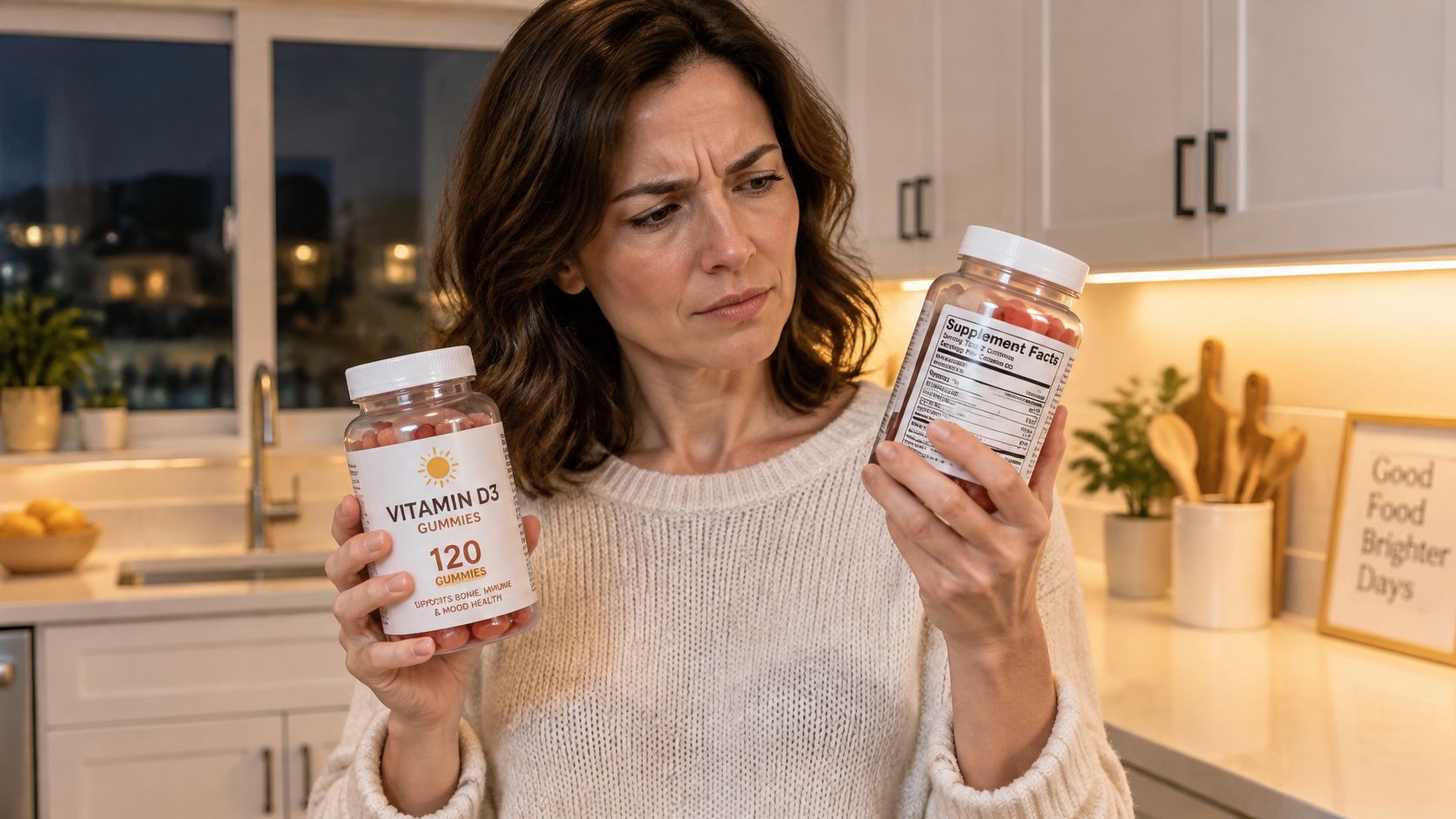
An adult reaches for a sweet gummy because the number on the front looks reassuring. Later, the back label reveals that the listed amount applies to a serving rather than an individual gummy. After an uncomfortable morning, it's hard to separate the effects of the amount taken, the timing, and other ingredients.
That's a representative situation, not a reported case. It illustrates why convenience shouldn't replace the questions normally asked about a supplement.
Popularity doesn't establish the right dose
National Health and Nutrition Examination Survey data showed reported adult melatonin use rising from 0.4% in 1999–2000 to 2.1% in 2017–2018, according to the NIH summary of adult melatonin use. That increase describes use, not proof that every product or amount is appropriate.
The useful distinction isn't between a weak gummy and a strong gummy. It's between a clearly understood serving and an uncertain exposure.
- Amount: The front label and Supplement Facts panel need to be read together.
- Format: A pleasant taste doesn't establish a gentle physiological effect.
- Purpose: A bedtime supplement shouldn't become an automatic response to every difficult night.
- Response: Morning functioning matters alongside any perceived nighttime benefit.
A better question than whether stronger is better
The more useful question is whether a particular amount, taken at an appropriate time, produces a worthwhile result without unwanted effects. The guide to too much melatonin provides related context for adults reconsidering higher-dose products.
For ordinary bedtime use, melatonin belongs in the evening, before bed, not as an extra dose after a night waking. A gummy should never be treated as candy or an invitation to keep taking more until sleep arrives.
What Melatonin Gummies for Adults Are
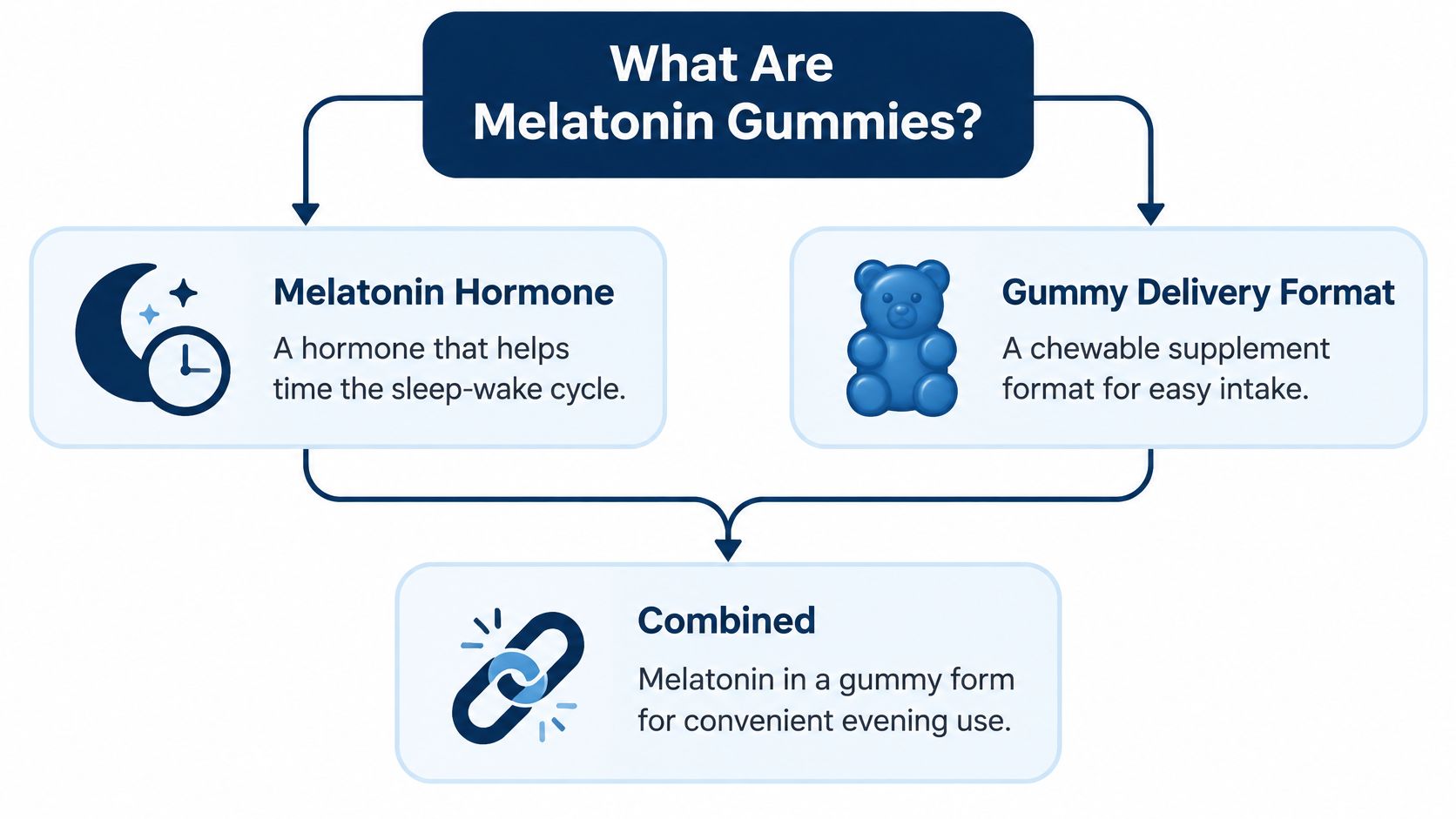
Melatonin gummies combine an active ingredient with a chewable delivery format. Those are separate features: melatonin determines the ingredient being taken, while the gummy determines how it's delivered.
The distinction matters because changing the texture doesn't turn melatonin into a different substance. It also doesn't establish that the product is suitable for every kind of sleep difficulty.
The concept map separates the hormone from its delivery format.
Melatonin is a timing signal
Melatonin is a hormone involved in the sleep-wake cycle. A useful analogy is a scheduling signal: it helps communicate biological nighttime rather than operating like a switch that guarantees unconsciousness.
That analogy also explains an important limit. A signal about timing isn't the same as an answer to every reason an adult might have difficulty sleeping.
A sleep-timing signal and a guaranteed night of sleep aren't the same thing.
What the gummy format changes
After a gummy is chewed and swallowed, melatonin must be absorbed and processed. The amount swallowed isn't identical to the amount that reaches circulation: melatonin's bioavailability varies widely, from roughly 1% to 74%, likely depending on formulation and dose, as described in the NCBI clinical overview of melatonin.
Those figures aren't instructions for calculating a replacement dose. They help explain why the same labeled amount doesn't necessarily produce an identical response in every adult.
A chewable format can suit someone who dislikes capsules, but the texture may also make repeat consumption easier to overlook. Portion control still depends on the directions, not the size or sweetness of the gummy.
What a personal trial can establish
A carefully observed trial can help an adult describe whether sleep timing or morning functioning changed. It can't independently establish the product's potency, prove a hormone deficiency, or identify the cause of an ongoing sleep complaint.
A useful record distinguishes the intended result from unwanted effects. Falling asleep somewhat earlier, feeling unchanged, and waking groggy are different observations, and none should automatically trigger a larger serving.
How to Choose a Low Starting Dose
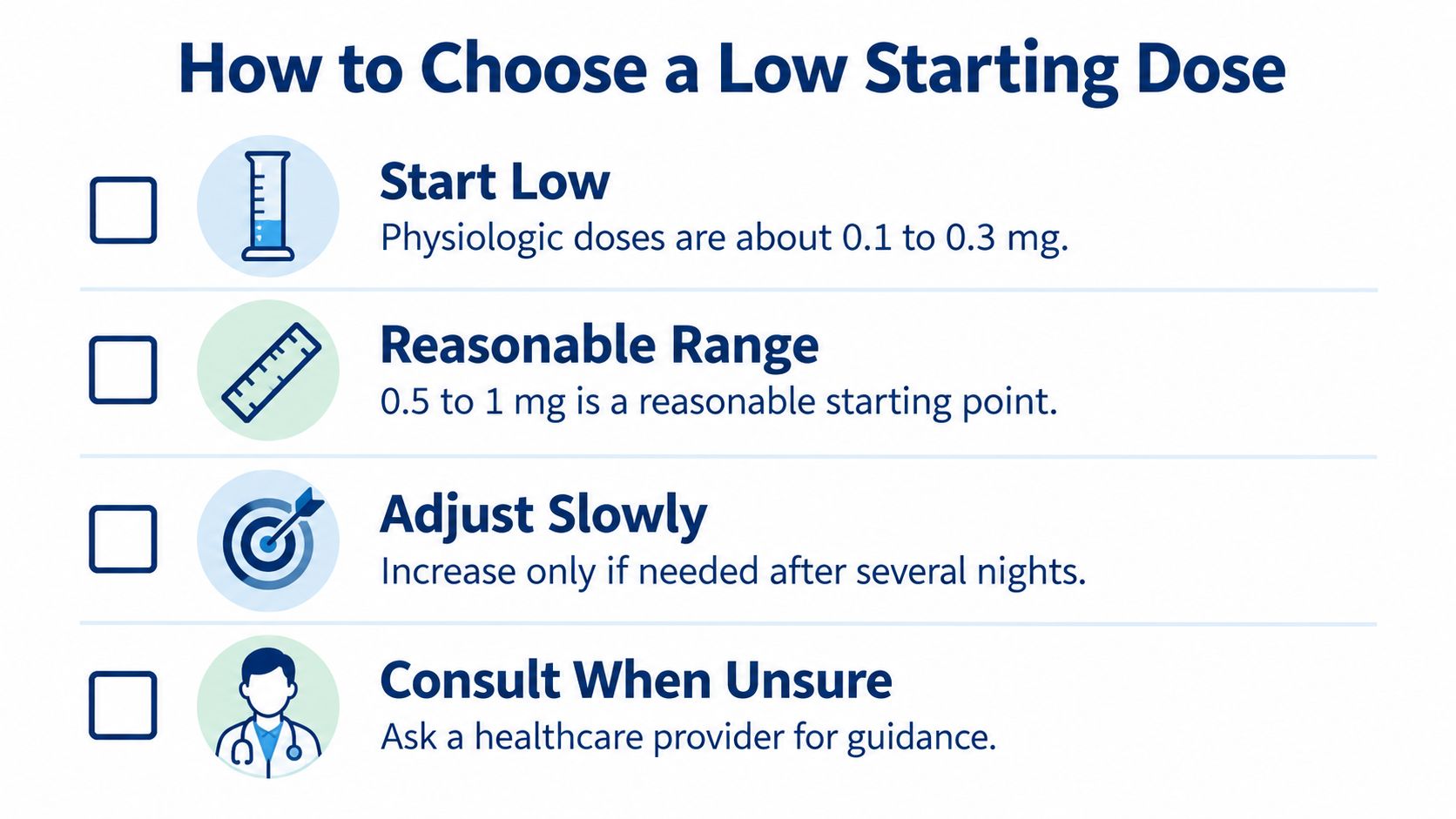
A low-first approach is more defensible than choosing the largest milligram number available. However, there isn't a universally established effective adult dose, and the absence of an established maximum shouldn't be interpreted as permission for unrestricted use.
The practical starting point is a conversation about the smallest suitable labeled amount, not a contest between high-strength bottles. The discussion of low-dose melatonin offers additional context for understanding that distinction.
The checklist below illustrates the low-first approach. Its numerical examples aren't a personalized prescription, and dose changes deserve more consideration than a quick reaction to a disappointing night.
Separate the amount from the timing
Dose and timing answer different questions. The amount describes exposure; timing describes when that exposure occurs relative to intended sleep.
For an immediate-release product, the plan should account for when the ingredient becomes available rather than assuming that chewing means an instant effect. A clinician or pharmacist can help interpret the product's directions without turning a general bedtime recommendation into a universal schedule.
An adult who changes the amount, bedtime, and other supplements together may struggle to interpret the result. A clearer approach keeps a simple record and avoids making several changes at once.
Readiness checklist before a trial
The following details belong on the same page, whether that's a notebook or a phone note:
- Melatonin per serving: Record the amount from the Supplement Facts panel, not just the front of the package.
- Gummies per serving: Identify how many pieces make up that stated amount.
- Total planned intake: Include every supplement containing melatonin.
- Other ingredients: Note botanicals and other active ingredients rather than treating the product as melatonin alone.
- Alcohol and sedatives: Flag combinations for professional review instead of experimenting casually.
- Morning responsibilities: Consider driving, caregiving, work, and other activities requiring alertness.
- Reassessment point: Decide when the trial will be reviewed rather than allowing automatic, indefinite use.
An unsatisfactory night isn't enough information to justify escalation. It may reflect an unsuitable timing plan, a product-quality question, or a sleep problem that needs a different assessment.
The accompanying video provides another format for considering these dose questions.
Practical rule: A dose decision should include the following morning, not just the moment a supplement is taken.
If an adult feels impaired afterward, the response shouldn't be to push through or add another sleep product. That experience is a reason to pause and obtain guidance.
Compare Gummies, Strips, Capsules, and Free Options
Before comparing purchases, an adult can choose free changes that make an evening less complicated. Options include writing down unfinished tasks, reducing avoidable interruptions, or choosing a repeatable wind-down activity.
These are choices, not prerequisites for earning good sleep. A household with caregiving demands, shared rooms, or rotating schedules may need a flexible menu rather than a rigid routine.
Compare Sleep Supplement Formats
| Format | Melatonin Status | Water Needed | Key Label Check | Best-Fit Consideration |
|---|---|---|---|---|
| Traditional melatonin gummies | Contains melatonin | Usually taken without water | Amount per serving and pieces per serving | A chewable option for adults who dislike pills |
| Dissolvable oral strips | Depends on the formula | Generally no water when designed to dissolve on the tongue | Amount per strip and all added ingredients | A dissolving format rather than a swallowed capsule |
| Conventional capsules | Depends on the formula | Generally taken with water | Amount per capsule versus full serving | Adults comfortable swallowing capsules |
| Melatonin-free gummies | No melatonin when accurately labeled | Usually taken without water | Every active ingredient and its amount | Adults seeking a chewable format without melatonin |
| Free routine options | No supplement | Not applicable | No ingredient label | Adults preferring to begin without a purchase |
Format alone doesn't establish release characteristics. A gummy shouldn't automatically be assumed to work faster, and a capsule shouldn't automatically be assumed to release its contents gradually.
Sleep All Nite doesn't sell a melatonin gummy. For a chewable option without melatonin, Nite Bites are melatonin-free blackberry gummies containing reishi extract, L-theanine, lemon balm, passion flower, and valerian root, offered for winding-down support.* For a low labeled melatonin amount in a format that needs no water, Drift Off oral strips contain 1 mg of melatonin per strip.
Compare expectations before comparing packaging
A meta-analysis of 19 randomized trials involving 1,683 participants found that melatonin reduced sleep-onset latency by about 7.06 minutes and increased total sleep time by about 8.25 minutes compared with placebo. Those statistically significant averages were modest, and they don't establish that a particular gummy or delivery format will produce the same result.
The useful comparison therefore includes the evidence, not just the convenience of chewing, dissolving, or swallowing. A different format may fit a preference without establishing greater effectiveness.
- For swallowing preferences: A chewable or dissolving product may be easier to take.
- For ingredient simplicity: Compare the entire formula rather than focusing only on melatonin.
- For avoiding melatonin: Confirm that the product is explicitly melatonin-free.
- For reducing complexity: Choosing no supplement remains a valid option.
Melatonin-free doesn't mean interaction-free or suitable for everyone. The broader comparison of sleep-support supplements can help frame ingredient questions without treating any format as universally preferable.
Verify the Label Before You Trust the Number
A gummy label is a starting point, not independent proof of its contents. It resembles a printed map: the directions are useful only if the scale is reliable.
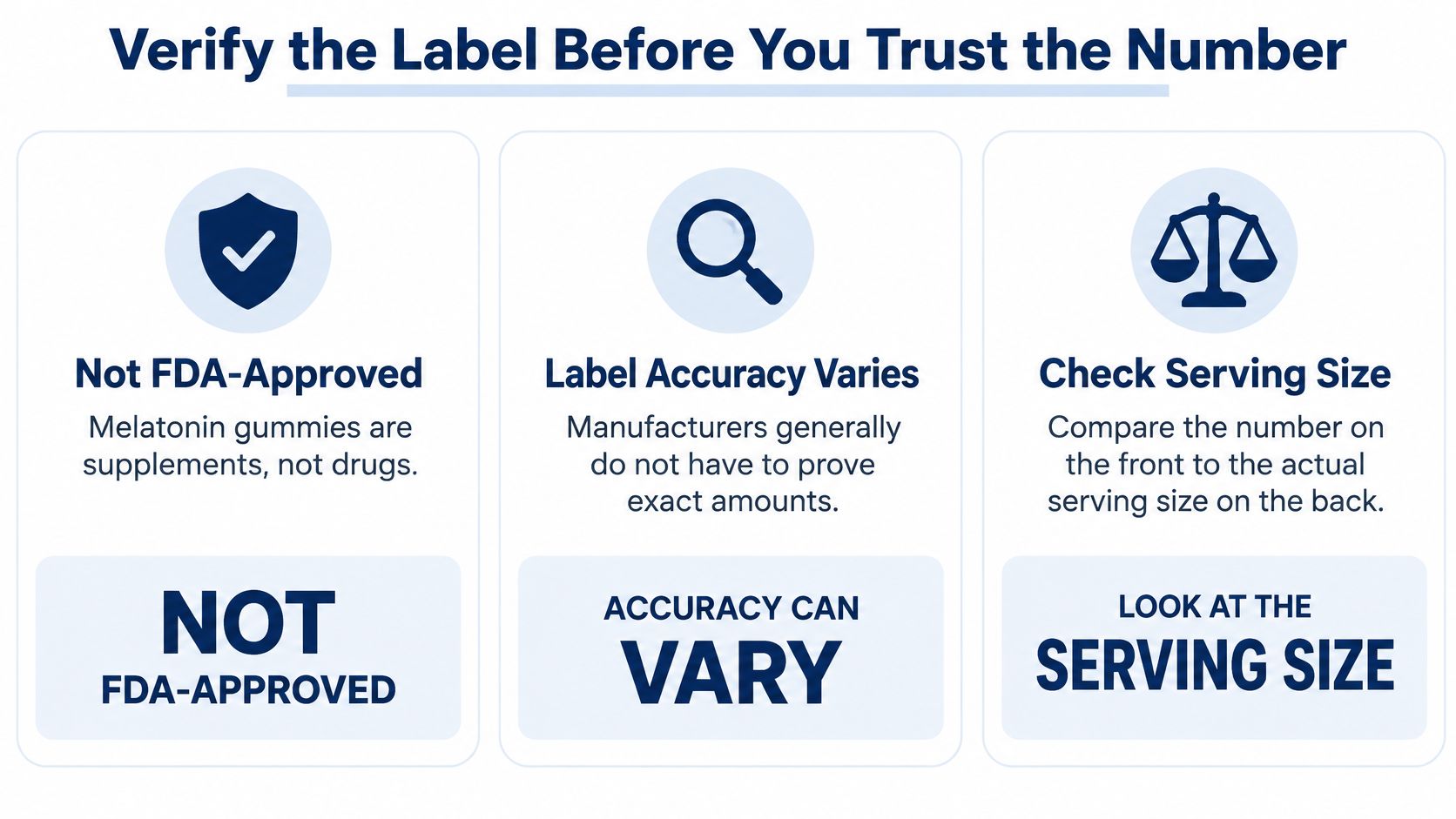
In the United States, melatonin is regulated as a dietary supplement rather than an approved drug. Manufacturers generally don't have to demonstrate a supplement's safety and effectiveness to the FDA before marketing it, as explained in the NCCIH guide to melatonin.
The label-verification graphic highlights the difference between a printed claim and established product quality.
What laboratory testing found
In a laboratory analysis published in JAMA, 22 of 25 U.S. melatonin gummy products were inaccurately labeled, and measured melatonin ranged from 74% to 347% of the declared amount.
The study doesn't prove that every gummy currently sold is inaccurate. It does show why a reassuring milligram number can't substitute for documented quality controls.
For an adult deliberately choosing a smaller amount, this distinction is especially important. A low label claim and a verified low amount aren't interchangeable.
Questions worth asking a manufacturer
A useful quality inquiry goes beyond whether a company says that it tests products.
- Finished-product testing: Does testing cover the gummies sold to consumers, rather than only a raw ingredient?
- Lot identification: Can the test report be matched to the lot printed on the container?
- Potency results: Does the documentation report measured melatonin rather than merely confirming its presence?
- Acceptance criteria: What range does the manufacturer consider acceptable around the label claim?
- Shelf-life controls: What evidence supports the stated amount through expiration?
- Independent verification: Who performed the testing, and what exactly was tested?
A certificate of analysis can help answer those questions when it identifies the relevant finished-product lot and meaningful results. A generic document, an unrelated lot, or a broad testing badge provides less useful information.
The strongest label question isn't “How large is the number?” It's “What evidence supports that number?”
The serving information also needs to remain understandable after purchase. Servings per container, pieces per serving, and melatonin per serving should fit together without guesswork.
Combining gummies with a separate melatonin capsule or strip creates another source of uncertainty. Even clearly labeled products become harder to evaluate when an adult overlooks overlapping ingredients or forgets an earlier serving.
Check Safety, Interactions, and Timing
Safety depends on more than whether melatonin is available without a prescription. A responsible trial includes a medication review, a plan for unwanted effects, and secure storage.
Short-term melatonin use appears relatively safe, but long-term safety has not been established. The Mayo Clinic discussion of melatonin side effects and interactions also identifies medication combinations that warrant professional review.
Side effects and next-day functioning
Possible unwanted effects include drowsiness, headache, nausea, and next-day grogginess. These effects aren't inevitable, but they matter when deciding whether continued self-directed use makes sense.
Reduced alertness, confusion, or disorientation should never be dismissed as evidence that a supplement is working strongly. An adult who feels impaired shouldn't drive or perform hazardous tasks.
A simple record can distinguish several observations:
- Sleep onset: Whether falling asleep seemed easier, harder, or unchanged.
- Nighttime experience: Whether awakenings or other symptoms changed.
- Morning function: Whether alertness, balance, concentration, or ordinary responsibilities were affected.
- Timing details: When the serving was taken relative to intended sleep.
The discussion of melatonin timing for sleep offers further context for planning use rather than reacting to a difficult night.
Medication checks before starting
A pharmacist or clinician should review melatonin use alongside anticoagulants, seizure medicines, blood-pressure medicines, diabetes medicines, immunosuppressants, and other sedating drugs. A full list should include nonprescription products and supplements, not just prescriptions.
Alcohol and sleep-inducing products shouldn't be combined casually with melatonin. Adding several ingredients makes both safety assessment and interpretation of unwanted effects more difficult.
A useful question for the pharmacist is whether the proposed combination is appropriate and whether any existing medicine could contribute to the sleep complaint. Prescription treatment shouldn't be stopped or adjusted to accommodate a gummy without professional advice.
Pregnancy, nursing, and medical conditions
Pregnant or nursing adults shouldn't self-direct melatonin use. People managing a medical condition also need individualized advice rather than relying on another adult's experience or a general online dose suggestion.
The same caution applies to anyone under 18. An adult-focused label doesn't establish suitability for a child or adolescent.
Safe storage remains essential
A CDC report recorded 260,435 pediatric melatonin ingestions reported to U.S. poison control centers from 2012 through 2021, with about 1.6% involving more serious outcomes. Those findings concern children, not the rate of adverse effects among adult users.
Nevertheless, candy-like products deserve deliberate storage. Gummies should remain in their original labeled packaging, secured out of children's reach and sight, preferably with child-resistant packaging.
When self-directed use should stop
Persistent or worsening sleep trouble deserves assessment rather than indefinite dose adjustment. Recurrent awakenings, substantial daytime impairment, and suspected medication effects are reasons to seek clinical advice.
A clinician can assess whether the complaint involves insomnia, sleep apnea, anxiety, perimenopausal symptoms, or another underlying issue. None can be identified by whether a gummy seems to help on a particular night.
Make a Careful Format and Dose Decision
The most useful decision begins with a clear description of the problem. Difficulty becoming sleepy at the intended bedtime is different from repeated awakenings, an irregular work schedule, or feeling exhausted despite adequate opportunity to sleep.
The American Academy of Sleep Medicine suggests that clinicians not use melatonin to treat sleep-onset or sleep-maintenance insomnia in adults, while distinguishing chronic insomnia from certain circadian-timing disorders in its clinical practice guideline. That distinction helps prevent a timing-related tool from becoming a default response to every sleep complaint.
A decision that accounts for uncertainty
A practical sequence combines the earlier dose, label, and safety questions without assuming that a purchase is necessary.
- Define the intended purpose: Describe the difficulty in ordinary language before selecting an ingredient.
- Set an appropriate schedule: Avoid self-directed morning dosing or rescue dosing during the night; unusual schedules warrant individual advice.
- Choose conservatively: Favor a low-first discussion rather than assuming that a larger amount provides greater benefit.
- Verify the product: Check the serving instructions and available lot-specific documentation.
- Account for the whole formula: Include overlapping melatonin sources and other active ingredients.
- Match the format to preferences: Consider chewing, swallowing, and access to water without assuming a format guarantees effectiveness.
- Plan reassessment: Agree on a defined trial and review both nighttime observations and daytime functioning.
When professional guidance comes first
People who are pregnant or nursing, under 18, managing a medical condition, or taking prescription medication shouldn't self-direct use. Persistent insomnia also belongs in a healthcare conversation, not an escalating supplement experiment.
A careful choice can also be a decision not to take melatonin. If the purpose is unclear, the label can't be verified, or unwanted effects outweigh any perceived benefit, choosing another bottle isn't the only next step.
The goal is an understandable decision with realistic expectations. A convenient format matters only after the ingredient, amount, and intended use make sense.
Sleep All Nite offers melatonin-free gummies, plus oral strips and capsules with labeled melatonin amounts. Adults comparing formats and ingredient amounts can visit Sleep All Nite and review any proposed supplement with a healthcare professional before starting.
*These statements have not been evaluated by the Food and Drug Administration. These products are not intended to diagnose, treat, cure, or prevent any disease.
This article is for general education and isn't medical advice. Talk with a healthcare professional before starting a supplement, especially if you're pregnant or nursing, under 18, managing a medical condition, or taking prescription medication.


