
How to Fix My Sleep Schedule with Light and Timing


A late bedtime, a groggy morning, and an early bedtime that turns into hours of staring at the ceiling can make a sleep schedule feel impossible to change. The instinct is often to force sleep earlier, but an earlier lights-out time by itself doesn't reset the body clock.
A more practical starting point is a consistent wake time, paired with well-timed light and gradual bedtime changes. For anyone wondering how to fix a sleep schedule, the aim isn't to produce one perfect night. It's to give the body repeatable timing cues while protecting enough opportunity for sleep.
Table of Contents
- Start With a Stable Wake Time
- Build Your Circadian Reset Plan
- Use Light to Move Your Sleep Earlier
- Time Melatonin Instead of Escalating It
- Tune Naps, Caffeine, and Alcohol
- Adapt the Reset for Work and Life Changes
- Troubleshoot Progress and Know When to Seek Help
Start With a Stable Wake Time
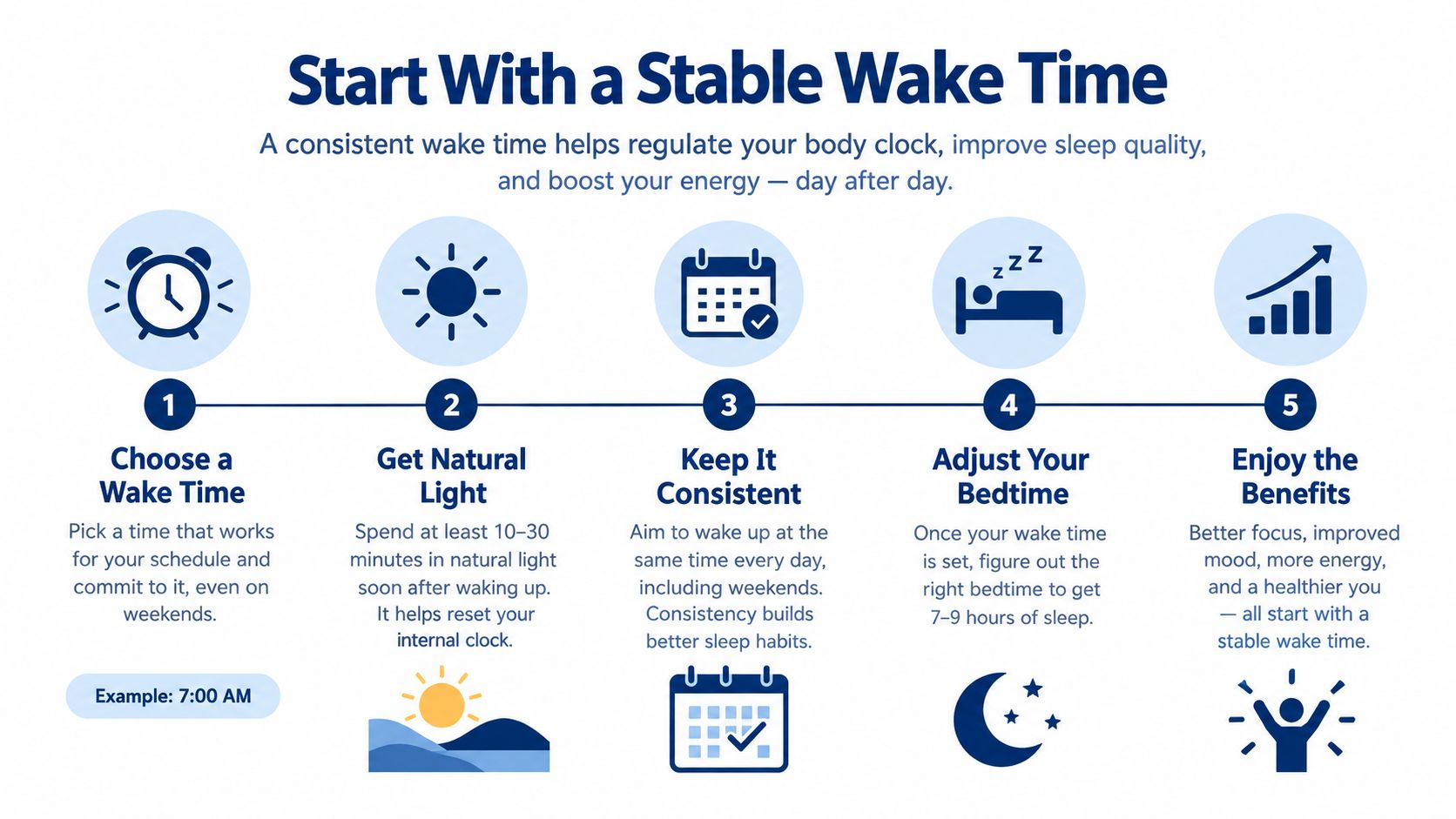
A familiar cycle goes like this: bedtime slips later, the morning alarm feels brutal, and the next night brings an attempt to get into bed much earlier. But if the body isn't sleepy yet, an early bedtime may mean more time awake in bed, not more sleep. A steady morning rise time is a more useful place to begin. CDC/NIOSH sleep guidance recommends going to bed and getting up at about the same times every day, including days off, which makes a consistent wake time a practical anchor for resetting a disrupted sleep schedule.
Start by observing the current pattern rather than guessing what needs to change. For seven days, record when the person gets into bed, an estimate of when sleep begins, any noticeable awakenings, the final wake time, and daytime sleepiness. This simple diary can show whether the problem is mainly late timing, an inconsistent morning, or frequent waking that needs more than a schedule adjustment.
Choose a wake time the body can keep
A useful wake time needs to fit work, caregiving, and other daily responsibilities while leaving enough time for sleep. It should be realistic on weekdays and weekends, not an ambitious time that lasts only a few mornings. If sleeping until late morning on days off is part of the current pattern, shifting toward a more consistent morning can feel uncomfortable at first, but a long lie-in may make the next night's sleepiness arrive later.
Consider someone who usually falls asleep around 2 a.m. and wants an earlier schedule. Rather than abruptly choosing an early bedtime and expecting sleep to follow, the person can begin by keeping a sustainable wake time steady, then make gradual adjustments to bedtime when sleepiness starts arriving earlier. The diary helps reveal whether that change is improving timing or just cutting sleep short.
The first target is repeatability, not an early bedtime. A steady morning gives the next decisions a clearer foundation.
A poor night doesn't mean the plan has failed. The useful question is whether the wake time and other cues stay reasonably consistent over time, not whether every night goes perfectly.
Build Your Circadian Reset Plan
A reset works best as a series of manageable adjustments, so start small rather than jumping from a late schedule straight to an idealized one. First, use the sleep diary to see when sleep usually happens and how the morning unfolds. Then choose a sustainable rise time and protect enough time for sleep around it. CDC/NIOSH training material on sleep and shift work notes that the body's clock works best when you get up at about the same time every day. From that anchor, bedtime can move earlier in small steps, such as 15 to 30 minutes at a time, as sleepiness starts arriving earlier.
Let sleepiness guide the bedtime shift
Two people can share the same wake time but need different approaches to bedtime. Someone who already feels sleepy around 10:30 p.m. may be able to start settling down then, provided the wake time allows enough sleep. Someone who doesn't feel sleepy until 2 a.m. may need smaller, slower changes. Getting into bed much earlier while wide awake can create long stretches of wakefulness and frustration.
When sleepiness begins to arrive earlier and waking feels manageable, bedtime can move earlier in small steps. The diary can show whether that shift is working: sleep begins earlier, wake time remains stable, and daytime alertness is acceptable. If the person is spending less time asleep, or getting increasingly sleepy during the day, the change may be too aggressive.
A practical weekly rhythm can stay simple:
- Keep the morning steady. Use the same wake time on workdays and days off as consistently as circumstances allow.
- Follow the diary, not an ideal bedtime. Look for a pattern in sleep onset and waking before making another adjustment.
- Shift gradually. Move bedtime earlier in small increments only when the current timing is becoming comfortable.
- Review the result. If sleep is getting shorter or daytime sleepiness is worsening, pause the shift and reconsider the plan.
A common mistake is to copy clinician-led sleep restriction, a structured insomnia treatment, by sharply cutting time in bed without professional guidance. That approach is not a casual schedule-reset shortcut. Gradual timing changes are the safer home approach, and extra caution is important for people with safety-sensitive jobs or severe daytime sleepiness. For practical ideas on habits and tracking, the guide to improving sleep quality offers related reading.
Use Light to Move Your Sleep Earlier

Light is more than a screen issue. It's a timing cue for the sleep-wake cycle, so when the eyes receive bright light matters as much as whether screens are used. The National Heart, Lung, and Blood Institute identifies light as the strongest environmental signal for resetting this cycle and recommends morning light-box exposure when shifting sleep and wake times earlier.
Make mornings brighter and evenings calmer
A free, simple place to start is outdoor light soon after waking. A short walk, time outside with a morning drink, or another practical way to be outdoors can pair light with the consistent wake time. If going outside isn't realistic, keeping the daytime space bright can still make the morning-to-evening contrast more noticeable. No special gadget is required to try the outdoor-light option.
Evening lighting can move in the opposite direction. Dimming overhead lights, choosing lower screen brightness, and reducing bright electronic light as bedtime approaches can make the home environment less stimulating. A dark bedroom supports the nighttime part of the routine, while morning brightness reinforces the start of the day.
A light box may be an option for someone who needs help shifting earlier, but its use should be discussed with a healthcare professional rather than treated as a one-size-fits-all prescription. People with eye conditions or taking photosensitizing medications should ask a professional before using bright-light therapy.
This video provides another overview of circadian timing and light cues.
The difference between two evenings can be modest but meaningful. In one, a person works under bright overhead lights, scrolls on a bright screen in bed, and tries to sleep before feeling drowsy. In the other, the person keeps the wake time, dims the room as evening progresses, and lets bedtime follow gradually shifting sleepiness. Light works best as part of that repeated pattern, not as an isolated fix.
Time Melatonin Instead of Escalating It
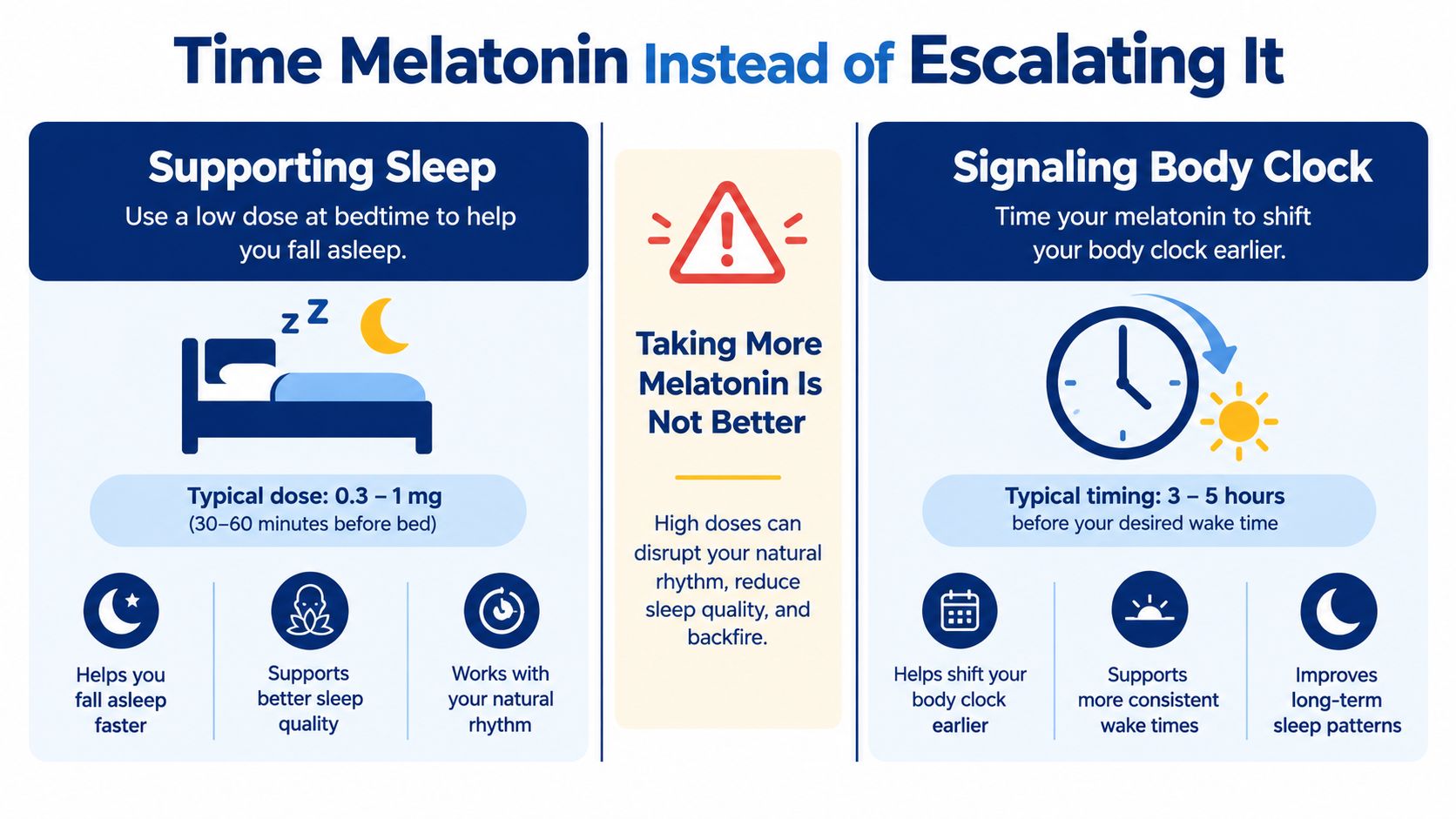
Melatonin can be confusing because it's used in two different ways: as part of an evening bedtime routine and as a signal that may shift body-clock timing. Those are not interchangeable. A larger amount doesn't automatically move a delayed schedule earlier, and taking it at the wrong time may not support the intended shift.
Melatonin administration windows commonly range from 15 minutes to two hours before sleep, while circadian approaches may use substantially earlier timing; the relationship between timing and dose remains underexplored, according to a scoping review of systematic reviews from University of Oxford researchers. That distinction matters because bedtime support and clock shifting aren't the same goal.
Dose and timing are separate questions
Physiologic melatonin doses are about 0.1 to 0.3 mg, and a reasonable low starting range is often described as 0.5 to 1 mg, as covered in our low-dose melatonin guide. A systematic review of melatonin pharmacokinetics found that oral bioavailability averages about 15%, ranging from roughly 9% to 33% across studies, and that immediate-release melatonin typically peaks in about 50 minutes. These figures aren't personalized dosing instructions. They illustrate why a person shouldn't assume that taking more will work better or correct an underlying timing problem.
For a bedtime routine, a product may be taken before the intended sleep time according to its label. For example, Drift Off is a raspberry oral strip that dissolves on the tongue without water and contains 1 mg melatonin with valerian root, lavender, chamomile, and hibiscus; its label directs one strip any time before bed, with a maximum of one strip per day. This is a format and ingredient description, not a promise that it will reset a body clock.
For circadian advancement, earlier timing may be considered, but the appropriate timing depends on the person's sleep pattern, light exposure, and desired shift. The Learn guides on low-dose melatonin, melatonin timing, and taking too much melatonin explore those questions further.
Melatonin belongs in the evening before bed. It shouldn't be taken after waking during the night. Persistent insomnia, pregnancy, medication interactions, bipolar disorder, or suspected sleep apnea are reasons to talk with a healthcare professional before using it or changing its timing.
Tune Naps, Caffeine, and Alcohol
A new bedtime can be undermined by daytime choices that change how sleepy a person feels at night. A nap may be useful when sleepiness is interfering with safe functioning, but a late or prolonged nap can leave less sleep pressure at bedtime. Caffeine timing can also matter, while alcohol may make someone feel sleepy initially without guaranteeing an uninterrupted night.
Think of these choices as a menu of experiments rather than a rigid routine. A person can try moving a nap earlier, keeping caffeine earlier in the day, or observing whether evening alcohol coincides with more awakenings. The important part is to track the pattern instead of making a conclusion from one night.
Follow the pattern, not one rough night
Consider a person who moves bedtime earlier but still drinks coffee late in the day and takes a long nap at 4 p.m. If sleep doesn't arrive at the new bedtime, it may not mean that the earlier schedule is impossible. The late caffeine and nap are two variables worth recording before making another change.
A useful diary can include:
- Caffeine and alcohol. Note whether either appeared that day and roughly when.
- Naps. Record the timing and whether the nap seemed short or prolonged.
- Light exposure. Note outdoor morning light and bright evening lighting.
- Sleep timing and alertness. Track bedtime, estimated sleep onset, final waking, and next-day sleepiness.
When the pattern is unclear, change one variable at a time. Changing the bedtime, nap habits, caffeine, alcohol, and lighting all at once makes it difficult to tell what influenced the result. A single poor night also isn't enough to establish a cause.
If a person wakes during the night, adding a dose of melatonin then isn't the answer. Melatonin belongs in the evening before bed, not as a response to waking. A calm, low-stimulation activity away from bed can be more appropriate if wakefulness persists, while repeated or distressing awakenings deserve a broader look.
For someone who prefers a chewable format while winding down, Nite Bites are blackberry gummies containing reishi extract, L-theanine, lemon balm, passion flower, and valerian root; the stated use is one to two gummies daily. They're melatonin-free, but no supplement replaces a consistent schedule or evaluation of persistent sleep problems.
Adapt the Reset for Work and Life Changes
A daytime schedule isn't a universal template. Work hours, changing responsibilities, and changing sleep patterns can all affect what a realistic anchor looks like. The basic idea is to use repeatable timing cues, but the cues need to fit the person's actual life rather than an assumed daytime routine.
| Situation | What needs adapting | A practical direction |
|---|---|---|
| Stable daytime schedule | Morning rise time and evening wind-down | Keep the morning anchor consistent and adjust bedtime gradually. |
| Permanent night work | Daytime sleep and light around the shift | Protect a daytime sleep window and coordinate light exposure with work and the commute. |
| Rotating or occasional overnight work | Changing shifts and days off | Plan naps when feasible and consider an anchor sleep period that can overlap between schedules. |
| Repeated 3 a.m. waking or perimenopause-related sleep concerns | The cause of waking may be broader than clock timing | Track patterns, avoid assuming a circadian cause, and seek professional advice when symptoms persist or affect daytime function. |
Night shifts need their own light plan
For permanent night workers, following conventional advice to seek bright light in the morning may not fit the schedule. The worker may need to coordinate light exposure with the night shift, then protect daytime sleep from disruptive light and noise as much as the home situation allows. A 2022 systematic review and meta-analysis covering 14 studies from seven countries found that lighting interventions improved sleepiness among night-shift workers (review in Healthcare). That finding does not prescribe one lighting plan for every shift, especially when shifts rotate.
Rotating and occasional overnight schedules create a different trade-off. Full adaptation to overnight hours may conflict with daytime life on days off. Planning ahead, keeping an overlapping sleep period where practical, and using a planned nap when feasible may be more realistic than repeatedly trying to force the same conventional bedtime. The guide to sleeping after working a night shift offers additional shift-specific context.
Repeated 3 a.m. awakenings aren't automatically a circadian problem. Schedule drift is one possibility, but persistent waking may have other explanations and should not be met by moving bedtime earlier. The guide to why waking at 3 a.m. can happen provides more background.
Perimenopausal adults may be balancing changing sleep patterns, stress, and daytime demands. A steady morning routine may help organize timing, but it can't diagnose or resolve every reason for disrupted sleep. More reading is available in the guides to perimenopause and sleep problems and circadian rhythm disruption. Persistent symptoms, significant daytime impairment, or repeated awakenings warrant discussion with a healthcare professional.
Troubleshoot Progress and Know When to Seek Help
After two weeks of tracking and making gradual changes, review the diary rather than judging the plan by its best or worst night. Check whether the wake time has stayed reasonably stable, whether the sleep window has moved earlier without becoming shorter, whether bedtime sleepiness feels realistic, and whether daytime alertness is acceptable or getting worse.
If the reset seems delayed, check whether weekend mornings are shifting later or evenings remain bright. If daytime sleepiness is increasing, don't push bedtime earlier or restrict time in bed more aggressively. If the schedule changes only on paper, return to a sustainable wake time and practical cues the person can repeat.
Stabilize the morning, brighten the morning, dim the evening, move bedtime gradually, and reassess rather than escalating everything at once.
A schedule adjustment and chronic insomnia aren't the same problem. For chronic insomnia, the American Academy of Sleep Medicine's behavioral treatment guideline recommends multicomponent cognitive behavioral therapy for insomnia (CBT-I). A common stimulus-control instruction within that approach is leaving bed for a quiet activity after roughly 20 minutes of being unable to sleep. A person who is persistently unable to sleep, experiences significant daytime impairment, or has repeated awakenings should seek professional evaluation rather than continually intensifying a home reset.
Further reading is available in the guides to insomnia and its treatment, stress-related insomnia, and middle-of-the-night insomnia. For guidance on when symptoms merit medical attention, see when to talk with a doctor about insomnia.
Sleep All Nite offers sleep and relaxation products in formats including oral strips, capsules, and gummies, with ingredient amounts listed for comparison. Visit Sleep All Nite to review those options, and check with a healthcare professional before starting a supplement.
*These statements have not been evaluated by the Food and Drug Administration. These products are not intended to diagnose, treat, cure, or prevent any disease.
This article is for general education and isn't medical advice. Talk with a healthcare professional before starting a supplement, especially if you're pregnant or nursing, under 18, managing a medical condition, or taking prescription medication.


