
Winding Down Routine: A Practical Plan for Better Sleep


The laptop is closed, but the day hasn't let go. A message still needs answering, tomorrow's list is running through your head, and bedtime feels less like rest than another task to get right. A useful winding down routine doesn't demand a perfect evening. It gives the mind and body a few repeatable cues that the busy part of the day is ending.
Short sleep is common in the United States. In 2024, 30.5% of adults slept fewer than seven hours per 24-hour period on average, and 54.8% said they woke feeling well-rested most days or every day, according to CDC-reported National Health Interview Survey data. A routine can't guarantee better sleep, but a protected transition before bed is a practical place to start.
Table of Contents
- What a Winding Down Routine Actually Is
- A 60 to 90 Minute Pre-Sleep Timeline
- Building a Minimum Viable Wind-Down for Racing Minds
- Choosing a Format That Fits Your Routine
- When Screens Are Doing a Job You Need to Replace
- Troubleshooting a Routine That Is Not Working
What a Winding Down Routine Actually Is
A winding down routine is a short, repeatable sequence before bed that helps reduce stimulation and mark the shift from daytime activity to sleep. It might include dimming lights, finishing hygiene tasks, reading, writing down tomorrow's priorities, or doing a relaxation exercise. The specific activities matter less than their purpose: they should help the evening feel quieter, not give you more to accomplish.
What does matter is the structure. Doing the same few things, in roughly the same order, starting at about the same time each night, is what lets the routine become a signal. Which activities fill that window is your call.
The anchor is a protected buffer of roughly 60 to 90 minutes before intended sleep, or at least 30 minutes on evenings when that isn't possible. That doesn't mean every minute needs a prescribed activity. It means choosing a start time, then gradually stepping away from demanding work, bright light, and emotionally activating entertainment. A fixed alarm can help make the start visible, especially when the evening tends to blur into one more task.
A routine is not the same as general sleep hygiene
Sleep hygiene includes habits across the day and night, such as keeping regular sleep and wake times. A winding down routine is narrower. It occupies a particular window before bed and gives that window a recognizable shape.
That distinction keeps the plan practical. Someone who works late, shares a bedroom, or cares for family may not be able to recreate an idealized bedtime scene. They can still choose one or two low-cost cues: switch off overhead lights, put the work materials away, or spend a few quiet minutes with a book.
Keep the standard modest: The routine's job is to reduce stimulation, not to prove that bedtime has been perfected.
Regularity can make the transition easier to recognize, but there's no universal sequence that guarantees sleep. If a routine becomes a checklist you feel compelled to complete, simplify it. The most useful version is the one that fits the evening and can be repeated without turning into another source of pressure.
A 60 to 90 Minute Pre-Sleep Timeline
A winding down routine works best as a flexible timeline, not a strict script. Start with the intended sleep time and work backward. Choose a few actions that lower stimulation, and leave room for evenings when work, caregiving, or a shift schedule changes the usual pattern. The blocks below are a menu of options, not a list to complete.
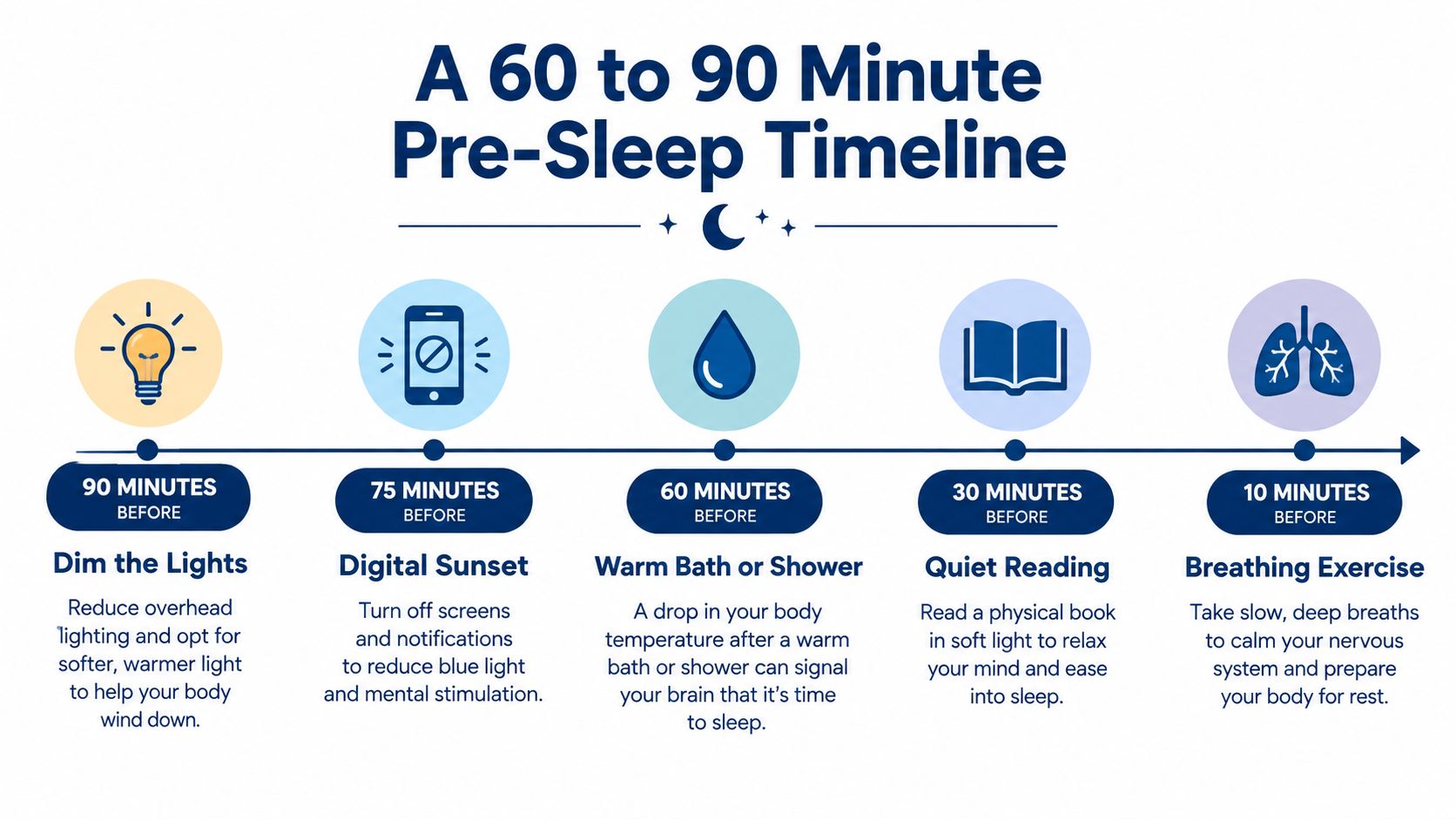
Ninety minutes before bed
Use this block to put the day away. If work is still open, write down the next action for tomorrow and close the laptop. Lower the room's lighting if practical, and move away from demanding tasks or emotionally intense media.
This is also a good point to think about food and drink. Caffeine can stay active in the body for several hours, so a practical starting point is to keep it to earlier in the day. Finishing heavy or spicy meals a few hours before bed can also help, and it's worth avoiding alcohol close to bedtime. Alcohol may make sleep onset feel easier while contributing to early waking and disrupted sleep; it's not a dependable wind-down tool.
Sixty minutes before bed
Finish the tasks that tend to pull attention back into the day, such as washing up or setting out what's needed for morning. Dim ambient and screen light where possible. CDC/NIOSH guidance recommends following a relaxing routine about 1.5 hours before bed, transitioning to dim lighting during that time, and going to bed and getting up at about the same times every day, including days off (CDC/NIOSH sleep guidance).
A warm shower or bath can be one option. So can putting the phone on its charger outside arm's reach, switching to audio, or changing into comfortable clothes.
Thirty minutes to lights out
Pick one quiet activity: read, journal, listen to calm music, or try paced breathing. Keep the activity simple enough that stopping it doesn't feel like a new decision. For melatonin timing and the difference between a routine cue and a supplement, see this guide to when to take melatonin for sleep.
The final fifteen minutes
Keep the last stretch familiar. Brush teeth, use the bathroom, set an alarm if needed, and turn off the remaining lights. If the routine has already lowered stimulation, there's no need to add another technique just because the clock is getting closer to bedtime.
Building a Minimum Viable Wind-Down for Racing Minds
A racing mind rarely responds well to a long list of instructions. The more steps a routine adds, the more chances there are to judge whether each step is “working.” A shorter ritual is easier to repeat, and repetition matters more than an elaborate sequence.
The simplest version has three pieces: one cue, one relaxation exercise, and one clear stopping point. A cue might be a fixed start time, washing up, or a warm shower. For the exercise, choose diaphragmatic breathing, a brief body scan, or a short worry list on paper. The stopping point might be closing the notebook and turning off the light, rather than continuing to search for one more sleep tip.
Choose by function, not by trend
If unfinished tasks keep circling, write down what needs attention tomorrow and the first step for each item. If physical tension is more noticeable, use gentle stretching or a slow body scan. If thoughts arrive without a clear theme, count comfortable, unforced breaths for a few minutes.
No purchase is required. A paper scrap can serve as a worry list; quiet breathing doesn't require an app. A phone may be useful for audio, but it can also pull someone back into messages or scrolling, so choose the option that creates fewer decisions.
A minimum viable routine should feel almost too easy to fail. If it takes more effort than the day can spare, cut steps rather than abandoning the whole idea.
A routine also needs an endpoint. Without one, relaxation exercises can become another round of checking whether sleepiness has arrived. Pick the cue and exercise that feel least effortful, repeat them consistently, and add steps only after those basics are settled.
For more options when thoughts won't slow down, explore this guide to sleeping when your brain is racing. The point isn't to empty the mind on command. It's to give attention something quieter to do.
Choosing a Format That Fits Your Routine
A product format can change how a bedtime routine feels, but it doesn't replace regular timing, reduced stimulation, or a calming activity. Compare formats by what they ask of the evening: when they're used, whether water is needed, and whether melatonin is part of the formula.
| Format | When to take it | Water needed | Melatonin profile |
|---|---|---|---|
| Dissolvable oral strip | Evening, before bed; follow the product's directions | No | Varies by product |
| Chewable gummy | Evening, according to its label | No | Can be melatonin-free |
| Capsule | Evening, according to its label | Usually taken with water | Varies by product |
| Topical night cream | As a skincare step in the evening | No | Some night creams contain melatonin; check the ingredient list |
A dissolvable strip may suit someone who wants to avoid swallowing a pill or finding water at bedtime. For example, Drift Off is a raspberry oral strip that dissolves on the tongue without water. Each strip contains 1 mg of melatonin with valerian root, lavender, chamomile, and hibiscus, and the directions specify taking one strip any time before bed, with a maximum of one strip per day. The product is intended to support healthy sleep patterns and relaxation.*
Match the format to the friction
A gummy offers a chewable option, while a capsule may feel familiar to someone who already takes supplements with an evening routine. People who prefer a melatonin-free supplement should check the ingredient panel and serving information rather than infer the formula from its format.
A topical night cream is different: it's a skincare step, not a sleep aid. It can fit into the same evening sequence as washing the face, but it shouldn't be treated as a substitute for a quiet activity or consistent timing. If a cream lists melatonin, count it alongside any other melatonin products.
The best choice is the one that adds the least friction and fits the person's preferences. Some people want no extra item at all. Others prefer a consistent supplement format as one small part of the routine. In either case, melatonin belongs in the evening before bed, never as a response to waking during the night.
When Screens Are Doing a Job You Need to Replace
A screen isn't always just entertainment at bedtime. It may be helping someone coordinate a night shift, decompress after a demanding day, keep in touch with family, or follow a calming audio routine. The useful question isn't only whether a screen is present. It's what the screen is doing, when it's being used, and whether it's delaying the intended bedtime.

Researchers are now testing structured programs that target evening device use and bedtime procrastination, including a registered randomized pilot trial with new career starters. That work is still early, and it supports trying a practical reduction rather than declaring that every screen activity automatically harms sleep.
Replace the function, not just the device
If scrolling is a way to discharge worries, try a brief written worry list and close it when the main concerns are recorded. If the screen provides company, an audio-only conversation or a timed phone call may preserve the connection without keeping the eyes on a display. If a video or social feed is being used to decompress, try quiet music, a familiar audiobook, or low-effort stretching instead.
For shift workers, a conventional early-evening routine may not fit. Keep the sequence tied to the intended sleep period, and protect a consistent wake time when the work schedule allows. This guide to circadian rhythm disruption offers more context for schedules that don't follow a standard day-night pattern.
A short video can also demonstrate a calmer screen transition; treat it as an option, not another task to complete.
A complete digital detox isn't the only sensible goal. A more sustainable change may be ending bedtime delay: decide when screen use stops, choose a lower-stimulation substitute that meets the same need, and keep the wake-time anchor where possible.
Troubleshooting a Routine That Is Not Working
A routine can make the transition to bed calmer, but it can't make someone sleep on command. If someone lies awake and becomes frustrated, continuing to work harder at the routine may add pressure rather than help.
Stimulus control, a core behavioral approach for insomnia, recommends going to bed only when sleepy and leaving the bed for a relaxing activity when sleep doesn't come (NHLBI insomnia guidance on stimulus control). A common rule of thumb is about 20 minutes. Use perceived time rather than repeatedly checking the clock. Sit somewhere dim and do something quiet, then return to bed when drowsiness comes back. The same principle applies after a middle-of-the-night awakening: don't stay in bed struggling to force sleep.
Know when habits aren't enough
A winding down routine is a habit, not a complete treatment for persistent insomnia. Sleep-hygiene education alone isn't considered sufficient as an insomnia treatment; structured behavioral approaches such as cognitive behavioral therapy for insomnia, or CBT-I, may be appropriate (AASM behavioral treatment guideline). For a practical overview of treatment options, read how insomnia is treated.
If sleep difficulty occurs more than three nights a week for more than three months, ask a healthcare professional about assessment and structured treatment. That timeframe is a practical reason to seek help, not a diagnosis. A clinician can also assess possible contributors when sleep trouble appears alongside hot flashes, snoring, restless legs, low mood, medication effects, or other health concerns.
The useful routine is the one that lowers evening stimulation without becoming a nightly performance test. Keep the parts that feel calming, drop the ones that add pressure, and seek professional guidance when the problem persists or has a clear impact on daily life.
Sleep All Nite offers bedtime formats with different ingredients and serving details, so readers can compare what fits their routine. Visit Sleep All Nite to review product formats and ingredient amounts, and check with a healthcare professional before starting a supplement.
*These statements have not been evaluated by the Food and Drug Administration. These products are not intended to diagnose, treat, cure, or prevent any disease.
This article is for general education and isn't medical advice. Talk with a healthcare professional before starting a supplement, especially if you're pregnant or nursing, under 18, managing a medical condition, or taking prescription medication.


