
Tired but Can't Fall Asleep: Why It Happens and What Helps


The body feels heavy on the sofa, eyelids droop during a show, and bed sounds like the obvious next step. Then the lights go out and alertness returns. Thoughts replay the day, the clock becomes impossible to ignore, and being tired but can't fall asleep starts to feel like a personal failure. It isn't a discipline problem. More often, it's a mismatch between physical fatigue and a brain that hasn't left daytime alert mode.
Table of Contents
- The Wired but Tired Feeling Is More Common Than You Think
- Why Being Exhausted Can Actually Keep You Awake
- Quick Triage for a Racing Mind, Hormones, Environment, Habits, and Substances
- The Behavior Change That Beats More Sleep Hygiene
- Building a Realistic 20 to 30 Minute Wind-Down Routine
- Comparing Sleep Support Formats Without the Hype
- Putting It Together, When to Ask for Help, and the FAQ
The Wired but Tired Feeling Is More Common Than You Think
A common pattern sounds like this: exhaustion builds all evening, the bed feels welcome, and within minutes the mind starts planning, reviewing, or worrying. The body wants rest, yet sleep doesn't arrive. That gap between fatigue and sleepiness confuses many adults, because the two sensations aren't identical.
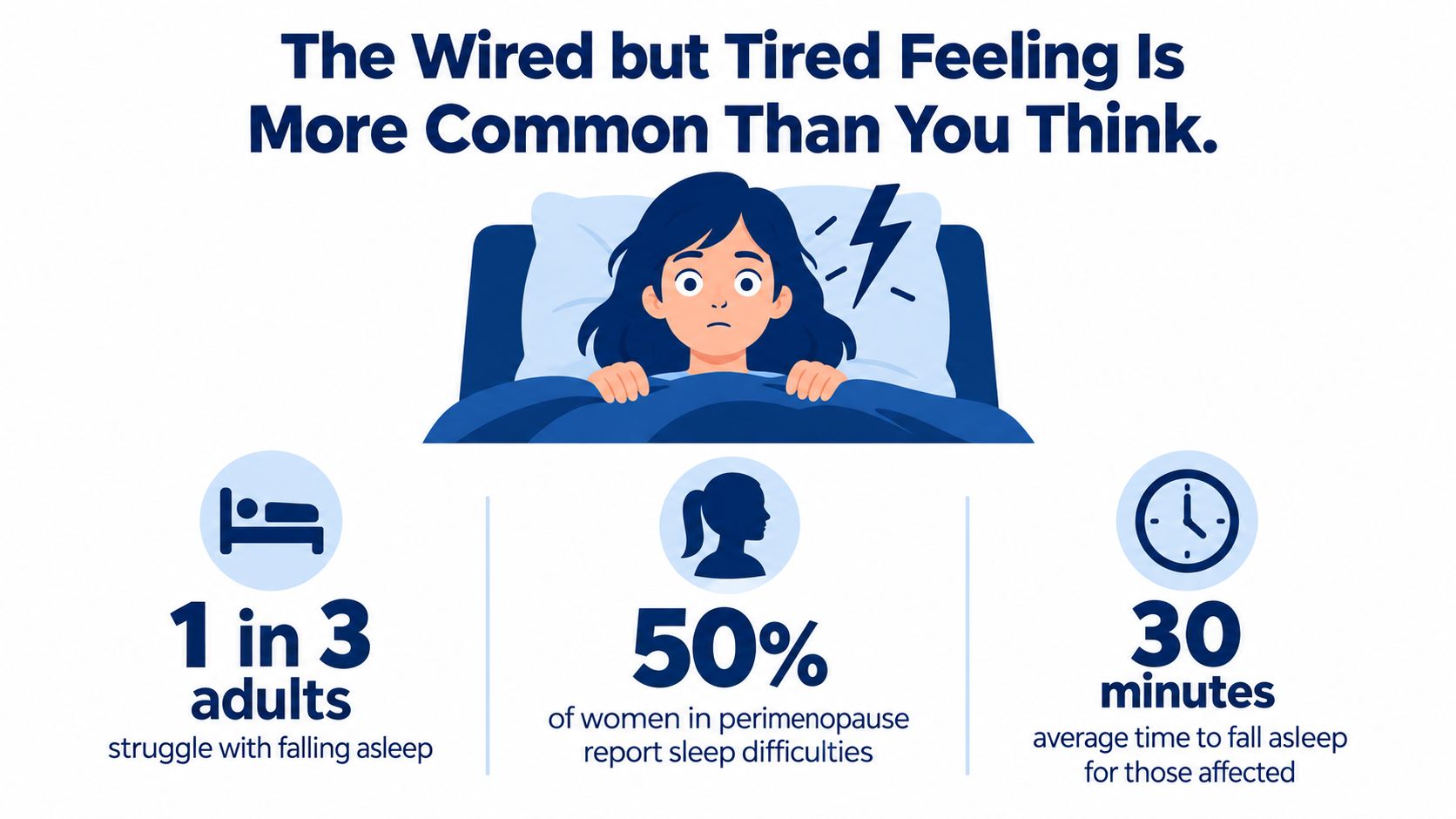
Fatigue means low energy, heavy limbs, or mental depletion. Sleepiness is the specific pressure to drift off, with drooping eyelids and fading attention. A person can have plenty of the first and very little of the second, especially after a stressful day spent mostly sitting, thinking, and looking at screens.
A Shared, Measurable Pattern
This isn't rare. The U.S. National Center for Health Statistics 2020 survey on trouble falling and staying asleep found that 14.5% of adults had trouble falling asleep most days or every day in the prior 30 days, roughly 1 in 7 adults, while 17.8% had trouble staying asleep.
Age and place also mattered in that survey. Trouble falling asleep was reported by 15.5% of adults aged 18 to 44 compared with 12.1% of adults aged 65 and older. It was also lower in large central metropolitan areas, at 12.7%, than in nonmetropolitan areas, at 17.1%.
Shorter episodes are even more widespread. The Sleep Foundation notes that insomnia affects as many as 33% of people worldwide at some point. In practical terms, regular difficulty starting sleep affects about one in seven U.S. adults, while occasional symptoms may touch as many as one in three.
Duration provides another clue. Adults generally need at least seven hours of sleep, yet the CDC surveillance report on U.S. sleep duration found that only 65.2% of 444,306 respondents reported at least seven hours, leaving an estimated 83.6 million U.S. adults below that threshold. Spending enough time in bed doesn't guarantee enough sleep if the first hour is spent awake.
Three questions help organize a calmer response. First, what's keeping alertness switched on? Second, what can change tonight without forcing sleep? Third, when does a recurring pattern deserve clinical assessment rather than another round of tips?
Why Being Exhausted Can Actually Keep You Awake
Sleep requires two conditions at once: enough sleep pressure and low enough arousal. Exhaustion covers only part of that equation. If the brain remains highly active, the body can feel depleted while sleep stays out of reach.

Sleep clinicians call this pattern hyperarousal. In plain language, it means the alerting system stays turned up through heightened brain activity, emotional reactivity, sensory sensitivity, and busy pre-sleep thinking. A racing mind, tense shoulders, and repeated clock-checking can all belong to the same loop.
How the Loop Reinforces Itself
One difficult night creates an understandable concern about the next day. The following evening, that concern arrives before sleep does. Attention starts monitoring every minute awake, frustration builds, and the bed becomes associated with effort rather than rest.
Trying harder to sleep gives the brain a task. A task keeps the brain alert.
Tracking can add pressure for some sleep optimizers. Sleep researchers have described a pattern they call orthosomnia, in which people become so focused on perfecting their sleep-tracker data that the preoccupation itself feeds insomnia (case series in the Journal of Clinical Sleep Medicine). A score doesn't settle arousal, and watching it closely can do the opposite.
Schedule drift creates a different mismatch. A later weekend bedtime, irregular wake times, or evening light can shift when genuine sleepiness arrives, a pattern explored in the guide to circadian rhythm disruption and sleep timing. In that case, the person in bed at a chosen time may be tired, but the body clock isn't ready.
The distinction between a rough patch and a disorder matters. Standard sleep-medicine diagnostic criteria (the ICSD-3-TR) define chronic insomnia as difficulty initiating or maintaining sleep, or waking earlier than desired, at least three times per week for at least three months, with daytime consequences such as fatigue, impaired attention, irritability, or reduced motivation.
A brief video explanation can help separate sleepiness from alertness before applying the triage steps.
Occasional delayed sleep after travel, illness, or a stressful week doesn't meet that threshold. A pattern that persists despite adequate time and reasonable conditions for sleep deserves a different level of attention.
Quick Triage for a Racing Mind, Hormones, Environment, Habits, and Substances
Five drivers cover most nights when someone feels tired but can't fall asleep. A quick self-scan won't provide a diagnosis, but it can show where a small change is most likely to matter. Honest notes over several nights beat guessing from one bad night.
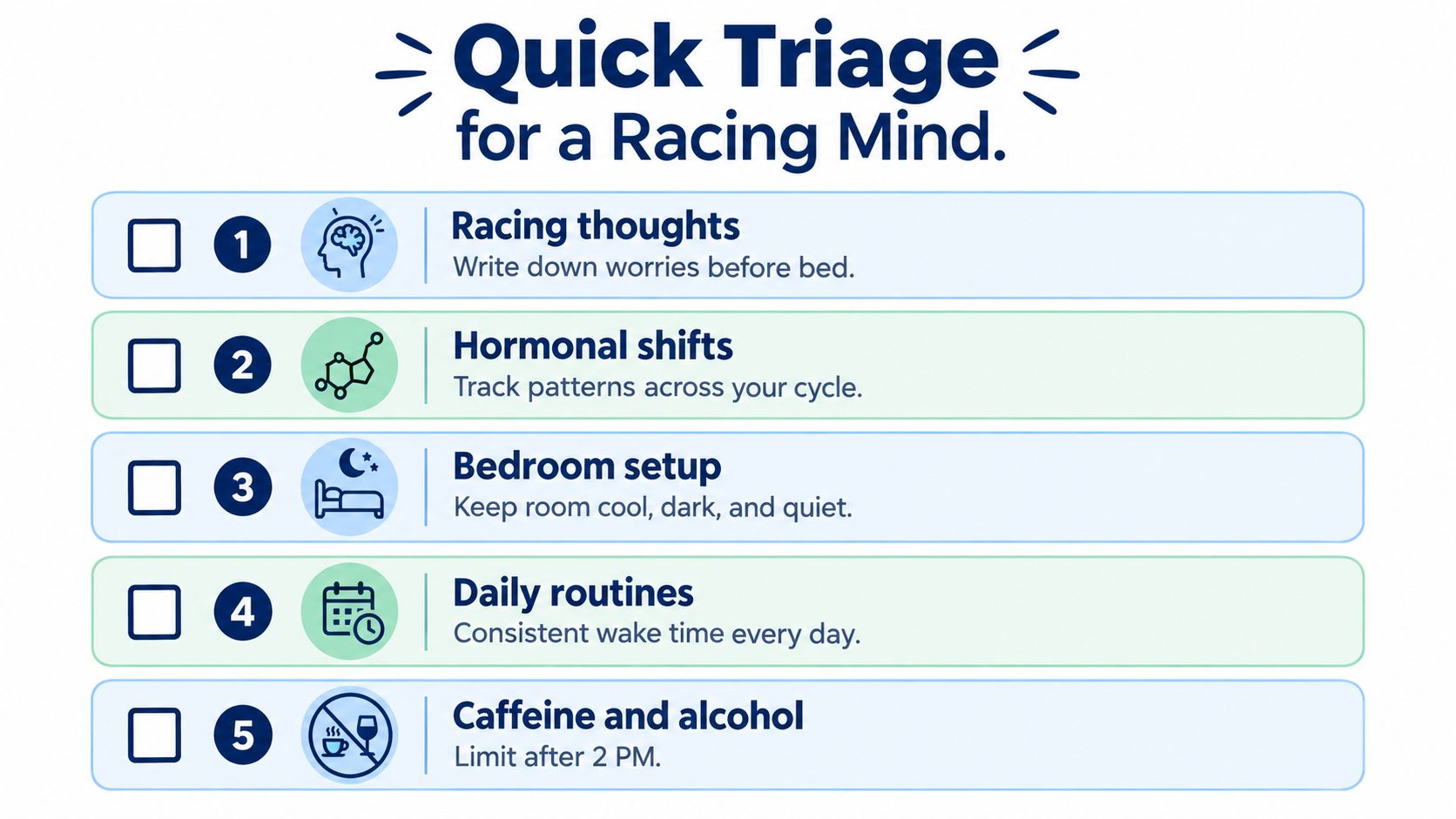
Five Questions to Ask Before Bed
- Racing mind: Do thoughts loop through conversations, unfinished tasks, or tomorrow's schedule once distractions disappear? Practical approaches for that pattern appear in the article on how to sleep when the brain is racing.
- Hormones and midlife changes: Do awakenings or delayed sleep coincide with cycle changes, heat, sweating, mood shifts, pain, or urinary symptoms? Notes about timing and accompanying sensations are more useful than assuming one cause.
- Environment: Is the bedroom bright, noisy, warm, or filled with glowing devices? A room can feel familiar and still work against sleep.
- Habits: Does bedtime drift later on weekends, or does wake time change after a poor night? Irregular timing makes sleepiness less predictable.
- Substances: How close to bedtime are caffeine, nicotine, alcohol, and large meals? Timing often matters as much as amount.
Midlife sleep deserves particular care because sleep-onset trouble and night waking can overlap. A review of sleep during the menopausal transition in Sleep Medicine Clinics notes that nighttime awakenings are the most common sleep complaint and that sleep problems are reported by 40% to 60% of women in midlife. The same review describes a longitudinal study in which sleep became shorter and more broken over time even after adjusting for hot flashes and mood, so the absence of obvious hot flashes doesn't rule out midlife sleep changes.
Other contributors can include mood symptoms, pain, urinary symptoms, and sleep-disordered breathing. Snoring, gasping, or repeated awakenings for urination point toward clinical assessment rather than changing a bedtime routine. Alcohol and medication timing also belong in the notes, since either can alter the shape of the night.
Environment and timing offer the simplest first checks. CDC guidance on sleep habits and bedroom conditions recommends a consistent bedtime and wake time, a quiet and dark bedroom at a comfortable temperature, and removal of televisions, computers, and mobile devices. It also advises avoiding large meals, nicotine, alcohol, and caffeine before bedtime.
The triage goal is prioritization, not perfection. One clear driver, addressed consistently, gives better information than changing everything for two nights and abandoning the effort.
The Behavior Change That Beats More Sleep Hygiene
Generic sleep hygiene lists often stop at dark rooms and fewer screens. Those steps can help, but they don't always break the learned association between bed and wakefulness. Stimulus control targets that association directly and forms a core part of cognitive behavioral therapy for insomnia, or CBT-I.
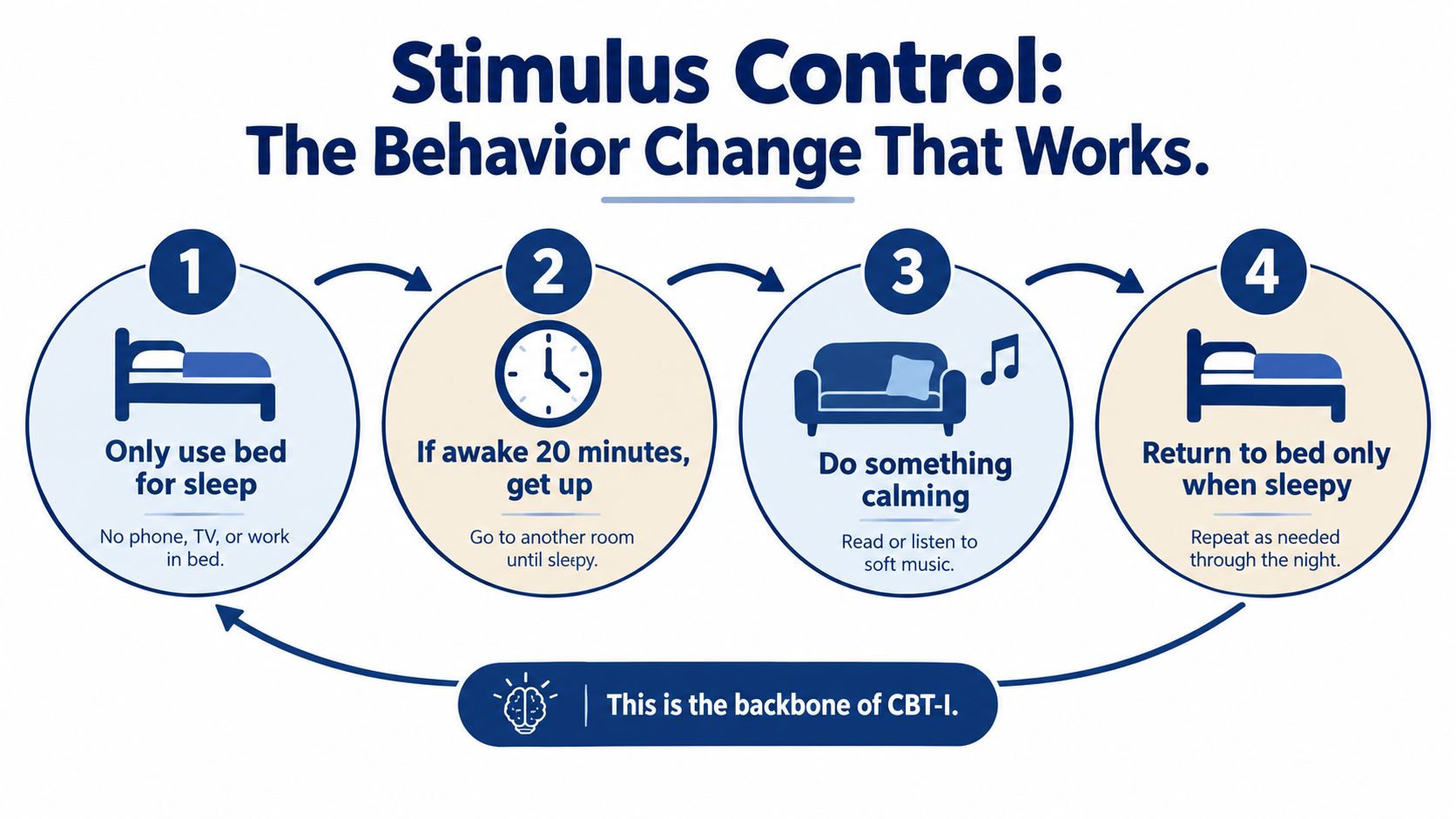
The logic is straightforward. Hours spent working, scrolling, worrying, or watching the clock in bed teach the brain that bed is a place to be alert. Stimulus control reverses that lesson by making bed a cue for sleep again.
The Stimulus Control Rules
- Go to bed only when sleepy: Heavy eyelids and drifting attention matter more than the planned bedtime or a general feeling of exhaustion.
- Reserve bed for sleep and sex: Work, news, messages, television, and problem-solving happen elsewhere whenever possible.
- Leave bed when sleep doesn't come: Move to a dim, quiet place, choose a non-stimulating activity, and return only when sleepiness comes back.
- Repeat without negotiating: Several trips in one night can happen at first, and repetition is part of retraining the association.
- Keep one fixed wake time: The morning anchor stays steady even after a poor night, and daytime naps are avoided while the pattern is being rebuilt.
The National Heart, Lung, and Blood Institute insomnia guidelines on stimulus control describe the same behavioral rule: use the bed and bedroom only for sleep, leave when unable to fall asleep or return to sleep easily, and maintain a consistent morning rise time regardless of the previous night. Avoiding naps helps preserve sleep pressure for the evening.
Practical rule: Bed should predict sleep, not effort, frustration, or clock-watching.
Two pitfalls commonly weaken the approach. Staying in bed while monitoring the time increases wakefulness and strengthens the bed-alertness link. Sleeping much later after a bad night feels compassionate, but it can perpetuate an irregular schedule and reduce sleepiness the next evening.
For recurrent symptoms, stimulus control works best inside a structured 6 to 8 week course of CBT-I. The American Academy of Sleep Medicine clinical practice guideline on behavioral insomnia treatment strongly recommends multicomponent CBT-I and conditionally supports stimulus control as a standalone treatment for chronic insomnia. CBT-I can be delivered in person, by telephone, or online, and persistent symptoms warrant clinical assessment rather than indefinite self-management.
Building a Realistic 20 to 30 Minute Wind-Down Routine
A useful wind-down lowers stimulation gradually. It doesn't require a renovated bedroom, expensive devices, or an identical ritual every night. A menu of free, repeatable choices works better for most households.
A Flexible Evening Sequence
- Dim the light: Lower overhead lighting and switch to a lamp if one is available. Reduced brightness gives the evening a clear boundary.
- Adjust comfort: Open a window, use a fan if one is available, or change bedding layers. The aim is neither too hot nor too cold.
- Close open loops: Set out clothes, prepare a glass of water, and place keys or other morning items in a consistent spot.
- Choose one quiet activity: Read a print book, stretch gently, breathe slowly, listen to calm audio, or take a warm shower.
- Park tomorrow on paper: Spend five minutes writing unresolved thoughts and the first small step for each, then close the notebook.
Screen choices deserve honesty rather than shame. News, work messages, arguments, and fast-scrolling feeds ask the brain to react. A familiar show in another room, finished before bed, creates a different pattern from scrolling in bed until exhaustion takes over.
Slow breathing can serve as a transition, not a performance. A longer exhale than inhale for a minute or two gives attention a steady focus. If counting breaths creates pressure, noticing the weight of hands or the feeling of bedding works as another neutral anchor.
Some adults place a supplement within this part of the evening as one optional element of a broader routine. Deep Calm is a melatonin-free capsule providing 275 mg magnesium per serving as magnesium glycinate, and magnesium supports normal nerve function and muscle health.* Label directions and personal medical considerations come first, and a supplement doesn't replace the behavioral cues around it.
Consistency matters more than length. Twenty minutes repeated nightly teaches a clearer transition than an elaborate routine used only after especially bad nights. The final step remains the same: enter bed when sleepy, not merely because the routine has ended.
If wakefulness stretches on after lights out, the wind-down hasn't failed. Stimulus control still applies. Leaving bed for a dim, quiet activity protects the routine from becoming another source of performance pressure.
Comparing Sleep Support Formats Without the Hype
Formats differ mainly by ingredient, dose, timing, and personal preference. None should be framed as a cure for being tired but can't fall asleep, and higher melatonin doses aren't automatically better. A clear label comparison helps prevent dose creep.
Oral melatonin has variable absorption, and a systematic review of melatonin pharmacokinetics found that immediate-release forms generally peak in about 50 minutes. Physiologic doses are about 0.1 to 0.3 mg, while 0.5 to 1 mg is often described as a reasonable low starting dose for adults considering melatonin, as covered in our low-dose melatonin guide. More is not better, especially when next-day grogginess is already a concern.
| Format | Melatonin per serving | Best for | Timing |
|---|---|---|---|
| Melatonin-free capsule | 0 mg | Adults avoiding melatonin | Evening, per label |
| Melatonin-free gummy | 0 mg | Adults preferring a chewable wind-down format | Evening, per label |
| Low-dose oral strip | 1 mg | Adults who dislike swallowing pills | Before bed, per label |
| Moderate-dose capsule blend | 2 mg | Adults comparing multi-ingredient blends | Evening, per label |
| Higher-dose capsule blend | 10 mg per 2-capsule serving | Adults who have reviewed dose and interactions carefully | Evening, per label |
As one low-dose example, Drift Off is a raspberry oral strip that dissolves on the tongue with no water, combining 1 mg melatonin with valerian root, lavender, chamomile, and hibiscus, taken any time before bed with a maximum of one strip per day, to support relaxation as part of a bedtime routine.* Format convenience doesn't change the need to review total melatonin from all products.
Higher-dose blends require extra scrutiny. A standard capsule containing 10 mg melatonin and St. John's Wort carries a specific caution because St. John's Wort interacts with many prescription medicines. Medication lists should be checked before combining products, and none of the formats discussed here should be described as extended-release.
Melatonin belongs in the evening, before bed. It should never be taken after a middle-of-the-night waking.
Prescription paths belong in a clinician conversation, particularly when symptoms are frequent, prolonged, or impairing during the day. Over-the-counter support may suit occasional schedule disruption, but recurring insomnia calls for assessment of causes, medicines, mood, breathing, and other sleep disorders. The broader comparison of sleep support supplement formats and ingredients can help organize label questions before that conversation.
The safest comparison asks four things: how much melatonin is present, what else is in the formula, when it's taken, and whether any ingredient interacts with current medicines. Claims about staying asleep or sleeping through the night should be treated skeptically.
Putting It Together, When to Ask for Help, and the FAQ
Start tonight with one change: go to bed only when sleepy and get up if wakefulness stretches on. This week, add a fixed wake time and one triage fix. Persistent trouble at least three nights weekly for three months, with daytime impairment, warrants clinical assessment, as explained in the guide on when to see a doctor for insomnia. In a 2024 American Academy of Sleep Medicine survey of 2,006 U.S. adults, 12% reported a chronic insomnia diagnosis.
FAQ
- Does a racing mind always need clinical help? No. Frequency, duration, and daytime impairment determine urgency.
- Do wearables help everyone? No. Tracking can increase monitoring and pressure for some adults.
- Can midlife hormonal changes affect sleep without hot flashes? Yes. Research on the menopausal transition has found sleep changes that persist even after accounting for hot flashes.
- Should melatonin be taken after waking at night? No. Melatonin belongs before bed, in the evening.
Readers comparing evening formats can review ingredient amounts, melatonin levels, and label directions at Sleep All Nite, then choose only what fits personal preferences and medical circumstances. A healthcare professional should check supplement choices against current medicines and health conditions before use.
*These statements have not been evaluated by the Food and Drug Administration. These products are not intended to diagnose, treat, cure, or prevent any disease.
This article is for general education and isn't medical advice. Talk with a healthcare professional before starting a supplement, especially if you're pregnant or nursing, under 18, managing a medical condition, or taking prescription medication.


