
Over the Counter Sleep Aid Guide: What Actually Works


In 2024, 12.9% of U.S. adults used a sleep aid most days or every day during the previous 30 days, while 5.7% used an over-the-counter medication or supplement. That demand is substantial, but it doesn't answer the question that matters most: which type of over the counter sleep aid matches the actual sleep problem, and what does it cost the next morning?
An antihistamine, melatonin, valerian blend, and magnesium capsule aren't interchangeable. One may be designed for occasional sleeplessness, another for circadian timing, and another for an evening wind-down. The safest comparison starts with the symptom, then considers evidence, dose, duration, interactions, and next-day impairment.
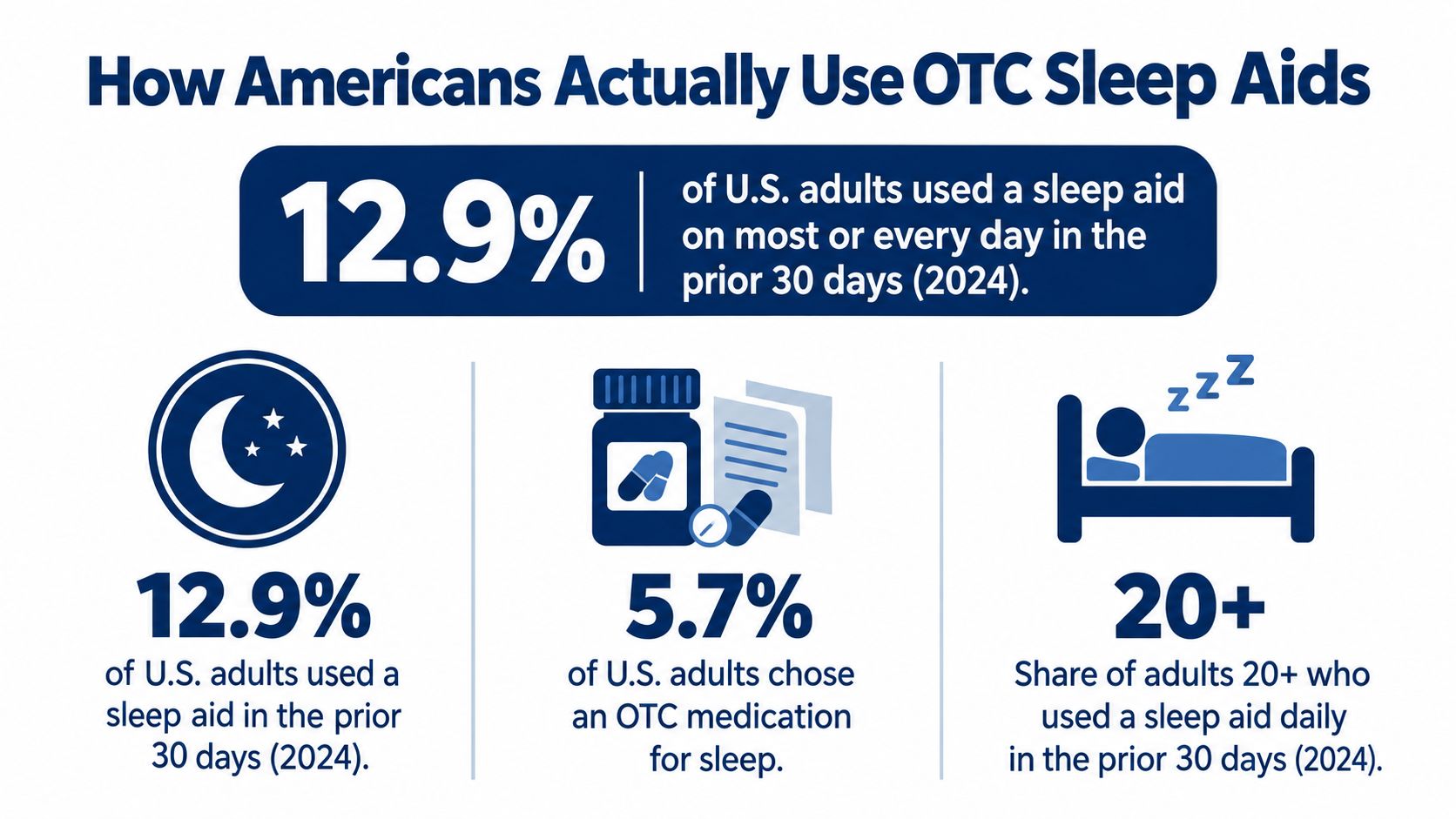
Table of Contents
- How Americans Use OTC Sleep Aids in Practice
- The Four Main OTC Sleep Aid Families at a Glance
- Melatonin as a Timing Signal Rather Than a Sedative
- Antihistamine Sleep Aids and the Next-Day Trade-Off
- Herbal Blends and Melatonin-Free Botanicals
- The Safety Audit Most OTC Comparisons Skip
- Which OTC Sleep Aid Fits Which Sleep Problem
How Americans Use OTC Sleep Aids in Practice
The 2024 National Health Interview Survey found that 12.9% of adults used some type of sleep aid most days or every day during the previous 30 days. OTC medications or supplements accounted for 5.7%, compared with 5.2% for prescription sleep medications and 3.7% for marijuana or CBD products, according to the CDC's 2024 sleep-aid analysis.
Use varied across demographic groups. Women reported OTC medication or supplement use at 7.0%, compared with 4.3% among men, per the same National Health Interview Survey results. Adults aged 65 and older reported use at 7.6%, compared with 3.9% among adults aged 18 to 34.
These figures describe demand, not effectiveness for every complaint. The survey found that 15.4% of adults had trouble falling asleep most days or every day, so frequent sleep difficulty was more common than frequent sleep-aid use. That gap suggests many people choose an OTC product before identifying the sleep pattern they want to address.
A practical framework separates four problems:
- Sleep-onset difficulty, or trouble falling asleep at bedtime.
- Repeated nighttime waking, which may point to an underlying sleep or health issue rather than a need for stronger sedation.
- Circadian disruption, including jet lag or a rotating work schedule.
- Racing-mind wind-down, where relaxation is the immediate goal and melatonin may not be the preferred ingredient.
The matching logic matters because these categories call for different evaluations of timing, ingredients, duration, and next-day impairment.
Practical rule: A product's front label does not identify the sleep problem. The timing and pattern of symptoms do.
Readers comparing options can review this guide to non-habit-forming sleep aids, while remembering that “non-habit-forming” does not mean risk-free, suitable for long-term use, or appropriate alongside every medicine.
The Four Main OTC Sleep Aid Families at a Glance
The phrase over the counter sleep aid covers several different families. Their intended roles, onset patterns, and safety concerns differ enough that a single “best ingredient” ranking can mislead.
| Family | Typical onset | Best for | Key caution |
|---|---|---|---|
| Melatonin | Often timed before the desired sleep period | Circadian timing, including jet lag or shift-work schedules | Evidence is limited for chronic insomnia, and more isn't necessarily better |
| Sedating antihistamines | Sedation may occur during the night | Occasional sleeplessness within labeled use | Next-day impairment, anticholinergic effects, interactions, and limited support for chronic use |
| Botanicals and blends | Variable, depending on ingredient and formulation | Evening wind-down when expectations remain modest | Evidence is mixed, and combination formulas can make dose evaluation difficult |
| Minerals and amino-acid derivatives | Variable and generally context-dependent | Relaxation routines without melatonin | Evidence differs by ingredient, and supplements can still interact with medicines |
Matching the family to the complaint
Melatonin is best understood as a timing signal. It may have a role when the sleep schedule is out of alignment, but it shouldn't be treated as a universal sedative or a solution for persistent insomnia.
Diphenhydramine and doxylamine are sedating antihistamines. Their regulatory role is narrower than many shoppers assume. In the United States, diphenhydramine labeling addresses occasional sleeplessness, not chronic insomnia.
Valerian, chamomile, lavender, lemon balm, and passion flower appear in many botanical blends. Their effects can be difficult to separate, especially when a formula combines several ingredients without a clearly stated amount for each one.
Magnesium glycinate, L-theanine, and GABA are commonly positioned for relaxation and wind-down. They may suit someone who wants a melatonin-free evening option, but that doesn't establish that they treat repeated waking or chronic insomnia.
The key comparison isn't just “natural versus medication.” It is timing signal versus sedation, single ingredient versus blend, and occasional use versus repeated symptoms.
Melatonin as a Timing Signal Rather Than a Sedative
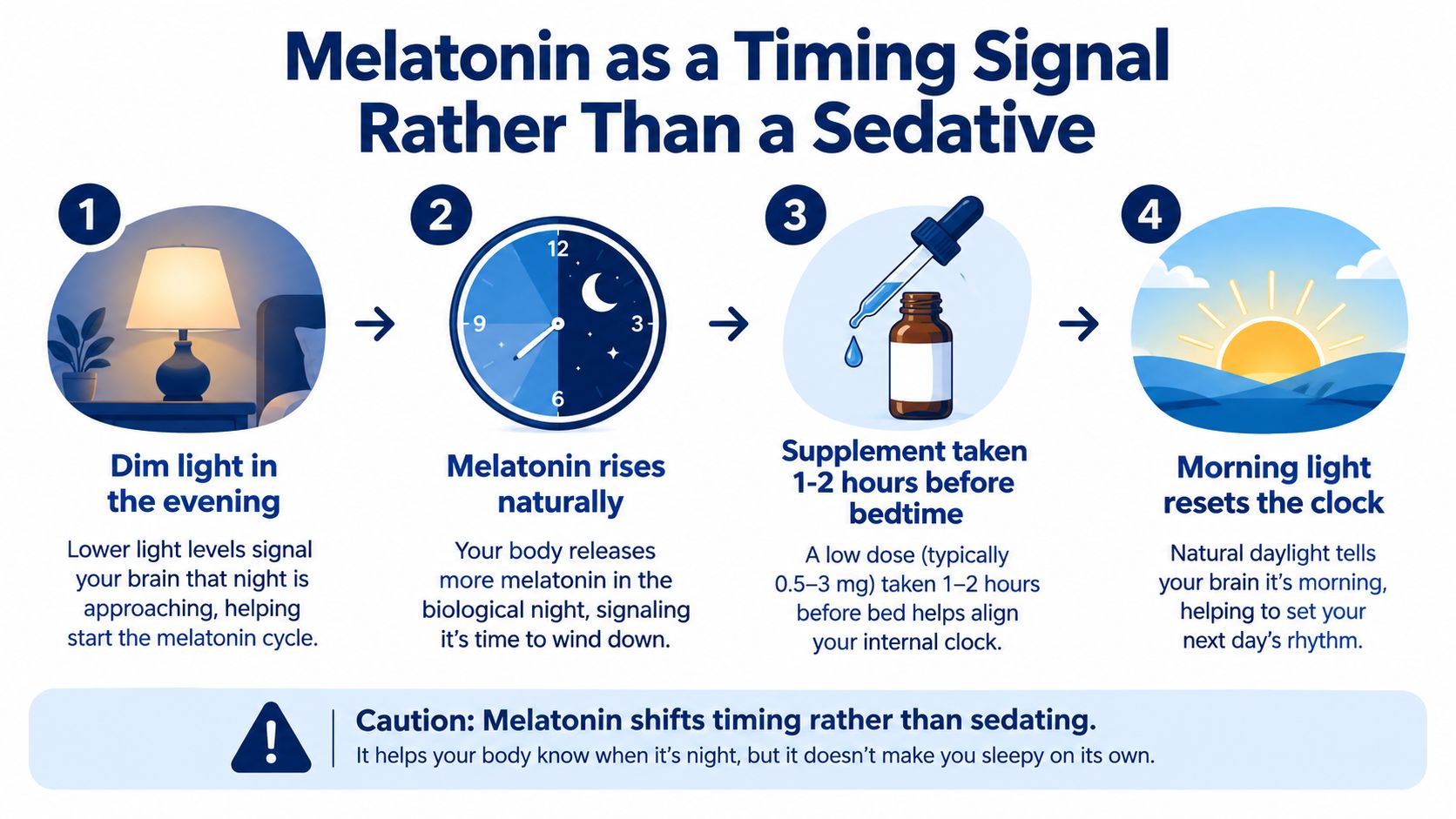
Melatonin is better classified as a biological timing signal than as a conventional sedative. It helps indicate that the body is entering its biological night, so its potential value depends on the sleep problem. A mistimed schedule is a more plausible target than persistent insomnia or repeated nighttime waking.
Oral absorption varies considerably. Bioavailability can range from roughly 10% to 56%, and immediate-release melatonin usually reaches peak levels within about an hour. Doses of about 0.1 to 0.3 mg can produce near-physiological melatonin levels, and clinical references describe taking a low dose 30 to 60 minutes before bed for sleep onset. (Review the NCBI Bookshelf melatonin overview)
Higher doses deserve scrutiny. More melatonin can increase exposure without correcting a schedule that is out of alignment, and it does not automatically solve waking during the night. A low-dose melatonin guide can help readers compare dose logic with product instructions.
Timing matters more than chasing sedation
Melatonin generally belongs in the evening, before the intended sleep period. Taking it after a 3 a.m. waking may add a timing signal when the person needs to be alert soon, increasing the chance of morning grogginess without explaining the underlying disruption.
The American Academy of Sleep Medicine suggests that clinicians not use melatonin for adult sleep-onset or sleep-maintenance insomnia. Its evidence summary describes a small improvement in sleep latency and judged the overall evidence quality as very low. (Read the AASM pharmacologic treatment guideline) NCCIH also notes that the long-term safety of melatonin supplements hasn't been well established.
A practical melatonin audit asks four questions:
- Is the problem a shifted schedule or persistent insomnia?
- Is the product immediate-release, with clear timing instructions?
- Is the dose low enough to evaluate without assuming that more will work better?
- Could another medicine or health condition explain the sleep disruption?
Sleep All Nite's Drift Off is an example of an evening product containing 1 mg of melatonin in a raspberry oral strip with valerian root, lavender, chamomile, and hibiscus. The strip dissolves on the tongue without water, is taken before bed, and is limited to one strip per day. Those features describe its format and ingredients, not a treatment for chronic insomnia.
Antihistamine Sleep Aids and the Next-Day Trade-Off
Diphenhydramine has been used as an antihistamine since the 1940s and became the foundation of U.S. OTC nighttime sleep-aid regulation. The FDA issued a tentative final monograph in 1978 and a 1982 notice allowing diphenhydramine to be marketed, as described in the FDA rulemaking history.
Under the U.S. OTC monograph, diphenhydramine hydrochloride is allowed at 50 mg orally at bedtime for adults and children aged 12 or older. Diphenhydramine citrate is permitted at 76 mg. The permitted claim is narrow, relief of occasional sleeplessness or help falling asleep, not treatment of chronic insomnia, according to the FDA OTC monograph.
The label also says to seek medical advice when sleeplessness persists continuously for more than two weeks. That instruction matters because recurring sleep difficulty may reflect a condition, medication effect, or behavioral pattern that sedation only masks.

Sedation isn't the same as restorative sleep
First-generation antihistamines can cause daytime impairment, dry mouth, blurred vision, urinary difficulty, and confusion. Older adults face particular concerns involving cognitive impairment, falls, and motor-vehicle accidents. The concern isn't that every user will experience every effect. The concern is that stronger subjective drowsiness can be mistaken for better sleep.
Doxylamine belongs to the same broad sedating-antihistamine discussion. A product can be legally available without being suitable for nightly use, for an older adult with fall risk, or for someone who needs to drive early in the morning.
The FDA warns against combining nighttime sleep aids with alcohol, sedatives, or tranquilizers. It also advises paying attention to active ingredients so the same ingredient isn't taken twice in different products. The FDA interaction guidance makes the label a screening tool, not a formality.
The American Academy of Sleep Medicine suggests that clinicians not use diphenhydramine for sleep-onset or sleep-maintenance insomnia. Readers comparing alternatives can review this non-drowsy sleep-aid discussion, but “non-drowsy” still requires attention to ingredients, timing, and individual response.
Herbal Blends and Melatonin-Free Botanicals
Botanical products deserve neither automatic approval nor automatic dismissal. Their evidence is usually more variable than the marketing language suggests, and a blend can make it difficult to identify which ingredient is responsible for an effect or side effect.
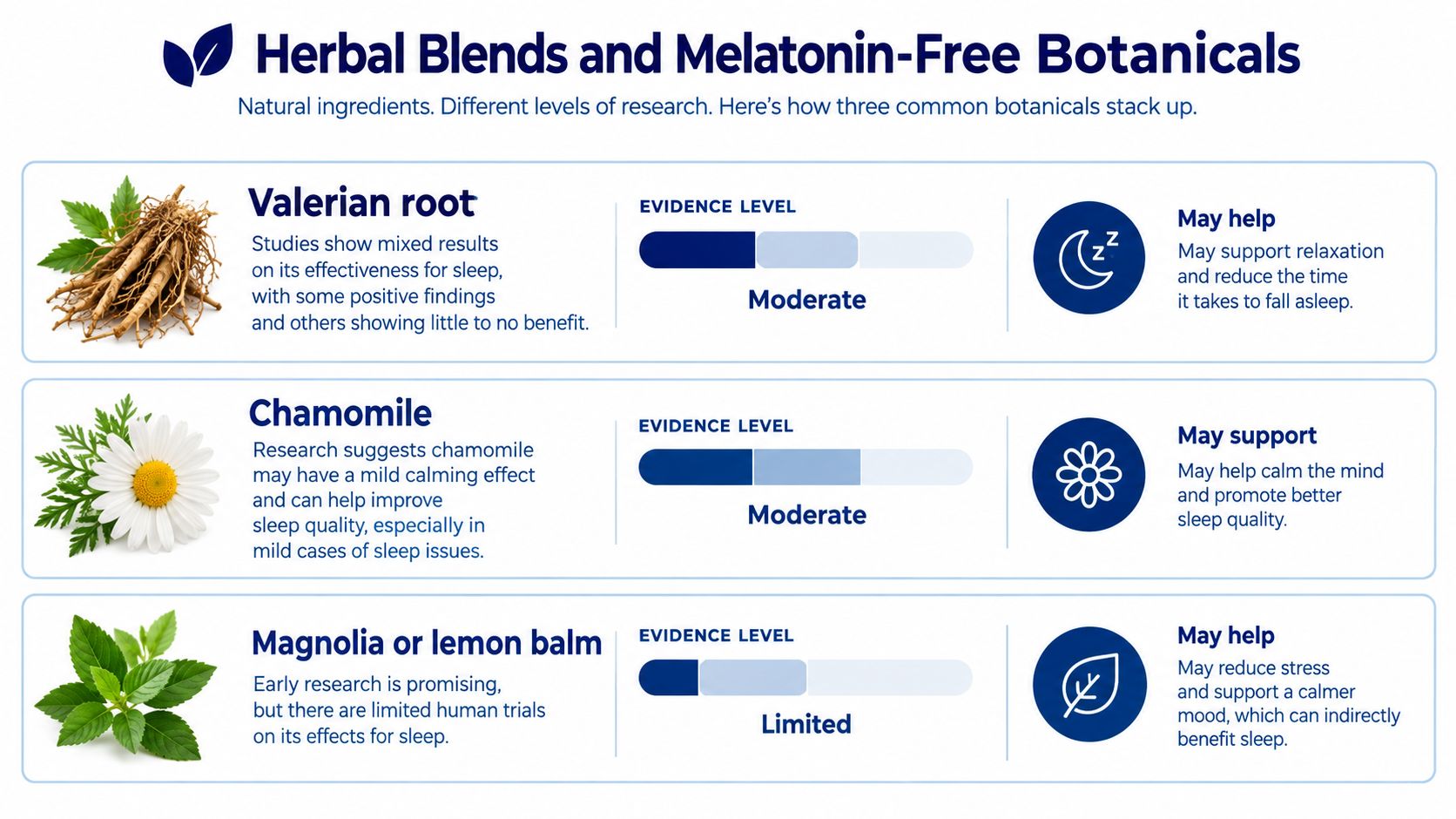
Valerian root has mixed evidence, with some research suggesting a possible effect on sleep latency, but not enough consistency to treat it as a dependable answer for chronic sleep difficulty. Chamomile is commonly used for a mild calming ritual, while lavender has more plausible support in aromatherapy contexts than as a guaranteed oral sleep agent.
Lemon balm and passion flower are often selected for relaxation. Human evidence remains limited or mixed, and a combined formula doesn't automatically become stronger because it contains more named botanicals. The sensible question is whether the ingredient, dose, timing, and intended use match the complaint.
What melatonin-free formulas can and can't clarify
Magnesium and L-theanine frequently appear in melatonin-free products intended for evening relaxation. GABA also appears in blends, although oral products don't provide a simple guarantee that the ingredient will produce a predictable sleep effect.
A label can be evaluated with four questions:
- Ingredient amount: Are meaningful per-serving amounts disclosed?
- Purpose: Is the formula positioned for wind-down, or does it make an implied claim about chronic sleep symptoms?
- Complexity: Does the combination contain so many ingredients that side effects and interactions become difficult to identify?
- Duration: Is the product being used briefly while the underlying pattern is assessed, or indefinitely?
For someone who wants a melatonin-free wind-down format, Sleep All Nite's Nite Bites contain reishi extract at 200 mg, plus L-theanine, lemon balm, passion flower, and valerian root. The blackberry gummies are described for winding down. They don't establish treatment for insomnia or repeated nighttime waking.
Deep Calm is another melatonin-free format. It contains magnesium glycinate and provides 275 mg of magnesium per serving, with structure/function language limited to normal nervous-system and muscle function support.* Neither product should be evaluated by the number of ingredients alone.
The Safety Audit Most OTC Comparisons Skip
The important safety question often appears after the purchase, when someone combines products, drinks alcohol, or discovers that morning alertness matters more than expected. The FDA advises checking warnings for conditions, interactions, circumstances in which a product shouldn't be used, and when to stop taking it.
The NHLBI specifically advises speaking with a healthcare provider before using antihistamine sleep products because they may be unsafe for some people. Relevant screening questions include:
- Alcohol: Has alcohol been consumed or planned? The FDA advises avoiding alcoholic beverages with nighttime sleep aids.
- Sedating medicines: Are sedatives, tranquilizers, sedating allergy medicines, cannabis products, or other CNS depressants involved?
- Medical conditions: Is there glaucoma, urinary difficulty related to an enlarged prostate, emphysema, or chronic bronchitis? The FDA monograph's label warnings list these as reasons to ask a doctor before using diphenhydramine sleep aids, and the NHLBI treatment guidance recommends talking with a provider first.
- Morning responsibilities: Will the person drive, operate equipment, supervise someone, or need reliable balance and concentration?
- Pregnancy or nursing: Has a healthcare professional reviewed the ingredient list?
Morning-after test: A product that makes someone sleepier but leaves them impaired isn't a successful self-care choice for a morning that requires alertness.
Duration deserves its own check. The FDA monograph limits diphenhydramine's sleep-aid role to occasional sleeplessness, and the long-term safety and effectiveness of most nonprescription insomnia products haven't been well established. Repeated use should trigger a review rather than an automatic dose increase.
A person should stop self-experimenting and seek clinical evaluation when symptoms persist, when 3 a.m. awakenings recur, when daytime fatigue continues, or when loud snoring and breathing pauses suggest possible sleep apnea. Restless legs, medication effects, mood symptoms, and perimenopause-related changes can also require a different assessment. A review of too much melatonin can help readers recognize why escalating a dose isn't a substitute for understanding the pattern.
Which OTC Sleep Aid Fits Which Sleep Problem
The best match depends on the complaint, not on the word “natural” or the popularity of a brand.
For jet lag or shift-work timing, a carefully timed low dose of melatonin may be more conceptually appropriate than a sedating antihistamine. For ordinary occasional sleep-onset difficulty, an evening melatonin product may be considered, but persistent trouble falling asleep should move the decision toward clinical evaluation.
For racing-mind wind-down, a melatonin-free format containing ingredients such as magnesium glycinate or L-theanine may fit the desired routine better than a sedating antihistamine. For occasional sleeplessness, an FDA-monographed antihistamine should only be considered according to its label, with attention to age, interactions, medical conditions, and next-day function.
OTC self-treatment is the wrong first tool when symptoms suggest persistent insomnia, suspected sleep apnea, restless legs, perimenopause-related sleep changes, anxiety or depression overlap, or a medication effect. Repeated waking at night also deserves investigation rather than a promise that stronger sedation will solve it.
The most defensible decision is often modest: identify the pattern, choose one clearly labeled option if appropriate, avoid stacking, monitor the next morning, and stop when the use no longer fits occasional support.
Sleep All Nite offers several formats to compare, including a 1 mg melatonin oral strip, melatonin-free capsules, and melatonin-free gummies with clearly listed ingredients. Readers can review formats and ingredient amounts at Sleep All Nite, then check the choice with a healthcare professional, especially when symptoms persist or prescription medicines are involved.
*These statements have not been evaluated by the Food and Drug Administration. These products are not intended to diagnose, treat, cure, or prevent any disease.
This article is for general education and isn't medical advice. Talk with a healthcare professional before starting a supplement, especially if you're pregnant or nursing, under 18, managing a medical condition, or taking prescription medication.


