
Sleep Medication Side Effects Guide


At 6:30 a.m., the bedroom may look like the problem has been solved. The pill was taken, sleep seemed to arrive, and the clock moved forward. Yet the morning brings a heavy head, slow thinking, a dry mouth, or the uneasy feeling that the body rested while the brain didn't fully return.
That experience is why sleep medication side effects deserve more attention than a checklist of headache, nausea, or drowsiness. A sleep aid can affect driving, balance, judgment, memory, household safety, and the way a person responds to alcohol or other medicines. The central question isn't only, “Did the medicine help someone sleep?” It's also, “Could that person function safely afterward?”
Table of Contents
- The Hidden Costs of Chasing Sleep
- Complex Sleep Behaviors and Prescription Risks
- Next-Morning Impairment Across Drug Classes
- The Dose-Response Trap in OTC Aids and Melatonin
- Navigating Interactions and Safety Red Flags
- Building a Safer and More Sustainable Sleep Routine
The Hidden Costs of Chasing Sleep
A common pattern starts with understandable frustration. Someone wakes during the night, reaches for a familiar sleep aid, and finally gets several uninterrupted hours. The next day, however, coffee becomes necessary, simple decisions feel harder, and the person can't tell whether the medicine helped or merely created a longer period of unconsciousness.
Sleep duration is only one measure of a useful night. Attention, reaction time, coordination, memory, and morning alertness matter too. The FDA explains that residual concentrations of insomnia medicines can remain high enough to impair attention, judgment, reaction time, or driving the following morning, even when a person feels awake. The risk depends on the medicine, formulation, dose, metabolism, and time available for sleep. FDA guidance on next-morning impairment describes why subjective wakefulness isn't a reliable safety test.
Sleep isn't the same as restoration
Different products create drowsiness through different pathways. Prescription hypnotics, over-the-counter sedating antihistamines, and melatonin supplements don't have identical effects, and a product's duration can extend beyond the period a person intended to sleep. A person may also interpret vivid dreams, fragmented memory, or morning fog as evidence that the product was strong enough, when those effects may instead signal excessive exposure or poor timing.
The American Academy of Sleep Medicine identifies risks associated with sedative-hypnotics that include memory and performance impairment, falls, dependence or withdrawal, and undesired behaviors during sleep such as sleep-driving. Older adults may need lower doses of insomnia medicines, except ramelteon, and clinicians are advised to consider side effects and drug interactions carefully. The AASM clinical guideline for chronic insomnia emphasizes that a standard adult dose isn't automatically appropriate for every person.
Practical rule: A night that looks successful on a sleep tracker isn't necessarily safe if the morning brings slowed thinking, poor coordination, or memory problems.
The safest interpretation of morning impairment is not “the medicine is working.” It is a signal to pause, avoid safety-critical activity, and speak with a healthcare professional about the specific product, dose, timing, and other substances involved. A prescription should never be increased independently, and a long-used medicine shouldn't be stopped abruptly without medical guidance when withdrawal is possible.
Complex Sleep Behaviors and Prescription Risks
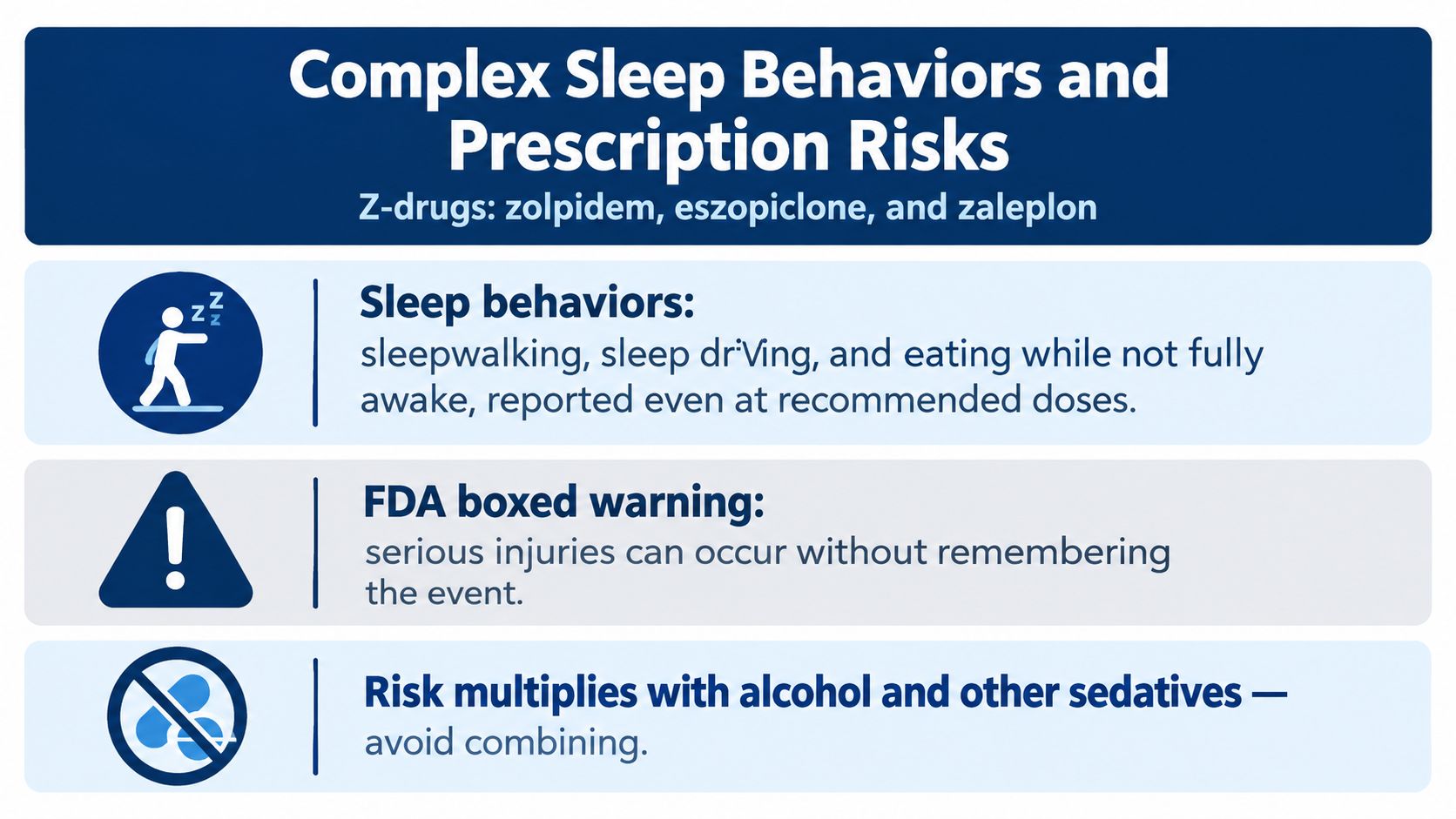
Some prescription sleep medication side effects are more serious than ordinary sedation. In April 2019, the U.S. Food and Drug Administration required a boxed warning, its strongest prominent warning, for zolpidem, eszopiclone, and zaleplon after reports of rare but potentially catastrophic complex sleep behaviors. The FDA reported that these events had caused serious injuries and deaths. The FDA safety communication covers both immediate- and extended-release versions of affected medicines, including products marketed as Ambien, Ambien CR, Lunesta, and Sonata.
A complex sleep behavior occurs when someone performs an activity while not fully awake and later has no memory of it. Reported activities include sleepwalking, sleep-driving, sleep-cooking, taking other medicines, using a stove, making phone calls, preparing or eating food, and having sex. These events differ from a person feeling groggy after waking. The person may carry out coordinated actions without normal awareness or later recall.
Why previous tolerance doesn't guarantee safety
A person may have taken zolpidem or another affected medicine many times without an unusual event. That history doesn't eliminate the risk. Complex sleep behaviors can occur even when someone has previously tolerated the medicine, and the absence of memory means the person may not recognize what happened without a partner, family member, or other observer noticing.
The FDA advises anyone who experiences a complex sleep behavior to stop the medicine and contact a healthcare professional immediately. Clinicians shouldn't prescribe these drugs to someone who has previously experienced one of these episodes linked to the medicine. Alcohol and other sedating substances can add to impairment, so combining them with a prescription hypnotic creates an avoidable safety concern.
The key distinction is practical. Next-day drowsiness may suggest residual drug activity. Sleep-driving or another unremembered activity is a specific warning event that requires prompt medical attention and a reassessment of the medication plan.
Next-Morning Impairment Across Drug Classes
Feeling alert doesn't prove that reaction time and judgment have returned to normal. The FDA required lower recommended bedtime doses for certain zolpidem products after data showed that blood concentrations could remain high enough the next day to impair activities such as driving, even when patients felt fully awake. The FDA's questions and answers on zolpidem dosing and next-morning impairment specifically address this mismatch between perception and performance.
The comparison below is intentionally qualitative. The same class can affect people differently depending on dose, formulation, metabolism, age, other medicines, and the amount of time left for sleep.
| Medication class | Primary use | Next-morning impairment risk |
|---|---|---|
| Prescription hypnotics, including Z-drugs | Short-term support for difficulty sleeping | May impair attention, reaction time, judgment, coordination, and driving. Some also carry risks of complex sleep behaviors. |
| Over-the-counter sedating antihistamines | Drowsiness used as a sleep aid | Can leave grogginess, slowed thinking, dry mouth, and reduced alertness. Duplicate ingredients in allergy or cold products can increase exposure. |
| Melatonin supplements | Timing support for the sleep-wake cycle | Can cause sleepiness, headache, or dizziness, particularly when timing or dose doesn't suit the person. |
| Other sedating medicines and combinations | Sleep support or treatment of another condition | Effects can add together, especially with alcohol, opioids, or other central-nervous-system depressants. |
Signs that deserve caution
Morning impairment isn't always dramatic. A person may notice that ordinary tasks take longer, balance feels less steady, words are harder to find, or lane changes require more effort. Memory gaps, poor coordination, unusual confusion, or the need to fight sleep are stronger reasons to avoid driving and contact a healthcare professional.
People who need to drive early, operate machinery, work at height, care for another person, or make high-stakes decisions should discuss timing and residual effects before using a new sleep medicine. A product marketed as a nighttime aid can still affect the next workday. Readers exploring non-sedating approaches can also review non-drowsy sleep aid options, while remembering that “non-drowsy” doesn't remove the need to check ingredients and interactions.
A melatonin-free supplement isn't automatically risk-free. For example, Deep Calm provides magnesium as magnesium glycinate, with 275 mg of magnesium per serving, and its product information describes support for a sense of calm and normal nerve and muscle function.* Magnesium can interact with health conditions and medicines, so a healthcare professional should review it when relevant.
The Dose-Response Trap in OTC Aids and Melatonin
Many people assume that one dose that didn't work means the next dose should be larger. That logic can turn a difficult night into a worse morning. With melatonin, available evidence doesn't support treating more as automatically better. A 2022 meta-analysis of high-dose trials (10 mg or more) found an increased risk of minor adverse events such as drowsiness, headache, and dizziness, without a detectable increase in serious adverse events. (Read the high-dose melatonin meta-analysis) A 2019 systematic review of 37 randomized controlled trials found that the most frequently reported adverse events were daytime sleepiness at 1.66%, headache at 0.74%, and dizziness at 0.74%. (Read the melatonin adverse-event review)
Those figures describe study findings, not a guarantee about an individual product or person. Timing matters too: melatonin taken during the day is more likely to cause unwanted sleepiness and impairment than appropriately timed nighttime use.
What a cautious dose review looks like
A person who feels worse after a high-dose melatonin product shouldn't automatically escalate again. A more useful review asks:
- Dose: Could the amount be producing morning sedation, headache, dizziness, or vivid dreams?
- Timing: Was melatonin taken in the evening with enough time remaining for sleep? It belongs before bed, not after waking in the middle of the night.
- Goal: Is the product intended to support sleep timing, or is persistent insomnia pointing toward another issue that needs evaluation?
- Interactions: Could alcohol, anticoagulants, seizure medicines, diabetes medicines, blood-pressure medicines, contraceptives, or immunosuppressants be involved?
Melatonin is sold as a dietary supplement in the United States rather than as an FDA-approved insomnia drug, so the actual dose and product quality can vary by brand. That regulatory distinction makes label review and clinician guidance especially important. A lower amount may be more appropriate for some adults, but the right choice depends on the person's circumstances.
Readers comparing the reasoning behind smaller amounts can see low-dose melatonin guidance. The goal isn't to identify a universal dose. It's to avoid treating morning impairment as proof that a product should be taken more often or in larger amounts.
Household storage is part of medication safety
Melatonin can look harmless because many products are sold as supplements or gummies. U.S. poison-control data summarized by the National Center for Complementary and Integrative Health found that calls involving melatonin ingestion among people aged 19 years and younger rose from 8,337 in 2012 to 52,563 in 2021. 94.3% involved children aged 5 years or younger who accidentally consumed products at home. NCCIH's melatonin safety overview also reports that most exposed young people had no symptoms, but accidental ingestion still warrants poison-control guidance.
Secure storage, careful serving measurements, and keeping supplements away from children matter regardless of whether a product is labeled “natural.”
Navigating Interactions and Safety Red Flags
Sleep medication doesn't act in isolation. Alcohol, opioids, sedating allergy medicines, cold products, prescription medicines, and supplements can all change the total sedative load. Clinical guidance states that even small amounts of alcohol can intensify sedative effects and cause dizziness, confusion, or fainting, while combining opioids with sleeping pills can further depress the central nervous system and lead to slowed breathing. Mayo Clinic's guidance on sleeping-pill safety explains why “just one drink” isn't a dependable safety boundary.
A practical interaction check
Before taking a sleep aid, the person using it should review the full list rather than focusing only on the product marketed for sleep.
- Alcohol: Avoid combining alcohol with sedating sleep medicines or supplements. The combined effect can be stronger than either substance alone.
- Opioids: Ask a prescriber or pharmacist before combining an opioid with any sleep aid. Breathing suppression is an urgent concern.
- Duplicate ingredients: Check allergy, cough, cold, and pain products for sedating antihistamines or other central-nervous-system depressants.
- Age and sensitivity: Older adults may be more vulnerable to impaired balance, falls, confusion, and drug interactions.
- Morning responsibilities: Don't drive or perform safety-critical work until the medicine's effects are known.
Emergency warning: Inability to wake, breathing difficulty, severe confusion, fainting, or unresponsiveness after a sleep aid requires immediate emergency help.
A new symptom after starting, stopping, or changing a medicine deserves a call to a healthcare professional. The same applies when a person experiences a memory gap, sleep-driving, a fall, unusual behavior, or repeated morning impairment. The when to see a doctor for insomnia guide can help organize that decision, but emergency symptoms require urgent care rather than a routine appointment.
Medication review becomes especially important when someone takes several daily prescriptions, has a condition affecting metabolism, or uses more than one product for sleep. A pharmacist can identify duplicate ingredients, while a prescriber can determine whether a dose, timing change, taper, or different treatment approach is appropriate. No person should combine sedatives or alter a prescription based only on how another product affected a friend.
Building a Safer and More Sustainable Sleep Routine
Sleep medication can sometimes play a limited role, but medication-only strategies don't address every reason sleep becomes difficult. A longer-term plan may include evaluation for an untreated sleep problem, cognitive behavioral therapy for insomnia, a consistent wake time, stress-management practices, and a bedroom routine that doesn't depend on escalating sedation.
The American Academy of Sleep Medicine guideline on behavioral and psychological treatments supports cognitive behavioral therapy for insomnia as an important treatment approach. Medication decisions should fit the person's health history, morning responsibilities, other medicines, and response to side effects. A person taking a prescription hypnotic shouldn't taper or discontinue it independently, especially if regular use raises concerns about withdrawal.
A flexible evening menu
A sustainable routine can remain simple and free:
- Set a wind-down cue: Dim lights, reduce stimulating work, or choose quiet reading before bed.
- Give racing thoughts somewhere to go: A paper list of unfinished tasks can reduce the pressure to solve them in bed.
- Protect the sleep window: Melatonin belongs in the evening before intended sleep, not after a middle-of-the-night waking.
- Use low-cost sensory support: A fan, earplugs if comfortable, or a free white-noise app may help when available.
- Track function, not only sleep duration: Note morning alertness, coordination, mood, and memory alongside bedtime and wake time.
The sleep quality improvement guide offers additional habit ideas without treating a supplement as a substitute for medical evaluation. For adults considering a dietary supplement, format and ingredient amounts should be compared carefully. Sleep All Nite offers oral strips, capsules, and gummies, including melatonin-containing and melatonin-free options, but each product still deserves an interaction and suitability check with a healthcare professional.
Sleep All Nite offers several nighttime formats and ingredient profiles for adults who want to compare options without assuming that a higher dose is better. Readers can review the available products and serving information at Sleep All Nite, then check with a healthcare professional before starting a supplement, especially when prescription medicines, alcohol use, pregnancy, nursing, or a medical condition is involved.
*These statements have not been evaluated by the Food and Drug Administration. These products are not intended to diagnose, treat, cure, or prevent any disease.
This article is for general education and isn't medical advice. Talk with a healthcare professional before starting a supplement, especially if you're pregnant or nursing, under 18, managing a medical condition, or taking prescription medication.


