
Why Do I Wake Up at 3am Every Night? Common Causes


At 3 a.m., the room can feel unusually still. The eyes open, the ceiling comes into focus, and the clock seems to confirm a pattern that has already become familiar. The mind may start reviewing the day, predicting tomorrow, or calculating how much sleep remains. Then the same question returns: why do I wake up at 3am every night?
That pattern usually has more than one possible explanation. A normal lighter phase of sleep, stress, alcohol, reflux, pain, bathroom trips, breathing problems, hormonal changes, or clock-watching can all create a similar experience. The useful next step isn't to guess at one mysterious “3 a.m. hormone.” It's to sort the pattern by its timing, triggers, duration, and effect on daytime life.
Tags: Waking at Night, Insomnia, Perimenopause
Table of Contents
- The 3 A.M. Wake-Up: A Common but Misread Pattern
- How Normal Sleep Architecture Sets the Stage
- Stress, Racing Thoughts, and the Cortisol Myth
- Everyday Triggers That Turn Brief Awakenings Into 3 A.M. Problems
- Perimenopause and Hormonal Reasons for Nighttime Waking
- Why Your Sleep Tracker May Be Misleading You
- A Two-Week Self-Check and Triage Plan
- When Self-Help Stops and Professional Help Starts
The 3 A.M. Wake-Up: A Common but Misread Pattern
You fall asleep without much trouble, move through the first part of the night, and then open your eyes at 3:02. The room looks unchanged, yet sleep no longer feels automatic. A few thoughts appear, frustration follows, and attention shifts to one question: how long until sleep returns?
That clock time does not prove your body has set a fixed biological appointment. In a representative study of 8,937 adults in the United States, 35.5% reported waking during the night at least three nights per week. The estimate was 34.2% when the pattern continued for at least one month and 19.5% when daytime impairment was also required. The review of nocturnal awakenings also notes that more than half of people who woke had trouble returning to sleep. These figures separate a frequent nighttime event from a sleep problem that is affecting daily life.
The same clock time can point to different causes. One person may notice a brief awakening during a naturally lighter part of the night. Another may be responding to alcohol, reflux, pain, urination, a warm room, anxious thoughts, or disrupted breathing. For someone in perimenopause, night sweats or hormone-related sleep fragmentation may play a role without producing an obvious hot flash.
Use the clock as a clue, then sort the pattern with three questions:
- Timing: Does waking follow a regular bedtime, or appear after only a short sleep?
- Triggers: What happened before bed, and what sensation or thought appears first?
- Daytime impact: Do you return to sleep quickly, or remain awake long enough to feel impaired the next day?
This is triage, not a reason to reach for a supplement immediately. A repeated awakening may reflect a regular schedule, an evening trigger, a learned expectation, or a brief interruption that becomes memorable once you check the time.
Practical rule: A brief awakening is common. Repeated prolonged wakefulness, daytime impairment, or warning symptoms deserve a closer look.
How Normal Sleep Architecture Sets the Stage
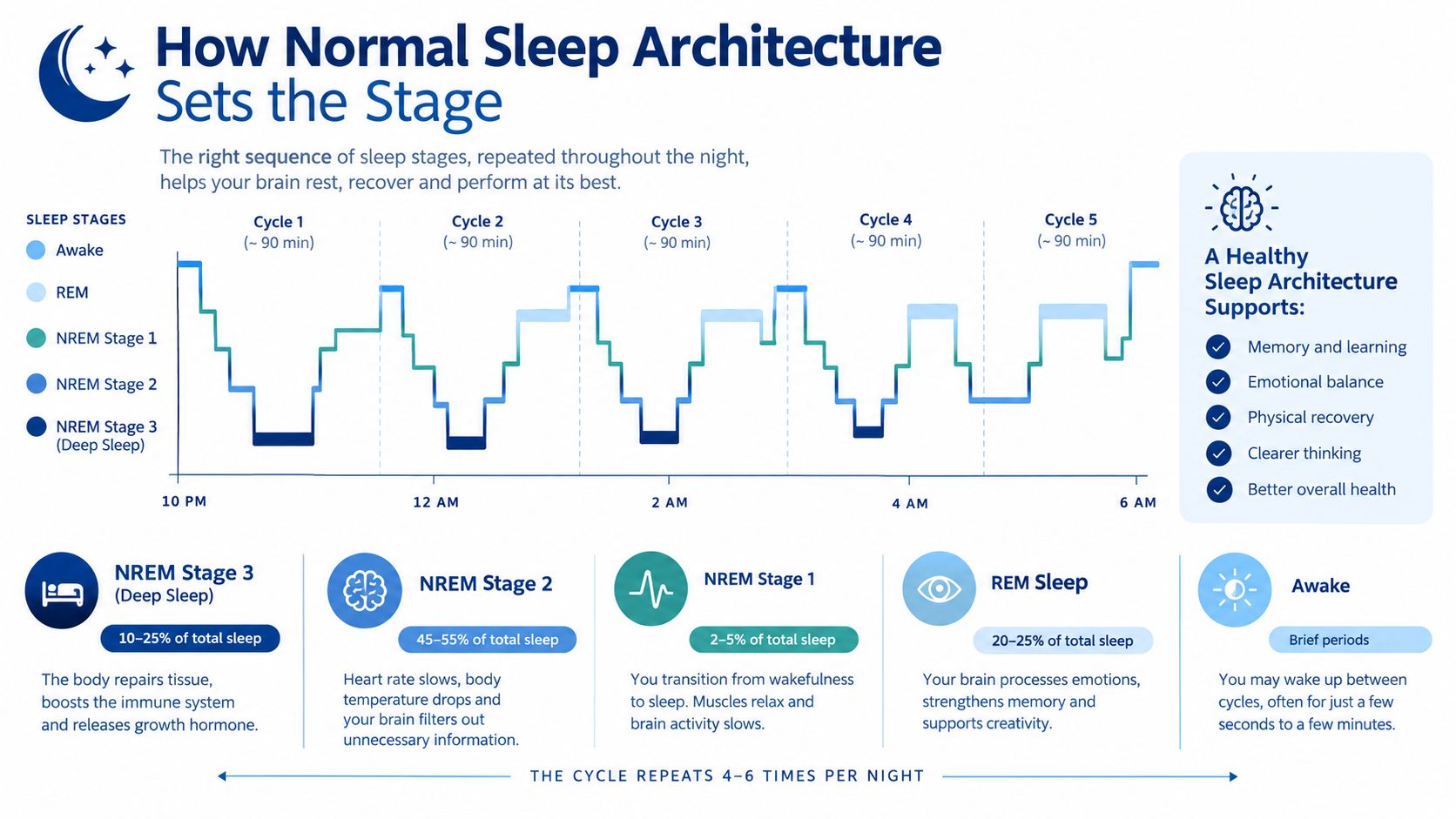
Sleep isn't a single uninterrupted state. It moves through changing stages, and the balance shifts as the night progresses. Earlier sleep generally contains more deep sleep. Later sleep contains more lighter sleep and REM, which creates more opportunities to notice a brief awakening. The exact clock time depends on when a person goes to bed, how long they usually sleep, age, recent sleep loss, and the timing of the internal body clock.
A useful analogy is a train moving through stations. During deeper sleep, a small disturbance may pass without reaching full awareness. Later in the journey, the train spends more time near the surface. A sound, a physical sensation, a thought, or a change in temperature can bring the sleeper briefly into wakefulness. Most of those moments disappear from memory by morning.
The body also has less accumulated sleep pressure after several hours of sleep. At the same time, the circadian system gradually increases alerting signals as morning approaches. That combination creates a vulnerable window, but it doesn't make 3 a.m. universally special. A person who goes to bed earlier may notice the window earlier, while another person with a later schedule may experience it later.
Why the awakening becomes memorable
A normal arousal can turn into a distinct event when the sleeper checks the clock, reaches for a phone, or begins evaluating the night. More than half of people who report nighttime awakenings also report difficulty falling back asleep, according to the review of nocturnal awakening patterns. The longer the person stays awake, the more the brain links the bed and the clock with alertness.
This is why the question why do I wake up at 3am every night shouldn't be answered with sleep architecture alone. Natural lighter sleep may create the opening, but another factor often determines whether the person rolls over and forgets the moment or remains awake long enough to remember it.
Stress, Racing Thoughts, and the Cortisol Myth
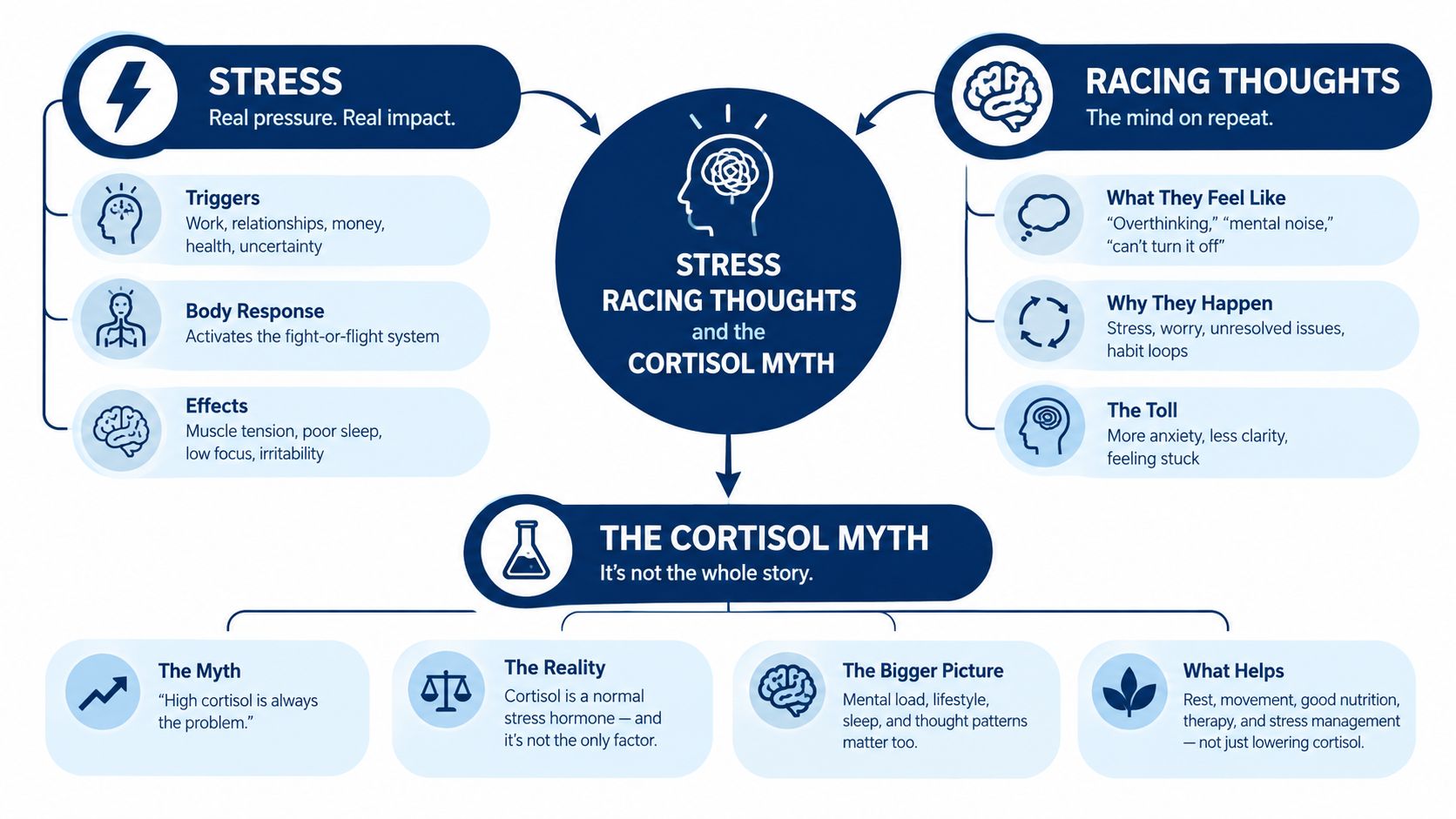
Stress can turn a small opening in sleep into a full alertness episode. The person wakes, notices a thought about work or family, and begins solving the problem. The body responds to that mental effort with greater activation. As frustration grows, sleep becomes something to force, and that effort keeps attention pointed toward wakefulness.
This loop can become learned. The bed begins to signal planning, checking, and worry rather than sleep. A person may fall asleep normally at bedtime but become highly alert after a nighttime awakening because the brain has practiced that response repeatedly.
Cortisol isn't a universal 3 a.m. switch
Cortisol follows a circadian pattern, but the popular idea of a universal “3 a.m. cortisol spike” oversimplifies the situation. The body's alerting signals gradually increase toward morning, and a normal awakening may become more noticeable during that transition. That doesn't show that cortisol alone caused the awakening, nor does it mean the hormone should be blocked.
A better question is: what keeps the nervous system alert after a normal brief awakening? The answer may include unresolved stress, anxiety, clock-checking, alcohol-related disruption, physical discomfort, or fear about not sleeping. Readers interested in the relationship between stress physiology and sleep can review cortisol and sleep problems, while remembering that a nighttime awakening can't be diagnosed from the clock time alone.
A calmer response changes the evidence
During a nighttime awakening, the goal is not to prove that sleep is happening. It is to reduce stimulation. The sleeper can avoid clock arithmetic, keep lighting low, and use a quiet, familiar activity if frustration is building. Writing worries down earlier in the evening may also reduce the urge to solve them in bed.
The American Academy of Sleep Medicine's clinical guidance identifies CBT-I as the standard first-line behavioral treatment for persistent insomnia. Its components include stimulus control, sleep restriction, cognitive therapy, and relaxation. Those methods address the learned alertness loop rather than trying to explain every awakening through one hormone.
Everyday Triggers That Turn Brief Awakenings Into 3 A.M. Problems
A brief awakening becomes easier to remember when the body has a reason to remain uncomfortable. Evening alcohol is one example. It may make falling asleep feel easier at first, but later sleep can become more fragmented. The review of nighttime awakenings lists alcohol-related rebound wakefulness among potential contributors.
Other triggers are more physical. Reflux can become noticeable when a person lies down after a heavy or late meal. A full bladder can wake someone who would otherwise have rolled over. Pain, breathing difficulty, nasal symptoms, and an overheated room can also interrupt sleep, particularly when sleep is lighter later in the night.
Match the trigger to the timing
A useful evening review asks what changed before the pattern began.
- Alcohol timing: If the awakening follows an evening drink with some regularity, alcohol may be stretching a brief arousal into a longer period of wakefulness.
- Caffeine timing: Late-day caffeine can keep the nervous system more alert even when falling asleep wasn't difficult.
- Food and reflux: Burning, sour taste, coughing, or throat discomfort points toward reflux rather than a mysterious clock signal.
- Fluids and urination: A predictable bathroom trip suggests that evening fluid timing or a urinary issue deserves attention.
- Heat and discomfort: Sweating, heavy bedding, or a warm room can make a light-sleep window harder to pass through.
- Light and screens: A bright phone check adds stimulation at the exact moment the brain is trying to return to sleep.
The National Institute on Aging's guidance for sleep problems recommends consistent sleep and wake times, avoiding late naps, keeping the bedroom comfortable, limiting devices in the bedroom, avoiding large meals near bedtime, and avoiding caffeine late in the day. These choices are a menu, not a test of discipline. A person can change one likely trigger at a time and observe whether the pattern shifts.
For racing thoughts specifically, how to sleep when the brain is racing offers a useful behavioral frame. The central point is simple: the trigger may start the awakening, but stimulation and worry often determine how long it lasts.
Perimenopause and Hormonal Reasons for Nighttime Waking
You may fall asleep normally, wake at 3 a.m., and find no obvious hot flash, yet changing reproductive hormones can still be part of the explanation. For some women in midlife, why do I wake up at 3am every night is a triage question rather than a single-answer puzzle. Perimenopause can affect sleep through hormonal fluctuations, vasomotor symptoms, mood changes, and shifts in circadian timing. A dramatic night sweat is not required for sleep to become more fragmented.
Data from the Study of Women's Health Across the Nation show that difficulty sleeping, including waking several times or earlier than intended, rises from about 30% before menopause to 40% in early perimenopause and 45% in late perimenopause, as reported in a 2025 systematic review of perimenopausal sleep. Earlier research also associated lower estradiol and higher follicle-stimulating hormone with more awakenings, independently of nighttime vasomotor symptoms and depressive symptoms.
Separate heat-related waking from sleep fragmentation
A hot flash or night sweat gives you a visible clue. Hormonal sleep fragmentation can feel less specific: restlessness, lighter sleep, mood changes, or awareness of being awake without a strong physical symptom. Both patterns can occur during the menopause transition. They can also resemble anxiety, sleep apnea, restless legs, medication effects, alcohol-related disruption, or ordinary brief arousals.
Use three questions to sort the possibilities:
- Cycle changes: Have periods become irregular or changed their usual pattern?
- Temperature symptoms: Do flushing, night sweats, or waking overheated accompany the awakening?
- Breathing signs: Are there snoring, gasping, or witnessed pauses that call for evaluation?
- Mood changes: Has new anxiety or depressed mood appeared, worsened, or affected daytime functioning?
- Leg sensations: Are uncomfortable sensations relieved by movement?
- Time awake: How long are you awake, and how much does the pattern affect your day?
The National Institutes of Health overview of menopause-related sleep problems describes early-morning awakening and repeated nighttime waking as common concerns during this life stage. It also reports that insomnia diagnoses were more likely among women with hot flashes, 28.5% compared with 10.5% among women without them. That association does not show that every 3 a.m. awakening comes from a hot flash. Persistent awakenings, breathing symptoms, severe mood changes, or major daytime impairment support a conversation with a healthcare professional. For a closer look at the connection, see perimenopause and sleep problems.
Why Your Sleep Tracker May Be Misleading You
A wearable can make a nighttime pattern look more exact than it really is. A watch may display 3:00 a.m. with apparent precision, but consumer devices don't directly measure sleep stages in the same way as a clinical sleep study. Quiet wakefulness can be misclassified, and brief arousals may be missed or exaggerated.
A 2025 validation study found that commercial wearables weren't reliable for measuring global sleep parameters or sleep architecture in people with sleep complaints. One device underestimated wake after sleep onset by an average of 25 minutes, while another overestimated it by about 10 minutes, according to the peer-reviewed wearable validation research.
Use the tracker for trends, not diagnosis
| Device Class | Wake Detection Accuracy | Stage Accuracy vs. PSG | Best Used For |
|---|---|---|---|
| Consumer sleep wearable | Can differ from actual wakefulness | Not reliable enough to diagnose sleep architecture | Broad trends and personal observations |
| Phone-based sleep app | Depends on sensors and algorithms | Exact stages shouldn't be treated as clinical findings | General bedtime and wake-time patterns |
| Clinical sleep testing | Assessed with medical equipment | Provides the professional comparison standard | Evaluation when symptoms warrant testing |
The exact 3 a.m. timestamp may therefore combine three things: a real light-sleep window, attention trained on the clock, and a device that highlights the moment. Checking the display can also increase alertness and make a short awakening feel longer.
A tracker can raise a useful question, but it can't answer why a person wakes without context.
For a short period, a reader can hide the clock and record morning impressions instead. Useful notes include whether the person felt restored, how long wakefulness seemed to last, and whether daytime sleepiness changed. Persistent impairment, gasping, loud snoring, uncomfortable legs, or prolonged wakefulness calls for clinical evaluation, not increasingly detailed gadget data.
A Two-Week Self-Check and Triage Plan
A two-week log can turn the question why do I wake up at 3am every night into a more specific question. The purpose isn't to create a perfect record. It's to identify whether the awakening follows a trigger, appears at a stable point relative to bedtime, or causes meaningful daytime consequences.
Record the pattern without chasing precision
Each morning, note:
- Timing: Bedtime, estimated sleep onset, first awakening, approximate time awake, final wake time, and out-of-bed time.
- Evening inputs: Caffeine, alcohol, large meals, late fluids, medications, and supplements.
- Physical clues: Heat, sweating, reflux, pain, urination, snoring, gasping, or leg sensations.
- Mental state: Racing thoughts, anxiety, low mood, or clock-checking.
- Daytime effect: Energy, concentration, mood, sleepiness, and ability to function safely.
The CDC summary of sleep difficulty among adults reports that in 2020, 17.8% of adults had trouble staying asleep most days or every day during the previous 30 days, compared with 14.5% who had trouble falling asleep. That distinction matters. Someone who wakes briefly and returns to sleep is in a different situation from someone who remains awake and impaired.
Sort the result into a practical branch
- Likely occasional: The awakening appears on isolated nights and follows an obvious trigger such as alcohol, reflux, heat, or unusual stress. A modest habit change can be tested first.
- Needs disorder screening: Snoring, gasping, breathing pauses, frequent urination, pain, or uncomfortable leg sensations suggest that a primary sleep or medical problem may be contributing.
- Needs insomnia-focused support: Repeated prolonged wakefulness, suitable opportunity for sleep, and daytime impairment fit a pattern worth discussing with a clinician about CBT-I.
The American Academy of Sleep Medicine describes insomnia as difficulty falling asleep, staying asleep, or waking earlier than desired despite adequate opportunity. For chronic insomnia, the problem and related daytime impairment occur at least three nights per week for at least three months, according to the AASM diagnostic criteria.
A log shouldn't become another nighttime performance. The person can write estimates in the morning, keep the clock hidden, and look for consistent relationships rather than exact minutes. More guidance on the distinction between a middle-of-the-night awakening and a persistent sleep disorder appears in insomnia and middle-of-the-night waking.
When Self-Help Stops and Professional Help Starts
Self-help is reasonable when awakenings are occasional, a clear trigger is present, and daytime function remains intact. It becomes less appropriate when the pattern persists despite consistent habits, keeps producing prolonged wakefulness, or affects mood, concentration, work, or safety. A recurring problem deserves evaluation rather than endless experimentation with supplements, trackers, or increasingly strict routines.
Choose the right starting point
A primary care professional can review medical conditions, medication timing, pain, reflux, urinary symptoms, mood changes, and menopause-related concerns. A sleep specialist can assess suspected sleep apnea, restless legs, circadian timing problems, or other sleep disorders. A qualified mental health professional can help when anxiety, depression, trauma, or persistent rumination is closely tied to the awakening.
Warning signs deserve particular attention:
- Loud snoring, gasping, or witnessed pauses in breathing
- Severe daytime sleepiness, especially falling asleep while driving
- New or worsening depressed mood or anxiety
- Hot flashes or night sweats that repeatedly interrupt sleep
- Uncomfortable leg sensations that improve only with movement
- Significant pain, frequent urination, or nighttime breathlessness
CBT-I is different from general sleep hygiene and different from taking a sleep product. It uses structured methods such as stimulus control, sleep restriction, cognitive therapy, and relaxation to reduce conditioned wakefulness and rebuild a dependable relationship between bed and sleep. The AASM identifies CBT-I as the standard first-line behavioral treatment for persistent insomnia, so a clinician can help determine whether that approach fits.
The 3 a.m. pattern is information. It can point toward a trigger that needs adjusting, a hormone-related concern that deserves discussion, a breathing or movement disorder that needs screening, or an insomnia pattern that responds to structured care. Treating the clock time as a clue, rather than a verdict, makes the next step clearer.
Sleep All Nite offers multiple nighttime supplement formats, including melatonin-free options, capsules, gummies, and dissolvable oral strips. Visit Sleep All Nite to compare formats and ingredient amounts, and check with a healthcare professional before starting any supplement, especially when managing symptoms or taking prescription medication.
*These statements have not been evaluated by the Food and Drug Administration. These products are not intended to diagnose, treat, cure, or prevent any disease.
This article is for general education and isn't medical advice. Talk with a healthcare professional before starting a supplement, especially if you're pregnant or nursing, under 18, managing a medical condition, or taking prescription medication.


